
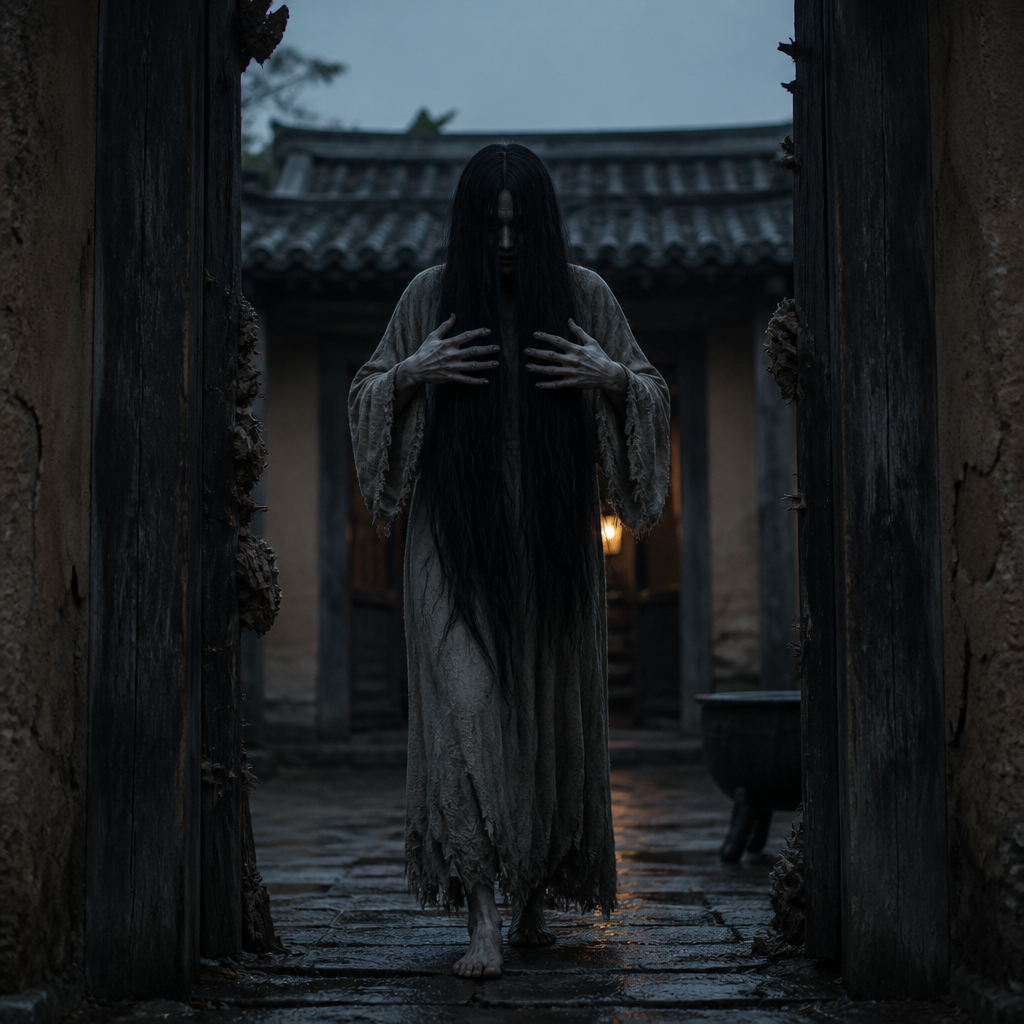
Yuan Gui
Also Known As: 冤鬼, “wronged ghost”; also yuanhun 冤魂, “wronged soul”; the oldest texts call such a spirit a li 厲, one of the malignant dead
Region/Culture: East Asia
Mythos: Chinese Mythology
Primary Type/Nature: Undead/Cursed Beings
Mythical Attributes: A yuan gui is held in the world by the injustice of its own death and cannot rest until that wrong has been answered.
Role in Mythos: It is the means by which a killing that escaped human justice is reopened and punished, usually with Heaven’s express permission.
Relation to Humans: A yuan gui goes after the person who wronged it, and the accounts rarely show it harming anyone else. The remedy the tradition prefers is not exorcism but redress, whether a restored sacrifice or a reopened case.
In 581 BCE the ruler of the state of Jin dreamed of something enormous standing in his own courtyard. Its hair hung unbound all the way to the ground. It beat its breast and leapt, and it shouted that he had killed its descendants, that the killing had been unjust, and that it had put the case to the Lord on High and been granted what it asked. Then it smashed the main gate and came through, and when he fled to his inner chamber it smashed that door too. The chronicle that preserves this, the Zuo Zhuan, reads the dream against the duke’s own record: two years earlier he had put to death Zhao Tong and Zhao Kuo, men of an ancestral line that did not forget.
That scene holds the whole idea. The character yuan, 冤, does not mean death or even murder. It means a wrong that has never been set right, a grievance still open, and Chinese dictionaries define a yuanhun plainly as the ghost of someone who died under one. The other Chinese dead are defined by what they lack. The hungry ghosts starve, the wandering ghosts drift because nobody is left to feed them. The yuan gui is defined by what it has, which is a complaint and a defendant.
The oldest of them are not monsters but aristocrats with a case to press. In 535 BCE the capital of Zheng went into a panic over the ghost of a nobleman called Boyou, killed in a factional fight eight years before. People ran through the streets shouting that Boyou had come. Someone dreamed of him walking in armour, naming two men and the days on which he would kill them. Both died on the days he had named. The statesman Zichan ended it with an appointment rather than a rite: he made Boyou’s son Liangzhi the heir of his line, so that the dead man had descendants to sacrifice to him again, and the haunting stopped. Asked how that could possibly work, Zichan answered that a ghost with somewhere to go does not turn malignant. Then he went further, explaining that the soul is built up by everything a life takes in, and that even a commoner who dies a violent death can have a spirit strong enough to cling to the living and do harm. A great lord, fed on the best of everything for three generations, would have more strength still.
A third ancient case is the most cinematic. The philosopher Mozi, arguing that ghosts are real, tells of Du Bo, a minister put to death by King Xuan of Zhou for a crime he had not committed. Du Bo swore that if the dead have any awareness, his king would know it within three years. In the third year, as the king hunted with his lords, Du Bo appeared at midday on a white chariot drawn by white horses, dressed in red and carrying a red bow, and shot him through the heart. The king collapsed across his bow case and died, and everyone present saw it.
The histories kept recording such things as causes of death. When the Han chancellor Tian Fen fell ill in the spring after he had engineered the executions of Dou Ying and Guan Fu, Sima Qian’s Shiji says he spent his sickness crying out apologies. A man who could see ghosts was sent for and found both dead men standing guard over him, waiting to kill him. He died.
By the sixth century the type had its own book. Yan Zhitui, a scholar who served four successive states and outlived three of them, compiled the Yuanhun zhi, some sixty short accounts of the wrongfully killed returning to collect, running from the Zhou kings down to his own day. Du Bo is in it. He was a fervent Buddhist, and the collection was put together to press home the lesson of retribution, but the ghosts in it still talk like plaintiffs in an old court. Again and again one of them announces that it has already appealed to Heaven, or to the Lord on High, and that the verdict has gone its way.
The finest yuan gui is not in a history at all. In Guan Hanqing’s play of the late thirteenth century, a young widow named Dou E is accused of a poisoning she did not commit and beaten without confessing, and she gives in only when the magistrate turns his rods on her mother-in-law. At the execution ground she makes three vows: that her blood will fly up onto the white silk hung above her and not stain the earth, that snow will fall in the sixth month to cover her body, and that her district will have three years without rain. Heaven grants all three. Snow comes down out of a summer sky onto the cold body. Three years on, her father returns as an inspecting official, her ghost comes to him at night, and the case is heard again. The real killer is put to death by slow slicing. Chinese speakers still use snow in June as shorthand for a verdict that should never have been given.
The powers follow from the position rather than from any dark gift. A yuan gui files its first complaint through dreams. It can sicken and harry the guilty, and in the oldest stories it can kill them outright, in daylight and in front of witnesses. It can stand in a room unseen by everyone except the one person who ought to be afraid. It can wait, which in these stories is the most alarming ability of the lot, since the grievance does not expire and neither does the plaintiff.
The limits are just as strict. A yuan gui can do nothing outside its own grievance, which is why its terror is so narrowly aimed. It usually needs a higher sanction before it strikes, and it tends to say so. It can be settled by giving it back what was taken, a line of descendants and a share of offerings, which is exactly what Zichan did with one appointment and no ritual at all. And when the wrong is finally answered, as it was for Dou E, the dead woman does not linger to gloat. She asks for her name to be cleared and goes.
The duke of Jin got the worst of it twice. His diviner read the dream and told him he would not live to eat the new wheat. When the wheat came in he had it cooked, summoned the diviner, showed him the dish, and had him executed. Then, as he was about to eat, his belly swelled. He went to the privy, fell in, and died.
Frequently Asked Questions
What is a yuan gui?
A yuan gui is the ghost of a person who died unjustly in Chinese tradition, held in the world by the specific wrong done to them. The name means “wronged ghost”, from yuan (冤), a grievance that has not been set right. Unlike ghosts defined by hunger or neglect, a yuan gui has a case to press and a particular person to press it against.
How do you get rid of a yuan gui?
The traditional answer is to settle the injustice rather than fight the ghost. In the Zuo Zhuan, the statesman Zichan ended the haunting of the Zheng capital by the nobleman Boyou by making Boyou’s son heir to his line, so the ghost’s sacrifices resumed. Zichan’s own explanation was that a ghost with somewhere to go does not turn malignant.
Who does a yuan gui attack?
A yuan gui goes after the person responsible for its death, not the public at large. In the Shiji, the ghosts of Dou Ying and Guan Fu were seen standing over the chancellor Tian Fen, who had brought about their executions, until he died. In Yan Zhitui’s sixth-century Yuanhun zhi, the ghosts often announce that they have appealed to Heaven or the Lord on High before taking revenge.
Is Dou E a yuan gui?
Yes, and she is the most famous one. In Guan Hanqing’s Yuan-dynasty play, Dou E is executed for a poisoning she did not commit and vows that her blood will fly onto white silk, that snow will fall in the sixth month, and that her district will suffer three years of drought. All three come true, and her ghost later appears to her father, an inspecting official, who reopens the case. The phrase “snow in June” still stands for a miscarriage of justice in Chinese.
What does a yuan gui look like?
There is no fixed appearance, because the type is defined by how the person died rather than by a shape. The oldest full description, in the Zuo Zhuan dream of the duke of Jin in 581 BCE, is an enormous figure with unbound hair hanging to the ground, beating its breast. Mozi’s account of Du Bo has the ghost in red, carrying a red bow and riding a white chariot drawn by white horses.
Related Entries
Nü Gui, Diao Si Gui, Wu Tou Gui, You Hun Ye Gui, Er Gui, Ba Jiao Gui, Jiangshi, Yanluo, Zhong Kui, Meng Po, Onryō, Goryō, Yūrei, Churel, La Llorona