
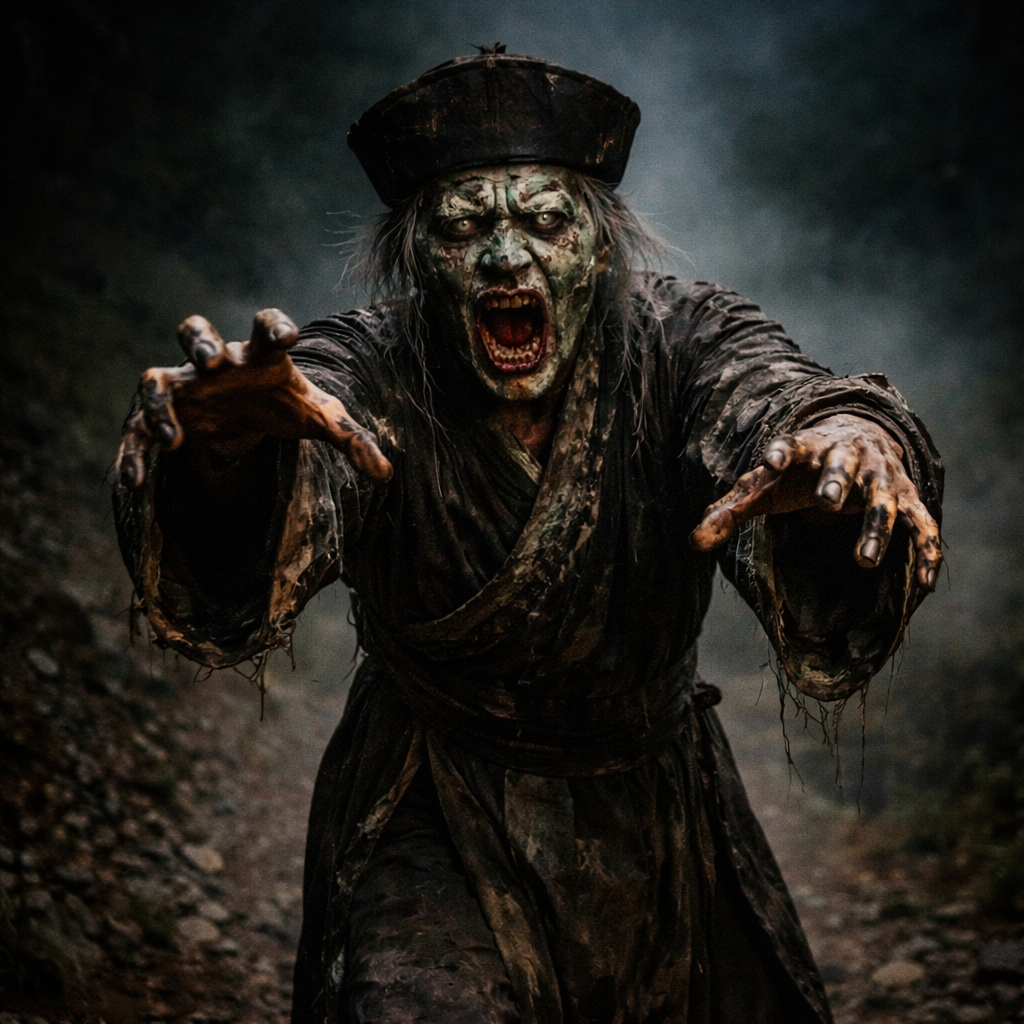
Jiangshi
Region/Culture: East Asia
Mythos: Chinese Mythology
Primary Type/Nature: Undead/Cursed Beings
Mythical Attributes: A reanimated corpse driven by the po (the lower, irrational aspect of the soul), which feeds on the qi (life force) of the living to sustain itself and grow more powerful.
Role in Mythos: Serves as a supernatural consequence of improper burial, neglected funerary rites, or spiritual imbalance between the hun and po aspects of the soul.
Relation to Humans: The jiangshi preys on living humans by draining their vital qi, and its scratch or bite can infect victims with corpse poison, gradually transforming them into jiangshi as well. Taoist priests have traditionally served as the primary line of defense, using talismans, peachwood weapons, and ritual incantations to immobilize or destroy the creatures.
Somewhere in western Hunan, long after dark, a bell rings once across a mountain path. That, at least, is the modern telling: two men shoulder a bamboo pole between them, and strung along its length, arms lashed tight, several corpses bounce with each step. The pole flexes. The dead appear to hop. No lantern but the one held out front, its glow barely reaching the feet of the man behind. Villagers who glimpse this procession from a distance learn not to look twice. They also learn a word for what the dead might become if the rites go wrong: jiangshi.
The name translates bluntly. “Stiff corpse.” The character for jiang means hard, rigid, unyielding, and that quality defines everything about the creature. A jiangshi cannot bend its knees or elbows. Rigor mortis never releases its grip. In the Hong Kong films that made it famous, the thing moves by hopping, arms thrust forward for balance, covering ground in lurching, mechanical jolts that look absurd until one gets close enough to feel the weight of what is coming. The Qing ghost stories have it run, stagger and leap instead. The skin is greenish-white, slick in places with mould or fungus, and the fingernails have grown long and black as ink. Sharp teeth crowd the mouth. The hair is wild and pale. Some accounts mention an animal quality to the movement, something feral and graceless, as if a human body were being operated by something that had never bothered learning how one worked.
The folklore roots run deeper than the Qing dynasty corpse-driving trade, though that practice certainly fed the legend. Migrant labourers died by the thousands far from their ancestral villages, and families who could not afford to transport the bodies home hired professionals to do it. These corpse-drivers worked at night, partly to slow decomposition and partly to avoid startling the living. In the earliest written accounts, one man walked ahead and another followed with a bowl of charmed water, and the dead man walked between them; the priest with a bell and the bodies bouncing on bamboo poles belong to later retellings. But the jiangshi predates even this. The Qing scholar Ji Xiaolan catalogued causes of reanimation in his Yuewei Caotang Biji around 1789, and Yuan Mei’s Zi Bu Yu of 1788 went further, building what amounted to a taxonomy of the walking dead.
The soul mechanics are specific. Chinese tradition holds that a person carries three hun and seven po. The hun is the higher soul, rational and good, associated with yang energy, light, and heaven. The po is lower, instinctive, bound to yin, darkness, and earth. At death, the hun should depart upward. The po should dissipate. When the po refuses to leave, or cannot, it seizes the body. That is a jiangshi. It is not haunted. It is occupied.
The causes pile up like bad luck. Improper burial. Suicide. A body left too long above ground, soaking up yang qi from sun and moon until it twitches back to motion. A bolt of lightning striking a coffin. A black cat leaping over the corpse. In Yuan Mei’s stories the reanimated dead do odd, almost pitiable things. One demands to be painted. Another stumbles into a forest and gets slapped. Two make love. But the dangerous ones hunt. They detect the living by breath and sound, being functionally blind, and they drain qi the way a Western vampire takes blood. Older jiangshi, those that have absorbed enough energy over years or centuries, can run. The oldest can fly. One folktale describes them soaring from hillsides to snatch infants.
The powers scale with age and accumulated qi. A fresh jiangshi is slow, mindless, driven by raw appetite. It hits like something dropped from a height. Brute strength, no finesse. Given time, the creature grows faster, tougher, harder to kill. It does not age. It does not rot, or at least it rots no further. A scratch or bite delivers corpse poison, and the infected person transforms over hours or days into another jiangshi.
But the weaknesses are just as specific, and they come from the same cosmological system that produced the creature. Sunlight destroys it. A rooster’s crow, which signals the return of yang energy, sends it fleeing. Mirrors terrify it, possibly because the reflection reveals its own condition. Peachwood, considered the essence of the Five Elements in Taoist thought, repels or wounds it. Seven jujube seeds nailed into the acupuncture points along the spine will make it let go of anyone it has seized. Rice, scattered round the coffin with red beans and iron filings, keeps it from getting back in; the glutinous-rice cure for corpse poison comes from the 1980s films. Fire works, and Yuan Mei’s text notes that when a jiangshi burns, the flames crackle, blood rushes out, and the bones cry. The most iconic countermeasure, thanks to the films, is the fulu, a Taoist talisman written in vermillion ink on yellow paper and pressed to the creature’s forehead. In the older corpse-escort accounts the charm goes into a bowl of water instead. Taoist priests of the Maoshan tradition specialized in this work, and a six-inch strip of wood nailed across a door threshold could supposedly keep the thing from entering a house, since it cannot step over obstacles it cannot bend its legs to clear.
To destroy one permanently, the body must be burned and the ashes salted. Anything less risks a return. The creature that started as a metaphor for neglected duty and botched funeral rites became, by the 1980s, a horror-comedy icon through Hong Kong films like Mr. Vampire. But the older stories carry a colder weight. The jiangshi is what happens when the living fail the dead, when the rituals that keep the cosmic order intact are skipped or bungled or simply too expensive to perform. It hops because it is broken. It feeds because it was never properly released.
Frequently Asked Questions
What is a jiangshi?
A jiangshi is a reanimated corpse from Chinese folklore that hops on stiff legs and drains the qi, or life force, from the living. The name translates as “stiff corpse,” referring to the rigor mortis that prevents the creature from bending its knees or elbows. The jiangshi is animated when the lower po soul refuses to depart the body after death, taking possession of the corpse it was meant to leave behind.
Why does a jiangshi hop instead of walk?
In the Hong Kong films that made it famous, a jiangshi hops because it is too stiff to bend its knees or elbows. The Qing ghost stories describe stiff corpses that run, stagger and leap rather than hop, and the earliest written accounts of corpse-escorting have the dead walking. The steady hop belongs to twentieth-century lore and film.
How do you kill or stop a jiangshi?
In the films, a jiangshi can be temporarily immobilized with a fulu, a Taoist talisman written in vermillion ink on yellow paper and pressed to the creature’s forehead. Other defenses include sunlight, a rooster’s crow, mirrors, peachwood weapons, a broom, bells, a carpenter’s ink line snapped round its coffin, rice scattered round the coffin with red beans and iron filings to keep it from getting back in, and seven jujube seeds nailed into acupuncture points along the spine, which make it let go of anyone it has seized. The glutinous-rice cure comes from the 1980s films. To destroy a jiangshi permanently, the body must be burned and the ashes salted, otherwise the creature risks returning.
What causes a person to become a jiangshi?
A person becomes a jiangshi when their po, the lower and instinctive aspect of the soul, refuses to leave the body after death. Triggers include improper burial, suicide, a body left above ground absorbing yang qi from sun and moon, a bolt of lightning striking the coffin, or a black cat leaping over the corpse. The condition reflects a breakdown of the balance between the hun and po souls and a failure of proper funerary rites.
Can a jiangshi turn other people into jiangshi?
Yes, a jiangshi can infect the living through its scratch or bite, delivering what is called corpse poison. The victim gradually transforms into another jiangshi over hours or days. Glutinous rice can be used to draw the corpse poison out of someone who has been infected.
Related Entries
Ba Jiao Gui, Diao Si Gui, Er Gui, Nü Gui, Wu Tou Gui, You Hun Ye Gui, Yuan Gui, Yanluo, Kyūketsuki, Vampire, Draugr, Vrykolakas