
Ba Jiao Gui
Also Known As: 芭蕉鬼, “banana ghost”; also 芭蕉精, Ba Jiao Jing, “banana spirit”; enshrined in Selangor as 香蕉姑姑, Xiang Jiao Gu Gu, “Banana Aunt”; glossed in Malay as Hantu Pokok Pisang
Region/Culture: Southeast Asia
Mythos: Chinese Mythology, Malaysian Mythology
Primary Type/Nature: Undead/Cursed Beings
Mythical Attributes: She lives inside a clump of banana plants and can be pinned there by red thread and metal, after which she will trade knowledge she does not want to give.
Role in Mythos: She is the spirit a gambler goes to when he has run out of gods who will listen.
Relation to Humans: Left alone she is a reason to keep children out of the plantation after dark, and nothing worse. Bound, she becomes a creditor, and the debt is collected in full.
The banana grove behind the temple at the sixth mile of Cheras New Village was coming down, a little more of it each season, to make room for whatever Kuala Lumpur was becoming. Tan Fatt Tek, who keeps the altar there, told a reporter in 2015 that some six years earlier he had seen a woman standing in that scrub. Narrow face. Red cap. A long silk scarf. He said the fright went through him so hard he could not move, and that he never saw her again, though two of his disciples had seen her too. The temple’s own dark-side patron explained her afterwards: she had been cultivating herself in those banana plants for a few hundred years, and the clearing had left her nowhere to stand.
She has a name, and it is not a personal one. Ba jiao gui means banana ghost, the way you might say house fire. The plant comes first.
That naming is old. In the fifth volume of the Gengsi bian, a book of strange reports set down by the Suzhou scholar Lu Can in the first half of the sixteenth century, there is a short piece called The Banana Woman. A man is visited by a woman in green. He gets hold of a piece of what she is wearing, and in the morning the scrap fits exactly against a banana leaf in his own courtyard, freshly torn. That is the whole trick of her, four centuries before anyone in Selangor thought to ask her for numbers. The same volume opens with a long complaint about the household spirits of Suzhou, the ones every family kept a shrine for and fed with tea and burnt paper, and Lu Can is quite clear about what he thinks they are: old things out of the deep hills, tree-dwellers, the sort that move your furniture and take an interest in your wife.
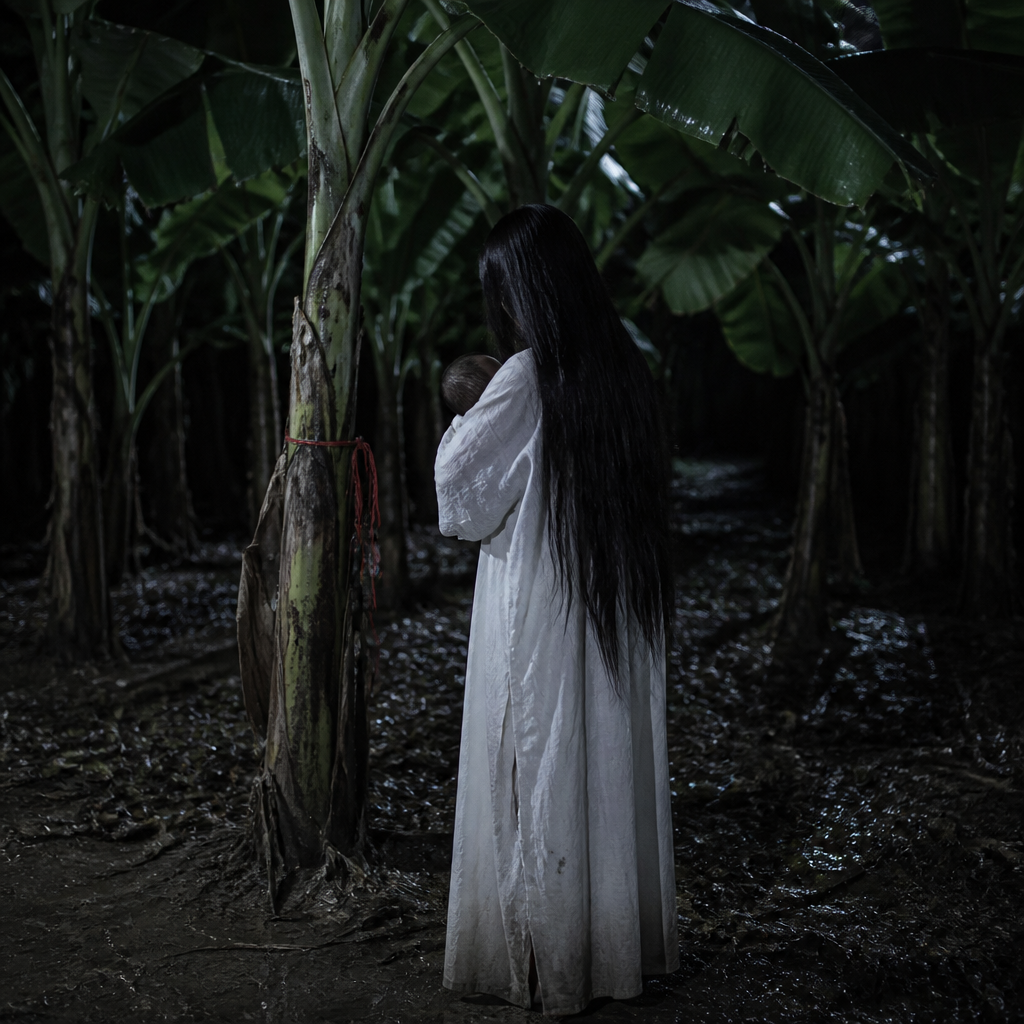
What she looks like depends entirely on who is telling it. Green in the Ming account, because that is the colour of the leaf. White or red in the Malaysian and Singaporean tellings, where she is usually a young woman crying at the foot of the clump at nightfall, sometimes with a baby held against her. The one man who says he saw her put her in a red cap with the scarf hanging long, and thought she looked less like a corpse than like something from a temple painting. The constant is not her face. It is the plant. Get close to a banana clump on a still night and it makes itself known before you see anything: the sap smell, sweetish and green and faintly rotten, the leaves moving in a wind that is not touching your skin, the wet heat trapped under all that broad leaf.
The birth logic is not hard to follow. A banana plant throws out a heavy purple flower bud that hangs down and swells and eventually delivers, and in the folk reasoning of the region that is a body doing what a body does. The women who become ba jiao gui are the ones who did it badly: dead in labour, dead in miscarriage, dead with the work unfinished. The same idea is running through the Malay ghosts the Chinese communities lived beside, the pontianak and the langsuir, both of them women killed by childbirth and both of them fond of trees. The Chinese papers do not pretend these are separate systems. The Sin Chew report that describes the Cheras shrine glosses her, in its opening line, with the Malay name.
Which brings us to the thread. The story told across Malaysia and Singapore is that a man who wants money goes out to a banana clump at night and ties red thread around the trunk, tight, so the flower cannot open and the ghost cannot deliver. He drives needles or nails into the soft green pseudostem. He carries the other end of the thread back to his house and knots it to the leg of his bed, and then he sleeps. She comes to him in the small hours and asks to be let go, and he does not let her go, and eventually she pays. What she pays in is four digits, because four digits is what the numbers game in this part of the world runs on. The bargain is a kidnapping.
Then he wins, and he has a choice, and the choice is the point of the whole story. Untie the thread, pull out the needles, and the account is settled. Leave her tied and go back for a second set of numbers, and she will give them, and she will name her own price, and the tellings are unanimous that whatever comes for the man afterwards is not quick.
Her power is real but it is narrow. She knows what has not happened yet, at least where money is concerned, and that is the only thing anybody in the stories ever wants from her. She does not appear to travel. She does not appear to take revenge on strangers. Everything she does is downstream of what someone else started.
And her weaknesses are almost insulting. She can be held in place by a length of thread and a handful of metal, which is to say by materials from any kitchen. She cannot leave her clump, so the clump is the whole of her: the standard folk remedy is to take the plant down in the middle of the day when the sun is at its hardest, dig the corm out of the ground, break it up and burn the lot, root and stem together. A being that can see next week’s winning numbers can be ended by a man with a parang and an afternoon.
What the record does not give is anything about her before the tree. No name in life, no village, no death scene, no family looking for her. The bargain and the punishment are told and retold; the woman is not. At Cheras they have gone the other way and given her a home instead. Because she is not a bright-side deity she is not allowed an incense burner, only sandalwood, so they made her a plaque and a small house and set it in a corner. After the temple was renovated the resident Taishang Laojun gave permission for her to come inside, and she now stands in the main hall with Nezha and Lord Bao and the eighteen arhats. They are still working out what her face should look like on the statue.
Frequently Asked Questions
What is Ba Jiao Gui?
Ba Jiao Gui is a female ghost of Chinese folklore in Southeast Asia who lives inside a clump of banana plants. Her name means “banana ghost”, after the plant rather than after any woman, and she is best known in Malaysia and Singapore rather than in mainland China. She is usually described as the spirit of a woman who died in childbirth or miscarriage.
How do you get lottery numbers from Ba Jiao Gui?
In the stories told in Malaysia and Singapore, a person ties red thread tightly around the banana trunk, drives needles or nails into it, and runs the other end of the thread to the leg of his bed before sleeping. The ghost appears in the night and begs to be released, and gives a set of four winning digits in exchange for freedom. The exchange is coercive rather than a gift, and it only works because she is trapped.
What happens if you break your promise to Ba Jiao Gui?
Anyone who takes her numbers and then refuses to untie the thread is said to meet a horrible death. Some tellings have the gambler return to demand a second set, which she grants on her own terms, and the reckoning that follows is described as slow rather than sudden.
How do you get rid of a Ba Jiao Gui?
The folk remedy is to destroy the plant she inhabits in the middle of the day, when the sun is at its strongest: cut the banana down, dig out the underground corm, break it up, and burn the stem and root together. She is not recorded as being able to leave her clump, so removing the clump removes her.
Is Ba Jiao Gui worshipped anywhere?
Yes. A temple at the sixth mile of Cheras New Village in Selangor keeps a plaque and a small shelter for a banana spirit its altar-master calls Xiang Jiao Gu Gu, “Banana Aunt”, after he and two disciples reported seeing her in the banana scrub behind the building. Because she is not counted a yang deity she receives sandalwood rather than an incense burner, and she was later admitted into the main hall alongside the temple’s other gods.
Related Entries
Nü Gui, Diao Si Gui, Wu Tou Gui, Er Gui, Jiangshi, Yaoguai, Huli jing, Zhong Kui, Pontianak, Langsuir, Penanggalan, Nang Tani, Nang Takian, Krasue