
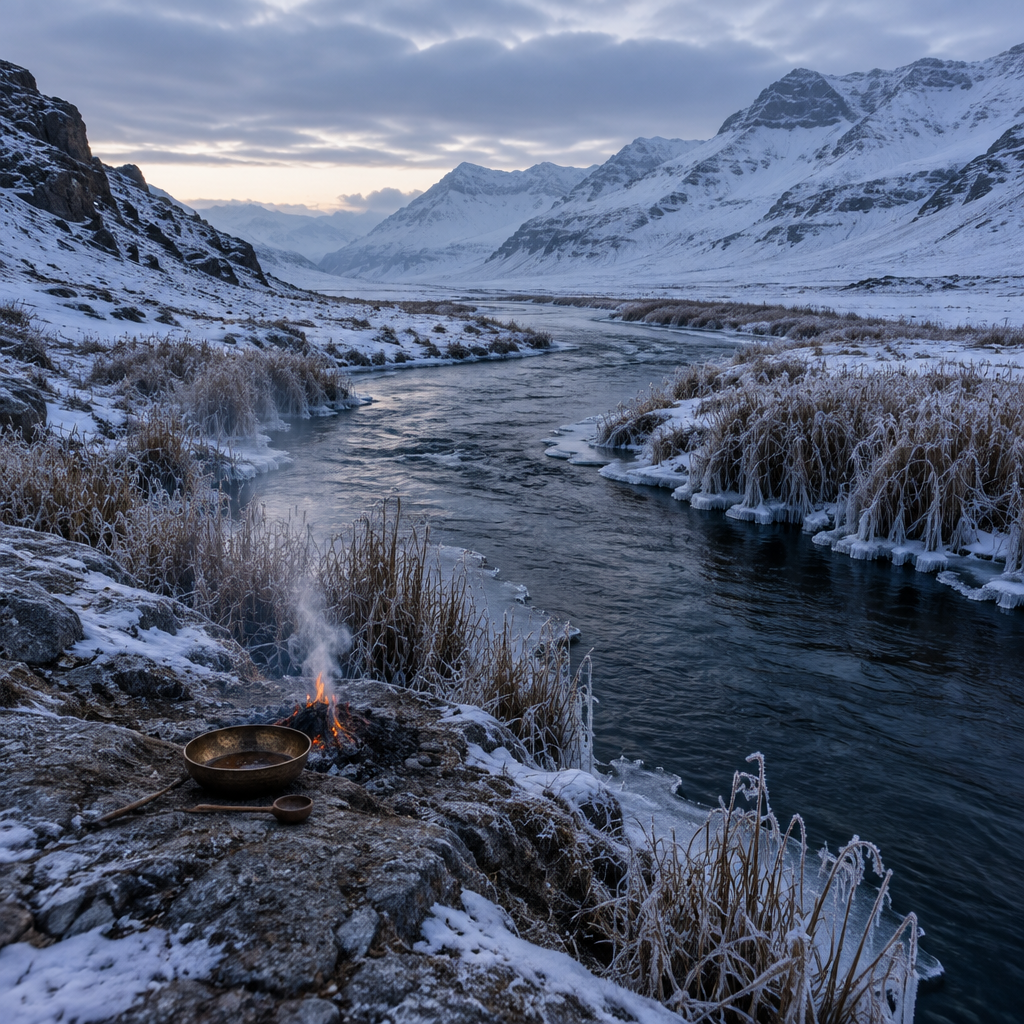
Airyanem Vaejah
Also Known As: Avestan Airyanəm Vaēǰō, “expanse of the Aryans”; Middle Persian Ērān-wēz; the source of the modern name Iran
Region/Culture: West Asia/Middle East
Mythos: Persian Mythology, Zoroastrian Mythology
Primary Type/Nature: Mythological Places
Mythical Attributes: The first and, by its own scripture’s account, best of the sixteen lands Ahura Mazda created, answered in kind by Angra Mainyu with a venomous serpent and a winter lasting ten months of the year.
Role in Mythos: It is the sacrificial ground where Ahura Mazda and Zarathustra both make offerings to the water goddess Anahita, and the place where Zarathustra receives the Good Religion directly from Ahura Mazda.
Relation to Humans: No source describes anyone actually living there in comfort; its inhabitants are defined instead by what the land forces on them, most of all Yima, whom Ahura Mazda instructs to dig an underground shelter and fill it with the best of every living thing before a still-worse winter arrives. Later Zoroastrian tradition treats it less as a place people visit than as the point every Iranian people and language is said to radiate outward from.
Somewhere the Avesta never draws a map for, a river called the Daitya runs black between banks of frozen reed, and for ten months of the year nothing moves on it but the wind. This is airyanem vaejah, the expanse of the Aryans: the first and, its own scripture insists, the best of the sixteen lands Ahura Mazda made when he set the world going. Later ages folded the name down to Ērān-wēz, and folded it further still into the word a whole country now carries. Iran begins, mythically speaking, as a memory of this one cold valley.
The name itself is argued over almost as much as the place. Airyanem is straightforward enough, the genitive plural of the same root that gives Old Iranian its self-description as Aryan. Vaejah is not. Friedrich Carl Andreas read it as an old word for territory or region. Émile Benveniste connected it instead to a verb meaning to brandish or hurl, arriving at something closer to expanse, or a river’s throw, a name built around motion rather than ground. Other readers push it toward a fast-moving current entirely, which would make the name, roughly, the swift water of the Aryans before it is anything else.
The Vendidad lists the land first for a reason that is also a warning. No sooner had Ahura Mazda finished it than Angra Mainyu, the Hostile Spirit, answered in kind, throwing a great serpent into the river and calling down a winter with no equal anywhere else in the text: ten months of it, then two months of a summer so grudging the text can only say the water, the earth and the trees still felt cold. Every land Ahura Mazda made got its own ruinous counter-gift from Angra Mainyu. Airyanem Vaejah, being first, got the worst of him.
What the land is actually used for, in the surviving hymns, is sacrifice. The Aban Yasht places both Ahura Mazda and Zarathustra on the Daitya’s bank, each pouring an offering to Anahita, goddess of the waters, and asking her for something specific: victory in one telling, the strength to carry the good religion into the world in the other. Other hymns run the same scene again with different gods invited to it, prize horses asked of one, prosperity of another, as though the riverbank were less a location than an altar the whole pantheon takes turns using. Scholars usually identify that river, the Vanguhi Daitya, “the good Daitya,” with the Amu Darya, the river Greek writers called the Oxus, though the identification is no more secure than anything else about the place.
Nobody in the Avesta ever describes what Airyanem Vaejah looks like beyond the river and the cold. No mountains are named there, no forests, no cities; a place central enough to be creation’s opening move gets almost no scenery at all. What little else it holds comes from a different, later book. The Bundahishn, written in Middle Persian centuries after the Avesta, says the first ox and the first man were shaped there too, and that it was on that same riverbank that Zarathustra finally stood before Ahura Mazda and received the religion whole. The geography still amounts to a river and some frost. That is the whole physical record, and it has never gotten longer.
The clearest thing anyone does there is build something to survive it. When Ahura Mazda warns Yima, the first king, that a second, even worse winter is coming, one that will freeze every spring solid and starve the land of the growing season it depends on, he does not tell him to flee Airyanem Vaejah. He tells him to dig. Yima builds a vara, a walled shelter sunk below the frost line, and packs it with the seed of every plant, the finest of every animal, and pairs of the best men and women, sealing them in against a catastrophe the homeland itself set loose. The land does not save its people from the winter it was cursed with. It teaches them to outlast it underground instead.
Where any of this actually happened is a question that has occupied Iranologists for more than a century without producing an answer anyone fully trusts. Wilhelm Geiger and Josef Markwart argued for Khwarezm, on the delta of that same Oxus, where the cold at least matches the text; Mary Boyce later backed them. Frantz Grenet has pushed the search further up the same river, into the highlands near the Pamirs, reading the Avesta’s cold as altitude rather than latitude. Michael Witzel places it further south again, in the mountains around Bamiyan. By the time the Bundahishn was written, Zoroastrian tradition itself had relocated the whole story to Azerbaijan, in the far northwest, a shift Émile Benveniste blames on politics rather than memory: when the Sasanian court moved west, the old eastern place names apparently moved with it. Prods Oktor Skjaervø, surveying all of it, has simply called the question unsolvable. A religion’s founding land, and nobody since antiquity has managed to point to it on a map.
As a place, what Airyanem Vaejah offers is proximity. It is where the gods can be reached directly, where a sacrifice on the riverbank goes straight to Anahita rather than through any intermediary, where Zarathustra does not hear about the good religion secondhand but takes it from Ahura Mazda’s own hand. That directness is also its exposure. Being first in the list of created lands meant being first in Angra Mainyu’s sights, and the punishment fitted the honor exactly: no other land in the Vendidad’s roll call carries a winter this long. The land that stands for the beginning of everything spends most of its own year, mythologically, frozen shut.
Frequently Asked Questions
What is Airyanem Vaejah?
Airyanem Vaejah is the first and, according to the Avesta, best of the sixteen lands the god Ahura Mazda created at the start of the world. Its name means roughly “the expanse of the Aryans,” and Zoroastrian tradition treats it as the mythical homeland the early Iranian peoples trace themselves back to. Later Middle Persian texts call it Ērān-wēz, a name that eventually contracted into the word Iran itself.
Where was Airyanem Vaejah located?
No one knows for certain, and modern scholars disagree sharply. Early researchers such as Wilhelm Geiger and Josef Markwart, and later Mary Boyce, placed it in Khwarezm on the delta of the river usually identified with the Avesta’s Daitya, today’s Amu Darya. More recent scholarship, including Frantz Grenet and Michael Witzel, argues for locations further southeast, in the highlands near the Pamirs or around Bamiyan in Afghanistan, while Zoroastrian tradition itself later relocated the story to Azerbaijan in northwestern Iran. Prods Oktor Skjaervø has concluded the question cannot be settled from the available evidence.
Why did Airyanem Vaejah have such a harsh winter?
The Avesta blames Angra Mainyu, the destructive spirit who opposed Ahura Mazda’s creation at every land he made. Because Airyanem Vaejah was the first and finest of the sixteen lands, Angra Mainyu answered it with the worst counter-creation of all: a venomous serpent thrown into its river and a winter lasting ten months, followed by only two months of summer too cold to warm the water, earth or trees.
What is Yima’s connection to Airyanem Vaejah?
Ahura Mazda warned Yima, the first king in Zoroastrian myth, that an even more catastrophic winter was coming to destroy every living thing in the land. Rather than telling Yima to flee, Ahura Mazda instructed him to build a vara, an underground shelter, and fill it with the seed of every plant and animal and pairs of the finest people, preserving life until the disaster passed.
What role does Airyanem Vaejah play in Zoroaster’s own story?
Zoroastrian scripture places Zoroaster, or Zarathustra, on the bank of the Daitya river within Airyanem Vaejah at the moment he receives the Good Religion directly from Ahura Mazda. The Aban Yasht also shows both Ahura Mazda and Zarathustra sacrificing to the water goddess Anahita on that same riverbank, and the Middle Persian Bundahishn adds that the first ox and the first man were created in this land as well.
Related Entries
Ahura Mazda, Angra Mainyu, Zoroaster, Anahita, Vohu Manah, Amesha Spenta, Atar, Mithra, Gayomart (Kayumars), Zahhak, Fereydun, Mount Damavand