
Angra Mainyu (Middle Persian: Ahriman)
Region/Culture: West Asia/Middle East
Mythos: Zoroastrian Mythology, Persian Mythology
Primary Type/Nature: Demons and Devils
Mythical Attributes: Angra Mainyu is the Destructive Spirit of Zoroastrianism, the source and embodiment of all evil, chief of the daevas, and counter-creator of winter, sickness, and death.
Role in Mythos: He is the cosmic adversary of Ahura Mazda and the Bounteous Spirit Spenta Mainyu, assaulting the good creation throughout history until his final defeat at the renovation of the world.
Relation to Humans: Angra Mainyu afflicts humanity with pollution, disease, temptation, and death, and personally tried to bribe the prophet Zoroaster into renouncing the good religion. Every human choice for truth over the Lie weakens his cause, making ordinary people active combatants in the war against him.
Somewhere beyond the northern rim of the world, in a darkness that has never known firelight, something waits for the light to make the first move. Zoroastrian tradition calls him Angra Mainyu, the Destructive Spirit, and it grants him no body, no home inside creation, and no power to make a single living thing. What he has instead is an army of demons, a bottomless appetite for ruin, and one talent he has polished across the whole span of cosmic time: wrecking what someone else built.
He enters the record early and almost shapelessly. In the Gathas, the hymns attributed to Zoroaster himself and the oldest layer of the Avesta, the phrase angra mainyu is closer to a description than a name. The prophet sings of two primal spirits, twins in vision, who stood at the beginning of things and chose. One chose asha, truth and right order. The other chose druj, the Lie. In those verses the hostile spirit’s opposite number is not yet the high god Ahura Mazda but Spenta Mainyu, the Bounteous Spirit, and the whole drama of existence flows from that first act of choosing. The idea seems to have been Zoroaster’s own invention, which makes Angra Mainyu one of the oldest deliberately designed devils in any tradition.
The Younger Avesta gives him a name, a title, and an address. He becomes daevanam daevo, the daeva of daevas, chief of the false gods of chaos and deceit, and his dwelling is fixed in the cold north, the direction from which demons come. From there he conducts his one great enterprise. When Ahura Mazda shapes sixteen good lands, each one generous with water and pasture, Angra Mainyu answers each in turn with a scourge: a killing winter, a plague, a vice, a serpent in the river. He studies each new country the way a forger studies a signature, then sets about producing the counterfeit. He never builds anything of his own.
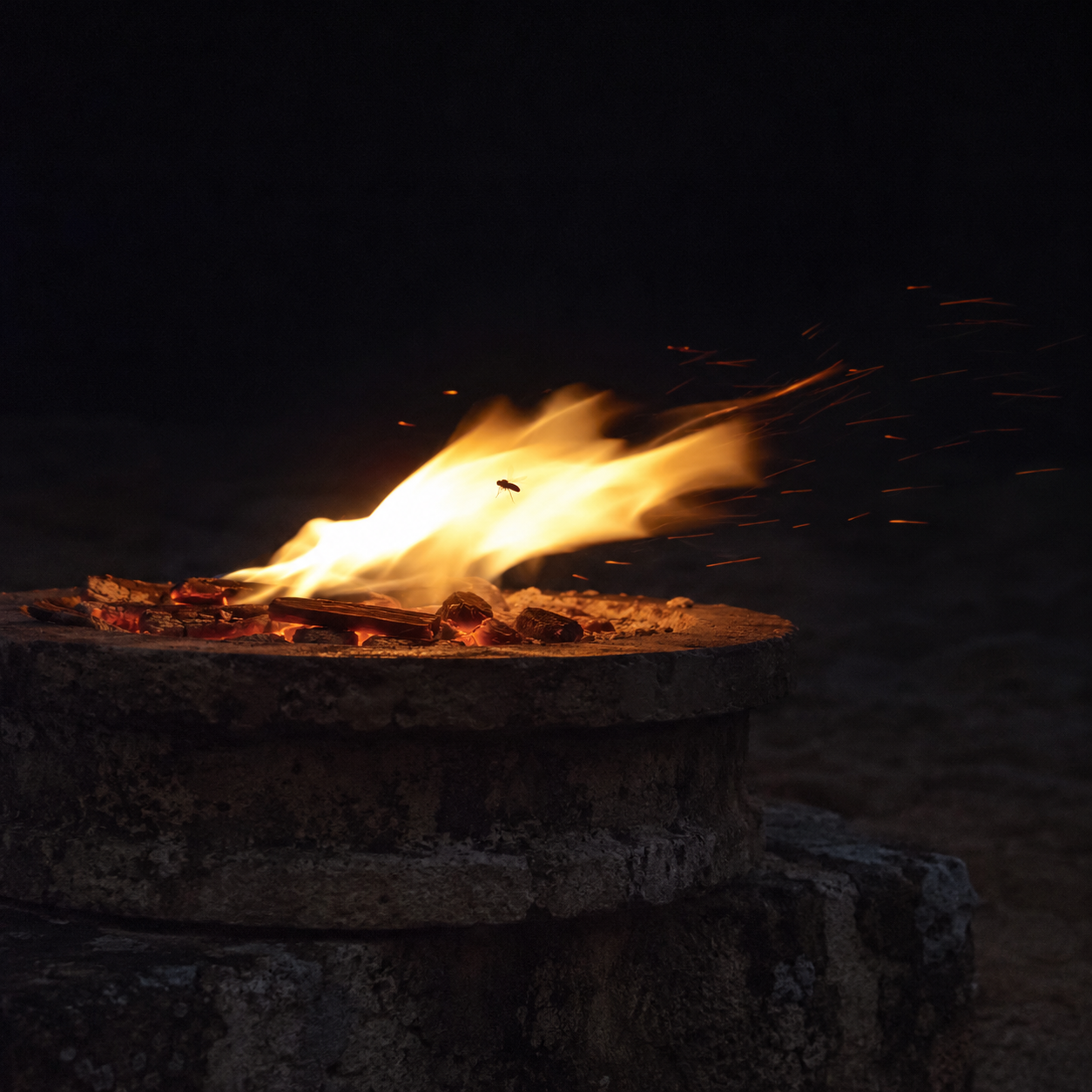
What he looks like while doing this is a question the tradition refuses to answer, and the refusal is the point. Evil, in Zoroastrian thinking, has no substance of its own, so its lord owns no face. When Angra Mainyu needs a body he borrows one: a snake, a lizard, a young man, or a fly, that smallest and most insolent of shapes, the buzz at the edge of the sacrifice, the speck that lands on what was clean.
The Bundahishn, the great Pahlavi account of creation, stages the whole war from its first blow to its last. In the beginning Ahura Mazda dwelt on high in endless light, and Angra Mainyu below in endless dark. For three thousand years the wise lord prepared his creation in spirit. Then the Destructive Spirit saw the light, hungered for it, and rose to attack, and Ahura Mazda recited the Ahuna Vairya, the holiest of prayers. The sound of it alone knocked Angra Mainyu back into the darkness, where he lay senseless for three thousand years, the weight of one prayer pinning him like a fallen beam.
When he finally woke he made up for lost time. He beheld a physical world that was perfect, and he bored into it, bringing pollution, pain, sickness, and death where none had existed. He slew the primal bull, the first animal, but the moon caught and purified its seed, and from that seed sprang the animal kingdom. He poisoned Gayomart, the first man, bright as the sun, and boasted of the deed. The sun purified the seed that Gayomart left in the earth, and after forty years a rhubarb plant pushed up through the soil and opened into Mashya and Mashyanag, the first human couple. Every kill he makes turns into more life. It must be maddening.
He tried persuasion exactly once. The Vendidad tells how he came to Zoroaster and offered him sovereignty over the whole world if the prophet would only renounce the good religion. Zoroaster answered with prayer, and the rejected tempter threw legions of demons at him, every one of them deflected. In another text, Yasht 19, Angra Mainyu and Spenta Mainyu fight for possession of the khvarenah, the divine glory that legitimizes kings, and again he comes away with nothing.
A later heresy gave him a stranger birth. In Zurvanism, a branch of Zoroastrian thought, Time itself, the god Zurvan, sacrificed for a thousand years in hope of a son. Near the end of that vigil a single doubt crossed his mind, and twins were conceived: Ohrmazd born of the sacrifice, Ahriman born of the doubt. Orthodox tradition rejected the brotherhood, but the image survives because it answers a hard question simply. Evil is what happens when even Time hesitates.
His powers are real and terrible. He commands the daevas, with the Lie as his banner and greed, wrath, and envy as its expressions. He fashioned Azhi Dahaka, the three-headed, six-eyed serpent with a thousand senses, to destroy the world of truth. He counterfeits creation with plagues, slips into borrowed bodies, and tempts the best of men. Yet his limits are built into his nature. He cannot create, only react and spoil, and each act of spoiling has a way of seeding new life. He has no form, no glory, and no future. The tradition is unanimous that at the frashokereti, the final renovation, evil will be utterly defeated, the dead will rise, and creation will be restored to its first perfection, while his demons, confined to their own realm, devour one another and his very existence is quenched. He loses. Every strand of the story agrees on that. Which is why, in the meantime, the sacred fires are kept burning through the night, tended and fed, each flame a small lit border he cannot cross.
Frequently Asked Questions
Who is Angra Mainyu?
Angra Mainyu is the destructive spirit of Zoroastrianism, the embodiment and source of all evil and the chief of the daevas, the demons of chaos and deceit. He is the cosmic adversary of the supreme god Ahura Mazda and of the Bounteous Spirit Spenta Mainyu, and he attacks the good creation with pollution, sickness, and death until his foretold defeat at the end of time.
Are Angra Mainyu and Ahriman the same being?
Yes. Angra Mainyu is the Avestan name, meaning destructive or hostile spirit, while Ahriman is the later Middle Persian form of the same name used in Pahlavi texts such as the Bundahishn. The two names refer to the same figure at different stages of the tradition.
Is Angra Mainyu the twin brother of Ahura Mazda?
In mainstream Zoroastrianism, no. The Gathas describe two primal twin spirits who chose between truth and the Lie, but the hostile spirit’s opposite there is Spenta Mainyu, not Ahura Mazda himself. Only the later Zurvanite branch made Ahriman and Ohrmazd literal twin brothers, born of the god Time when a moment of doubt crossed his mind, and orthodox tradition rejected that idea.
What does Angra Mainyu look like?
Angra Mainyu has no true form of his own, because in Zoroastrian thought evil has no substance. When he needs a body he borrows one for a limited time, appearing in the texts as a snake, a lizard, a fly, or a young man.
Is Angra Mainyu ever defeated?
Yes. Zoroastrian teaching holds that at the frashokereti, the final renovation of the world, evil will be utterly defeated, the dead will be resurrected, and creation will be restored to its original perfection. Angra Mainyu’s demons will devour each other in their own realm, and his existence will be quenched entirely.
Related Entries
Ahura Mazda, Amesha Spenta, Daeva, Aka Manah, Vohu Manah, Ahura, Zahhak, Div, Mithra, Peri, Bakhtak, Satan, Lucifer, Demons, Angels