
Atar
Also Known As: Avestan atar-, nominative atarsh, “fire”; Middle Persian and Parthian adur, New Persian azar and atash; called throughout the Avesta athro ahurahe mazdao puthra, “Fire, the son of Ahura Mazda”
Region/Culture: West Asia/Middle East
Mythos: Persian Mythology, Zoroastrian Mythology
Primary Type/Nature: Gods and Deities
Mythical Attributes: Atar is fire itself made a person, a yazata who sees falsehood, tests it by burning, and speaks aloud to the people whose houses he lives in.
Role in Mythos: He is the son of Ahura Mazda and the carrier of offerings between earth and heaven, the divine instrument of judicial ordeal, and the champion who contests the kingly Glory with the dragon Azhi Dahaka.
Relation to Humans: Atar is the only Zoroastrian divinity who is physically dependent on the people who worship him, because he cannot gather his own fuel and must ask for it every night. In return he blesses the household that feeds him with cattle, children and a quiet soul, and he keeps a long memory of anyone who lets him go out.
The householder wakes because something in the room is asking him to. It is the first watch of the night, the fire on the hearth has sunk to a red seam under grey ash, and in the Avesta the fire speaks at exactly this hour. What it says is not grand. Up, arise, master of the house; put your girdle on over your clothes, wash your hands, bring me wood. A demon is coming who means to put my life out.
That is the whole of the request, and it is repeated twice more before dawn. In the second watch the fire calls the husbandman with the same words. In the third it gives up on human beings and calls Sraosha, who wakes the cock, and the cock throws its voice at the coming light and shouts at everyone still lying down that the demon of sleep is on them and that they should get up and say their prayers. Two people in a bed then turn to each other and argue about who heard it first, because whichever of them rises first will enter paradise first. The one who gets there with clean hands and dry wood receives a blessing so domestic it barely sounds divine: may your cattle increase, may you have sons, may you live out all the nights of your life in the joy of your soul.
The word behind all this is simply the Avestan word for fire. Atar means fire and it also means Fire, and Iranian religion never troubled to keep the two apart, because every hearth flame was held to be a real presence of the divinity and not a symbol of one. He is called the son of Ahura Mazda more often than he is called anything else. Zoroaster took an inheritance he had not invented, the Indo-Iranian cult of the hearth that reaches back past the Iranian plateau into Indo-European antiquity, and gave it a moral spine: fire became the creation of Asha Vahishta, Best Truth, and the instrument by which the world will one day be judged. The cosmogonists went further and called fire the seventh creation, the life-force lying inside the other six and animating them, which makes Atar less a god of a thing than the heat in everything.
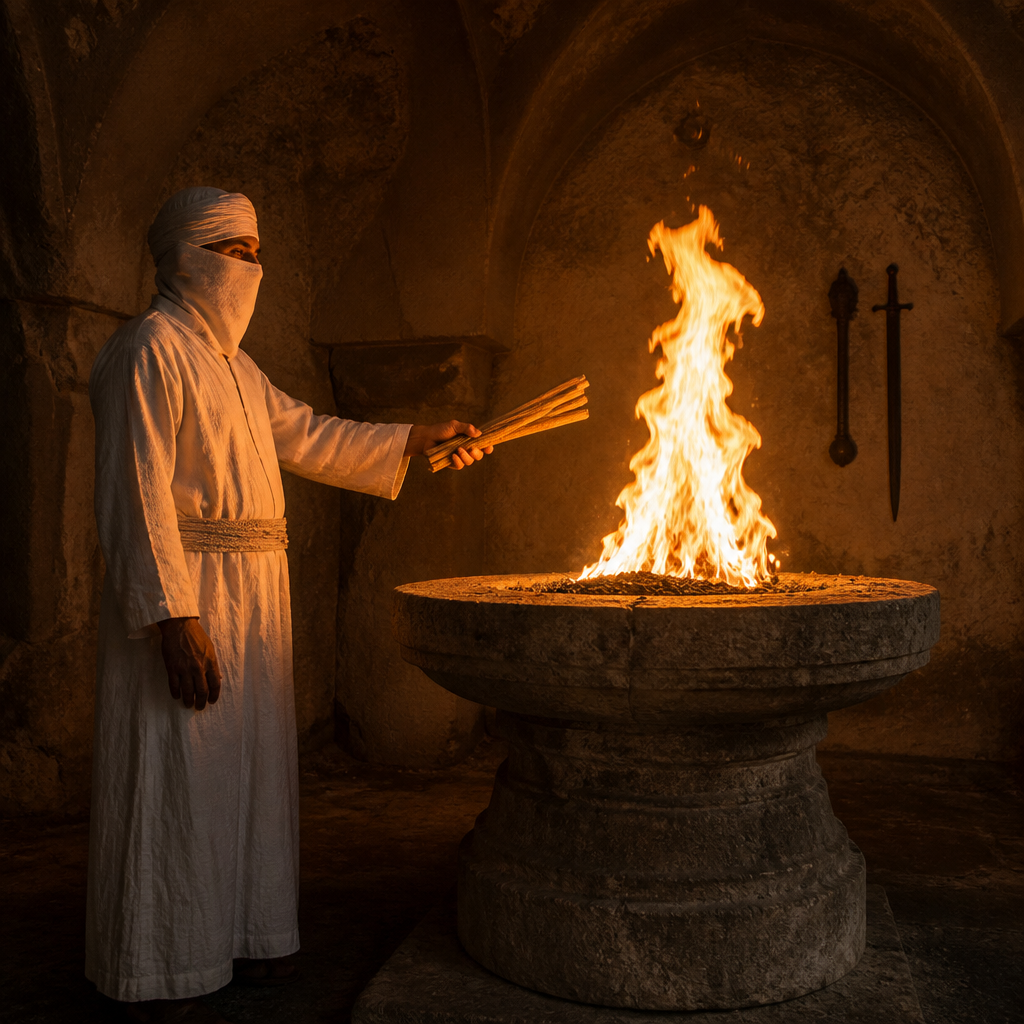
He has no face. There were no statues of him, and when the Sasanians struck their coins they put a fire-holder on the reverse where another dynasty would have put a portrait, sometimes with a royal diadem tied round the shaft to show whose personal fire it was. The closest thing to an iconography is the ritual around the greatest of the sacred fires, which is assembled from embers gathered out of many fires, including fire taken from lightning, purified over and over, then carried in procession to its sanctuary by priests holding swords and maces. Afterwards some of the weapons stay hanging on the wall. A Pahlavi commentator put the paradox flatly: bodily he is infirm, unable to move, and spiritually he is a warrior.
The warrior showed himself once, and the story does not flatter him. The kingly Glory, the khvarenah that cannot be seized by force, had fled from Yima and was loose in the world, and the good and evil powers threw themselves at it. Atar came forward with the rest, wanting it. Azhi Dahaka, three-mouthed and six-eyed, rushed at his back and told him that if he took it, the dragon would see to it that he never blazed on the earth again. Atar pulled his hands back. The god of fire flinched. Then the dragon lunged for the Glory in his turn, and Atar came up behind him and said that if Azhi closed on it, he would go into the dragon from behind and blaze up in its jaws, and the dragon took its hands back too. Neither of them got it. The Glory swelled away into the sea Vouru-Kasha, where the Son of the Waters took it down to the bottom of the deep rivers, and the whole contest ended with two frightened powers standing over nothing.
His powers run along a single line, and the line is truth. Because he burns falsehood and cannot be lied to, ancient Iran used him as a court. A man accused of perjury or of breaking a contract might be made to walk through fire, or have molten metal poured on his bare chest, and there were said to be around thirty varieties of the ordeal in all. The mildest version only required him to swallow a draught of sulphur while he swore, on the understanding that if he was lying it would burn him from the inside. The Persian word for a solemn oath is still, to this day, the word for that sulphurous drink. At the end of time the same principle is scaled up to cover the earth: a flood of molten metal in which everyone who has ever lived undergoes the last ordeal at once. Priestly scholars eventually sorted him into five kinds, ranked in ascending dignity, the fire of high benefit, the fire that loves the good and burns as the life in men, the most joyful fire that lives in plants, the swiftest fire which is lightning, and the holiest, which burns in the presence of God.
His weakness is the flip side of the same nature, and it is unusually humiliating for a deity. He cannot move. He cannot feed himself. He is armest, motionless, and every hour of his existence depends on somebody bringing him clean dry wood in washed hands, which is why he begs. The Atash Nyayesh has him raising his voice to everyone whose evening and morning meal he cooks, and then watching the doorway: Atar looks at the hands of all those who pass by, and asks what the friend is bringing to his friend, what the one who comes and goes brings to the one who stays. He can be defiled by the work people do with him, so embers rescued from a smith’s shop have to be relit through nine successive fires before they are fit to approach a temple. He can be extinguished outright, and history did most of that job. After the Arab conquest most of the sacred fires of Iran went out over six hundred years as their temples were razed or converted. What survived, survived by hiding: the Zoroastrians of Yazd gave up the custom of enthroning the fire where it could be seen and moved it into a small side room behind a door like a cupboard, so that anyone breaking into the hall would find an empty fire-holder and conclude the flame was already dead. The laity lost the sight of their own fire for centuries and accepted the trade. In the twentieth century, when the community shifted to Tehran, priests carried embers on foot across the Dasht-e Kavir to light a new great fire there, walking a burning coal across a desert because that was the only way it could legitimately be born.
Frequently Asked Questions
Who is Atar in Zoroastrianism?
Atar is the yazata of fire, called the son of Ahura Mazda throughout the Avesta. He is not a symbol of fire but fire itself understood as a divine person, so every hearth flame and every temple fire is a real presence of him. He acts as the intermediary who carries offerings between people and the divine.
What does Atar do?
Atar tests truth and burns falsehood. Ancient Iran used him judicially, putting the accused through ordeals by fire or molten metal, with around thirty recognised varieties, and the mildest version required swearing an oath while drinking a draught of sulphur. At the end of time a flood of molten metal will put the whole of humanity through the same ordeal at once.
Why does Atar ask people for firewood?
Because he cannot move or feed himself. In the Vendidad he calls out three times in the night, first to the master of the house, then to the husbandman, then to Sraosha, asking for clean dry wood carried in washed hands so that a demon cannot put his life out. The Atash Nyayesh has him watching the hands of everyone who passes, asking what the friend brings to his friend.
Did Atar defeat Azhi Dahaka?
No. In the Zamyad Yasht the two contest the kingly Glory and each frightens the other off. Azhi Dahaka threatens that Atar will never blaze on earth again, and Atar pulls back; Atar then threatens to blaze up inside the dragon’s jaws, and the dragon pulls back. Neither wins the Glory, which escapes into the sea Vouru-Kasha.
What does Atar look like?
No source gives Atar a body, and Zoroastrians never made a cult image of him. The nearest thing to a portrait is the sacred fire itself on its stone stand, which the Sasanians put on their coins where another dynasty would have put a king’s face, and the swords and maces the priests hang on the sanctuary walls after installing a great fire.
Related Entries
Ahura Mazda, Angra Mainyu, Zahhak, Amesha Spenta, Vohu Manah, Aka Manah, Mithra, Anahita, Zoroaster, Div, Kaveh the Blacksmith, Simurgh, Agni, Vesta, Hestia