
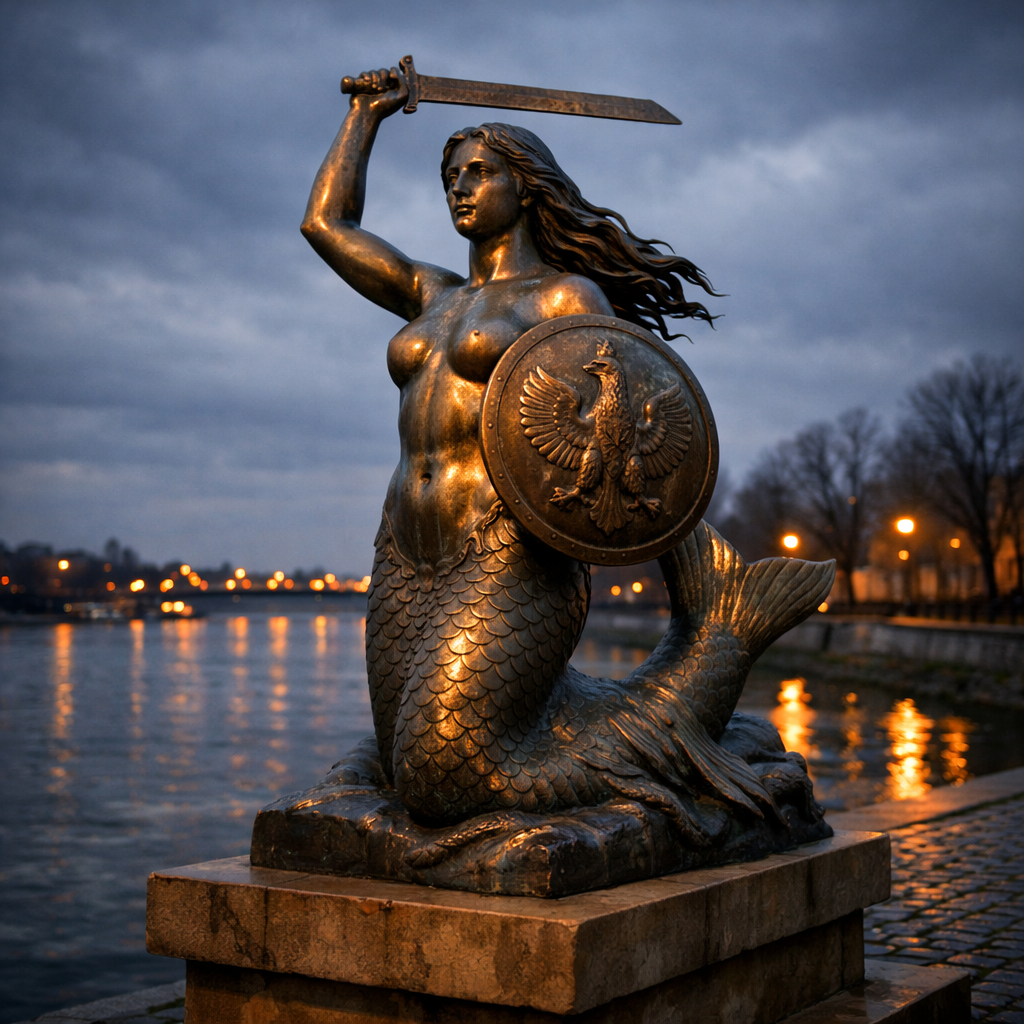
Syrenka
Region/Culture: Central and Eastern Europe
Mythos: Slavic Mythology
Primary Type/Nature: Fairy Folk and Spirit Beings
Mythical Attributes: A freshwater mermaid (melusina) with an enchanting voice, wielding a sword and shield as the sworn guardian of Warsaw.
Role in Mythos: Syrenka serves as the protective spirit of Warsaw, pledging to defend the city and its people after being rescued by local fishermen.
Relation to Humans: She is benevolent toward those who treat her with kindness, having formed her bond with Warsaw’s people after a fisherman’s son freed her from captivity. Her enchanting song can entrance listeners, and she stands armed and ready to defend the city from any threat.
The Vistula is a slow, cold river in its lower reaches, the colour of pewter under overcast skies, and it was somewhere along its muddy banks that the fishermen of a small Polish settlement first heard singing they could not explain. The voice came from the water at dusk, a sound so clear and strange that the men stopped mending their nets and stood motionless, unable to look away from the current. The singer was Syrenka, the mermaid of Warsaw, and she had already been there longer than anyone could say.
The most widely told version of her arrival begins in the Baltic Sea, where two mermaid sisters grew restless and swam their separate ways. One headed for the Danish straits, where she would eventually become the subject of a famous fairy tale. The other turned south, slipping into the mouth of the Vistula and following its course deep into the Polish interior. She passed Gdańsk and kept going. When she reached a stretch of riverbank near what is now Warsaw’s Old Town, something made her stop. The landscape suited her. She stayed.
The fishermen noticed her quickly, though not by sight. Their nets came up empty or torn. Fish vanished from their traps. They assumed a thief and set about catching it. What they found, tangled in their ropes, was a woman from the waist up, her lower half covered in smooth, silvery scales tapering to a muscular tail. Her hair was long and pale. She spoke, or sang, and the anger went out of them. They cut her free and, in the nights that followed, gathered on the riverbank after the day’s work to listen to her voice carry across the cold water.
It did not last. A wealthy merchant passing through the settlement spotted Syrenka on the shore and saw profit. He tricked her, seized her, and locked her in a wooden shed. The stories vary on the specifics of his method, but the result was the same: the mermaid was caged, and her cries filled the village like the saddest sound in the natural world. People’s hearts ached. A young fisherman’s son, unable to bear it, gathered his friends. They broke down the door, overpowered the merchant’s men, and set her free.
Syrenka made a promise. She told the fishermen she would guard them and their village from that day forward, and that if threats came that they could not handle alone, she would return with sword and shield. The small settlement grew. It became Warsaw. And the mermaid kept her word.
The oldest surviving trace of her image on an official city seal dates to 1390, though the creature depicted there barely resembles the figure Warsaw knows today. That early seal showed a dragon-scaled torso with a male head and bird’s legs, clutching a sword and shield. By 1459, the figure had acquired feminine features, a bird-like upper body, and a fishtail alongside those clawed feet. The full transformation into a recognizable mermaid, woman above and fish below, did not appear until 1622. Through every version, the sword and shield remained.
The most famous statue stands in the Old Town Market Square, a figure cast in zinc by sculptor Konstanty Hegel in 1855. She emerges from sculpted waves, her tail spiralling beneath her, a sword raised high above her head and a round shield pressed to her chest. At 180 centimetres, she is roughly life-sized, which makes her seem more real than monumental. The original endured relocations, vandalism, and decades of weather before being moved to the Museum of Warsaw in 2008 and replaced by a replica. A second major statue, cast in bronze by Ludwika Nitschowa and unveiled in 1939 near the Vistula at Powiśle, stands 2.75 metres tall and carries a different weight. The young woman who posed for Nitschowa was Krystyna Krahelska, a 23-year-old ethnography student, poet, and Girl Scout. Five years after the statue was unveiled, Krahelska was shot three times in the chest while trying to rescue a wounded comrade on the first day of the Warsaw Uprising. She died the next morning. Her most famous poem became the Uprising’s most popular song. The statue survived the war almost untouched.
Syrenka’s power is her voice, the thing that disarmed the fishermen and that, in some tellings, could summon storms or calm rough water. She is tied to the Vistula the way a heartbeat is tied to a body. But her strength carries a limitation built into the legend itself: her protection depends on the bond with the people who freed her. She guards those who showed her kindness. The promise was specific, not universal. Some versions of the tale end with her warning that she would only return if the people could not cope on their own, a conditional pledge rather than an unconditional guarantee. Warsaw’s motto, Semper invicta, always unconquered, sits well beside a guardian who expects the city to fight for itself before she draws her sword.
The word syrenka is a Polish cognate of siren, but the creature is more properly a melusina, a freshwater mermaid of European tradition. She is not the death-luring singer of Greek rocks. She does not drown sailors. She frees fish from nets, sings for working men at the end of long days, and carries a weapon she will use only in defence. Warsaw is 300 kilometres from the nearest coast. Its guardian came from the sea anyway.
Frequently Asked Questions
Who is Syrenka?
Syrenka is the guardian spirit of Warsaw and the Vistula River in Polish folklore, a figure within Slavic mythology. She is a mermaid-like being who serves as a symbol of protection and freedom for the city and its people.
What does Syrenka look like?
Syrenka has the upper body of a woman with flowing golden hair and piercing green eyes, while her lower half takes one of two forms. She may appear with the scaled tail of a fish in shades of blue and green, or with the powerful limbs of a bird that hint at a celestial connection.
Is Syrenka good or evil?
Syrenka is primarily benevolent and serves as the protector of Warsaw and its inhabitants. Her character is more complex than that, however, since she is also known to lead sailors astray with her irresistibly beautiful song. The same voice that lures the unwary rises in fierce defiance against any who would threaten the city she guards.
What powers does Syrenka have?
Syrenka commands a hypnotic, melodious song capable of enchanting sailors and rallying defenders of Warsaw alike. She is a being of both water and air, able to move between these realms with ease, and some tales credit her with summoning storms or calming waters depending on her mood.
What is Syrenka’s weakness?
Syrenka’s deep bond with Warsaw and the Vistula River is both her strength and her vulnerability. Her existence is inextricably linked to the wellbeing of the city and its river, meaning her fate rises and falls with theirs.
Related Entries
Rusalka, Vodyanoy, Vila, Strzyga, Kikimora, Baba Yaga, Leshy, Lisovykha, Domovoi, Marzanna, Mokosh, Mermaid, Melusine, Undine, Iara