
Sukhāvatī
Also Known As: Sanskrit सुखावती, “possessing bliss”, from *sukha* “joy” plus *-vat* “full of”; Chinese 極樂世界 Jílè shìjiè, “realm of ultimate bliss”; also called the Western Pure Land and the Land of Bliss; Japanese Gokuraku, Korean Geungnak, Vietnamese Cực Lạc, Tibetan Dewachen
Region/Culture: East Asia
Mythos: Buddhist Mythology
Primary Type/Nature: Mythological Places
Mythical Attributes: A buddha-field of golden ground, seven-jewelled pools and trees that preach the Dharma when the wind moves them, where affliction, ageing and death do not occur.
Role in Mythos: It is the land Amitābha built by vow and the destination his eighteenth vow promises to anyone who calls his name, a place to be reborn into rather than a heaven to be rewarded with.
Relation to Humans: Humans reach it by sincerely wishing to be born there and holding Amitābha’s name in mind, above all at the moment of death. Those who arrive come up inside closed lotus buds that open only when the occupant is purified, and many leave again afterwards, returning to this world as bodhisattvas.
Go west from here past ten trillion buddha-lands and the ground turns to gold. That is the direction the Buddha pointed when Śāriputra asked, and the distance is stated plainly in the Shorter Sūtra, as though a man might set out and walk it. What waits at the far end has no sun. It has no moon either, no planets, no constellations, no fire, and no darkness that would make any of them useful. Light there comes off Amitābha and off the jewels, and there is so much of it that nobody in that land has ever needed to name a time of day.
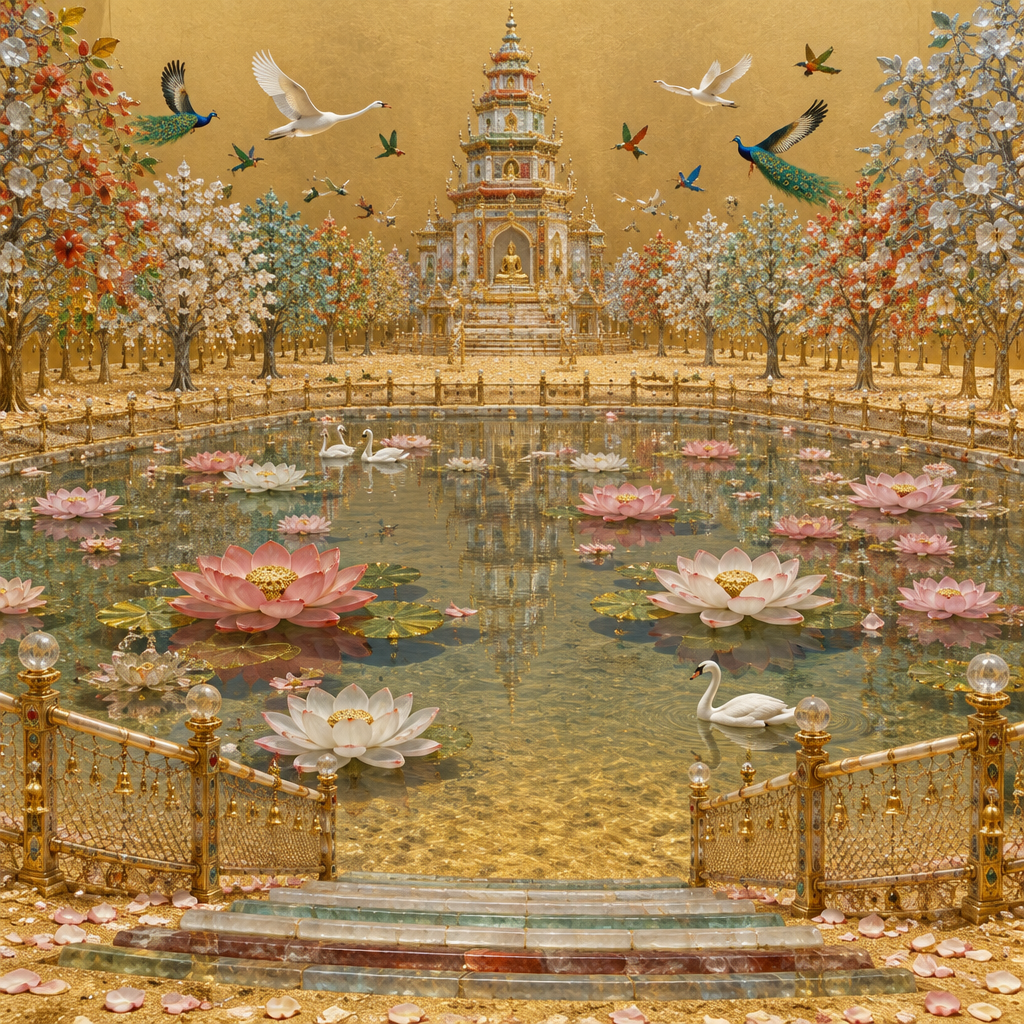
The architecture arrives in sevens. Seven tiers of railings ring the land, then seven layers of netting, then seven rows of trees, every one of them built from four precious materials. The pools are cut from the seven jewels and filled with water of eight excellent qualities, and the floor of each pool is gold sand rather than mud. Steps go down into them in combined gold, silver, beryl and crystal. Above the water stands a tower of gold, silver, beryl, crystal, mother of pearl, ruby and coral, and in the pools themselves lotuses open as wide as chariot wheels, throwing off green, yellow, red and white light and a fragrance the text is careful to call subtle rather than strong. Six times across what would elsewhere be a day and a night, the sky rains down māndārava flowers.
Then the sound. A breeze passes through the jewelled trees and the jewelled nets and they ring like a hundred thousand notes struck in agreement, and the birds answer. Swans, peacocks, parrots and egrets, along with two stranger species the sūtra names outright, the kalaviṅka and a two-headed bird, sing six times over at the same intervals, and what they sing is doctrine: the five roots, the five powers, the seven factors of awakening, the branches of the eightfold path. Anyone who hears it finds his mind turning toward the Buddha, the Dharma and the Saṃgha without having decided to. Śākyamuni breaks off his own description here to head off a misreading. Do not imagine, he tells Śāriputra, that these birds are birds because they did something to deserve it. There are no lower destinies in that land. The names of the lower destinies are not even in circulation there. Amitābha made the birds by transformation, so the teaching would have a voice in every part of the sky.
A morning there looks like this. Beings rise and go out among the flowers, gather them by the armful because the precepts have given them an abundance to gather, then travel to the ten trillion buddha-lands of the other directions to make their offerings. They are back by mealtime. They eat, and they walk about. It is the least paradisiacal line in the whole description and the most convincing one.
The place was designed, and the sūtras name its designer. Long ago a bodhisattva called Dharmākara stood before the buddha Lokeśvararāja and made a set of vows describing the world he intended to build, forty-eight of them in the Chinese recension and forty-seven in the surviving Sanskrit that Luis Gómez translated, in a different order. He then spent five kalpas working through other buddhas’ countries, noting what served and what did not, before he fixed the wording. The eighteenth vow is the one that reshaped East Asia. Anyone who sincerely wishes to be born in his land and calls his name, ten times will do, will be born there, so long as the wish is genuine and carries no doubt. Dharmākara kept his vows and became Amitābha, and the Shorter Sūtra mentions almost in passing that ten eons have since gone by.
Death is the door. In Japan the moment has its own name, *raigō*, the welcoming approach: Amida arrives on a purple cloud at the close of a life, and the hanging scrolls show him descending at an angle with his retinue strung out behind him. The Shorter Sūtra is more procedural. Hold the name single-mindedly and without confusion for a day, or two, or as many as seven, and at the end of life Amitābha will appear with his assembly of holy beings, and the dying mind, unconfused, arrives. Tibetan practice built a technique around the same crossing. In *phowa*, the transference of consciousness, a lama works on behalf of the dead, coaxing the consciousness toward clarity through a sequence of funeral rites before sending it on to Dewachen, which is this same land under its Tibetan name.
Arriving is not the same as being finished. The newly dead come up inside lotus buds, and a bud opens when its occupant is ready and not one moment before. The Contemplation Sūtra, taught to Queen Vaidehī as a course of sixteen visualisations that opens with nothing more exotic than the setting sun, sorts arrivals into nine grades, and the lowest of those grades waits twelve great kalpas in the closed dark of a flower before the petals move. The Shorter Sūtra is blunter about the entrance requirement: those with few good roots and little merit may not get in at all.
There is a harder problem in the record, and the tradition has been arguing over it for centuries. The Larger Sūtra read straight says that only men are reborn in Sukhāvatī, and the mechanism sits in the thirty-fifth vow, where Dharmākara promises that a woman who hears the name, rejoices in faith and turns from her female body will not take a female body again. That teaching travelled out of India with the sūtras and was repeated and adapted as it spread. Vernacular Buddhist writing in East Asia records a popular conviction running clean against the letter of the text, which is that women go there too.
What the land gives is mostly subtraction. No ageing, no death, no affliction, no lower rebirth, and no possibility of sliding backwards, since everyone born there is *avinivartanīya*, incapable of regression. What it does not give is an ending. Many who reach Sukhāvatī leave it again, coming back to this world as bodhisattvas to work on everyone still in it. The realm is a staging ground with very good acoustics.
Chinese Buddhism never entirely settled where it is. One reading places it in the west, genuinely far off, a real destination in an actual direction. The other holds that it is not separate from this world at all, and that the whole difference lies in the mind of the one looking. Charles Jones observes that the two readings are usually held together rather than chosen between. The art answered the question its own way, by building the place here. Sukhāvatī is the most-painted sūtra scene at Dunhuang, turning up in eighty-four murals, among them the five-metre south wall of Cave 220 from 642. In 1052 the regent Fujiwara no Yorimichi went further and had it constructed at Uji: the Phoenix Hall of Byōdō-in, a gilded Amida two and a half metres tall, fifty-two carved bodhisattvas around him playing and dancing, the whole building set to reflect in a pond so that a visitor standing in Japan could see the Western Paradise twice.
Frequently Asked Questions
What is Sukhavati?
Sukhavati is the Pure Land of the Buddha Amitābha in Mahayana Buddhism, a buddha-field of golden ground, jewelled pools and self-preaching trees where affliction, ageing and death do not occur. Its name is Sanskrit for “possessing bliss”, and it is also called the Western Pure Land or the Land of Bliss. It is the best known of all the Mahayana pure lands, largely because of how widely Pure Land Buddhism spread across East Asia.
Where is Sukhavati?
The Shorter Sūtra places Sukhavati in the west, past ten trillion buddha-lands from our own. Chinese Buddhism has carried two readings of that location for centuries: one treats it as a genuinely distant realm in an actual direction, the other holds that it is not separate from this world, which only looks impure because of the minds perceiving it. The two views are usually held together rather than treated as alternatives.
How do you get reborn in Sukhavati?
By sincerely wishing to be born there and calling on Amitābha’s name, especially at the moment of death. The eighteenth of Dharmākara’s vows, known as the Primal Vow, promises rebirth to anyone who calls the name even ten times, provided the intention is genuine and free of doubt. The Shorter Sūtra also allows that those with few good roots and little accumulated merit may not attain birth there at all.
What does Sukhavati look like?
The land is a level plain of yellow gold ringed by seven tiers of railings, seven layers of jewelled netting and seven rows of jewelled trees, all made of precious materials. Terraced pools floored with gold sand hold lotuses as wide as chariot wheels, and the sky rains māndārava flowers six times across each day and night. There is no sun and no moon, because the radiance of Amitābha and of the jewels is light enough.
Can women be reborn in Sukhavati?
The Larger Sūtra, read literally, says only men are reborn in Sukhavati, and its thirty-fifth vow states that a woman who hears Amitābha’s name, rejoices in faith and turns from her female body will not take a female body again. That teaching was repeated and adapted as Pure Land doctrine spread from India into East Asia. Vernacular Buddhist writing in East Asia nonetheless records a widespread popular belief that women enter Sukhavati as well.
Related Entries
Amitabha, Avalokiteśvara, Kṣitigarbha, Maitreya, Manjushri, Buddha, Mount Meru (Sumeru), Mara, Preta, Asura, Deva, Yama, Jannah, Elysium, Aaru, Penglai