
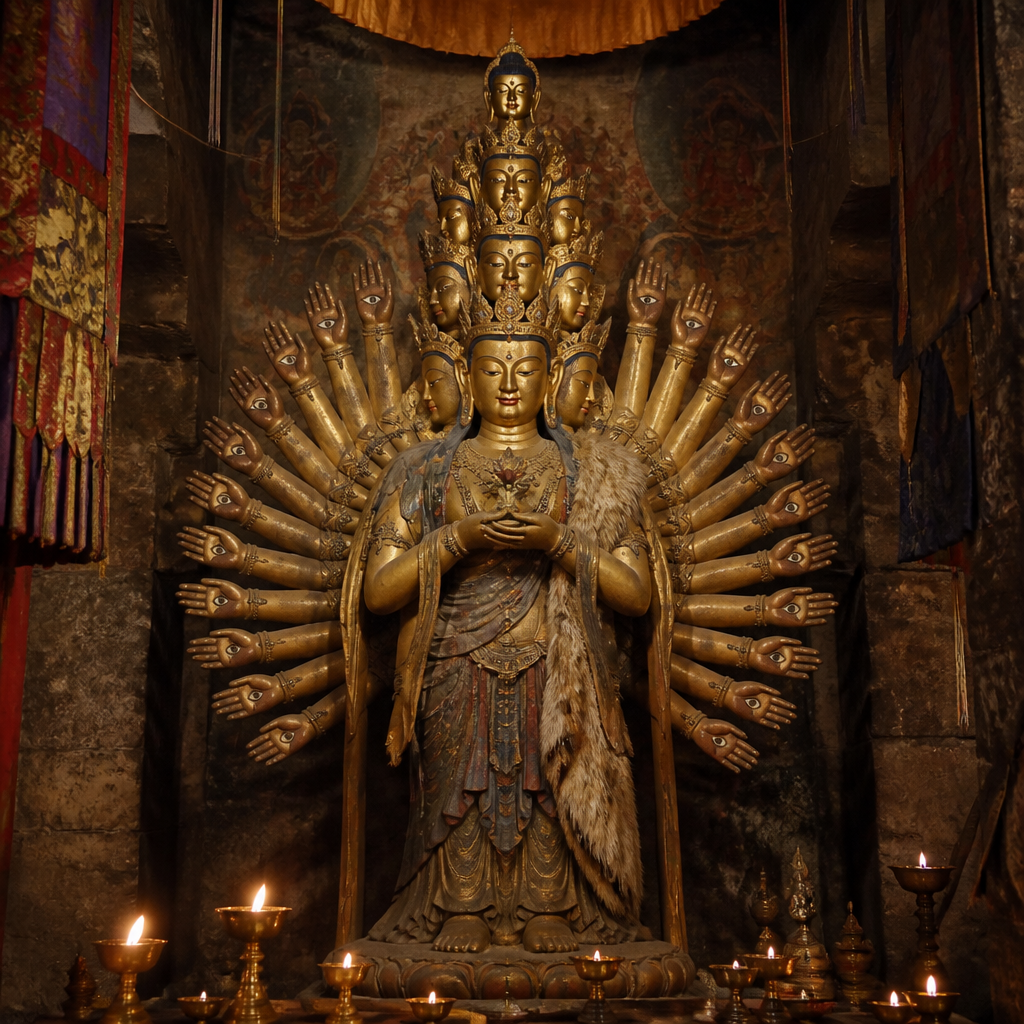
Avalokiteśvara
Region/Culture: Mahayana Buddhist; originating in India and spread across Tibet, China, Japan, Korea, Vietnam, and Southeast Asia
Mythos: Buddhist Mythology
Primary Type/Nature: Gods and Deities (a bodhisattva, an enlightened being who postpones buddhahood)
Mythical Attributes: The bodhisattva of infinite compassion who perceives and responds to the suffering of all sentient beings at once.
Role in Mythos: He vows to free every being from the cycle of birth and death before accepting his own buddhahood, descending even into the hells to relieve the condemned.
Relation to Humans: Anyone who calls his name is said to be heard and helped, and he takes whatever form a given person needs in order to reach them. He guides the dying toward Amitabha’s Pure Land and is petitioned for rescue, mercy, and, in his East Asian form, for children.
The floor of the lowest hell is molten iron, and the air there tastes of hot metal and ash. Into that place walks a figure who does not belong, calm among the burning, and from the tips of his many fingers a fine water falls, hissing where it strikes the glowing ground. The flames sink. The condemned look up. This is the work he chose over his own peace, and he has been doing it, by his own vow, for longer than the world remembers.
Avalokiteśvara is the bodhisattva of compassion, the most beloved figure in Mahayana Buddhism and arguably the most widely worshipped being in all of Asia. His name resists a single translation. It has been read as “the lord who looks down,” as “the lord who looks in every direction,” and, most tenderly, as “the one who hears the cries of the world.” All three meanings hold at once. He is the attention that turns toward suffering wherever it sounds.
He is counted as the spiritual son of Amitabha, the Buddha of the Western Pure Land, and in image after image a tiny figure of Amitabha sits in his hair or crown, a reminder of where he comes from. The relationship is more than lineage. It is the hinge of his central story.
According to the tradition, Avalokiteśvara took a vow of staggering scope: he would not rest, would not accept his own buddhahood, until every last being had been freed from the wheel of birth and death. He worked without pause. And then he looked, really looked, at how many remained in torment, at how the numbers never seemed to fall no matter how many he saved. The grief of it broke him. His head split into pieces. Amitabha gathered the fragments and remade them, not as one head but as eleven, stacked so their compassionate gaze could face every direction, with Amitabha’s own face set at the very top. To the rebuilt bodhisattva he gave a thousand arms, each palm opened with an eye, so that seeing and helping might become a single act.
The Kārandavyūha Sūtra, an Indian scripture of around the fourth century, pushes these numbers past counting and gives him a hundred thousand arms and ten million eyes. It is in this text that he descends into the realm of Yama, lord of death, and quenches the fires of the hells with water streaming from his fingers, and it is here that the six syllables most associated with him first enter the written tradition: Oṃ maṇi padme hūṃ. The mantra travels with him everywhere after that, carved into stones, spun in prayer wheels, murmured by people who may know nothing else of doctrine.
A different scripture, the twenty-fifth chapter of the Lotus Sutra, known as the Universal Gate, explains how the help actually arrives. Call his name, the text promises, and he will come: to the man about to be burned, and the fire will not catch; to the sailor swept toward a reef, and the wreck will not happen; to the prisoner at the block, and the blade will break. To reach each person he takes whatever shape will reach them. He appears as a buddha to those ready for a buddha, as a king, a monk, a child, a woman, shifting through more than thirty forms. The promise is plain and almost reckless in its openness. Whoever cries out is heard.
In his older Indian form he is a graceful young man called Padmapani, the lotus-bearer, holding a single open blossom, sometimes draped in the skin of a black antelope across one shoulder. The lotus is the point: a flower that grows clean out of mud, which is exactly what he offers to the worst-off beings. The more elaborate images are harder to forget. Eleven faces rising in tiers, most of them serene, one or two wrathful for the beings that only fear will move, and behind the figure a great fan of arms, each hand precise, each palm watching.
Nowhere is he held closer than in Tibet, where he is Chenrezig and the patron of the entire land. The Dalai Lamas are understood to be his emanations, born again and again to keep his work going through a single lineage of bodies. The country’s holiest palace, the Potala in Lhasa, takes its name from Mount Potalaka, the mountain paradise where he was said to dwell. The goddess Tara is said to have been born from one of his tears, shed when his compassion overflowed. Even his grief is generative.
Carried east, he changed in a way few deities ever do. In China, beginning around the tenth century, the male bodhisattva slowly became female, emerging as Guanyin, the goddess of mercy, a white-robed figure prayed to for children and for safe childbirth. Early Chinese images are unmistakably male, some later ones ambiguous, a largely feminine figure carrying the faint shadow of a moustache, before the transformation settled and Guanyin became one of the most loved deities in East Asia. She is Kannon in Japan and Quán Âm in Vietnam, the same compassion wearing a face each culture could love.
What he can do follows from what he is. He hears every cry, all at once and without exhaustion, and answers in the form best suited to the hearer. He passes into the hells and cools them. He guides the dying toward Amitabha’s Pure Land. He divides himself into thousands of helping hands and tens of thousands of watching eyes, and he gives away even his tears as protectors.
His limits are the strange kind that belong only to the very powerful. He could have become a Buddha. He refused, and keeps refusing, because accepting that peace would mean leaving the work unfinished. His help, vast as it is, waits on being asked; the Universal Gate turns on a being calling his name. And the head that shattered is not a small detail. It is the honest center of him, the admission that even limitless compassion can be overwhelmed by the sheer volume of the world’s pain, and that the only answer is to be remade and go back in.
Frequently Asked Questions
Who is Avalokiteśvara?
Avalokiteśvara is the Mahayana Buddhist bodhisattva of compassion, regarded as one of the most widely worshipped figures in Asia. A bodhisattva is an enlightened being who delays his own final buddhahood in order to help others, and Avalokiteśvara has vowed to free every sentient being from the cycle of suffering before he accepts that peace. He is considered the spiritual son of the Buddha Amitabha, who is often shown as a small figure in his crown.
What does the name Avalokiteśvara mean?
The name Avalokiteśvara has been translated several ways, most commonly as “the lord who looks down,” “the lord who looks in every direction,” and “the one who hears the cries of the world.” All of these point to the same idea: a being whose attention is permanently turned toward suffering. The variety of readings reflects how central the act of perceiving and answering pain is to his identity.
Why does Avalokiteśvara have eleven heads and a thousand arms?
According to tradition, Avalokiteśvara was so overwhelmed by the suffering he saw that his head shattered into pieces. The Buddha Amitabha reassembled the fragments into eleven heads so the bodhisattva could see in all directions, and gave him a thousand arms, each palm marked with an eye, so that perceiving suffering and relieving it would become a single act. The forms are symbolic of his limitless capacity to notice and respond to the cries of all beings.
Is Avalokiteśvara the same as Guanyin?
Yes. Guanyin, the East Asian goddess of mercy, is the same figure as the Indian bodhisattva Avalokiteśvara. Beginning around the tenth century in China, the originally male bodhisattva gradually came to be depicted as female, becoming the white-robed Guanyin who is prayed to for mercy and for children. The same being is known as Chenrezig in Tibet, Kannon in Japan, and Quán Âm in Vietnam.
What mantra is associated with Avalokiteśvara?
The mantra most closely associated with Avalokiteśvara is Oṃ maṇi padme hūṃ, which first appears in the Kārandavyūha Sūtra alongside his praises. It is carved into stones, spun in prayer wheels, and recited throughout the Tibetan Buddhist world, where Avalokiteśvara is the patron deity. The mantra functions as a direct invocation of his compassion.
Related Entries
Amitabha, Guan Yin, Tara, Manjushri, Vajrapani, Maitreya, Bodhisattvas, Buddha, Yama