
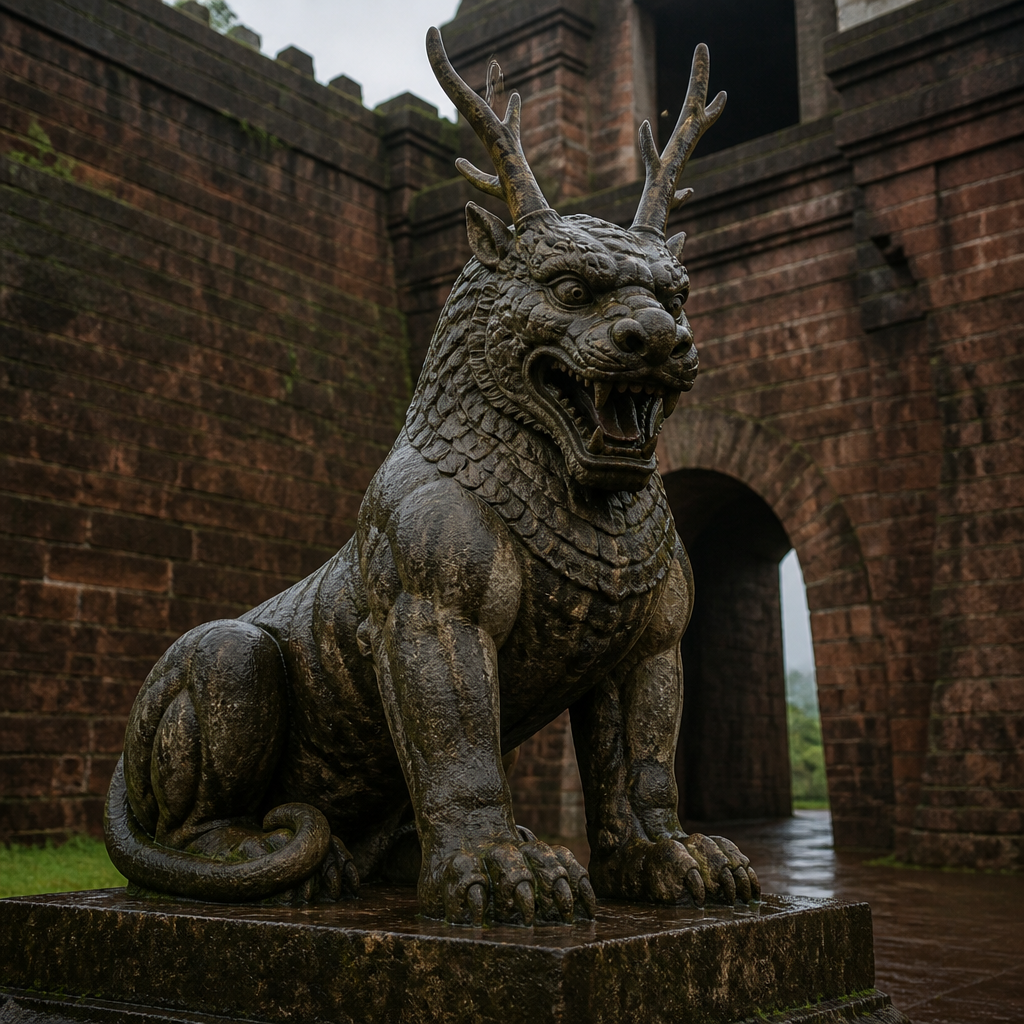
Kangla Sha
Also Known As: Kanglā shā; Kangla Sa, Kanglasha; earlier Nongsha, “heavenly beast”
Region/Culture: South Asia
Mythos: Meitei Mythology
Primary Type/Nature: Monsters and Beasts
Mythical Attributes: It stands at the threshold of the royal citadel and turns malevolent forces back the way they came.
Role in Mythos: It is the guardian beast of the Meitei kings of the Ningthouja line, stationed in pairs before the Uttra at the heart of the Kangla fort.
Relation to Humans: Manipuris treat the beast as a living presence rather than a monument: winners of traditional races are not confirmed until they have touched it, and in 2021 the state removed iron rods from its jaws because the beast was held to be in pain and its pain to be falling on the people. Its destruction by foreign armies in 1819 and 1891 is felt as an injury done to Manipur itself.
In July 1891 British gunners wheeled artillery into position inside a captured fort in Imphal and levelled it at two brick animals. The beasts stood eighteen feet high on either side of the way to the citadel, whitewashed, crouched back on their haunches with their forelegs braced straight as posts, tails curling up towards their spines, mouths open. They had been standing there for forty-seven years. It took only a few rounds to bring them down, and the noise of it went out across the moats and over the whole of the Kangla.
The Meiteis of Manipur called them Nongsha, heavenly beasts. Outsiders reaching for a word have tried lion, leogryph and dragon, and none of the three quite lands. The body is a lion’s: deep chest, heavy shoulders, thick forelegs. The head is not. It is long and reptilian, the jaws hinged open in a permanent snarl, and from the skull rise two horns that fork partway up their length. Those horns are the local signature, and they belong to no Chinese or Burmese guardian beast. They are the antlers of the sangai, the brow-antlered deer that picks its way across the floating reed islands of Loktak Lake and lives nowhere else on earth. Somebody looked at the deer, then looked at the imported monster, and made the monster Manipuri.
The importation is worth being plain about. The first pair went up in 1804, raised by Maharaja Chourjit in front of the Uttra, the innermost hall of the Kangla, where the Ningthouja kings were crowned and where the dynasty traced its line back to Pakhangba. They were an adaptation of the chinthe, the guardian beasts that sit at the foot of Burmese pagoda stairs. Manipur and Burma had been tangled together for generations by then through marriage, tribute, hostage princes and war, and the borrowing was the sort a small kingdom makes when it wants to be looked at like a large one. The court at Ava noticed. Gilded palaces, tiered roofs, royal emblems: the kings of Manipur were dressing above their station. In 1819 the Burmese came, wrecked the Kangla and held the valley for seven years, a stretch the Meiteis still call Chahi Taret Khuntakpa, the Seven Years Devastation. Nobody knows what became of the first pair of beasts.
The second pair belonged to Narasingh. The court chronicle records that the work started on 2 June 1844, on the old foundations, and that on 24 July the king inaugurated the finished statues and dedicated them to the royal deity. Brick, plaster, whitewash, eighteen feet tall. They faced west, towards the main gate, watching whatever came in.
An old saying in Manipur held that one day the heads of white men would fall in front of the beasts. In the spring of 1891 the saying came true in a manner nobody was glad of afterwards. Five British officials, seized during the crisis at the palace, were tried and executed on the ground before the leogryphs, and their blood was smeared across the statues’ open mouths. The British army came, the Manipuris lost, and by April the Kangla was occupied. In July General Collett gave the order and the guns did the rest, though the accounts disagree about the exact day. The intention is not in dispute. The beasts were not a military target. They were a meaning, and the meaning was blown apart deliberately.
For the next century the fort belonged to someone else. It was a British reserve until 1947, then a paramilitary camp, closed to the people whose kings had been crowned inside it, until public agitation won the Kangla back in 2004. Replicas went up on the original foundations in 2006 and 2007, modelled from photographs printed in old colonial books because there was nothing else left to copy. They were built with four kinds of brick salvaged from the ruins of the old palace at Canchipur, and each one weighs thirty-six and a half tonnes. Before the final carving, the sculptor B. Mohendro Sharma set mud prototypes out in public and asked Manipur what it thought. In 2008 a film crew blew those prototypes up with crackers to restage the destruction of 1891, and a crowd came to watch a thing already lost being lost a second time.
None of this has made the beast into furniture. In the traditional races, the winner is not the winner until he has climbed up and laid a hand on the Kangla Sha, and that touch on hot brick in the flat afternoon light is what closes the result. In June 2021, after rites performed by the amaibas and amaibis, the priests and priestesses of the Sanamahi religion, the government removed the kaba khanba, the rods that had been fitted between the statues’ jaws. The reason given was that the rods hurt the beast, and that its pain was being paid for by the people of Manipur. Now, it was said, the Kangla Sha could close its mouth, speak and swallow. Others insisted the rods were structural and said so at volume. A retired civil servant wrote that the whole business showed how little the self-appointed experts knew of their own tradition, and copies of the newspaper that printed him were burned in the street.
What the beast does is territorial and uncomplicated. It sits at the threshold and turns malevolence back. Its authority is positional rather than personal: it is the king’s beast, the king’s power is the Kangla, and the beast’s power is that it is standing there. Behind it in the older stratum of Sanamahi belief stands Nongshaba, the lion god, a maker of light and a king among the gods, whose name the heavenly beasts carry inside their own. The name Kangla Sha, beast of the Kangla, is younger than the statues; it settled on them only after 1891, once the fort had been taken and the loss needed something to be called.
The weakness follows from all of it and needs no inventing. The Kangla Sha is made of brick. It cannot leave the ground it guards, it cannot pursue anything, and it has never once survived a war. Burmese soldiers took down the first pair. British artillery took down the second. The third pair stands on the foundations of both, in a fort that had to be asked for back, and its entire claim is that it is standing there again.
Frequently Asked Questions
What is the Kangla Sha?
The Kangla Sha is a guardian beast of Meitei mythology in Manipur, with the body of a lion and a long two-horned dragon-like head. Statues of it stand in pairs before the Uttra, the inner citadel of the Kangla fort in Imphal, where they guard the seat of the Meitei kings. It has been the state emblem of Manipur since 1980.
Why does the Kangla Sha have horns?
The two forked horns of the Kangla Sha are taken from the antlers of the sangai, the brow-antlered deer found only in Manipur and now the state animal. They distinguish the Kangla Sha from the East and Southeast Asian guardian beasts it was adapted from, and are the clearest mark of its Manipuri identity.
Where does the Kangla Sha come from?
The first pair of statues was raised in 1804 by Maharaja Chourjit, adapted from the Burmese chinthe, the guardian beasts that stand at the entrances of Burmese pagodas. The Meiteis called them Nongsha, meaning heavenly beasts, and the name Kangla Sha came into use only after the Anglo-Manipuri War of 1891. Behind the statues lies Nongshaba, the lion god of the Sanamahi religion.
What happened to the Kangla Sha statues?
They have been destroyed twice. The 1804 pair was lost when the Burmese overran Manipur in 1819, and the pair rebuilt by Maharaja Narasingh in 1844 was blown apart by British artillery in 1891 after the Anglo-Manipuri War. The statues standing today are replicas built in 2006 and 2007, each weighing 36.5 tonnes.
Why were rods removed from the Kangla Sha’s mouth in 2021?
Iron rods known as the kaba khanba had been fitted between the jaws of the statues, and in June 2021 the Government of Manipur removed them after rituals performed by Sanamahi priests and priestesses, on the belief that the rods were causing the beast pain and bringing misfortune on the people. The decision was publicly contested, with critics arguing the rods were structural supports.
Related Entries
Pakhangba, Poubi Lai, Keibu Keioiba, Lainingthou Sanamahi, Leimarel Sidabi, Uchek Langmeidong, Helloi, Chinthe, Komainu, Shisa, Qilin, Haetae, Yali, Makara, Lamassu