
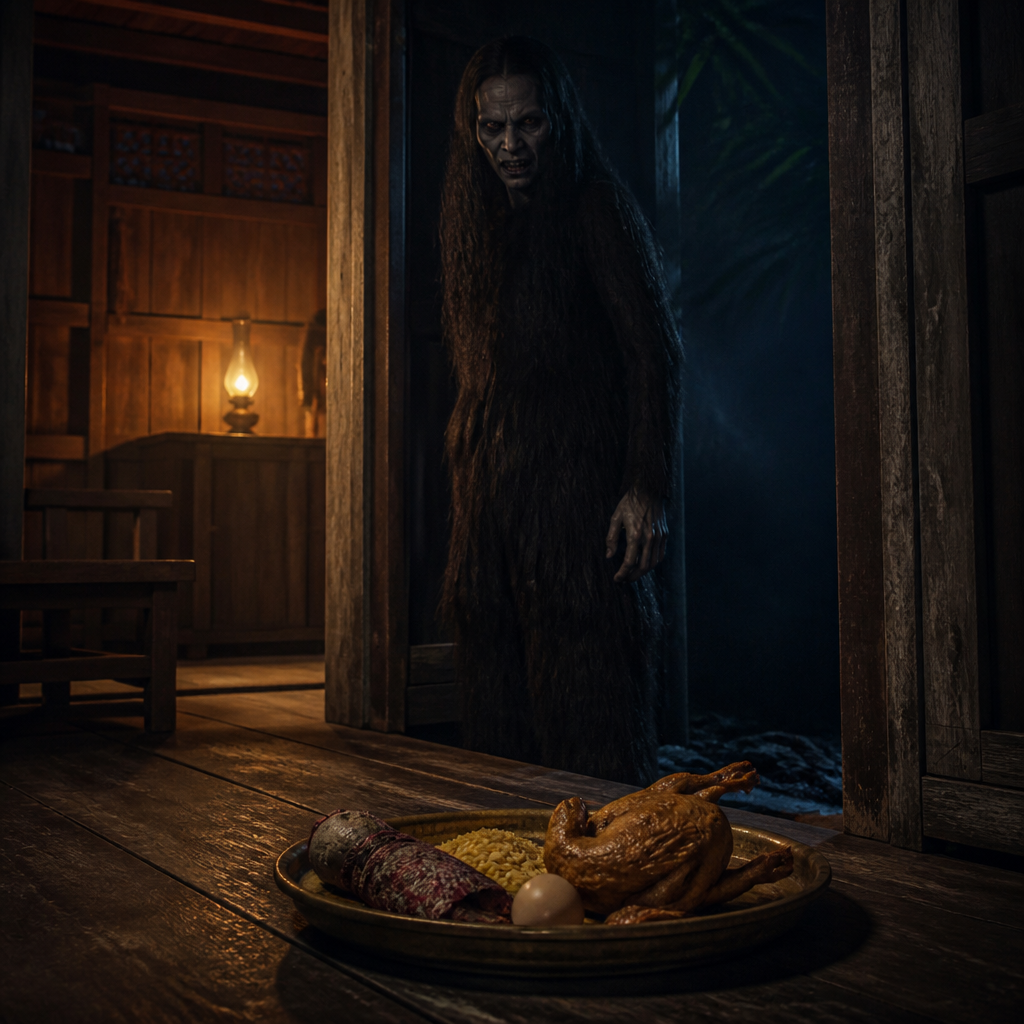
Hantu Raya
Also Known As: Malay hantu, “spirit” or “ghost”, and raya, “great”; the Great Hantu
Region/Culture: Southeast Asia
Mythos: Malaysian Mythology
Primary Type/Nature: Demons and Devils
Mythical Attributes: The most powerful of the Malay hantu, it changes shape at will, bends trees that are found whole in the morning, and belongs to whichever human agrees to feed it.
Role in Mythos: It is the great kept spirit of Malay belief, a familiar that a man takes on for strength and advantage and must then keep fed for the rest of his life.
Relation to Humans: A person who takes a hantu raya gains a servant with more strength than any man and acquires a hunger that must be answered on time, every time. Everyone else in the village becomes a potential meal, since a neglected hantu raya goes into the body of a sick neighbour and screams through their mouth that it is starving.
Alor Setar, at dusk, some evening in 1914. A young woman is sitting on the rungs of the house-ladder when she notices a man standing outside the corner of the compound, looking in at her. He is about ten feet tall. She runs for the front door and finds it locked, then turns and runs for the side porch fifty feet away, and as she runs she glances right and sees him striding along the fence, keeping pace with her, unhurried. She goes up the eight-foot ladder in two leaps. When she looks out through the shutter, the fence is empty.
The story comes down through her son, and he was careful about one detail. The thing does not vanish into thin air, because the air is never thin where it is standing. It takes up room. The skin on the back of your neck knows before you do.
Hantu is the Malay word for a spirit, and raya means great. The hantu raya is the biggest of them, the one that outranks the rest of the crowded Malay spirit world, and in the villages of Kedah it was never a distant thing. It lived close. There was a middle-aged man a few compounds down who fed and looked after one, and everybody knew it, in the way that everybody in a small place knows which neighbour keeps something in the back room.
That is the whole engine of the belief. A hantu raya is not wandering loose in the jungle by preference. It is kept. A man takes one on, and in exchange for the strength and the advantage it brings him, he agrees to feed it well and feed it regularly. The Malay word for the arrangement is bela hantu, to rear or nurse a spirit, and the phrase orang bela hantu, a person who keeps a demon, is not a compliment. The scholarship of the Malay world files it alongside the pelesit, the bajang and the toyol, the other spirits that men take into service, and Islamic writers on Malay belief place all of them among the jinn: creatures of fire who consent to be useful and are never safe.
It does not hold one shape. It comes as a calico cat, or a stallion, or a boar, or a giant, and it goes as quickly. On a wet midnight in 1943, on a country road outside town, a figure wrapped in white cloth walked out of the nipah palms and fell into step beside a young man, glancing him up and down as it went. He recited an opening line of the Quran three times and the road was empty. When he asked his father why it had not been ten feet tall like the one his mother saw, he was told the obvious thing: it can be a man or an animal, and its size is a decision it makes.
The shapes are not decoration. Hunters in the rubber country died of them. A hantu raya would take the form of a wild boar and place itself carefully in the line between two men waiting on opposite sides of a drive, and when the shot came, it went through the space where a boar had been and into a friend. And when a master finally died, the corpse would not settle. It would sit up on the mat as if refusing the whole business of dying, and everyone in the room understood exactly whose joke that was.
The hunger is the point of the story. A hantu raya that is not fed on time does not sulk. It goes wild, and it enters the body of somebody sick and weak nearby and works the mouth like a puppet, and what comes out is one sentence, over and over. Saya lapar. Saya lapar. I am hungry.
Then somebody sends for a bomoh. In one house in Kedah, a ten-year-old girl threw the breakfast plates across the room, and when her father caught her in a bear hug she broke his grip and put him on the floor. The bomoh they fetched was a very dark middle-aged man with unblinking eyes, and he never took them off her. He folded a betel leaf smeared with lime around chunks of areca nut, put it in his mouth, and chewed until his cheeks bulged and the juice ran red at both corners. Then he sprayed it over her, head to foot. The stiffness went out of her body, her head sagged, and she was a child again, sticky and mild. Whether it was the spirit leaving or the smell of the spray is a question the family enjoyed for years afterwards.
Its powers all follow from the same root. It is strong enough to bend trees over in the dark and leave them standing in the morning. It is not fixed to a body, so it can wear a boar or a cat or a man, and it can wear the man who owns it, which is the trick everyone remembers. It can enter a person and hold them. It kills at a distance, by fright and by fever, and the deaths people blamed on it were the ordinary deaths of the kampong: a man who met something in the jungle at night, went home grey, burned all night with a fever nobody could bring down, and was gone by sunrise.
The weaknesses are just as plain. It answers to whoever feeds it, which means it is always subordinate to an appetite it cannot satisfy on its own. It can be driven off by scripture, and a few words of the Quran, said with conviction, are enough to empty a road. It can be argued out of a body by a bomoh who knows the work. And it can be exploited by its own keeper, which was the ugliest discovery in the whole tradition: a man in Alor Setar named Anwar Yahya, who kept a hantu raya and sent it out to possess his neighbours, then arrived in the character of the healer and cured them for a fat fee. He was very good at it. He should have been. He knew exactly what was wrong with them.
Frequently Asked Questions
What is the Hantu Raya?
The Hantu Raya is the greatest of the hantu, the spirits of Malay belief, and it is a familiar: a spirit kept and fed by a human master in exchange for strength and advantage. Its name means “great spirit” in Malay. It is grouped with the other kept spirits of Malay tradition, the pelesit, the bajang and the toyol, and Islamic writing on Malay belief classes all of them as jinn.
What does the Hantu Raya look like?
No account gives the Hantu Raya a body of its own, because it appears in borrowed shapes. Witnesses in Kedah described a man about ten feet tall standing at a fence, a figure wrapped in white cloth walking beside a traveller at night, a calico cat, a stallion, and a wild boar. It is also said to take the exact appearance of the master who keeps it.
What happens if a Hantu Raya is not fed?
A neglected Hantu Raya turns violent and possesses a sick or weak person near its master, forcing them to cry out “Saya lapar”, meaning “I am hungry”. The possessed can become abnormally strong and destructive, and the household must call in a bomoh, a Malay shaman, to drive the spirit out.
How do you get rid of a Hantu Raya?
Reciting verses of the Quran is said to make it disappear on the spot, and this is what people on lonely roads in Kedah reported doing. Where it has entered a body, a bomoh performs the exorcism, in one recorded case by chewing betel leaf and areca nut and spraying the red juice over the possessed person from head to foot.
Is the Hantu Raya evil?
The Hantu Raya is dangerous rather than simply evil, and the danger usually starts with a human decision. It is blamed for hunting accidents, sudden fatal fevers and corpses that will not lie still, but it acts through the bargain a master has made with it, and Malays reserve a hard phrase, orang bela hantu, for the person who keeps one.
Related Entries
Hantu, Hantu Air, Pelesit, Polong, Toyol, Pontianak, Penanggalan, Orang Bunian, Orang Minyak, Harimau Jadian, Jenglot, Djinn, Leyak, Krasue, Aswang