Aztec Mythology: The Complete Guide to Blood Debt, the Five Suns, and the Smoking Mirror
The Aztecs believed the sun was dying. Not metaphorically — literally, every single day, the sun god Tonatiuh waged a losing battle against darkness, and only human blood could keep him moving across the sky. This is the single fact that unlocks everything else about Aztec mythology: the mass sacrifices, the flower wars fought specifically to capture prisoners, the obsidian blades, the priests in flayed human skins. To the modern eye it reads as cruelty. To the Aztecs it was cosmic maintenance — the repayment of a debt the gods had incurred at the moment of creation, when they threw themselves into a fire so that the world could exist at all.
That logic of debt and repayment runs deeper here than in almost any other mythology. Where the Greeks gave their gods human appetites and the Norse gave theirs a doomed nobility, the Aztecs built a theology of reciprocity so total that the universe itself was understood as a transaction perpetually coming due. The gods bled to make humans; humans bleed to feed the gods; the sun rises for one more day. Nothing is free.
Most of what survives comes from a narrow and complicated set of sources. The Spanish burned the great libraries of Tenochtitlan in the 1520s, so the richest record is the Florentine Codex, compiled between roughly 1540 and 1585 by the Franciscan friar Bernardino de Sahagún working with Nahua elders who still remembered the old religion. A handful of pre-conquest pictorial manuscripts survived, most importantly the Codex Borgia, a screenfold of ritual calendars and cosmic forces. Everything below is filtered through that lens — a conquered people describing their faith to the priests of the empire that destroyed it.
What Makes Aztec Mythology Different
The universe is a debt, and blood is the currency. Aztec religion is built on the principle of nextlahualiztli — payment, restitution. The gods sacrificed themselves to set the Fifth Sun in motion, so humanity owes a perpetual debt of blood in return. This is not sadism; it is bookkeeping on a cosmic scale. Once you accept the premise, the entire sacrificial apparatus of the empire becomes terrifyingly rational.
Creation already failed four times. Most mythologies have one creation. The Aztecs had five, and four of them were catastrophic dead ends — worlds destroyed by jaguars, hurricanes, fire, and flood. The current world, the Fifth Sun, is explicitly temporary and is prophesied to end in earthquakes. The Aztecs did not believe they lived in a stable cosmos. They believed they lived in the fifth draft, and that it too would be torn apart.
The same god is creator and destroyer, brother and enemy. Aztec deities are not fixed personalities so much as bundles of force that split, merge, and swap masks. Quetzalcoatl and Tezcatlipoca are rivals who tear each other’s worlds apart — and also partners who together lift the sky off the earth. A single deity can appear in four color-coded versions at the four directions. Identity here is fluid in a way that frustrates anyone hoping for a tidy family tree.
Death is a journey, not a judgment. Where you went after death had nothing to do with how you behaved and everything to do with how you died. Drown, and you went to a watery paradise. Die in battle or sacrifice, and you escorted the sun. Die of ordinary old age, and you faced a grueling four-year trek through nine layers of the underworld. Morality simply was not the sorting mechanism.
The skin of the dead is the promise of spring. The flayed god Xipe Totec wears the peeled skin of a sacrificial victim the way the dead seed wears the new green shoot. This is the most visceral agricultural metaphor in world religion: rebirth depicted not as a flower or a phoenix but as a priest dancing in another man’s skin until it rots away to reveal fresh flesh beneath.
The Major Gods
Aztec deities cluster into overlapping spheres — the great cosmic dualities, the gods of rain and fertility, and the deities of death and transgression. No clean hierarchy exists; even the supreme creator pair, Ometecuhtli and Omecihuatl, sit so far above daily worship that they had almost no cult.
The Cosmic Powers
Tezcatlipoca — “Smoking Mirror,” god of night, sorcery, fate, and rivalry. The most feared and arguably most powerful deity in the pantheon, he sees everything in his obsidian mirror and tests men cruelly. He lost a foot to the earth monster in the act of creation, which is why he is shown with a smoking mirror where his foot should be.
Quetzalcoatl — the Feathered Serpent, god of wind, wisdom, the morning star, and the priesthood. The civilizing deity who gave humanity maize, the calendar, and learning, and who in his Toltec legend opposed human sacrifice. His name fuses quetzal (the resplendent emerald bird) with coatl (serpent): a creature of both sky and earth.
Feathered Serpent — the older, pan-Mesoamerican creation aspect of the serpent deity, worshipped from Teotihuacan to the Maya as Kukulkan. Where Quetzalcoatl is the named Aztec god, the Feathered Serpent is the primordial cosmic principle from which he descends.
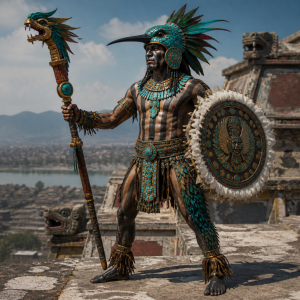
Huitzilopochtli — “Hummingbird of the South,” god of the sun and war, and the patron deity of the Mexica themselves. Born fully armed to defend his mother, he is the divine engine of Aztec imperialism, demanding the captives whose blood kept the sun alive. The Templo Mayor’s twin summit was half his.
Xiuhtecuhtli — the old fire god, “Turquoise Lord,” who burns at the center of the cosmos and at the hearth of every home. As the still point around which the four directions turn, he is one of the most ancient deities in all of Mesoamerica.
Rain, Earth, and Fertility
Tlaloc — the goggle-eyed god of rain, lightning, and agriculture, and one of the oldest gods in the region. He shared the very summit of the Templo Mayor with Huitzilopochtli, a measure of how completely Aztec life depended on his rains. Those he killed — by drowning, lightning, or water-borne disease — went not to the underworld but to his green paradise, Tlalocan.
Cōātlīcue — “She of the Serpent Skirt,” the earth-mother goddess who gave birth to the moon, the stars, and the sun-god Huitzilopochtli. Her colossal statue, with its skirt of writhing snakes and necklace of hands and hearts, is at once monstrous and maternal — the devouring earth that produces all life and reclaims it.
Xochiquetzal — “Flower Quetzal-Feather,” goddess of beauty, love, flowers, weaving, and sexual pleasure, eternally young and accompanied by butterflies and birds. She is the bright counterweight to the grimmer deities, the patron of artisans and lovers.
Tlazolteotl — “Eater of Filth,” the extraordinary goddess who consumed human sin and moral pollution, purifying the confessor by literally devouring his transgressions. She presided over both lust and its cleansing — a single deity governing the crime and the absolution.
Xelhua — a giant of the post-flood world, credited in some traditions with building the great pyramid of Cholula in an effort to reach the heavens, a Mesoamerican echo of the Babel motif.
The Deities of Death and Transgression
Xipe Totec — “Our Lord the Flayed One,” god of agricultural renewal, springtime, goldsmiths, and disease. His priests wore the flayed skins of victims for twenty days during the festival of Tlacaxipehualiztli, embodying the seed that must rot for the new plant to grow.
Xolotl — the dog-headed god of lightning, twins, monstrosities, and the evening star, and the twin brother of Quetzalcoatl. He guides the dead through the perils of the underworld and once descended to Mictlan himself to help recover the bones of humanity. The axolotl salamander bears his name.
Itzpapalotl — “Obsidian Butterfly,” a skeletal warrior-goddess with wings tipped in obsidian blades who rules the paradise of Tamoanchan and reigns as queen of the star-demons. She devours souls during solar eclipses and shelters the spirits of dead infants.
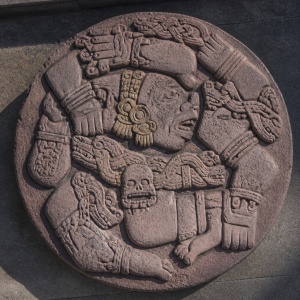
Coyolxauhqui — “Bells on Her Cheeks,” the moon goddess dismembered by her brother Huitzilopochtli at the moment of his birth. The enormous stone disk depicting her broken, decapitated body lay at the foot of the Templo Mayor, where sacrificial victims’ bodies were thrown to land upon her.
Tzitzimitl — one of the Tzitzimimeh, the terrifying star-demon goddesses who threaten to descend and devour all humanity if the sun ever fails to rise — the personified dread that made every eclipse and every end of a 52-year calendar cycle a moment of cosmic terror.
Ilamatecuhtli — “Old Princess,” an ancient earth and death goddess associated with the dying year and the winter harvest, an aged aspect of the maternal-devouring earth.
Creatures, Monsters & Supernatural Beings
Aztec monsters tend to be either cosmic-scale forces of creation or intimate, predatory horrors that stalk the edges of the village at night. Several survive in Mexican folklore to this day.
Primordial and Cosmic Beings
Cipactli — the primordial sea monster, half crocodile and half fish or toad, from whose torn body Quetzalcoatl and Tezcatlipoca fashioned the earth and sky. It is the raw chaos that had to be killed and dismembered before the world could exist; its appetite for blood is one mythic root of sacrifice.
Xiuhcoatl — the “Fire Serpent,” a weapon of pure solar fire wielded by Huitzilopochtli to slay his sister Coyolxauhqui. More a living lightning-bolt than a beast, it embodies the sun’s destroying ray.
Predators of the Night
Ahuizotl — a dog-sized water beast with a hand on the end of its tail, which it uses to drag swimmers and fishermen to a drowning death, then feasts on their eyes, teeth, and nails. Its victims were considered blessed by Tlaloc — a chilling inversion that made the creature a sacred terror.
Tlahuelpuchi — a cursed shapeshifting witch, doomed from birth, who must drink the blood of infants to survive and can transform into a turkey, buzzard, or glowing ball of light. Belief in the tlahuelpuchi persisted in rural Tlaxcala into the twentieth century.
Cihuateteo — the ghosts of women who died in childbirth, honored as fallen warriors yet feared as malevolent spirits who haunt crossroads at night and steal or deform children. They were the earthly manifestation of the star-demon Tzitzimimeh.
Chaneque — small, mischievous nature spirits who guard wild places, springs, and animals, and who can frighten a person so badly their soul leaves their body. To recover, the victim must perform a ritual to coax the soul back.
Shapeshifters and the Wandering Dead
Nagual — a sorcerer able to transform into an animal — usually a jaguar, puma, or owl — to work harm or travel unseen. The concept fuses the personal animal spirit-companion (the tonal) with the figure of the witch, and remains alive in Mexican folk belief.
La Llorona — “The Weeping Woman,” the wailing ghost who drowned her own children and now roams rivers and lakes at night searching for them. Though her most famous form is colonial, her roots reach back into Aztec omens of a weeping goddess crying out the doom of the empire before the Conquest.
The Central Myths
The Five Suns
In the beginning the dual creator divided into four sons, and these gods made and unmade the world four times. Each age, or “Sun,” was ruled by a different god and ended in disaster: the first sun’s people were devoured by jaguars, the second swept away by hurricanes, the third destroyed by fiery rain, the fourth drowned in a flood that turned people into fish. Each catastrophe was bound up in the endless rivalry between Tezcatlipoca and Quetzalcoatl, who kept knocking one another out of the sky.
To make the Fifth Sun — our own — the gods gathered at Teotihuacan and built a great fire. A god was needed to throw himself in and become the new sun. The proud, wealthy Tecuciztecatl hesitated at the flames four times; the humble, diseased little god Nanahuatzin leapt straight in and rose as the sun. But the new sun would not move. Only when the assembled gods sacrificed themselves, offering their own blood, did Tonatiuh begin his journey across the sky. This is the myth that justifies everything: the sun moves only because the gods died for it, and humanity must keep paying that same price or watch the world go dark.
The Birth of Huitzilopochtli at Coatepec
On the sacred mountain of Coatepec, the earth goddess Cōātlīcue was sweeping when a ball of feathers drifted down and touched her, and she found herself pregnant. Her existing children — the four hundred star-gods and their sister, the moon goddess Coyolxauhqui — were enraged by this shameful pregnancy and resolved to kill their mother. As they stormed the mountain, Huitzilopochtli burst from the womb fully grown and armored, wielding the fire-serpent Xiuhcoatl. He beheaded Coyolxauhqui and hurled her down the slope, her body breaking apart as it fell, and scattered the four hundred stars.
The Aztecs replayed this victory every dawn: the sun (Huitzilopochtli) rises and drives off the moon and stars. Why it matters: the entire Templo Mayor was built as Coatepec in stone, and the great carved disk of the dismembered Coyolxauhqui lay at its base — the bodies of sacrificial victims tumbled down the pyramid steps to land on her, re-enacting the founding violence of the Mexica sun.
Quetzalcoatl, the Smoking Mirror, and the Fall of Tula
In the golden Toltec city of Tula reigned the priest-king Topiltzin Quetzalcoatl, who forbade human sacrifice and offered only butterflies and snakes. His rival Tezcatlipoca plotted his downfall. The trickster god held up his obsidian mirror so that Quetzalcoatl, who had only ever known his own divine serpent form, saw his aged human face — and was filled with shame. Tezcatlipoca then plied him with pulque until, drunk, the holy king broke his vows in a night of disgrace. Humiliated, Quetzalcoatl burned himself on the eastern shore and rose into the sky as the morning star, vowing one day to return from the east.
Why it matters: this myth encodes the real historical collapse of the Toltec world and the eternal tension between civilization and bloodshed. It also carried a fateful charge — when Cortés arrived from the east in 1519, the prophecy of the returning Quetzalcoatl became one of the most consequential stories in the history of the Americas.
The Recovery of Human Bones from Mictlan
After the fourth world drowned, the earth was empty of people. Quetzalcoatl, with his twin Xolotl, descended into Mictlan to recover the bones of the dead so that humanity could be remade. The death lord set him trap after trap, and as Quetzalcoatl fled with the bones he stumbled, shattering them — which is why people today come in different sizes. Back in the paradise of Tamoanchan, the gods ground the bones like maize and the deities bled their own members over the meal to give it life. Why it matters: humans are quite literally made of divine blood mixed with the bones of the dead — the founding image of the debt that sacrifice repays.
The Afterlife and the Nine Layers of Mictlan
The Aztec afterlife was sorted not by virtue but by manner of death — a system found almost nowhere else in world religion. Four broad destinations awaited the dead.
Warriors who died in battle and captives sacrificed on the altar joined the sun’s retinue in the eastern sky, accompanying the sun god Tonatiuh from dawn to noon; after four years they returned as hummingbirds and butterflies. Women who died in childbirth — counted as warriors fallen in the battle of birth — escorted the sun from noon to dusk, and became the dreaded Cihuateteo. Those who drowned, were struck by lightning, or died of water-related disease went to Tlaloc‘s lush paradise of Tlalocan, a place of eternal spring and abundance.
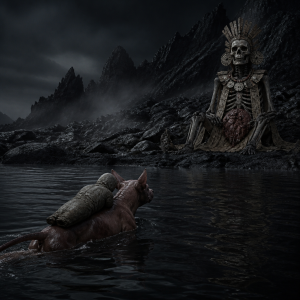
Everyone else — the vast majority who died of ordinary causes — faced Mictlan, the underworld ruled by the skeletal Mictlantecuhtli and his consort Mictecacihuatl. This was no hell of punishment but a grueling four-year journey through nine descending layers. The soul had to cross a river guarded by the dog-god Xolotl (which is why a dog was cremated with the dead), pass between two mountains that crashed together, climb a mountain of obsidian, endure a wind of flesh-cutting knives, ford a river of blood, and survive a place where banners and arrows flew — until at the ninth level the soul finally dissolved into rest. The dead were equipped for this trek with goods, and the living offered them food during the festival that survives today as Día de los Muertos. Crucially, Mictlan was not a verdict but a repayment: having consumed the earth’s resources in life, the dead returned themselves to the earth in death, completing the cycle of reciprocity that governs the whole Aztec cosmos.
How Aztec Mythology Connects to Other Traditions
Aztec religion is the late, imperial flowering of a far older Mesoamerican tradition, and its deepest connections are to its neighbors. The Feathered Serpent is the clearest case: worshipped at Teotihuacan a thousand years before the Aztecs, he appears in Mayan mythology as Kukulkan and among the Quiché as Gukumatz. The rain god Tlaloc has a Maya counterpart in Chaac and a Zapotec one in Cocijo — the goggle-eyed storm deity is pan-Mesoamerican. The flayed god Xipe Totec was honored from the Toltecs to the Maya. Many threads continue forward, too: figures like La Llorona, the Nagual, and the Chaneque live on in modern Mexican mythology and the wider body of Native Mexican mythology.
Beyond Mesoamerica, the comparisons are structural rather than historical. The Five Suns recall the cyclical world-ages of Hindu cosmology and the Norse expectation of Ragnarök far more than the single creation of Genesis. The descent of Quetzalcoatl into Mictlan to retrieve human bones echoes the descent myths of Inanna, Orpheus, and Izanagi — the hero who braves the land of the dead. And the idea of a god who must die so the world can live is a thread that runs from Osiris to the dying-and-rising vegetation gods of the Near East. What is distinctly Aztec is the relentless economic framing: not a single redemptive sacrifice but an unpayable, ongoing debt.
Where to Start Reading
The indispensable primary source is the Florentine Codex (the General History of the Things of New Spain) by Bernardino de Sahagún, available in the Anderson and Dibble English translation — twelve books of Nahua testimony on gods, ritual, and daily life. For the pre-conquest pictorial tradition, the Codex Borgia and the Codex Mendoza reward slow study, and Sahagún can be paired with the Codex Chimalpopoca, which contains the fullest “Legend of the Suns.”
For modern introductions, Miguel León-Portilla’s Aztec Thought and Culture remains the classic on the Nahua intellectual world, while Mary Miller and Karl Taube’s An Illustrated Dictionary of the Gods and Symbols of Ancient Mexico and the Maya is the single most useful reference for sorting out who is who. Inga Clendinnen’s Aztecs: An Interpretation is the most vivid and humane account of how this terrifying theology was actually lived.
Explore Aztec Mythology on Gods and Monsters
Gods and Monsters has 25 Aztec entries, from the great sky-gods to the witches of village folklore. Browse all Aztec Mythology entries →
Huitzilopochtli · Quetzalcoatl · Tezcatlipoca · Tlaloc · Cōātlīcue · Coyolxauhqui · Xipe Totec · Xolotl · Xiuhtecuhtli · Xochiquetzal · Tlazolteotl · Itzpapalotl · Tzitzimitl · Feathered Serpent · Cipactli · Xiuhcoatl · Ahuizotl · Nagual · Tlahuelpuchi · Cihuateteo · Chaneque · La Llorona · Mictlan · Ilamatecuhtli · Xelhua
Frequently Asked Questions
Why did the Aztecs practice human sacrifice?
The Aztecs sacrificed because they believed the gods had sacrificed themselves first. At the creation of the Fifth Sun, the gods threw themselves into a fire and gave their own blood to set the sun in motion, leaving humanity with a debt. Human blood — especially the blood of captured warriors — was the payment that kept the sun god Tonatiuh crossing the sky and held off the end of the world. It was understood as cosmic duty and reciprocity, not cruelty for its own sake, and the patron war-god Huitzilopochtli was its chief beneficiary.
What are the Five Suns in Aztec mythology?
The Five Suns are the five successive ages of the world. The first four worlds were each ruled by a different god and destroyed in turn by jaguars, hurricanes, fiery rain, and a great flood, largely through the rivalry of Quetzalcoatl and Tezcatlipoca. We live in the Fifth Sun, created at Teotihuacan when the humble god Nanahuatzin leapt into a fire to become the sun. It is prophesied to end in catastrophic earthquakes, which is why the Aztecs saw their world as fragile and temporary.
Who is the most important god in Aztec mythology?
There is no single chief god, but three contend for the title. Huitzilopochtli was the patron of the Mexica and god of the sun and war. Tezcatlipoca, the all-seeing “Smoking Mirror,” was the most feared and pervasive. Quetzalcoatl, the Feathered Serpent, was the great civilizing god of wind and wisdom. Above them all sat the remote creator pair Ometecuhtli and Omecihuatl, who were too abstract to receive much worship.
What happens after death in Aztec belief?
Your destination depended on how you died, not how you lived. Warriors and sacrificial victims accompanied the sun; women who died in childbirth became the Cihuateteo and escorted the afternoon sun; those who drowned or were struck by lightning went to Tlaloc‘s paradise of Tlalocan. Everyone else undertook a four-year journey through the nine layers of Mictlan, aided by the dog-god Xolotl, before dissolving into final rest.
Is Quetzalcoatl the same as the Mayan Kukulkan?
They are the same underlying figure — the Feathered Serpent — expressed in different cultures. The Feathered Serpent was worshipped across Mesoamerica for over a thousand years: as Quetzalcoatl among the Aztecs and Toltecs, as Kukulkan among the Yucatec Maya, and as Gukumatz among the Quiché Maya of the Popol Vuh. The shared imagery of a serpent fledged with the green feathers of the quetzal bird unites Mayan mythology with the Aztec tradition. The specific myths and personalities differ from culture to culture.
What is the difference between the Aztec and Maya religions?
Both grew from the same Mesoamerican root and share gods like the Feathered Serpent and the rain deity, but they differ in emphasis. The Maya developed an extraordinarily precise calendar and a written hieroglyphic literature centered on dynastic kingship and the hero-twin myths of the Popol Vuh. The Aztecs, a later imperial culture, foregrounded the cult of the sun, mass human sacrifice on a scale the Maya never matched, and the patron war-god Huitzilopochtli. You can explore the parallels through the Mayan mythology guide.