
Aztlán
Also Known As: also Aztlan; from Nahuatl aztatl, the snowy egret, with the locative -tlan, so “place of the egrets,” commonly rendered in English as “Place of Whiteness”
Region/Culture: Mesoamerica and the Caribbean
Mythos: Aztec Mythology
Primary Type/Nature: Mythological Places
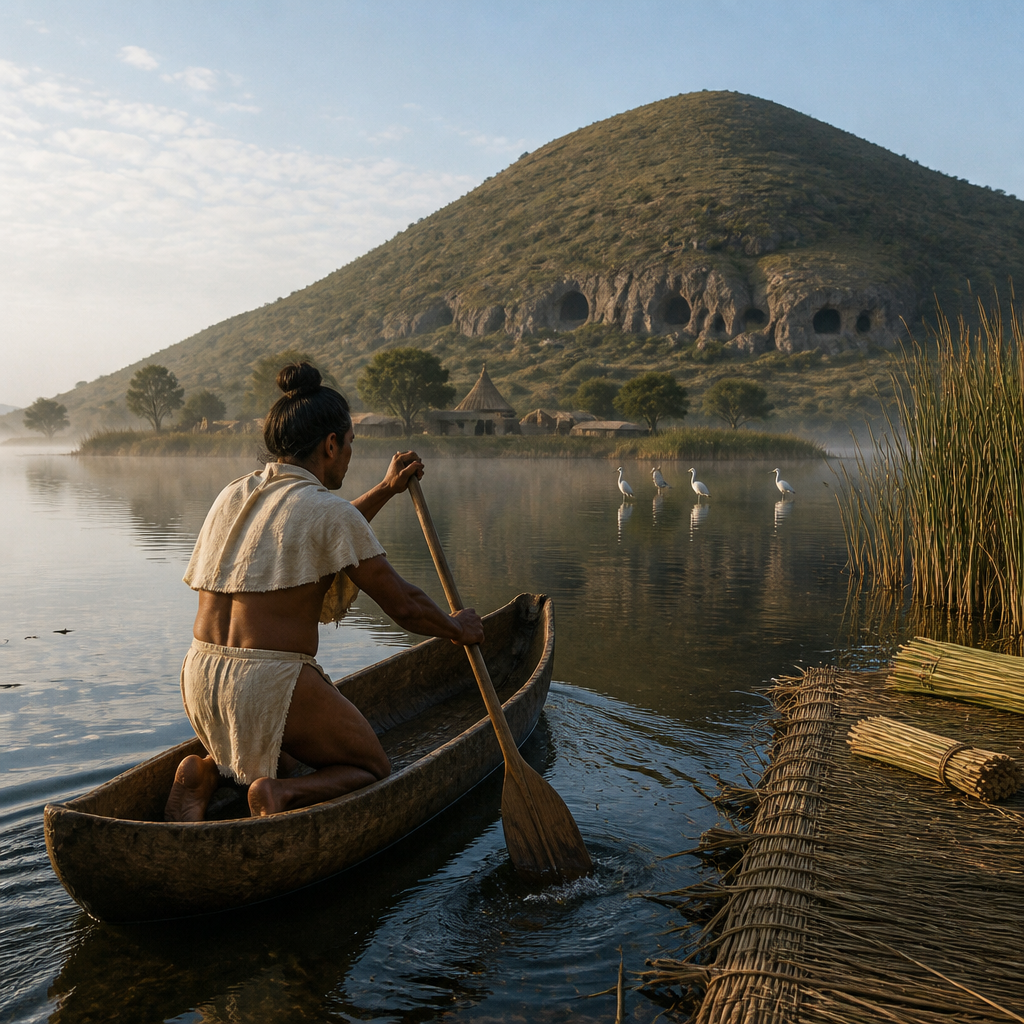
Mythical Attributes: An island in a lake, backed by a curved-topped hill with seven caves at its foot, from which the Mexica and other Nahua peoples date their departure southward.
Role in Mythos: It is the starting point of the migration that ends in the founding of Tenochtitlan, and the source of the name Azteca, which Huitzilopochtli later took away.
Relation to Humans: People leave Aztlán and cannot go back by ordinary means, and the one expedition ever sent to look for it travelled by sorcery and lost a third of its number on the way. Claiming descent from it granted ancestry and political legitimacy to communities across the central Mexican highlands.
On a strip of fig-bark paper five and a half metres long, the first thing a Mexica painter drew was an island. A square of water, a small shrine, a man kneeling in a canoe with the paddle already in the stroke. Everything that follows on that paper is footprints. The island is Aztlán, and it is the only place on the whole scroll that nobody ever comes back to.
The tellings that describe it at all describe somewhere worth staying. Reeds and marsh, fish and waterfowl, egrets standing in the shallows on legs like black stilts, and behind the settlement a hill with a curved top and seven cave mouths at its base. Cristóbal del Castillo, writing in the early sixteenth century, gives the surrounding water a name: Metztliapan, the Lake of the Moon. What no source supplies is an origin. Aztlán is never made, never founded, never raised out of anything. It is simply where the record starts, which is a different kind of beginning from the ones these traditions usually give.
The name itself is built on aztatl. Alonso de Molina’s 1571 Nahuatl vocabulary glosses the word in one syllable of Spanish: garza, heron. Sahagún’s informants were more precise, describing the aztatl as white, very white, long-necked and stringy, with a black pointed bill and very long black stilt-like legs, which identifies it as the snowy egret. Add the locative ending and you have the place of egrets. “Place of Whiteness,” the version that travels furthest in English, is a reading of the bird’s plumage rather than of the word. Either way it is a slightly strange name for a homeland, since it identifies the place by what stands in its shallows rather than by anyone who lives there.
Not every account makes it a paradise. The Codex Aubin says the people there were subject to a tyrannical elite, the Azteca Chicomoztoca, and that a priest led them out. Somewhere on the road afterwards Huitzilopochtli forbade them the name Azteca and told them they were Mexica now. That is the oddest thing the sources do to this place. They make it the origin of the people’s name, and then strip the name off them before they arrive anywhere.
The departure is dated on the paper. In the Codex Boturini the journey runs from 1168 to 1355 on the usual reckoning; the travellers cross to the mainland at Colhuacan, where Huitzilopochtli speaks to them from inside a cave, and eight other peoples ask to come with them. Four god-bearers carry the sacred bundles: Chimalma, Apanecatl, Cuauhcoatl, Tezcacoatl. Then a tree breaks. Five men eat together from one basket, six sit talking and weeping, and by night the Mexica split from the other eight. The first human sacrifices appear on the following folio.
The best story about Aztlán is a story about not getting there. Fray Diego Durán preserved it, and it is the only substantial account of anyone trying. The emperor Motecuhzoma Ilhuicamina sent sixty sorcerers north with baskets of costly offerings, wanting to know whether Huitzilopochtli’s mother was still living. The sorcerers protected themselves with ointment, summoned a demon, were turned into flying beasts, and came down on a curved hill in the middle of a wide lake.
An old man met them there and started up the slope, and the sand was so deep that the sorcerers sank and stalled. What have you been eating and drinking, he asked, that has made you weigh so much. They said they ate the food of their own country and drank chocolate. He told them that would be the death of them, shouldered their bundles, and went on ahead without apparent effort. At the top they found Coatlicue, who had not washed or changed her clothes since her son left, and who was weeping. She refused their expensive gifts. The name of the great emperor Motecuhzoma meant nothing to her whatsoever.
What she gave them instead was a rough cape and a loincloth, and a message: remind Huitzilopochtli of his promise. He had said he was going out to conquer and build an empire, and he had foreseen that he would himself be overthrown, and at that point he would come home to his mother. Two thirds of the sorcerers made it back. On the way down the old guide grew young with every step, then climbed back up ageing as he went, then returned young again, apparently just to show them he could. Motecuhzoma thanked them and had the cape and the loincloth laid before Huitzilopochtli’s altar for the journey home. The empire received its first notice of its own end in the form of folded cloth.
The power of the place is not the kind a landscape usually has. Aztlán manufactures ancestry. To have come out of it, or out of the seven caves of Chicomoztoc, was to hold a pedigree, and communities across the highlands wrote themselves into those migration lists for exactly that reason. Michael Smith counted fifteen separate treatments of the migration theme in the native histories, and the peoples they name are by no means all Mexica. The island works less like a location than like a machine for turning wanderers into somebody’s ancestors.
Its limits are equally sharp. There is no ordinary road back, the food of the empire makes its own sorcerers too heavy to climb the hill, and the mother of the war god does not recognise the emperor’s name. The chronology will not hold still either. The chronicles fix the departure with a year sign, which is a precise instrument, but converting that sign into a Christian year is not. Take the Tlaxcalteca departure, recorded as 5 Tochtli: the four defensible correlations yield 1302, 1250, 1198 and 1146. That is a century and a half of slack inside a date the sources themselves treat as exact.
Nobody has found it. In the 1880s Alfredo Chavero proposed the round island town of Mexcaltitlán in Nayarit, which sits in a lagoon and is suggestive enough to have kept the idea alive; the notion gathered support through the twentieth century without ever acquiring evidence, and Carl Sauer, working the north-west coast in 1932, judged the material culture there pre-Aztec at best. Smith’s position is more careful and more useful: the southward movements did happen, Mesoamerican historical linguistics supports a Nahuatl migration from a northern hearth, and the chronicles preserve genuine sequence and genuine dates. None of which puts a dot on a map.
The homeland got a second life in 1969. On 16 March, at the first National Chicano Youth Liberation Conference in Denver, the poet Alurista presented a preamble to El Plan Espiritual de Aztlán, which placed Aztlán in the American Southwest and claimed it as the spiritual homeland of Chicano people. That is a twentieth-century political act with an author and a date attached, not an inherited tradition, and it has probably done more than any codex to keep the word in circulation in English. The island that once turned migrants into a people was asked to do the same job a second time, eight centuries later, in a different language.
Frequently Asked Questions
What is Aztlán?
Aztlán is the legendary island homeland from which the Mexica and other Nahua peoples say they migrated south into central Mexico. The sources place it in a lake, with a curved-topped hill behind it and seven caves at the hill’s foot. Its name comes from the Nahuatl word for the snowy egret, and the word “Azteca” means people of Aztlán.
Where is Aztlán located?
No one has ever located Aztlán, and the sources place it only vaguely to the north. In the 1880s Alfredo Chavero proposed the island town of Mexcaltitlán in Nayarit, an idea that gained support in the twentieth century without ever being confirmed; the geographer Carl Sauer concluded in 1932 that the archaeology of that coast was pre-Aztec at best. Michael Smith argues that the migrations themselves were real events even though the starting point cannot be pinned to a map.
Why did the Aztecs leave Aztlán?
The accounts differ. The Codex Boturini shows the god Huitzilopochtli ordering the migration and speaking to the travellers from a cave at Colhuacan, where eight other peoples joined them. The Codex Aubin instead says the people were ruled by a tyrannical elite called the Azteca Chicomoztoca and were led out by a priest. In both versions Huitzilopochtli later forbids them the name Azteca and renames them Mexica.
What happened when Motecuhzoma sent sorcerers to find Aztlán?
According to Diego Durán, the emperor Motecuhzoma Ilhuicamina sent sixty sorcerers north with expensive offerings to learn whether Huitzilopochtli’s mother still lived. They summoned a demon, were transformed into flying beasts, and reached a curved hill in a lake, where an old guardian mocked them for being too heavy with rich food and chocolate to climb the sand. At the top they found Coatlicue, unwashed and weeping, who did not know the emperor’s name, refused the gifts, and sent back a rough cape and loincloth along with the warning that Huitzilopochtli would one day be overthrown and return to her. Only two thirds of the sorcerers made it home.
What does the name Aztlán mean?
Aztlán is built from the Nahuatl aztatl, meaning snowy egret or heron, plus the locative ending -tlan, giving “place of the egrets.” Molina’s 1571 dictionary glosses aztatl simply as garza, and Sahagún’s account describes the bird as very white with a black bill and long black legs. The common English rendering “Place of Whiteness” refers to the bird’s plumage rather than to the literal structure of the word.
Related Entries
Huitzilopochtli, Coatlicue, Coyolxauhqui, Mixcoatl, Tezcatlipoca, Quetzalcoatl, Mictlan, Tlaloc, Chalchiuhtlicue, Tonatiuh