
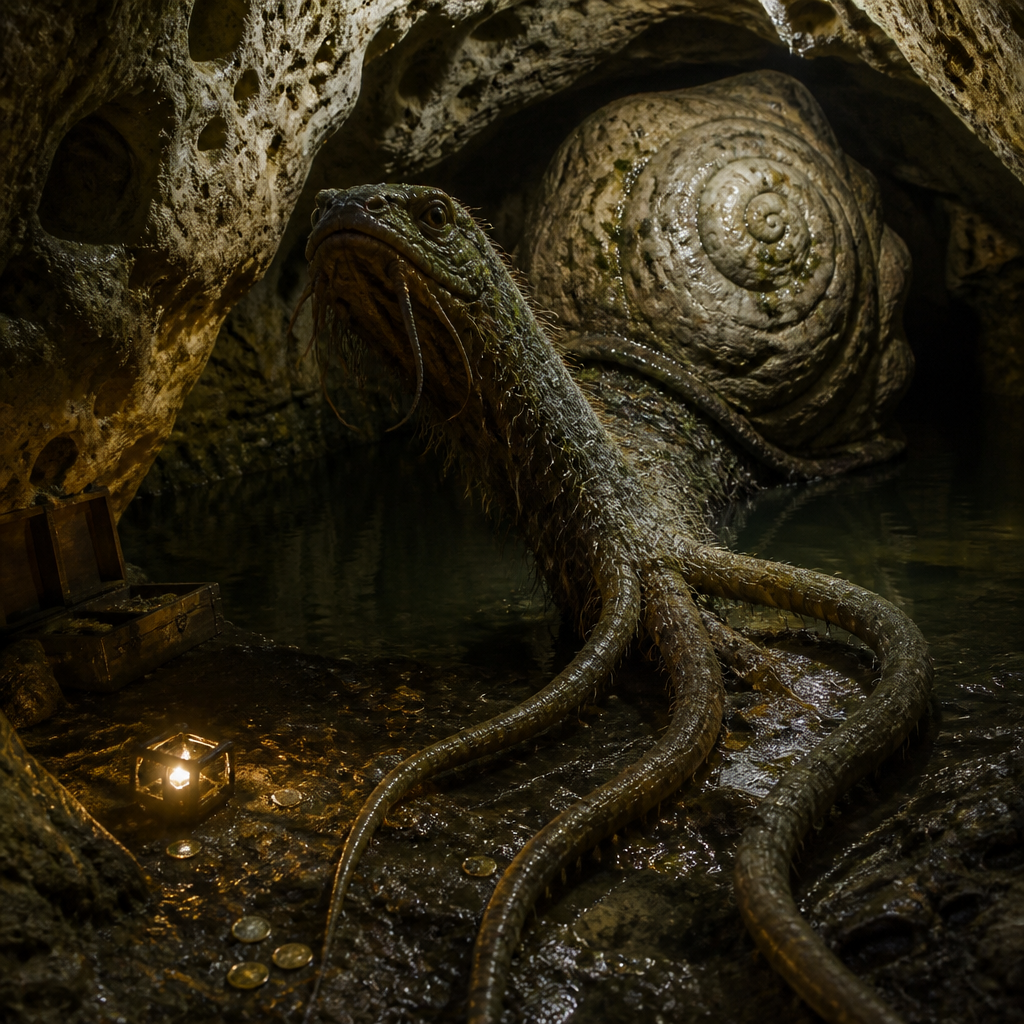
Lou Carcolh (the Carcolh)
Region/Culture: Western Europe (Gascony, Landes, southwestern France)
Mythos: French Mythology
Primary Type/Nature: Monsters and Beasts
Mythical Attributes: It reaches far down cave tunnels with long, hairy, prehensile tentacles to seize anyone who ventures near and draw them back to be swallowed.
Role in Mythos: A guardian-predator of the treasure buried beneath the town of Hastingues, devouring the greedy who come digging for it.
Relation to Humans: It preys on treasure-hunters who descend into the caves under the town, dragging them into its shell to be consumed at leisure. Above ground the people of Hastingues kept its name as an affectionate nickname and a mock warning aimed at wandering young women.
The first sign is the slime. It comes glistening down the tunnel wall before anything else, a wet sheen catching the last of a lantern’s light, and by the time a treasure-hunter notices the smell, cold and mineral and faintly rotten, the thing that left it is already close. Under the town of Hastingues, in the far southwest of France where the Landes flattens toward the Pyrenees, the ground is said to be hollow. Tunnels branch and rejoin beneath the houses like the chambers of a great shell. Somewhere in the dark at the center of them waits the Carcolh.
It is a snail the size of a legend. The body is a serpent, enormous and slick, shaggy in places with coarse hair, and it carries on its back a shell as big as a house. From the front of it uncoil long tentacles, prehensile and hairy, that reach far down the passages ahead of the creature itself. The Carcolh does not hunt the way a wolf hunts. It barely moves at all. It does not need to. Its arms do the walking.
The name is older than any story anyone can pin down, and plainer than it sounds. Carcolh comes from the Spanish caracol, which means, simply, snail. There is a riddle they told in the béarnais country to make the point: a little man who carries his house behind his back, who is he? The snail. Strip away the menace and the word is a child’s puzzle. No text mentions the beast before the twentieth century, which makes it either very new or very well kept, a thing passed by mouth in the villages of the Adour and never written down until it nearly slipped away.
The treasure is the hook that pulls people underground. Before a Spanish invasion, the story goes, the people of Hastingues buried their valuables in the caves beneath the hill, meaning to dig them up when the danger had passed. Some of them never did. The gold stayed down there, and the memory of it stayed up here, and every generation since has produced a few men greedy or desperate enough to go looking. They take a lantern and a length of rope and they climb down into the honeycomb. Most of the time nothing happens. Most of the time they come back empty-handed and a little ashamed. Now and then one of them does not come back at all.
Down in its chamber the Carcolh waits with the patience of something that has never once been hungry enough to worry. A tentacle drifts up a side-passage, testing the air, brushing the walls. When a warm shape blunders into it, the arm closes, unhurried, and begins to draw the catch back toward the shell, where it can be eaten later, at leisure. There is no chase. There is only the slow reeling-in, and the dark, and the smell.
One man is supposed to have seen it and lived. He had gone in after the gold like the others, and somewhere in the tunnels he came upon the Carcolh drinking. He did not stay to learn how a thing that size drinks. He turned and went back the way he had come, faster than he had come in, and when he reached the mouth of his tunnel he stopped and sealed it behind him, stone by stone, and swore on whatever he swore on that he would never go down there again. The story does not say whether he kept the oath. The story is fairly sure he did.
Above ground the Carcolh softened into something almost fond. Hastingues sits on a rounded hill, humped like a shell, and the town wears the monster’s name as a nickname. The men of the place used it to tease the young women, warning them with mock gravity that the carcolh would catch them, the way older relatives everywhere invent a bogey to keep the pretty and the reckless close to home. A house-sized cannibal snail, reduced to a line of flirtation. Folklore does this. It takes the worst thing it can imagine and, given a few centuries, turns it into a joke told at the well.
What the Carcolh has is reach and stillness. Its tentacles extend far beyond its body, so the danger arrives long before the animal does, and its slime announces its whole route to anyone paying attention. It asks nothing of speed. It sits at the heart of its maze and lets the maze deliver.
What it lacks is the same thing. It cannot follow. Bound to its shell and its cavern, the Carcolh is a threat only to those who come to it, and its own advertisement, that shining trail, that reek, is the very thing that lets a careful person read the tunnel and turn back in time. The one who escaped did not outfight it. He simply left, and then made sure the door stayed shut. Against a monster that cannot leave home, the surest defense is to not go looking in the first place.
Frequently Asked Questions
What is Lou Carcolh?
Lou Carcolh is a monster from the folklore of Gascony in southwestern France, described as a giant serpent-snail. It has a huge slimy, hairy serpent’s body, a shell as large as a house on its back, and long prehensile tentacles it uses to catch prey. Its name comes from the Spanish word caracol, meaning snail.
Where does the Carcolh live?
The Carcolh lives deep in a cave beneath the town of Hastingues in the Landes region of southwestern France. The hill under the town is said to be honeycombed with branching tunnels, and the creature sits at the center of them, rarely moving from its chamber.
What does the Carcolh do to people?
The Carcolh preys on people who enter the caves beneath Hastingues, usually treasure-hunters searching for gold the townsfolk buried there long ago. It stretches its long, hairy tentacles down the tunnels, seizes anyone within reach, and drags them back into its shell to be eaten at leisure.
How can you escape the Carcolh?
The best defense against the Carcolh is not to enter its caves at all, since it cannot leave its shell or chase anyone above ground. Its slime trail and foul smell reach far ahead of it, so an alert person can sense it coming and retreat. In legend, the one man who escaped fled back up his tunnel and then sealed the entrance behind him with stones.
Why is the Carcolh linked to the town of Hastingues?
Hastingues sits on a rounded hill shaped like a snail’s shell, and the town took the Carcolh as a nickname. Local men also invoked it playfully, warning young women that “the carcolh will catch you,” turning the cave monster into a figure of village teasing.
Related Entries
Peluda, Tarasque, Gargouille, Drac, Matagot, Dahu, Melusine, Kraken, Knucker, Lindworm, Amphisbaena, Kelpie, Nuckelavee, Bunyip