
Kuyutha
Also Known As: Arabic Kuyuthaʾ; also written Kuyoota, Kuyoothan, Kiyuban and, in English translations of Borges, Kujata; al-Rayann in the Tales of the Prophets of al-Kisaʾi
Region/Culture: West Asia/Middle East
Mythos: Arabic Mythology, Islamic Mythology
Primary Type/Nature: Monsters and Beasts
Mythical Attributes: A bull so vast that thousands of eyes, mouths and feet stand hundreds of years’ journey apart on its body, and whose breathing moves the sea.
Role in Mythos: Kuyutha is one link in the chain of supports beneath the earth in medieval Islamic cosmography, carrying the rock on which the world-bearing angel stands and standing in turn on the great fish Bahamut.
Relation to Humans: Nobody has ever met the bull, yet everybody lives on top of it, and some medieval writers explained the twice-daily rise and fall of the tide as its slow breathing. Many people, according to the same accounts, blamed earthquakes on the bull shifting under its load.
Under the lowest earth, past everything a person could dig to or sail to, a bull is breathing. Twice in each day and night the breath goes out of it, and on the coasts of the world the sea comes in. Twice it draws breath back, and the water runs away from the beach. Fishermen wading out at low tide are standing, in this telling, in the space left by one enormous inhalation.
The bull is Kuyutha, and the medieval Arabic writers who described it were trying to answer a reasonable question. If the earth rests on something, what does that rest on?
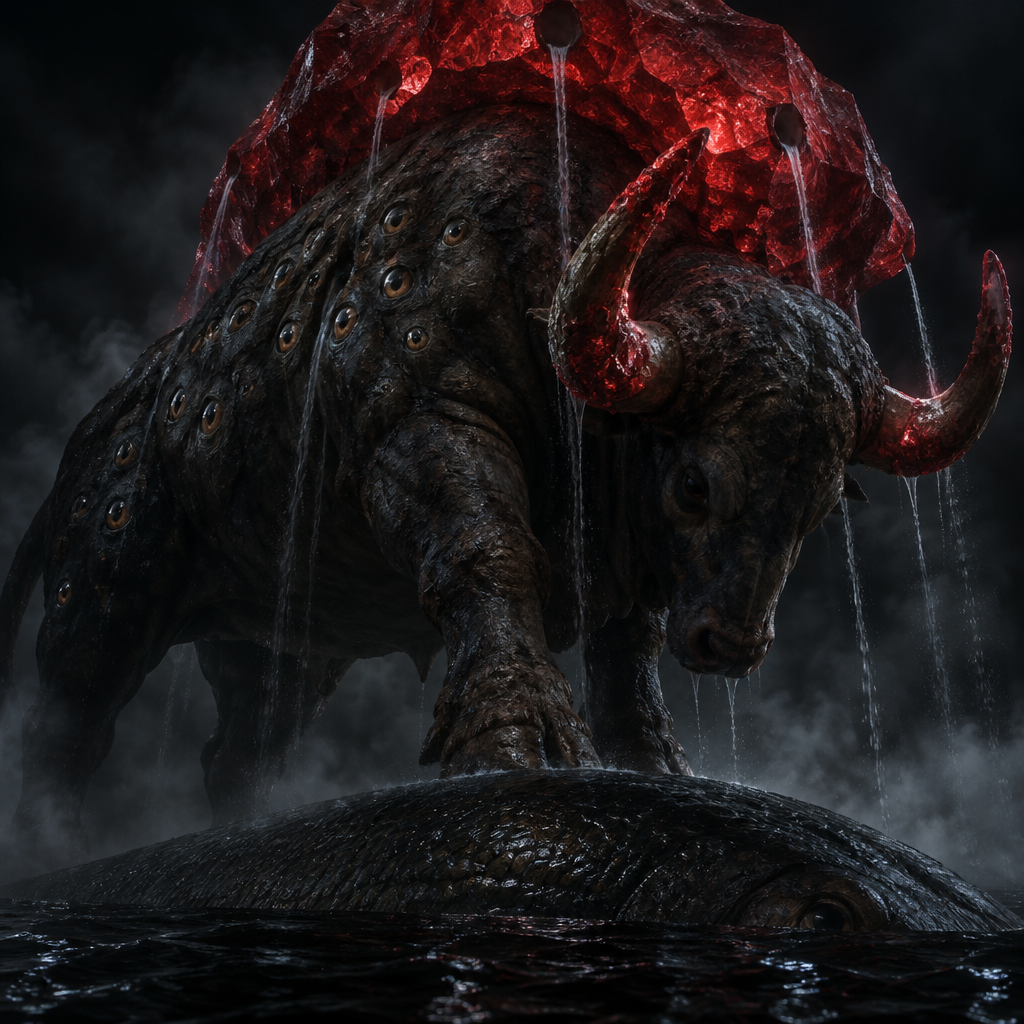
Their answer was a stack. The earth, the story goes, was unsteady when it was first made, so God created an angel of immense size and strength and sent him down beneath it. The angel took the earth onto his shoulders, and his hands reached out past the east and the west to grip its edges. His feet, though, had nothing to stand on. So God made a rock of ruby, pierced with seven thousand holes, and out of every hole poured a sea whose size only God knows. The rock had nothing to stand on either. That is where the bull comes in.
God created a bull of overwhelming size and set it under the rock, and it took the rock on its back and its horns. Under the bull went a fish so huge that no one could bear to look at it, because of its bulk and the blinding flash of its eyes. Every sea in the world poured into one of its nostrils would sit there like a mustard seed lost in a desert. That fish is Bahamut. Under the fish is water, under the water is darkness, and under the darkness the knowledge of humankind gives out.
The bull’s own body defies drawing. In the version the English orientalist Edward William Lane summarised from Arabic writers in his notes to the Thousand and One Nights, collected in 1883 as Arabian Society in the Middle Ages, it has four thousand eyes and as many ears, noses, mouths, tongues and feet. Between any two of them lies a journey of five hundred years. Older Arabic lists double down further and give forty thousand. It is less an animal than a landscape with horns.
Lane gives the name as Kuyoota and admits he cannot be sure how to say it. The vowels are not marked in the manuscripts, and another Arabic writer, Ibn esh-Shihneh, spells it Kuyoothan. The name has gone on shifting ever since. The cosmographer al-Qazwini, writing in the thirteenth century in his Wonders of Creation, is the main source for the form Kuyutha. The Tales of the Prophets credited to al-Kisaʾi calls the bull al-Rayann. When Jorge Luis Borges put the creature into his bestiary of imaginary beings in 1957, working from Lane, the English translation of 1969, titled The Book of Imaginary Beings, printed it as Kujata, and that misspelling is now the one most people meet first. Some modern readers suspect the whole arrangement is a scrambled memory of the two great beasts of the Hebrew Bible. Bahamut’s name looks very like Behemoth, while Behemoth was a land animal and Leviathan the creature of the sea, so the two may have traded places somewhere along the way.
The order of the stack was never fixed. Lane records a second opinion in which the earth sits on water, the water on the rock, the rock on the bull’s back, the bull on a bed of sand, the sand on the fish, the fish on a still and suffocating wind, the wind on a veil of darkness, the darkness on a mist. What lies under the mist, that account says, nobody knows. Some versions drop the angel. Some put him straight onto the bull’s hump. The bull is the one piece that almost every version keeps.
A low tide on a flat shore is the bull at work. The water slides out over the sand, slowly, because the breath of something that size takes half a day to draw. Then it stops, and turns, and comes back.
The tide story is told by Ibn al-Wardi, the fifteenth-century writer whose cosmography Lane drew on. The bull breathes twice in every day and night, out for the flood and in for the ebb. Lane was careful to add that the more learned Arabs of his sources already knew the moon governs the tides. The bull was never the only explanation. It was the one people told.
Earthquakes were the other story. Many people, Lane reported, believed the ground shook when the bull shifted under its burden. A sudden tremor in a medieval street, with dust sliding off the roofs and the cooking pots rattling on their shelves, was in this telling a beast far below adjusting its footing under the weight of everything.
Its power is endurance on a scale that makes the earth look small. It carries the rock, the seas and the angel, and through them the world. Its limits are just as absolute. It cannot hold itself up and needs the fish beneath it, which needs the water, which needs the darkness. It cannot move without the ground above it trembling. And it is the second-lowest thing in a creation built on top of it, which is no small job for a bull.
Frequently Asked Questions
What is Kuyutha?
Kuyutha is a gigantic bull from medieval Islamic and Arabic cosmography that helps hold up the earth. It carries on its back and horns the rock on which the world-bearing angel stands, and it stands in turn on the great fish Bahamut.
What does Kuyutha look like?
Kuyutha is described as a bull of unimaginable size with four thousand eyes, ears, noses, mouths, tongues and feet, in the version Edward William Lane summarised from Arabic sources. Older Arabic lists give forty thousand of each. In Lane’s account each of these features is separated from the next by a journey of five hundred years.
How is Kuyutha connected to the tides?
According to the tradition told by Ibn al-Wardi, Kuyutha breathes twice in each day and night. When the bull breathes out the sea flows in, and when it breathes in the sea ebbs. Lane noted that learned Arab writers also knew the moon causes the tides.
Is Kuyutha the same as Kujata?
Yes. Kujata is the spelling used in the 1969 English translation of Jorge Luis Borges’s Book of Imaginary Beings, which drew on Lane’s summary. The bull also appears as Kuyoota, Kuyoothan and Kiyuban, and al-Kisaʾi’s Tales of the Prophets calls it al-Rayann.
What is under Kuyutha?
Under Kuyutha is the giant fish Bahamut, so large that all the seas placed in one of its nostrils would look like a mustard seed in a desert. Beneath the fish is water and beneath the water darkness. One alternative account puts a bed of sand between the bull and the fish.
Related Entries
Bahamut, Angels, Djinn, Roc, Anqa, Behemoth, Leviathan, Ziz, Hadhayosh, Bull of Heaven, Akupara, Kurma