Mongolian Mythology: The Complete Guide to the Eternal Blue Sky, Tengrism, and the Spirits of the Steppe
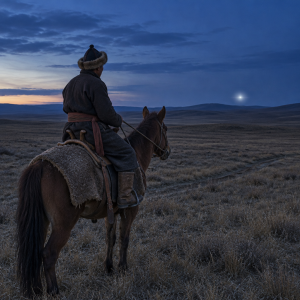
Mongolian mythology has no temples. It has no scripture in the way the Greeks had Hesiod or the Norse had the Eddas, and for most of its history it had no priesthood that wrote anything down. Its cathedral is the sky itself — Möngke Khökh Tengri, the Eternal Blue Heaven — and its theologians were shamans who climbed into trance rather than into pulpits. This is a religion of the open steppe, where the horizon is a perfect circle and the most powerful god is the thing you cannot touch and cannot escape: the weather, the cold, the blue overhead that decides whether your herds live or die.
That setting shapes everything. Where settled peoples built mythologies around cities, harvests, and kings, the Mongols built theirs around mobility, ancestry, and the vertical axis that connects a felt tent to the heavens. The supreme being, Tengri, is less a person than a presence — the sky as conscious will. Below him the earth mother sustains the herds, an underworld king collects the dead, and a teeming population of nature spirits inhabits every spring, mountain pass, and hearth fire. The whole system is called Tengrism, and remarkably it never died: it is still practiced today across Mongolia, Buryatia, and the Altai, making it one of the oldest continuously living religions on earth.
Our best window into it is the Secret History of the Mongols, a thirteenth-century chronicle that opens not with Genghis Khan the conqueror but with a blue-grey wolf and a fallow doe — the mythic ancestors of the Mongol people. Add the field reports of nineteenth- and twentieth-century ethnographers who recorded living Buryat and Altai shamanism, and you have a tradition that is far stranger, older, and more intact than its scant written record suggests.
What Makes Mongolian Mythology Different
The supreme god is the sky, not a person in the sky. Most “sky father” gods — Zeus, Jupiter, Dyaus — are anthropomorphic rulers who happen to live above. Tengri is closer to the sky as a living intelligence: impersonal, vast, and identified with the literal blue dome of heaven. The Mongols did not picture him with a face so much as feel him as the moral order of the cosmos. When Genghis Khan justified his conquests, he did not say a god commanded him; he said it was the will of Eternal Heaven, as if announcing a law of physics.
There is no fall, no apocalypse, and no salvation — only balance. Tengrism is not aiming anywhere. There is no end-times, no final judgment, no paradise to be earned. The goal is equilibrium: keeping the upper world, the middle world of humans, and the lower world in working harmony through correct ritual. A person’s job is not to be saved but to avoid offending the spirits and to honor the ancestors. This makes it one of the least eschatological major religious systems in the world.
The dead don’t leave — they become spirits you must manage. Ancestors remain active stakeholders in the family. Properly honored, they protect their descendants; neglected or killed violently, they curdle into ongon — restless, grudge-bearing spirits that bring illness and misfortune until appeased. Mongolian religion is therefore a constant negotiation with the deceased rather than a one-way farewell.
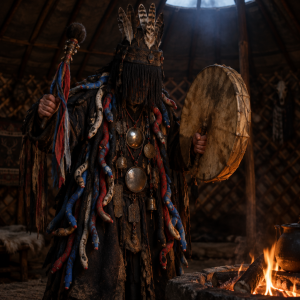
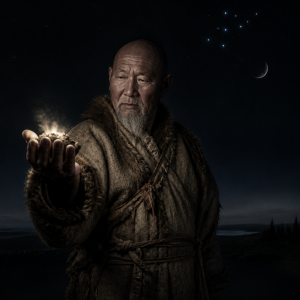
The shaman is a pilot, not a priest. The böö (shaman) does not interpret doctrine or lead congregations. He physically travels — his soul leaves his body and journeys to the upper or lower world to retrieve a lost soul, bargain with a spirit, or escort the dead. The drum is his horse, the trance his road. This is religion as expedition.
Numbers are theology. The heavens are populated by exactly 99 tngri — 55 benevolent “white” spirits of the west and 44 wrathful “black” spirits of the east. This numbered, factional cosmos, split into a western dawn-side and an eastern storm-side, is distinctly Inner Asian and has no real equivalent in the Mediterranean or Indian traditions.
The Major Gods and Spirits
Mongolian divinity is layered: a remote sky-god at the summit, a small number of great cosmic powers beneath him, and below them an almost infinite crowd of local and ancestral spirits.
The Sky and the Cosmic Powers
Tengri — the supreme sky god and father of all. He created the cosmos, sets its moral order, and grants or withdraws the mandate by which khans rule. Shared across the Turkic and Mongolic world, he is the still point the entire system turns around, invoked at the start of every great undertaking and blamed for every great defeat.
Etügen Eke — the Earth Mother, Tengri’s counterpart and consort. If Tengri is the blue above, Etügen is the brown below: the fertile ground, the pastures, the womb of the world that shapes land and life out of the primordial chaos. The pairing of Father Sky and Mother Earth is the structural heart of Tengrist cosmology.
Erlik — the king of the underworld and lord of the dead. In many tellings he was a co-creator of humanity whose pride got him cast down to rule the lower world, a figure who rhymes uncannily with the fallen-angel devil of monotheism. He is sometimes a totemic bear, sometimes a being with a human body and the grotesque face of a pig. The dead pass into his domain, and shamans must bargain with him for the souls of the sick.
Bai-Ülgen — the benevolent creator-god of the upper world, especially among the Altai peoples. Where Erlik rules below, Bai-Ülgen presides above, the source of goodness, abundance, and the sky’s white light. In the great earth-diver myth he is the one who fashions the first land from a fleck of mud.
Esege Malan — “Father Bald-Head,” the bright creator sky-god of the Buryat Mongols around Lake Baikal. A wise, sometimes comic patriarch who shapes the world and arbitrates the quarrels of the lesser gods, he is the Buryat face of the supreme creative principle, closely twinned with Bai-Ülgen as architect of the universe.
The Spirits of Hearth, Fire, and Tribe
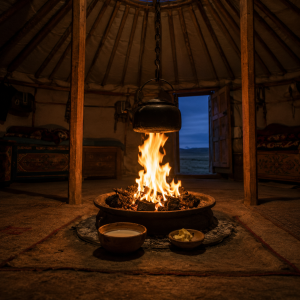
Od Ana — the Turkic-Mongolian goddess of fire, the “queen of fire,” and guardian of marriage. Born at the very moment earth and sky split apart, she manages the sacred fires that burn within the human soul, lit at Tengri’s command. A new couple jumps over a flame to win her blessing — a love, the saying goes, as bright as fire. The hearth was the holiest spot in the ger, and Od Ana was its resident deity.
Umay — the mother goddess of fertility, childbirth, and infants, shared across the Turkic-Mongolic world. She guards the unborn and the newly born, a winged or golden-haired protectress whose name still survives in words for placenta and womb. To her fall the most intimate and high-stakes moments of steppe life: the survival of children.
Creatures, Monsters, and Supernatural Beings
The steppe and the mountains that ring it are full of beings that are neither god nor human: wild men, restless dead, and shape-shifting spirits of place.
The Wild Man of the Mountains
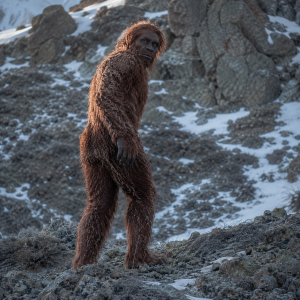
Almas — the wild man of the Mongolian and Central Asian high country, a hair-covered, humanlike creature of the remote ranges. He is Inner Asia’s own version of the Yeti and Bigfoot: primitive, elusive, and just human enough to unsettle. Some accounts make him a towering hairy demon; others, stranger still, describe a one-legged, one-armed, one-eyed witch. The Almas sits exactly on the line between cryptid and spirit, which is precisely why nomads kept their distance.
The Restless and the Resident Dead
Ongon — the spirits of those who died violently or were buried without proper rites. Unmoored from the ancestral order, they linger to cause illness, accident, and ruin until a shaman appeases them. The same word also names the small felt or wood idols a family kept to house a helpful protective spirit — a reminder that in Mongolian belief the dead are raw material, dangerous or useful depending on how they are handled.
The Numbered Heavens
The 99 Tngri — not monsters but a supernatural population worth meeting on its own terms. Fifty-five white tngri of the west incline toward mercy; forty-four black tngri of the east toward wrath and storm. Among them move specialized powers such as Daichi Tengri, a fierce war-god aspect invoked before battle. The shaman’s whole art is knowing which of these to call, flatter, or avoid.
The Central Myths
The Earth-Diver and the Theft of the Land
In the beginning there was only water and sky. The creator — told variously as Bai-Ülgen or another son of Heaven — needed earth, so he sent a loon to dive for mud from the bottom of the cosmic sea. The loon failed and had its legs broken for the failure. A goldeneye duck dove next and surfaced with a small pellet of mud, from which the creator shaped the first land and lay down to rest on it. Then Erlik, the dark brother, tried to drag the new earth out from under the sleeping god — but the more he pulled, the more the land stretched, spreading in every direction until it became the world. The creator then molded animals and the first humans from clay, setting a dog to guard the drying bodies.
Why it matters: this is the earth-diver creation pattern that runs in a great belt across Siberia and into Native North America, and the Mongolian version carries its signature tension — creation is a two-brother job, a collaboration between a bright maker and a dark saboteur whose interference accidentally produces the very breadth of the world. Evil here is not an intruder into a finished creation; it is built into the foundations.
The Blue Wolf and the Fallow Doe
The Secret History of the Mongols opens its account of Genghis Khan not with a man but with an animal pairing: Börte Chino, the blue-grey wolf, and Gua Maral, the fallow doe, who crossed the inland sea and settled at the source of the Onon River. Their descendant was Batachiqan, and eleven generations on came the widow Alan Gua, who — after her husband’s death — bore further sons she said were fathered by a radiant yellow man who entered her tent on a moonbeam. From that line of light descended the clan of Genghis Khan.
Why it matters: the myth fuses two claims that mattered enormously on the steppe — descent from a totemic predator (the wolf) and descent from Heaven’s own light (the moonbeam man). It made the Khan’s house not merely powerful but chosen by Tengri, a genealogy that doubled as a political charter for world conquest.
The Spirit Banner of the Khan
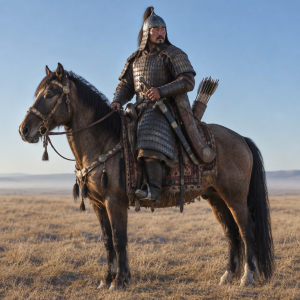
Every great Mongol leader carried a sülde — a spirit banner made of horsehair hung from a spear-shaft, believed to house his guardian spirit and his fortune. Genghis Khan’s white banner (tsagaan sülde) flew in peace; his black banner (khar sülde) was raised for war and was thought to concentrate the martial spirit of the nation. The banner was not a symbol of the leader’s soul — it was a vessel for it, tended like a living thing.
Why it matters: the sülde shows Tengrism’s core conviction that spirit is portable and houseable, the same logic that lets an ongon idol shelter an ancestor. Legend holds that Genghis Khan’s spirit banner survived him for centuries, and its eventual disappearance is still mourned as a genuine loss of the nation’s soul — myth and history bleeding into each other.
The Three Worlds and the Journey of the Soul
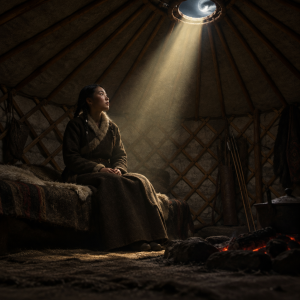
Tengrist cosmology is built on a vertical axis. There is an upper world of light and the benevolent white tngri, presided over by sky powers like Bai-Ülgen; a middle world where humans, animals, and the spirits of place live side by side; and a lower world of the dead and the wrathful black tngri, ruled by Erlik. A world-axis — pictured as a great tree or a central mountain, and echoed in the smoke-hole and central pole of every ger — joins the three, and it is this axis the shaman climbs or descends in trance.
The afterlife is not a reward or a punishment but a relocation. The dead travel to Erlik‘s realm, yet they remain entangled with the living as ancestors who must be fed, honored, and consulted. A person was thought to carry multiple souls, and at death these separate — one may stay near the body or the hearth, one journeys on, one may eventually return to the cycle of life. When a soul is lost, strayed, or stolen by a spirit before its time, the result is sickness; the shaman’s central healing act is soul retrieval, a journey down to Erlik or out across the spirit landscape to recover and restore it. Death, in other words, is a problem of logistics and balance more than of morality — which is exactly what you would expect from a religion with no heaven to win and no hell to fear.
How Mongolian Mythology Connects to Other Traditions
Mongolian myth is the western pole of a vast Inner Asian religious world, and its threads run in every direction. Its closest kin is Turkish (Turkic) mythology, with which it shares Tengri himself, the fire-goddess Od Ana, the mother Umay, and the underworld king Erlik — so much overlap that scholars often speak of a single “Turco-Mongol” pantheon rather than two separate ones.
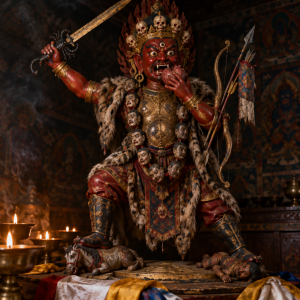
To the north and west lies the world of Siberian and Arctic shamanism, the source of the three-world cosmos, the soul-flying shaman, and the earth-diver creation myth that Mongolia shares with peoples stretching all the way to Indigenous North America. To the south, Tibetan mythology became deeply intertwined with Mongolian belief after Tibetan Buddhism swept Mongolia from the sixteenth century onward — the prayer-flag Wind Horse (lungta), carrying fortune on the breeze, is a perfect emblem of that fusion of steppe spirit-belief and Buddhist practice.
Further afield, the contact between the Mongol Empire and its neighbors left mythic echoes in Chinese mythology and Persian mythology, where the figure of the world-conquering, Heaven-mandated khan entered local legend. The single most exportable Mongolian idea, though, may be the political theology of Tengri: rule legitimized by the explicit mandate of Heaven, a concept that shadowed and reinforced similar ideas across East Asia.
Where to Start Reading
The indispensable primary source is the Secret History of the Mongols (thirteenth century), the only major narrative written by Mongols about themselves before the modern era; Paul Kahn’s accessible adaptation and Igor de Rachewiltz’s monumental scholarly translation are the two standard doors in. For the religion as a living system rather than a literary one, the ethnographic record of Buryat and Altai shamanism — gathered by researchers from the nineteenth century onward — preserves rituals, invocations, and cosmologies that the medieval chronicles only gesture at.
For modern introductions, start with general surveys of Central Asian and Inner Asian mythology, which set Mongolia inside its Turco-Siberian family, then move to focused studies of Tengrism and Mongol shamanism. Read the Secret History first for the stories and the texture; read the ethnography second for what the stories were actually for.
Explore Mongolian Mythology on Gods and Monsters
Gods and Monsters currently hosts 5 entries specific to Mongolian mythology, with many more shared across the wider Turco-Siberian world. Browse all Mongolian mythology entries →
Tengri · Esege Malan · Od Ana · Almas · Erlik · Bai-Ülgen · Umay · Wind Horse · Yeti · Bigfoot · Turkish Mythology · Siberian/Arctic Peoples’ Mythologies · Tibetan Mythology
Frequently Asked Questions
Who is the main god in Mongolian mythology?
The supreme god is Tengri, the Eternal Blue Sky — not a humanlike ruler but the conscious will of heaven itself. He created the cosmos, upholds its moral order, and grants the “mandate of Heaven” that legitimizes a khan’s rule. Genghis Khan justified his empire as Tengri’s will. He is balanced below by the Earth Mother Etügen and the underworld king Erlik, and the whole religion built around him is called Tengrism.
Is Tengrism still practiced today?
Yes. Tengrism never fully died out and has seen a strong revival since the end of Soviet-era repression. It is practiced today across Mongolia, the Buryat and Altai regions of Russia, and parts of Central Asia, both as living folk shamanism and as a self-conscious national religion. That continuity makes it one of the oldest religious systems on earth still in active practice, centered on Tengri, nature spirits, and ancestor veneration.
What is the Almas?
The Almas is the wild man of Mongolia and Central Asia — a hair-covered, humanlike being of remote mountains and forests, Inner Asia’s counterpart to the Yeti and Bigfoot. Reports vary wildly: some describe a giant hairy demon, others a strange one-legged, one-armed, one-eyed witch. The Almas blurs the line between cryptid and spirit, which is part of why it has fascinated both folklorists and monster-hunters.
What is a Mongolian shaman called, and what do they do?
A Mongolian shaman is a böö. Unlike a priest who interprets doctrine, the böö is a spirit-traveler: in trance, his soul leaves his body to journey to the upper or lower world — to retrieve a patient’s lost soul, bargain with spirits like Erlik, escort the dead, or appease a vengeful ongon. The drum is imagined as his mount and the trance as his road. He communicates with the 99 tngri and the spirits of place to keep the three worlds in balance.
What is the Blue Wolf legend?
The Secret History of the Mongols traces the Mongol people to Börte Chino, a blue-grey wolf, and Gua Maral, a fallow doe, whose descendants eventually produced Genghis Khan. Later in the line, the widow Alan Gua bore sons she said were fathered by a radiant being who entered on a moonbeam. The legend gave the Khan’s clan a double claim — descent from a totemic predator and from the light of Heaven itself — turning genealogy into a divine mandate for conquest.
How is Mongolian mythology different from Turkic mythology?
They overlap so heavily that scholars often treat them as one “Turco-Mongol” system: both venerate Tengri, the fire-mother Od Ana, the birth-goddess Umay, and the underworld king Erlik. The differences are mostly regional emphasis and naming — Mongolian tradition leans on Buryat and Altai figures like Esege Malan and was later fused with Tibetan Buddhism, while Turkish mythology preserves its own western Turkic variants of the shared pantheon.