
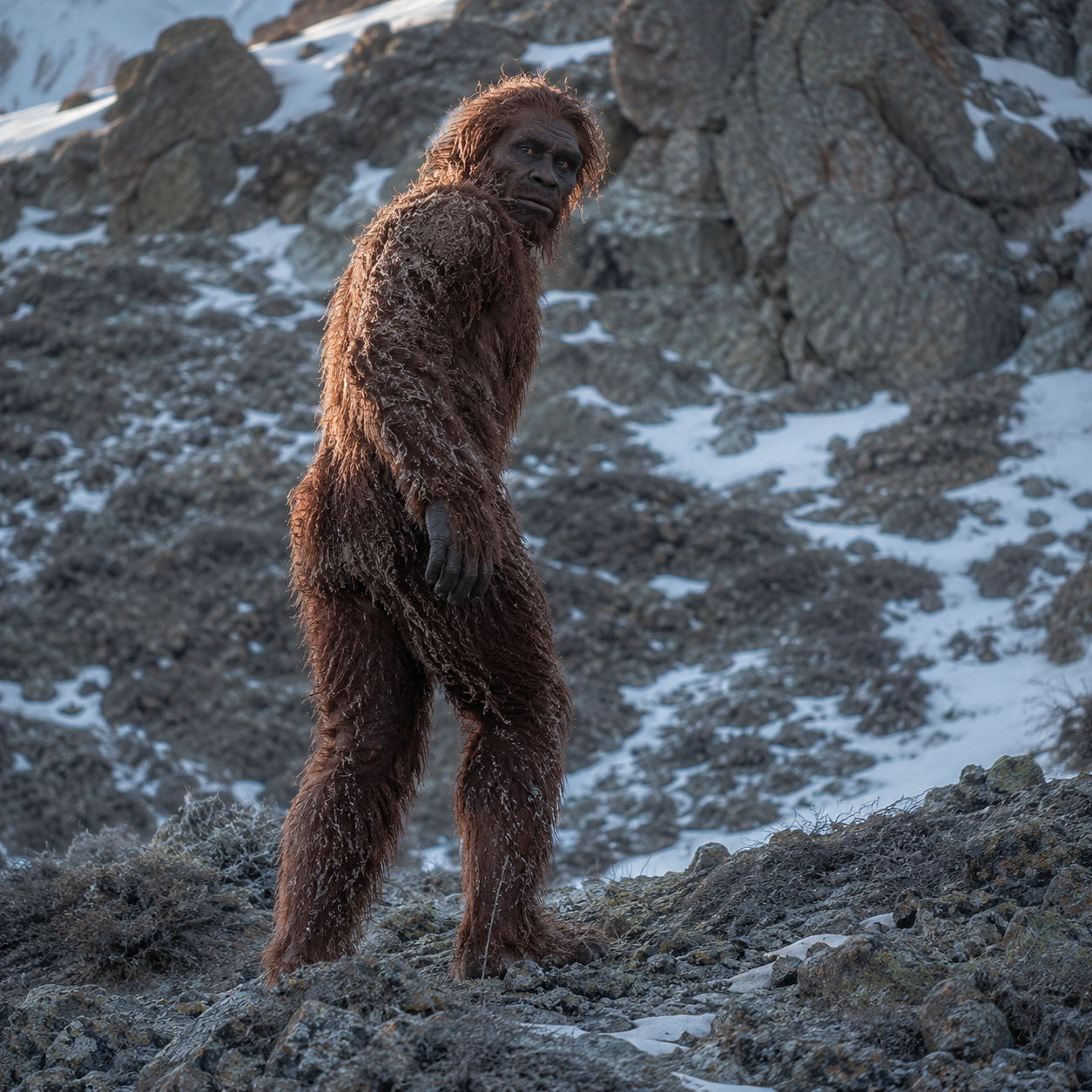
Almas
Region/Culture: Central Asia
Mythos: Mongolian Mythology, Cryptid Mythology
Primary Type/Nature: Monsters and Beasts
Mythical Attributes: A hair-covered wild man of the mountains, mute and immensely strong, said to live just beyond the edge of human settlement.
Role in Mythos: It stands as the local memory of something half-human surviving in the high country, neither fully animal nor fully one of us.
Relation to Humans: The almas keeps its distance and means no harm, raiding crops and startling herders rather than hunting them. Stories of captured individuals living among villagers blur the line between beast and forgotten cousin.
A herder crossing the Altai foothills before dawn finds a line of tracks pressed into the old snow. They are almost human. The heel lands square, the weight rolls forward the way a person’s would, but the stride is too long for any man walking and the toes splay wide at the front. Something passed here on two legs in the cold, and it was not wearing shoes. By the time the light comes up the maker is gone, back into the rock and scrub where the grazing thins out and people do not follow. This is how most encounters with the almas end. A glimpse, a smell of something rank on the wind, a shape that drops to all fours and is over the ridge before the eye can fix on it.
When witnesses do get a longer look, they describe a creature built like a lean, oversized person. It stands somewhere between five feet and six and a half, its body wrapped in curly hair the colour of dried blood and rust, six inches long in places, leaving only the face and the palms of the hands bare. The skin beneath is dark. The face carries a heavy ridge of bone above the eyes, a nose pressed flat, and a chin that recedes almost to nothing, so the jaw seems to hang forward. It walks upright with an ease no ape manages, then folds down to run when surprised. A few older accounts make it darker and fiercer, sheathed in near-black fur with clawed feet, but those reports are the minority and tend to come secondhand. The steady picture across centuries is plainer and stranger: a tall, silent, red-haired thing shaped unmistakably like a human being.
The name itself resists explanation. In Mongolian it carries the sense of “wild man,” and one folk etymology breaks it into the words for “to kill” and “animals,” though this reads more like a guess than a derivation. The scholar Rinchen, who spent years collecting almas reports, concluded flatly that the origin of the old word was unknown and that it would not translate into other tongues. What the name leaves behind instead is geography. Across southwestern Mongolia the creature is fixed into the land through place names: the Hills of the Almases, the Red Mountains of the Almases, the red rocks where they were said to shelter. People do not name barren ridges after things they never believed in.
Its range runs the spine of the continent’s high country, through the Caucasus, the Tian Shan, the Pamirs, and the Altai of western Mongolia. The behaviour reported there is consistent and unremarkable, which is part of what unsettles. The almas eats plants, roots, and fruit, takes its food raw, and shows no sign of fire or tools or speech. It is shy to the point of cowardice, and the violence in its legend is almost always the human kind directed back at it. In one account passed down among herders, Mongol children and young almas felt no fear of one another at all, and would meet at a distance like two kinds of animal that had simply decided the other was harmless.
The story that gave the almas its grip on the modern imagination came out of Abkhazia in the Caucasus. Late in the nineteenth century, near the village of Tkhina, men were said to have captured a wild, hair-covered woman. They called her Zana. She was tall, dark-skinned, draped in reddish hair, and strong enough to overpower grown men. She never learned to speak. She refused cooked food and would not keep clothes on her body, and for years she was kept in a pit and then gradually allowed to live at the edge of the household. The villagers said she bore several children to local men, and that those children spoke and lived as people do. Her bones, and theirs, became the object of a long and serious hunt.
That hunt belonged largely to Boris Porshnev, a Soviet historian who published Zana’s case in 1968 and argued that she was no fairy tale but a surviving relict hominid, possibly a Neanderthal stranded into the modern age. Investigators traced and interviewed her supposed descendants. For a time the almas looked less like folklore and more like an open zoological question, a door left ajar on the human family tree. The door has since mostly closed. When genetic analysis finally reached Zana’s line, it pointed not to any ancient European hominid but to recent ancestry in sub-Saharan Africa, the likeliest explanation being an enslaved or displaced woman whose strangeness hardened into legend. A separate 2014 study of hair samples attributed to the Caucasus almasty matched them to brown bear, horse, and cattle.
Whatever powers the almas holds are the powers of a body perfectly fitted to ground that kills careless people. It endures cold that drives herders indoors, climbs and runs across scree, and vanishes into terrain with a quickness that has kept it from ever sitting under a museum light. Its strength, in the captured accounts, is the kind that snaps a tether. But its limits are written into the same description. It builds nothing. It cannot speak, cannot make fire, cannot defend itself with anything but its own hands, and so it survives only by staying out of reach. The moment one is caught, the legend always ends the same way, with a creature that cannot explain itself standing mute among people who cannot decide what it is.
Frequently Asked Questions
What is the Almas?
The Almas is a wild-man cryptid from the folklore of Central Asia, especially Mongolia and the Caucasus. It is described as a hair-covered, human-shaped creature that walks upright, lives in remote mountains, and avoids contact with people. Most scientists regard it as legendary rather than a real undiscovered species.
What does the Almas look like?
The Almas is described as a bipedal figure between five and six and a half feet tall, covered in reddish-brown hair except for its dark-skinned face and palms. It has a pronounced brow ridge, a flat nose, and a weak, receding chin, giving it a look that is human in shape but distinctly different from a modern person.
Where does the Almas live?
The Almas is said to inhabit the high mountain ranges of Central Asia, including the Caucasus, the Tian Shan, the Pamirs, and the Altai Mountains of western Mongolia. Several place names in southwestern Mongolia, such as the “Hills of the Almases” and the “Red Mountains of the Almases,” are tied to sightings of the creature.
Who was Zana the Almas?
Zana was a wild, hair-covered woman reportedly captured near the village of Tkhina in Abkhazia in the late nineteenth century and identified by some researchers as an Almas. She never learned to speak, refused cooked food and clothing, and was said to have borne children with local men. Later genetic study of her descendants pointed to recent sub-Saharan African ancestry rather than any ancient relict hominid.
Is the Almas real?
There is no scientific evidence that the Almas is a real animal, and mainstream researchers consider it folklore. A 2014 genetic study of hair samples attributed to the Caucasus almasty matched them to brown bear, horse, and cattle, and analysis of Zana’s lineage found ordinary human ancestry rather than a surviving prehistoric species.
Related Entries
Tengri, Erlik, Bai-Ülgen, Yeti, Bigfoot, Yowie, Agogwe, Grassman, Mapinguari, Woodwose, Basajaun, Enkidu, Kapre