
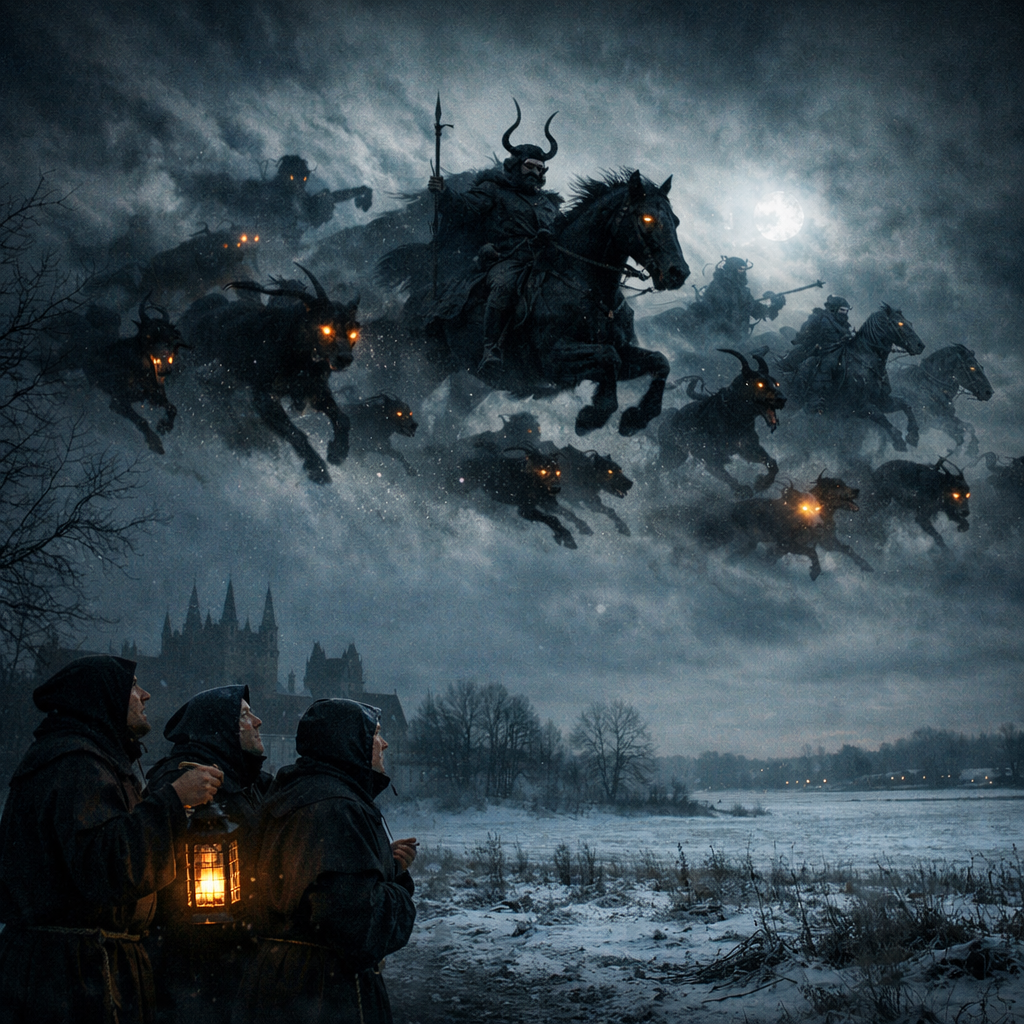
Wild Hunt
Region/Culture: Northern Europe
Mythos: Germanic Mythology
Primary Type/Nature: Fairy Folk and Spirit Beings
Mythical Attributes: A spectral cavalcade of ghostly riders, hounds, and dead souls that storms through the midwinter sky during the darkest nights of the year.
Role in Mythos: The Wild Hunt serves as a terrifying boundary event between the living and the dead, collecting lost souls and punishing the unwary during the liminal period of Yule.
Relation to Humans: Those who witnessed the Hunt risked death, abduction to the underworld, or being swept into its ranks against their will. In earlier pre-Christian traditions, however, people left offerings to the Hunt’s leader in exchange for blessings over harvests and livestock.
Something crosses the winter sky above Peterborough in 1127. The monks at the abbey hear it first: the low moan of horns threading through bare trees, carrying across frozen fields all the way to Stamford. Then they see the riders. Black horses, black goats, hounds with eyes like hot coals. The Peterborough Chronicle, one of the last gasps of the Anglo-Saxon tradition, records that reliable men counted twenty or thirty huntsmen in the cavalcade, and that the disturbance lasted from February through the whole of Lent. Nobody in the abbey slept well for weeks.
This was not a new story. The Wild Hunt had been tearing through the folklore of northern Europe for centuries before any monk troubled to write it down, and it would go on long after the abbeys crumbled. In Germany it went by the Wilde Jagd or the Wütendes Heer, the Raging Host. In Scandinavia it was the Oskoreia, the Terrifying Ride. In Normandy, the priest Walchelin claimed to have stumbled into a procession of the damned on a January night in 1091, watched a giant with a mace lead a parade of corpse-bearers, weeping sinners, and women riding saddles studded with glowing nails. He grabbed the reins of a riderless horse and was burned so badly by its bridle that the scar stayed on his hand for the rest of his life. The stories disagree on almost everything except the essentials: wind, darkness, noise, and the overwhelming sense that something has ripped the seam between the living world and whatever comes after.
The leader changed depending on who was telling the tale and when. Across the Germanic lands, the figure most often named was Odin, called Woden or Wotan south of the North Sea. Two of his bynames tie him to the season: Jólnir and Jauloherra, both meaning something close to Master of Yule. The connection fit. Odin was already the god of the dead, of wind, of ecstatic trance, a wanderer who rode the eight-legged horse Sleipnir through the nine worlds on errands no one else could manage. Leading a screaming host of ghosts through a December gale was, for him, practically a commute. But he was not the only candidate. In parts of southern Germany and the Alps, the procession answered to female figures: Holda, Perchta, Berchta. In England, the hunt rode under Woden, Herne, Herla, or sometimes the Devil himself. The Welsh gave it to Gwyn ap Nudd, lord of Annwfn, whose white hounds had blood-red ears. By the Middle Ages, the leader had become Charlemagne, King Arthur, or Frederick Barbarossa. In the sixteenth century, a man named Hans von Hackelnberg supposedly earned his place at the front after dying of a boar-tusk wound and being condemned to ride forever. The name kept changing. The cold did not.
The Wild Hunt rode in midwinter, the Rauhnächte, the rough nights between Christmas and Epiphany, or more broadly across the Twelve Days of Yule. For the Germanic peoples, this was the crack in the calendar when the dead walked and the boundaries between worlds grew thin. The hunt swept through forests and over rooftops in the worst of the storms, its passing marked by howling wind and the stink of something not quite earthly. Fire spurted from the hooves and eyes of its animals. Some of the riders bore wounds, the marks of violent death still fresh. Others were recognizable as neighbours who had died only recently.
Encountering the Hunt was bad in every possible way. Witnesses could be killed outright, dragged into the underworld, or simply deposited miles from where they had been standing, dazed and unable to explain what had happened. In some accounts, the soul could be torn from a sleeping body and pressed into service among the riders. The Peterborough monks got off easy. The priest Walchelin got a scar and a lifetime of insomnia.
Protection was simple but non-negotiable. Fall flat on the ground, face down. In parts of Scandinavia, one tradition held that Odin’s Hunt did not ride lower than the height of an ox’s yoke, so dropping to the earth could save a life. Others carried bread and steel to church during Yule: bread for the hounds, steel to throw against the riders. Food and drink left on doorsteps served as offerings, a way of saying the household had paid its respects and should be passed over. Before Christianity darkened the Hunt’s reputation entirely, these offerings were not born of terror alone. Older layers of the tradition suggest the procession once carried blessings, that the god and goddess riding at its head could be appeased with gifts and would repay the generosity with good harvests and healthy livestock. The howling overhead was not always a threat. Sometimes it was a transaction.
Jacob Grimm, the folklorist who gave this sprawling tradition its modern name in his 1835 Deutsche Mythologie, believed the Wild Hunt preserved a fossil of pre-Christian belief, the old god Woden stripped of his dignity and stuffed into a ghost story by centuries of Church hostility. Modern folklorists have pushed back on that, arguing that the motif is more composite and more alive than any single origin can explain. Still, as the historian Lotte Motz observed, the Wild Hunt is found above all in areas of Germanic speech. It thins out as it moves south and east, and it does not take root easily in the Mediterranean.
The Hunt carried power that defied easy categories. It was a psychopomp, ferrying the dead onward. It was a punisher, chasing the wicked and the unprepared. Some accounts describe it collecting unburied or morally impure souls, pressing them into a kind of itinerant purgatory, while simultaneously ushering the souls of the unborn toward rebirth. In its oldest form, it may have been tied to ecstatic warrior cults, bands of living men entering trance states and running with the dead in spirit while their bodies lay safe indoors. Otto Höfler argued in 1934 that the spectral troops of Woden had a ritual counterpart in the berserkers of Old Norse tradition, living fighters in cultic union with dead warriors of the past.
What the Wild Hunt could not do was be contained. It answered to no single god, no single culture, no single century. It outlived every attempt to Christianize it, demonize it, or explain it away. Its weakness, if it had one, was daylight and the turning of the season. When the Twelve Nights ended and the days began to lengthen, the Hunt withdrew. The dead went back to wherever the dead go. The living swept the offerings off the doorstep and got on with spring.
Frequently Asked Questions
What is the Wild Hunt?
The Wild Hunt is a spectral cavalcade of ghostly riders, hounds, and dead souls from Germanic folklore that storms through the midwinter sky during the darkest nights of the year. It functions as a boundary event between the living and the dead, sweeping across northern Europe under names like the Wilde Jagd in Germany, the Oskoreia or Terrifying Ride in Scandinavia, and the Wütendes Heer or Raging Host.
Who leads the Wild Hunt?
The Wild Hunt is most often led by Odin, called Woden or Wotan in southern Germanic lands, whose Yule-related bynames Jólnir and Jauloherra both mean something close to Master of Yule. Other regions assign the role to different figures: female leaders like Holda, Perchta, and Berchta in southern Germany and the Alps; Herne, Herla, or sometimes the Devil in England; Gwyn ap Nudd in Wales; and later medieval traditions name Charlemagne, King Arthur, or Frederick Barbarossa. A 16th-century German legend gave the lead to Hans von Hackelnberg, condemned to ride forever after dying of a boar-tusk wound.
When does the Wild Hunt ride?
The Wild Hunt rides in midwinter during the Rauhnächte, the rough nights between Christmas and Epiphany, or more broadly across the Twelve Days of Yule. This was the crack in the calendar when the dead were believed to walk and the boundaries between worlds grew thin. The Hunt withdraws when the Twelve Nights end and the days begin to lengthen.
What happens if you see the Wild Hunt?
Witnessing the Wild Hunt was dangerous in every possible way: people could be killed outright, dragged into the underworld, deposited miles from where they had been standing, or have their soul torn from a sleeping body and pressed into service among the riders. The Norman priest Walchelin, who claimed to have stumbled into a procession of the damned in 1091, grabbed the reins of a riderless horse and was burned so badly by its bridle that the scar stayed on his hand for life. In some traditions the Hunt also collected unburied or morally impure souls into a kind of itinerant purgatory.
How can you protect yourself from the Wild Hunt?
The simplest protection against the Wild Hunt was to fall flat on the ground face down, since one Scandinavian tradition held that Odin’s Hunt did not ride lower than the height of an ox’s yoke. Others carried bread and steel to church during Yule, bread to throw to the hounds and steel to throw against the riders. Households also left food and drink on doorsteps as offerings, a gesture that older pre-Christian traditions framed less as appeasement and more as a transaction with a god or goddess who could repay generosity with good harvests and healthy livestock.
Related Entries
Odin, Sleipnir, Valkyrie, Draugr, Einherjar, Perchta, Erlking, Krampus, Grýla, Yule Lads, Herne the Hunter, Arthur, Gwyn ap Nudd, Cŵn Annwn, Dullahan