Yoruba Mythology: The Complete Guide to the Orishas, Ifá Divination, and Destiny
Yoruba mythology is one of the few ancient belief systems on earth that is still expanding. While the gods of Egypt and Greece survive mainly in museums and textbooks, the orishas of the Yoruba are worshipped today by tens of millions of people — not only in their West African homeland across Nigeria and Benin, but in Cuba, Brazil, Haiti, Trinidad, and the United States, where the transatlantic slave trade carried them and where they took root under new names. When a Santería priest in Havana greets Yemayá, or a Candomblé devotee in Bahia drums for Xangô, they are speaking the living grammar of a mythology that never became a relic.
The system rests on a supreme creator, Olodumare, who is real but remote — too vast and impersonal to be petitioned directly. Between humanity and that distant godhead stand the orishas: hundreds of divine forces, each governing a slice of nature or human experience, from iron and thunder to rivers, smallpox, and the crossroads where roads and fates intersect. The orishas are reached through Ifá, an extraordinarily sophisticated divination system whose sacred corpus — the 256 patterns of the Odù Ifá — encodes thousands of verses of philosophy, ethics, medicine, and myth, and which UNESCO has recognized as a masterpiece of human oral heritage.
The primary sources are not written scriptures but living recitations: the Odù Ifá memorized by babalawo priests, the praise-poems (oríkì) chanted for each orisha, and the oral histories first set on paper by the Yoruba historian Samuel Johnson in The History of the Yorubas (1921). This is a mythology you can still hear performed.
What Makes Yoruba Mythology Different
*The creator god is deliberately unreachable.* Olodumare (also called Olorun, “owner of the sky”) is omnipotent and omniscient, the source of all existence — and almost nobody prays to him. He has no temples, no priesthood, no festivals of his own. He delegates the entire running of the universe to the orishas, who handle the actual business of the world. This is the inverse of the Abrahamic model: the high god is not the one you talk to. The contrast with traditions that put a personal, intervening creator at the center could not be sharper.
*You choose your destiny before you are born — and then forget it. In Yoruba thought, each person kneels before Olodumare in heaven and selects an ori*, an “inner head” that contains the entire blueprint of the life to come: its triumphs, its length, its disasters. Once you are born, you forget what you chose. The whole purpose of Ifá divination is to recover fragments of that forgotten contract so you can align your life with it. Destiny here is neither fate imposed from above nor free will — it is a bargain you made with yourself and lost the memory of.
*The pantheon is still growing.* Yoruba tradition counts the orishas at 401 — “400 plus one” — a number that signals openness rather than a closed roster. New orishas can be recognized; historical kings like Shango became gods after death; and the diaspora has added and renamed deities for five centuries. A mythology designed to absorb rather than to fossilize is rare.
*The feminine is sovereign, not subordinate.* Oshun, Yemoja, and Oya are not consorts or helpers; they are world-shaping powers in their own right. In one of the most important myths, the male orishas try to organize creation without Oshun and the world simply stops working until they beg her back. The lesson is structural: leave out the feminine and the cosmos fails.
*Trickster precedes everything. Before any orisha can be addressed, Eshu — keeper of the crossroads, the messenger who carries every prayer and sacrifice between worlds — must be acknowledged first. A mythology that ritually salutes its trickster before* its dignified gods has a very different theory of how the universe runs than one that treats chaos as an enemy to be defeated.
The Major Orishas
The Creators and Custodians of Wisdom
Obatala — sculptor of humanity and orisha of purity. Olodumare entrusted Obatala with shaping the earth and molding human bodies from clay; he is the patron of the disabled and the deformed, because the Yoruba say it was his own drunkenness on palm wine that caused such variations when he worked. Dressed always in white, he is the cool, wise elder of the pantheon.
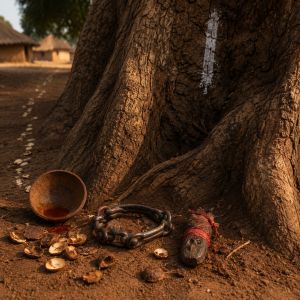
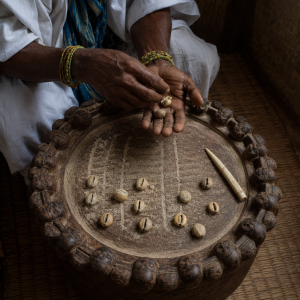
Orunmila — the witness of destiny and master of Ifá. Orunmila was present when each soul chose its ori, so he alone knows every person’s true fate. He does not speak to humans directly but through the babalawo, the trained diviner who reads the falling palm nuts and chains. He is wisdom incarnate, the divine memory of what we agreed to before birth.
Eshu — orisha of the crossroads, chance, and language. Neither good nor evil, Eshu is the indispensable mediator: no message reaches the orishas, and no sacrifice is accepted, unless he carries it. He delights in testing human character through tricks and reversals, and his lessons are usually about the gap between what we intend and what we cause. In the diaspora he splits and multiplies into figures like Elegua and Exu.
The Powers of Force and Labor
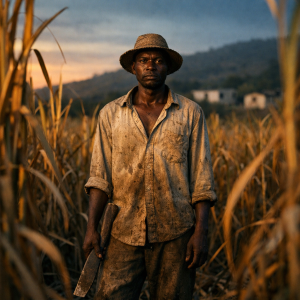
Ogun — orisha of iron, war, and all who work with metal. Ogun cleared the first path from heaven to earth with his machete when the other orishas were stranded, and so he is the patron of blacksmiths, hunters, soldiers, surgeons, and today truck drivers and mechanics. He is terrifying power harnessed to creation: the same blade that kills also builds. Oaths in Nigerian courts are still sworn on iron in his name.
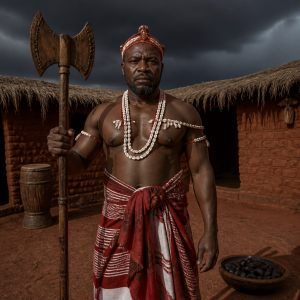
Shango — orisha of thunder, lightning, and justice. Once a historical king of the Oyo Empire, Shango became a god after death, hurling thunderstones from the sky to strike down liars and the wicked. Fiery, charismatic, and dangerous, he wields a double-headed axe and dances in red and white. His name survives across the Americas as Xangô and Changó.
Oshosi — orisha of the hunt and of justice. A master tracker who never misses his target, Oshosi is the patron of hunters, the wrongly accused, and those who seek what is hidden. He forms a working triad with Ogun (who clears the path) and Eshu (who opens the way), and in the diaspora he is invoked for legal trouble and for finding what is lost.
The Sovereign Waters
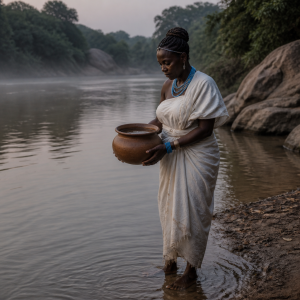
Oshun — orisha of fresh water, love, fertility, and wealth. The goddess of the Oshun River in Nigeria, she is sweetness, sensuality, and abundance — and, as her central myth shows, the indispensable power without which creation itself collapses. She is a fierce healer and the protector of women and children, draped in gold and honey, and her annual festival at Osogbo draws pilgrims from around the world.
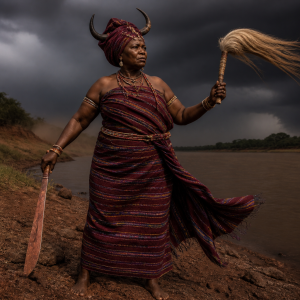
Yemoja — mother of the orishas and goddess of the sea and motherhood. Often called the mother of all living things, Yemoja is the ocean’s nurturing and protective face; rivers are said to flow from her body. Crossing the Atlantic, she became Yemayá in Cuba and Iemanjá in Brazil, where on New Year’s Eve millions launch flowers and candles into the waves for her.
Olokun — orisha of the deep, primordial ocean. Older than the dry land itself, Olokun ruled a world of sea and mist before Obatala created the earth, and remains a vast, temperamental power of the abyss — feared for the havoc the deep can wreak, yet revered as a protector of sailors and a curer of infertility. Where Yemoja is the ocean’s mothering surface, Olokun is its unknowable depth.
Creatures, Monsters & Supernatural Beings
The Death-Spirits and the Returning Dead
Abiku — “born to die.” Abiku are spirit-children who enter a mother’s womb only to die in infancy, then return to be born again to the same woman, repeating the cycle of grief deliberately. Families fight back with special names, scarification, and rituals meant to break the pact the child made with its spirit companions in the bush. The abiku is one of mythology’s most heartbreaking inventions — an explanation for repeated infant death that gives the loss a face and a name.
Emere — close kin to the abiku, the emere are beautiful, often female spirit-beings who live a double life between the human world and the spirit realm, frequently dying young to return to their otherworldly companions. They are shapeshifters whose foothold in two worlds makes them powerful and tragic at once.
The Forces of Misfortune
Ajogun — the “warriors against humanity.” The ajogun are a host of malevolent forces — Death (Iku), Disease, Loss, Paralysis, and others — that wage constant war on human wellbeing. Ifá divination exists in large part to detect which ajogun threatens a person and to prescribe the sacrifice that turns it aside. They are the antagonists in the cosmic drama of every Yoruba life.
The Spirits of the Bush
Iwin — nature spirits and fairy-folk of the forest and wilderness, shapeshifters who can help or harm those who wander into their domain. Like the fae of European lore, they occupy the uncanny edge between the human village and the untamed wild.
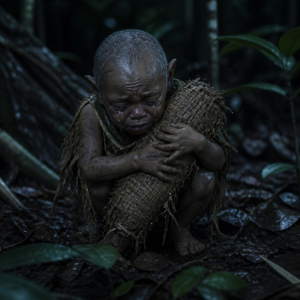
Egbere — a small, weeping creature of the bush said to wander at night carrying a magic mat and crying ceaselessly. Anyone bold enough to seize its mat is promised great fortune — a classic Yoruba bargain in which terror and reward are inseparable. The egbere is exactly the sort of obscure being a generic summary of “African mythology” would never mention.
The Central Myths
The Creation of Dry Land at Ile-Ife
In the beginning there was only the sky above and a limitless expanse of water below. Olodumare gave Obatala the task of making solid ground, handing him a golden chain, a snail’s shell full of sand, a white hen, and a palm nut. But on the way down Obatala grew thirsty, drank too much palm wine, and fell asleep. His younger sibling Oduduwa took the materials, climbed down the chain, poured out the sand, and set the hen loose; wherever the hen scratched, the sand spread into hills and plains. The first dry place was named Ile-Ife, and the palm nut grew into a tree with sixteen branches — the sixteen original Yoruba kingdoms.
Why it matters: Ile-Ife is not a metaphor; it is a real city in Nigeria that Yoruba people regard as the literal cradle of humanity, the spot where the world began. The myth fuses cosmology and geography, and Obatala’s drunken failure is why he became the patron of human imperfection.
How Oshun Saved the World
When the orishas first came down to organize the earth, the male deities decided to do the work without Oshun, dismissing her as merely a sweet river goddess. So they met, and planned, and labored — and nothing they attempted succeeded. Rains would not fall, crops would not grow, the world refused to function. Baffled, they returned to Olodumare, who told them the truth: without Oshun’s power, nothing they did could ever bear fruit. They went back and begged her to join them, and only then did the world come to life.
Why it matters: This is the Yoruba charter for the indispensability of the feminine. It is not a story about a goddess being nice — it is a structural claim that a cosmos built without feminine power is literally inoperative. Few mythologies state the principle so bluntly.
Eshu and the Two-Colored Hat
Two farmers who were lifelong friends boasted that nothing could ever divide them. Eshu, passing between their fields, wore a hat that was white on one side and black on the other, and walked the boundary between them. Afterward one friend insisted the stranger’s hat was white; the other swore it was black. Neither would yield, each certain the other was lying, and their friendship shattered into a bitter feud.
Why it matters: The parable is a precise theory of human conflict — that most quarrels come not from malice but from two people honestly seeing different sides of the same thing. Eshu is not punishing the farmers; he is revealing them. It captures why the trickster must be saluted first: chaos and misunderstanding are woven into the structure of perception itself.
The Afterlife, Ori, and the Architecture of Destiny
Yoruba teaching on death is less about reward and punishment than about completion. When a person dies, their spirit travels to Orun, the heavenly realm, but the destination divides: orun rere, the “good heaven,” welcomes those who lived well and fulfilled their destiny, while orun apadi, the “potsherd heaven,” torments the wicked — and, crucially, denies them rebirth. To be barred from the cycle of return is the real Yoruba hell.
For the righteous, death is a doorway rather than an end. Souls reincarnate, often within the same family — a grandfather may return as his own grandchild, a belief preserved in names like Babatunde (“father returns”) and Yetunde (“mother returns”). The engine of this whole system is ori, the inner head each soul selected in heaven before birth. Your ori holds your destiny, and your highest spiritual task is to live in harmony with the fate you chose but cannot remember — which is exactly what Ifá divination helps you recover.
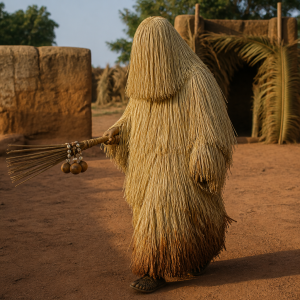
Between the living and Olodumare stand the ancestors. The egungun — the venerated dead — return at festival time embodied in masked, swirling costumed dancers who bring blessings and judgment from beyond the grave, the visible presence of the family’s departed walking once more among the living. And haunting the edges of this orderly cosmos are the spirits who refuse to complete the journey properly: the abiku who die and return only to die again, and the wandering dead. The Yoruba conception of the reanimated corpse — the zombie — traveled with the orishas into the Caribbean, where it became one of the most globally recognized figures in all of world folklore.
How Yoruba Mythology Connects to Other Traditions
*The wider West African family. Yoruba religion is the most globally famous strand of a larger weave of West African mythology. Its closest neighbor is the Dahomey, Fon, and Ewe tradition of Benin and Togo, whose vodun* spirits parallel the orishas so closely that the two systems shaped each other for centuries; Eshu’s role as crossroads-messenger mirrors the Fon trickster Legba almost exactly. The Akan trickster Anansi, the spider who carries the world’s stories, belongs to the same broad African mythological imagination, as does the alluring water spirit Mami Wata, revered across the whole region.
*The Atlantic crossing.* What makes Yoruba mythology unique among ancient systems is its survival of the Middle Passage. Enslaved Yoruba carried the orishas to the Americas and, forbidden to worship openly, hid them behind Catholic saints — Shango behind Saint Barbara, Yemoja behind Our Lady, Babalú-Ayé behind Saint Lazarus. From this ingenious concealment grew the living religions of Caribbean mythology, notably Cuban Santería, and the orisha-worship at the heart of Brazilian mythology in Candomblé. This is why entries like Eshu, Oshosi, and Yemoja belong to several traditions at once on this site.
*The universal patterns.* The trickster-messenger who stands at every threshold links Eshu to the Greek Hermes and the Norse Loki. The dying-and-returning spirit-child echoes in many traditions, and Ogun’s mastery of iron recalls the smith-gods of Greek (Hephaestus) and Egyptian (Ptah) lore. Yet the Yoruba theory of pre-natal destiny — choosing your own fate and forgetting it — has remarkably few parallels anywhere, and remains the tradition’s most original contribution to the world’s mythologies.
Where to Start Reading
The deepest source is the Ifá literary corpus itself — the verses of the Odù Ifá, preserved orally by babalawo and increasingly transcribed and translated; Wande Abimbola’s Ifá: An Exposition of Ifá Literary Corpus is the standard scholarly gateway. For the historical and dynastic background, Samuel Johnson’s The History of the Yorubas (1921) remains foundational, written by a Yoruba clergyman who recorded the oral traditions before they could fade.
For modern readers, William Bascom’s Ifá Divination and Sixteen Cowries are classic ethnographies of the system in practice, while the late Pierre Verger’s photographs and writings document the orishas on both sides of the Atlantic. Anyone curious about the living diaspora religions will find Joseph Murphy’s Santería and Working the Spirit accessible and humane introductions to how this ancient mythology breathes today.
Explore Yoruba Mythology on Gods and Monsters
Gods and Monsters currently holds 16 Yoruba entries, spanning the great orishas, the death-spirits, and the forces of misfortune.
Browse all Yoruba Mythology entries →
Obatala · Orunmila · Eshu · Ogun · Shango · Oshosi · Oshun · Yemoja · Olokun · Abiku · Emere · Ajogun · Iwin · Egbere · Zombie
Frequently Asked Questions
Who is the supreme god in Yoruba mythology?
The supreme being is Olodumare, also called Olorun (“owner of the sky”). He is the omnipotent, omniscient source of all existence, but he is deliberately remote: he has no temples and receives almost no direct worship. Instead he delegates the running of the universe to the orishas, divine intermediaries who handle the actual affairs of the world. This is why a Yoruba worshipper prays to Shango or Oshun rather than to the high god himself.
What is an orisha?
An orisha is a divine being who governs a specific force of nature or aspect of human life and serves as an intermediary between humanity and Olodumare. There are said to be 401 of them — “400 plus one,” a number meant to signal that the pantheon is open rather than fixed. Some, like Olokun, are primordial; others, like Shango, were once human kings who became gods after death. Each has its own colors, foods, drum rhythms, and personality.
What is Ifá divination?
Ifá is the Yoruba system of divination through which the orisha Orunmila communicates the will of heaven. A trained priest called a babalawo manipulates sacred palm nuts or a divining chain to produce one of 256 patterns called odu, each linked to a vast body of memorized verses containing myths, proverbs, and prescriptions. The diviner recites the relevant verses and interprets which sacrifice or action will set the seeker’s life right. UNESCO has recognized Ifá as a masterpiece of humanity’s oral heritage.
Why must Eshu be honored first?
Eshu is the divine messenger and guardian of the crossroads, and no prayer or sacrifice reaches the other orishas unless he carries it. To skip him is to have your offering go undelivered. He is neither good nor evil but the principle of exchange and chance itself, and Yoruba ritual salutes him before any other deity — a striking reversal of traditions that treat their trickster as an afterthought or an enemy.
What is ori, and how is it different from a soul?
Ori is your “inner head” — the personal destiny each soul chooses while kneeling before Olodumare in heaven, before birth. It contains the entire shape of your coming life, which you then forget the moment you are born. Unlike a Western soul, ori is something you selected for yourself, which makes it both deeply personal and partly hidden; recovering knowledge of it through Ifá is a central spiritual goal. In some respects your ori is regarded as a personal divinity in its own right, worthy of veneration.
How did Yoruba mythology spread to Cuba and Brazil?
Between the 16th and 19th centuries, the transatlantic slave trade carried hundreds of thousands of Yoruba people to the Americas. Forbidden to practice their religion, they disguised the orishas behind Catholic saints, and from this fusion emerged living faiths: Santería (or Lucumí) in Cuba within Caribbean mythology, and Candomblé in Brazil. Yemoja became Yemayá and Iemanjá; Shango became Changó and Xangô. These religions are practiced by millions today, which makes Yoruba one of the only ancient mythologies that is still a living, growing faith.