Ukrainian Mythology: The Complete Guide to the Kyivan Gods, the Household Spirits, and the Souls in the Reeds
Ukrainian mythology was never written down by the people who believed it — and that is exactly why so much of it survived. The pagan Slavs of the Dnipro had no Eddas, no Homer, no sacred book. Their gods reach us secondhand, sneered at in the margins of monks’ chronicles, and yet the older faith outlasted the parchment that condemned it. While the official pantheon was toppled into the river in 988, the household spirits, the water-maidens, and the seasonal effigies slipped quietly into folk custom and kept working for another thousand years.
The single most important document is the Primary Chronicle (the Povist vremennykh lit), compiled by Kyivan monks in the early twelfth century, which records that in 980 CE Prince Volodymyr the Great erected a hilltop pantheon of six idols outside his palace — and then, eight years later, had the chief of them dragged down and beaten into the Dnipro at his conversion. Everything else comes from the Hypatian Chronicle, scattered sermons against paganism, and above all from the nineteenth-century ethnographers who walked Ukrainian villages writing down what grandmothers still did at midsummer and what farmers still left out for the spirit under the stove.
What you get from those sources is not a tidy theology but a living, layered folk religion: a thunder-god who still rumbles in the spring, drowned girls who haunt the rye, a tutelary spirit behind every hearth, and a green paradise beyond the sea where the birds go in winter. This guide maps all of it — the state gods of Kyiv, the swarm of domestic and wild spirits that mattered far more to ordinary life, the central myths, and the three-world cosmos strung along a great oak.
What Makes Ukrainian Mythology Different
The gods were demoted, but the spirits were never dethroned. In most mythologies the high gods are the load-bearing wall. In the Ukrainian case the high gods — Perun, Veles, and the rest of Volodymyr’s hill — were politically installed and politically destroyed within a single decade. What actually carried the tradition forward was the lower stratum: the domovyk behind the stove, the rusalka in the river, the leshy in the woods. This is a mythology whose center of gravity sits at the household and the riverbank, not the throne room.
It is a survival, not a reconstruction. Kupala Night bonfires, the springtime drowning of Marzanna, the bread and salt left for the house-spirit — these were still being performed by Christian villagers well into the twentieth century, a pagan substrate wearing a thin Orthodox veneer. Few European traditions kept their old ritual calendar this intact and this alive under a new religion.
Its oldest worshipped beings were protective spirits, not sky-fathers. The earliest Slavic religious reference, a Kyivan monk’s twelfth-century sermon, complains that the Slavs first worshipped “vampires and bereginy” — spirits of the dead and protective riverbank spirits like Berehynia — and only later turned to Perun. The animist layer is explicitly older than the pantheon.
The afterlife is a migration, not a judgment. The good dead do not face a tribunal. They fly, with the birds, to Vyrai — a warm green land beyond the sea where spring is stored over the winter. Souls and starlings make the same journey. It is one of the gentlest and most agricultural visions of death in European myth.
The defining conflict is a thunderstorm, and it never ends. The cosmic enemy of the sky-god is not slain once and for all. Perun chases Veles every single spring, and every thunderclap is another round. There is no Ragnarök here, no final battle — only an eternal, seasonal, regenerative quarrel between the top of the world-tree and its roots.
The Major Gods of the Kyivan Pantheon
Volodymyr’s Six
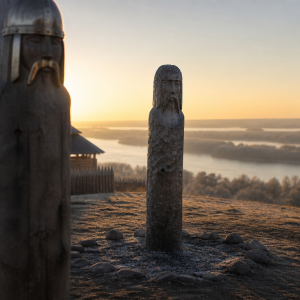
Perun — god of thunder, lightning, war, and sworn oaths, and the chief idol on Volodymyr’s hill: a wooden figure with a silver head and golden moustache. He is the Slavic cousin of Thor and Indra, an Indo-European storm-king whose weapon is the lightning-bolt and whose sacred tree is the oak. Warriors swore treaties on his name, and breaking such an oath invited his bolt.
Veles — god of cattle, wealth, poetry, magic, and the underworld, and Perun’s eternal adversary. Tellingly, his idol stood not on the royal hill but down in Kyiv’s merchant and craftsmen’s quarter by the river — the chthonic god of the commoners and the dead, set apart from the warrior-king on high.
Mokosh — the great mother goddess and the only female on Volodymyr’s hill, patroness of women, spinning, weaving, childbirth, and the moist earth. She proved the most durable of all: her cult bled seamlessly into the veneration of St. Paraskeva and “Mother Moist Earth,” and village women honored her spinning-taboos for centuries after the idols fell.
Svarog — the divine smith and sky-father associated with fire, the forge, and the heavens, who in some traditions hammered the sun into being and gave humans the gift of metalworking and marriage. His name echoes the Sanskrit svarga, “heaven.”
Simargl — the strangest of the six, a winged hound or griffin-like guardian of seeds, sprouts, and growing plants, almost certainly borrowed from the Iranian Simurgh. His presence on the hill is a fingerprint of the steppe’s Persian-speaking peoples on the Slavic pantheon.
Two further gods named in the Primary Chronicle — the sun-god Dazhbog and the wind-god Stribog, along with the solar Khors — were raised on the same hill but do not yet have their own entries on the site (see Notable Missing Entries below).
The Older and Wilder Powers
Rod — the primordial generative principle, the god of kin, fate, and birth, regarded by many scholars as an older and more abstract creator-figure than the warlike Perun. “Rod” is the root of the Slavic words for clan, kindred, birth, and nature itself.
Marzanna — goddess of winter, plague, and death, whose straw effigy is still drowned or burned every spring across the Slavic world to drive the cold season out and let life return. She is death made seasonal and reversible — killed annually so the spring can come.
Berehynia — originally one of a class of riverbank water-spirits among the oldest beings the Slavs venerated, reinvented in modern Ukraine as a national mother-protectress whose figure now crowns the Independence Monument in Kyiv. Few mythological beings have been so thoroughly resurrected as living symbols.
Dola — the personification of a person’s fate or fortune, a spirit allotted to each individual at birth who could be generous (dola) or ruinous (nedola). She is fate as a quiet companion rather than a thread cut by distant Norns.
Narecnitsi — fate-spirits who visit a newborn on its first nights to pronounce its destiny, the Slavic counterpart of the Greek Moirai. What they decree cannot be undone, and parents left out bread, salt, and wine to sweeten their judgment.
Creatures, Monsters & Supernatural Beings
The House and Its Guardians
Domovyk (Domovoi) — the bearded household spirit who lives behind the stove or under the threshold, protecting the family and livestock so long as he is respected and fed. A contented domovyk keeps a house prosperous; an offended one sours milk, tangles horses’ manes, and bangs in the night.
Dvorovoi — the spirit of the yard rather than the house, who watches over the farmstead and its animals but is touchier than his hearth-bound cousin, with a particular dislike of white-coated livestock.
Bannik — the spirit of the bathhouse, a genuinely dangerous being who claims the steam-room after the third or fourth round of bathers and will scald or suffocate anyone who intrudes on his time. The bathhouse, a place of birth and ritual washing, was always slightly outside the safe Christian world.
Ovinnik — the spirit of the threshing barn, a sooty, cat-shaped guardian of the grain-drying kiln who could either protect the harvest or, if angered, burn the whole barn down. Fire in a barn full of dry grain was the deadliest of household risks, and he personified it.
The Spirits of Field and Forest
Leshy — the lord of the forest, a shapeshifting spirit who can tower over the pines or shrink to a blade of grass, leading travelers in endless circles until they drop. He is morally neutral — guardian to those who respect the wood, tormentor to those who do not.
Lisovykha — the female forest spirit, the wild woodland counterpart and sometimes mate of the leshy, who lures and bewilders men who stray too deep among the trees.
Polevik — the noon spirit of the open field, who walks the furrows at the hottest hour and punishes anyone foolish enough to sleep in the grain at midday. The field, like the forest, had its own jealous master.
Lady Midday — Poludnitsa, a beautiful and terrible woman in white who appears in the shimmering heat of high noon, posing riddles to harvesters and striking down with sunstroke those who answer wrong. She is a mythologized heatstroke, and a warning to rest at midday.
Kikimora — a female household spirit gone wrong: a restless, often malevolent presence who whistles and rattles in the night, snarls the spinning, and pinches sleeping children. In some tellings she is the soul of an unbaptized or wronged dead girl.
The Restless and Drowned Dead
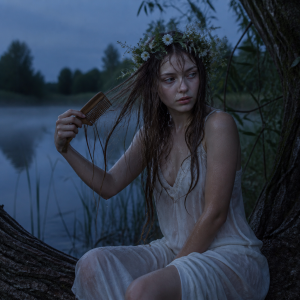
Rusalka — the most famous Ukrainian spirit of all: a water-maiden with long unbound hair, often the ghost of a girl who drowned or died unwed. In the older, pre-nineteenth-century understanding she was a benevolent fertility spirit who rose from the water in spring to bring life-giving moisture to the rye; only later did she become the seductive drowner of young men. During Rusalka Week the maidens were thought to leave the water and swing in the birch trees.
Vodyanoy — the male water-spirit, a bloated, frog-faced old man who rules rivers and mill-ponds and drowns the careless to add their souls to his servants. Millers and fishermen made quiet offerings to keep on his good side.
Topielec — the drowned-dead spirit itself, the malevolent ghost of one who died in the water and now drags others under to share its fate. Where the vodyanoy is the lord of the water, the topielec is its hungry victim, turned predator.
Nocnitsa — the “night hag,” a spirit that torments infants and sleepers after dark, sitting on the chest and stealing breath — the Slavic face of the nightmare. Mothers drew protective circles and hung iron to keep her from the cradle.
Mora — a night-spirit or living witch’s soul that slips from the body to press and suffocate sleepers, the very root of the word “nightmare.” She could squeeze through the smallest keyhole or knot-hole to reach her victim.
Strzyga — a vampiric undead born from a person with two souls or two rows of teeth, who rises from the grave to feed on blood and breath. The strzyga is one of the clearest ancestors of the Slavic vampire proper.
Koschei — Koschei the Deathless, the gaunt sorcerer-king who cannot be killed because his soul is hidden outside his body: in a needle, in an egg, in a duck, in a hare, in an iron chest, buried under a green oak on a far island. He abducts heroes’ brides and is undone only by a champion clever enough to unpack that nest of hiding-places.
Likho — the one-eyed embodiment of evil misfortune, a gaunt figure who attaches herself to a person and devours their luck and often their life. “Do not wake Likho while it is quiet” remains a Slavic proverb against tempting fate.
Bies — an ancient word for an evil spirit or demon, predating Christianity but readily absorbed into it as a term for the devil’s lesser imps. The old animist demon and the new Christian one fused in the single word.
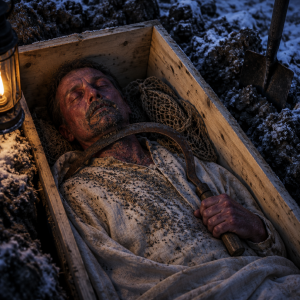
Nav — both the realm of the dead and the malevolent spirits of those who died wrongful or premature deaths, who return to trouble the living. The navky are close kin of the rusalky — the unquiet, unsatisfied dead.
Dragons, Beasts & Wonder-Birds
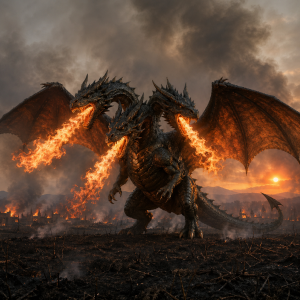
Zmey Gorynych — the great multi-headed dragon of the East Slavs, breathing fire, flying on leathery wings, and guarding the river-crossing into the underworld. Unlike the gold-hoarding Western dragon, the zmey abducts maidens and blocks the boundary between worlds; cut off one head and another grows unless you sear the stump.
Tugarin Zmeyevich — a dragon in human shape, a monstrous serpent-knight of the bylina epics who threatens the court of Kyiv until a hero like Alyosha Popovich brings him down. He fuses the dragon-myth with the historical memory of steppe nomad raiders.
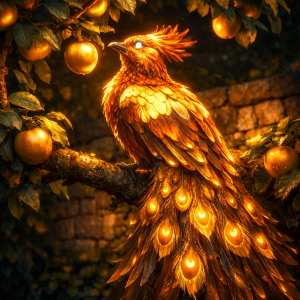
Fire Bird (Zhar-Ptitsa) — the glowing quarry of countless folktales, a bird whose feathers shine like flame and burn the hand that grasps a single plume. To seek it is to be sent on the impossible quest that drives the whole story forward. Magnificent and ominous at once: a single dropped feather is a blessing and a curse, beautiful enough to start a king’s obsession and dangerous enough to end a prince’s peace.
Alkonost — a woman-headed bird of paradise whose song is so ravishing that whoever hears it forgets everything they ever knew. She lays her eggs on the seashore at the winter solstice and rolls them into the sea, calming the waters for seven days.
Sirin — another woman-faced bird, darker than the Alkonost, whose enchanting song lures men to follow her into death. She and the Alkonost are the bright and shadow halves of the Slavic siren.
Gamayun — the prophetic bird of wisdom, who knows the secrets of creation and the fate of all things and speaks them to those who can understand. To hear the Gamayun is to receive a revelation of the future.
Maidens and Shapechangers
Vila — beautiful winged nymphs of mountain, cloud, and water, the souls of young women who can heal, prophesy, and fight, but who dance careless men to death and turn deadly if betrayed. They are the South Slavic cousins of the rusalka, fierce and free.
Werewolf — the vovkulaka, a person cursed or self-transformed into a wolf, a figure so deeply rooted in Slavic lands that the very word “werewolf” travels with the Slavic volk. Some were victims of a sorcerer; some shapeshifted willingly under the full moon.
The Central Myths
Perun and Veles: The Storm That Never Stops
The foundational myth of the East Slavs is the duel between Perun, enthroned in the crown of the world-tree, and Veles, coiled serpent-like among its roots. Veles slithers up and steals something vital — Perun’s cattle, his waters, sometimes his wife — and flees back toward the earth. Perun gives chase, hurling lightning, and Veles hides behind a tree, a stone, a cow, a man; wherever the bolt strikes, that is where the god was hiding. When Perun finally splits him, the stolen waters are released and the rains fall.
Why it matters: this is not a creation-ending war but a seasonal one. The combat returns every spring with the first thunderstorms and resolves into the rain that feeds the crops. It is the engine of the agricultural year mythologized as a family feud, and it explains why the storm-god and the cattle-and-underworld god are eternal, evenly matched enemies rather than victor and vanquished.
The Toppling of the Idols
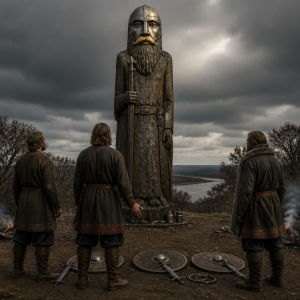
In 980 CE, according to the Primary Chronicle, Prince Volodymyr raised his six idols on the hill above Kyiv and the people made offerings, “and the land of Rus was defiled with blood.” Eight years later Volodymyr accepted Byzantine Christianity, and ordered the same idols destroyed: Perun was tied to a horse’s tail, beaten with sticks, dragged down to the Dnipro, and thrown in, with men appointed to push him off the bank whenever he caught on the shore.
Why it matters: this is the rare case of a pagan pantheon’s death recorded almost as journalism, by the very church that killed it. The image of the old thunder-god floating down the river, escorted to the rapids so he could not climb back out, is the hinge on which the whole tradition turns — and the moment the gods handed their long survival over to the humbler spirits the chroniclers never bothered to drown.
The Death of Marzanna and the Return of Spring
Each year at winter’s end, villagers build a straw effigy of Marzanna, the goddess of winter and death, dress her in rags and ribbons, carry her in procession to the edge of the village, and then drown her in the river or set her alight — driving death itself out of the community so that spring may enter. The rite is still performed today.
Why it matters: it encodes the deepest logic of Ukrainian myth, that death is seasonal, local, and reversible. You can physically evict winter; you can kill the goddess of death and know she will be back next year to be killed again. It is the same cyclical, regenerative worldview that powers the Perun–Veles storm, acted out by ordinary people with their own hands.
Afterlife & Cosmology: The Three Worlds and the Green Beyond
The Slavic cosmos is a single great oak — the world-tree. Its crown holds Prav, the realm of light, divine order, and the sky-gods. Its trunk is Yav, the visible middle world where humans, animals, and the spirits of field and forest live. Its roots descend into Nav, the dark underworld of the dead, ruled by Veles. Birds nest in the branches, a serpent coils at the root, and the whole structure binds the three worlds into one living organism — a scheme strikingly close to the Norse Yggdrasil.
But the dead do not simply sink into Nav. The blessed souls travel to Vyrai (Iriy) — a warm, green island-paradise beyond the sea or beyond the clouds, where it is always spring and where the migratory birds go each winter. Souls fly there as birds, and return with the birds in spring, sometimes to be reborn. The keys to Vyrai were held, in some tellings, by Veles or by the cuckoo; in Christianized versions, by St. Peter.
What makes this distinctive is its gentleness and its biology. There is no weighing of sins, no fiery torment, no courtroom. Death is a migration synchronized with the seasons and the flight of starlings — the same journey a swallow makes, made by a soul. Those who died badly, by contrast — the drowned, the suicides, the unwed girls — could not make the journey, and stayed behind as rusalky, navky, and topieltsi, the restless dead caught between the worlds.
How Ukrainian Mythology Connects to Other Traditions
Ukrainian mythology is the southern, Dnipro-centered branch of the wider Slavic mythology family, and it shares almost its entire pantheon and bestiary with its closest neighbor, Russian mythology — Perun, Veles, Baba Yaga, Koschei, and the domovyk all belong to the common East Slavic inheritance of Kyivan Rus. The three-headed god Triglav and the West Slavic deities link it westward to the Polish and Baltic Slavic worlds.
Deeper down, it is unmistakably Indo-European. Perun the oak-and-lightning storm-king is the structural twin of Norse Thor, Baltic Perkūnas, and Vedic Indra, and his serpent-enemy Veles replays the universal storm-god-versus-serpent combat found from India to Scandinavia. The world-tree strung between sky, earth, and underworld is a sibling of Yggdrasil, and Vyrai echoes other Indo-European island-paradises of the dead.
The steppe left its mark too: Simargl, the winged plant-guardian, is almost certainly the Iranian Simurgh, carried north by the Persian-speaking Scythians and Sarmatians who shared the Pontic grasslands with the early Slavs. And the woman-headed wonder-birds — the Alkonost, the Sirin, the Gamayun — arrived from Byzantium, Slavic reworkings of the Greek siren that flew up the trade-roads with Orthodox Christianity.
Where to Start Reading
The indispensable primary source is the Primary Chronicle (The Russian Primary Chronicle: Laurentian Text, trans. Cross and Sherbowitz-Wetzor), which preserves both the raising of Volodymyr’s pantheon in 980 and its destruction in 988 — read it alongside the Hypatian Chronicle for the fullest medieval picture. For the pagan substrate itself, the surviving anti-pagan sermons and the Zbruch idol are the closest things to physical scripture the tradition left.
For modern introductions, begin with the relevant chapters of the Encyclopedia of Ukraine and the ethnographic collections of the great nineteenth-century folklorists who recorded living custom before it faded. The broad comparative studies of Slavic religion — and the structural reconstructions of the Perun–Veles “basic myth” by Ivanov and Toporov — show how the fragments fit into a single Indo-European pattern. For atmosphere, the folktale collections of the firebird, Koschei, and Baba Yaga carry more of the living imagination than any chronicle.
Explore Ukrainian Mythology on Gods and Monsters
Gods and Monsters has 39 Ukrainian entries, from the high gods of Kyiv to the spirit behind the stove. Browse all Ukrainian Mythology entries →
Perun · Veles · Mokosh · Svarog · Rod · Simargl · Marzanna · Berehynia · Narecnitsi · Dola · Rusalka · Vodyanoy · Domovoi · Leshy · Baba Yaga · Koschei · Zmey Gorynych · Fire Bird · Alkonost · Sirin · Vila · Vyrai · Nav
Frequently Asked Questions
Is Ukrainian mythology the same as Russian or Slavic mythology?
It is a regional branch of the same family, not a separate system. Ukrainian, Russian, and Belarusian mythology all descend from the East Slavic religion of Kyivan Rus, so they share most gods and spirits — Perun, Veles, the domovyk, Baba Yaga. Within the broader Slavic mythology world, the Ukrainian tradition is distinguished mainly by its particular folk customs, its strong rusalka and Kupala lore, and the Dnipro-centered events of the Primary Chronicle.
Who is the most important god in Ukrainian mythology?
In the official state cult, it was Perun, the thunder-god Prince Volodymyr placed at the head of his pantheon in 980 CE. But in everyday folk practice the most enduring figure was the mother goddess Mokosh, whose worship survived for centuries by merging with Christian saints, and arguably Veles, the god of cattle, wealth, and the dead, who was beloved by the common people. Importance depends on whether you mean the throne or the hearth.
What is a rusalka, and is she good or evil?
A rusalka is a Slavic water-spirit, usually the ghost of a girl who drowned or died before marriage. Crucially, her character changed over time: in older pagan belief she was a benevolent fertility spirit who left the water in spring to bring moisture to the fields, but by the nineteenth century folklore had recast her as a dangerous seductress who lures young men into the water to drown. Both versions coexist in Ukrainian tradition.
What happens to the soul after death in Ukrainian mythology?
The blessed dead fly to Vyrai, a warm green paradise beyond the sea where it is always spring and where the migratory birds spend the winter — souls travel there as birds and may return with the spring. There is no judgment or hell in the Christian sense. Those who died badly, however — the drowned, the unwed, the violent — could not reach Vyrai and lingered as restless spirits like the rusalky and the navky.
Why do people still drown a straw effigy every spring?
That effigy is Marzanna, the goddess of winter, death, and disease, and drowning or burning her is one of the oldest surviving pagan rituals in the Slavic world. The act symbolically evicts winter and death from the community so that spring and new life can return. That it is still performed today, by Christian villagers, is a perfect example of how Ukrainian paganism survived inside folk custom rather than scripture.
Did Ukrainian mythology have written sources like the Greek myths?
No — and this is central to understanding it. The pagan Slavs left no scripture comparable to Homer or the Norse Eddas. Almost everything we know comes secondhand: the Christian Primary Chronicle and Hypatian Chronicle, hostile church sermons against paganism, and the customs that nineteenth-century ethnographers recorded from living villagers. The tradition survived in ritual and folktale rather than text, which is exactly why the household spirits outlasted the high gods.