Tibetan Mythology: The Complete Guide to Bön Spirits, Wrathful Protectors, and the Bardo
Tibetans believe their entire nation was born from an act of compassion: a meditating monkey, an emanation of the bodhisattva of mercy, who married a craggy mountain ogress and fathered the first Tibetans. That origin story tells you almost everything about this tradition. Where Greek myth begins in violence and Norse myth ends in fire, Tibetan mythology begins with tenderness restraining wildness — and never stops negotiating between the two.
Tibetan mythology is really two mythologies braided together. Beneath the Buddhism that arrived in the seventh and eighth centuries lies Bön, the indigenous religion of the Tibetan plateau, with its own founder, its own cosmos hatched from primordial eggs, and a teeming population of mountain gods, water spirits, and soil demons who had to be conquered, converted, or bound by oath before Buddhism could take root. The result is a tradition where enlightened buddhas and bloodthirsty local spirits share the same temple wall, and where the most sacred figures wear necklaces of skulls.
The sources are unusually rich and unusually strange. The Bardo Thödol — the so-called “Tibetan Book of the Dead” — narrates the soul’s terrifying 49-day journey between death and rebirth. The epic of King Gesar of Ling is the longest poem on earth, still sung by living bards. And the Bön scriptures describe the Nine Ways, a complete cosmology of prediction, ritual, and the dispersal of malevolent thought-forms. This is a mythology obsessed with the threshold — between life and death, god and demon.
What Makes Tibetan Mythology Different
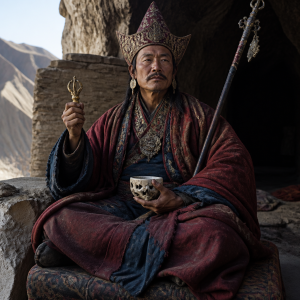
The demons were never destroyed — they were employed. When Buddhism reached Tibet, it did not erase the old gods of mountain and lake. Instead, the tantric master Padmasambhava is said to have subdued them one by one and bound them under oath to protect the new faith. The fierce indigenous spirits became dharmapalas, “dharma protectors,” keeping their terrifying forms and their taste for blood while now serving enlightenment. A Tibetan temple is a parole board for the supernatural.
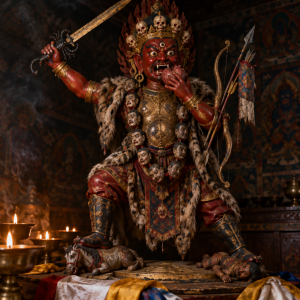
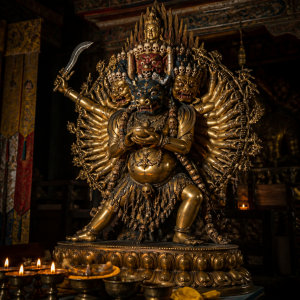
Wrathful does not mean evil. The most important protective deities — Mahakala, Palden Lhamo, Yamantaka — are depicted as monstrous: fanged, flaming, garlanded with severed heads, trampling corpses. Yet they are not demons. They are compassion wearing armor, the ferocity a loving parent shows when something threatens the child. This collapse of the Western good/evil binary is the single hardest thing for outsiders to grasp about Tibetan iconography.
Death is a skill you can practice. No tradition has thought harder about dying. The bardo teachings map the post-mortem state as a sequence of encounters — peaceful deities for the first week, then wrathful ones — that are really projections of the dying mind. The whole point is that you can rehearse death while alive, recognize the visions as your own mind, and win liberation in the gap between bodies. Mythology here is not entertainment; it is an instruction manual for the most important moment of your existence.
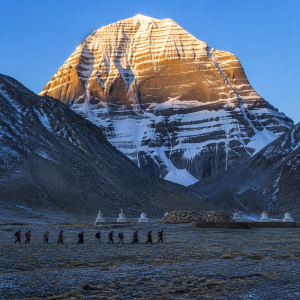
The land itself is divine and touchy. The Tibetan landscape is densely populated by lu (serpent water-spirits), sadak (lords of the soil), nyen (territorial spirits), and mountain gods who own specific peaks. Dig a well, build a house, or pollute a spring without the right ritual, and you risk leprosy, drought, or madness. Geography in Tibet is not a backdrop — it is a community of beings with opinions.
It carries a hidden, older world. Bön preserves a pre-Buddhist Tibet most outsiders never hear about: the lost kingdom of Zhang Zhung, the enlightened founder Tönpa Shenrab born in the mythical land of Ölmo Lungring, and a cosmogony in which gods and demons hatch from eggs laid by a primordial goddess. Bön is not merely “Tibetan paganism” — it is a complete, still-living religion with its own Dzogchen teachings, hiding in plain sight beside Buddhism.
The Major Deities
Tibetan mythology inherited the vast pantheon of Mahayana and Vajrayana Buddhism, then localized it — every cosmic buddha acquired a Tibetan name, a Tibetan home, and often a Tibetan job protecting a particular monastery or valley.
Buddhas and Bodhisattvas
Avalokiteśvara — the bodhisattva of compassion, known in Tibet as Chenrezig, and the single most important deity in the tradition. Tibetans consider themselves his people: he incarnated as the monkey-ancestor of the nation, and both King Songtsen Gampo and every Dalai Lama are held to be his living emanations. His mantra, Om mani padme hum, is the most-spoken prayer on the plateau.
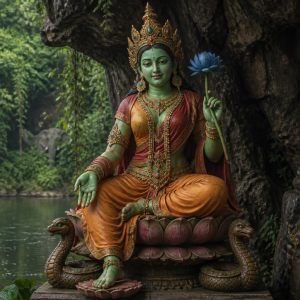
Tara — the swift female savior, born from Avalokiteśvara’s tears and embodying compassion in action. Green Tara rescues from immediate danger; White Tara grants long life and healing. In the origin myth it was Tara, in the form of a rock ogress, who became the mother of the Tibetan people.
Amitabha — the Buddha of Infinite Light, called Öpame in Tibetan, who presides over the western paradise of Sukhavati. He is Avalokiteśvara’s spiritual “father,” and in the bardo it is rebirth in his Pure Land that many Tibetans pray for. The Panchen Lamas are regarded as his emanations.
Manjushri — the bodhisattva of wisdom, who wields a flaming sword to cut through ignorance and holds the Prajnaparamita scripture. King Trisong Detsen, who established Buddhism as Tibet’s state religion, was considered his emanation. The three great bodhisattvas — Avalokiteśvara, Manjushri, and Vajrapani — are the “protectors of the three families.”
Vajrapani — the bodhisattva of power, who grips the thunderbolt-scepter (vajra) and represents the energy of all the buddhas. Wrathful and dark-blue, he is the spiritual enforcer of the Mahayana, said to have been the Buddha’s bodyguard and the keeper of his secret tantric teachings.
Wrathful Protectors (Dharmapalas)
Mahakala — the “Great Black One,” the supreme dharma protector across nearly every Tibetan school. A wrathful emanation of Avalokiteśvara himself, he proves the tradition’s central paradox: the same compassion that weeps as Tara roars as Mahakala, crushing whatever obstructs the path.
Palden Lhamo — the only female member of Tibet’s supreme trio of protectors and the special guardian of Lhasa, the Dalai Lamas, and the Gelug school. She rides a wild mule across a sea of blood, the animal’s flank marked with an eye made from a wound; legend says she killed her own son to break her ties to a demon kingdom, and wears his flayed skin as a saddle. Her wrath is grief transmuted into protection.
Yamantaka — the “Destroyer of Death,” the buffalo-headed wrathful form of Manjushri, created specifically to conquer Yama, the lord of death. He is the third of the great Gelug protectors alongside Mahakala and Palden Lhamo, and the meditational deity through whom a practitioner confronts mortality itself.
Yama — the lord of death and judge of the dead, called Shinje in Tibetan. He weighs the deeds of the deceased with black and white pebbles and holds the Wheel of Life in his jaws, a reminder that all of cyclic existence is gripped by death. In the bardo he appears as Dharmaraja, the terrifying king of the law.
Creatures, Monsters, and Supernatural Beings
The Tibetan supernatural ranges from celestial emblems woven into the national flag to soil-demons blamed for specific diseases.
Emblems of the Sacred Land
Snow Lion — the celestial guardian of Tibet, a turquoise-maned white lion that dwells in the high glaciers and embodies fearless joy. Eight snow lions support the Buddha’s throne, and a pair of them flank the Tibetan national emblem. Said to leap from peak to peak, the snow lion never touches the lowlands — it is the spirit of the mountains made flesh.
Wind Horse — lungta, the horse that carries prayers to the heavens on the back of the wind. It is the galloping figure at the center of every Tibetan prayer flag, bearing the wish-fulfilling jewel and flanked by the four dignities: Garuda and dragon above, tiger and snow lion below. To “raise the wind horse” is to lift one’s luck and life-force itself.
Garuda — the great bird, called Khyung in the Bön tradition, where it is among the oldest and most powerful symbols, predating Buddhism. Enemy of the serpent-spirits and lord of the sky, the Garuda hatches fully grown and ready to fly, an emblem of awakened awareness that needs no maturing.
Water-Spirits and Local Powers
Naga — the lu, serpent-beings who guard the springs, lakes, and underground treasures of Tibet. They control rain and fertility but inflict skin diseases and plagues on those who pollute their waters. Half-human and half-serpent, often female, the lu are among the most ritually significant beings in everyday Tibetan life — far more present than any remote buddha.
Makara — the chu-srin, a water-monster fusing crocodile, fish, and elephant, who guards thresholds and gateways. Its gaping jaws frame temple doorways and the tops of ritual victory-banners, devouring obstacles before they can pass.
Kinnara — half-human, half-bird celestial musicians whose songs fill the Buddhist heavens, paired as devoted lovers and held up as emblems of fidelity and beauty in the Himalayan imagination.
Hidden and Half-Glimpsed Beings
Yeti — the wild man of the snows, the mi-go, an ape-like giant haunting the highest passes. Long before Western mountaineers turned it into the “Abominable Snowman,” Himalayan peoples regarded the yeti as a real and dangerous mountain dweller, its scalp and hand preserved as relics in monastery treasuries.
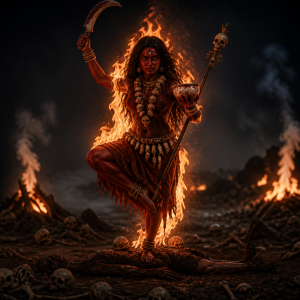
Dakini — the “sky-goer,” a female embodiment of enlightened energy who moves through the air and acts as muse, messenger, and initiator to tantric practitioners. Dakinis are wild and unpredictable, appearing as beautiful women or hideous hags; they guard the secret teachings and test the worthy, the feminine wisdom-force at the heart of Vajrayana.
Yaksha — nature-spirits and guardians of hidden wealth who dwell in trees, hills, and the earth. In Tibet they merge with the indigenous nyen, territorial spirits whose ground must not be disturbed, and they serve in the armies of the directional guardian kings.
Rakshasa — flesh-eating demons, called srin po, who in Tibetan myth are not merely monsters but ancestors: the rock ogress who mothered the Tibetan race was a srin mo, and the land itself was imagined as a vast demoness pinned down by temples built on her limbs.
The Central Myths
The Monkey and the Ogress
In the beginning the Tibetan plateau held no people. Avalokiteśvara sent a disciple, incarnated as a meditating monkey, to practice in solitude among the rocks. A mountain ogress — a srin mo demoness, later understood as an emanation of Tara — discovered him and threatened to take a demon husband and breed a race of monsters unless the monkey married her. Torn between his vows and his compassion, the monkey sought Avalokiteśvara’s blessing and consented. Their six children became the first Tibetans, inheriting from their father gentleness, faith, and compassion, and from their mother stubbornness, appetite, and fierce vitality.
Why it matters: Tibetans explain their own national character through this myth — the perpetual tension between spiritual devotion and earthly toughness. It also frames the entire arrival of Buddhism: a civilizing compassion taming a wild land, the same drama that plays out when Padmasambhava later subdues the demons.
Taming the Supine Demoness
When King Songtsen Gampo sought to build Tibet’s first Buddhist temples in the seventh century, his Chinese bride diagnosed the trouble through geomancy: the whole land was the body of a giant supine demoness (srin mo), lying on her back and obstructing the dharma. To pin her down, the king built temples on her vital points — the central Jokhang on her heart, and twelve “border-taming” and “district-taming” temples nailing her shoulders, hips, knees, elbows, hands, and feet across the plateau and beyond.
Why it matters: This is the founding charter of Buddhist Tibet, and a perfect image of the tradition’s method. The old chthonic power is never killed — she is fixed in place, made to bear the new religion on her own body. Tibet’s sacred geography is literally built on a conquered earth-goddess.
King Gesar of Ling
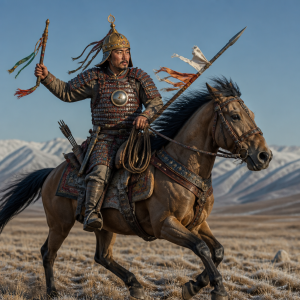
Gesar, a heavenly being reborn as a despised orphan, wins the kingdom of Ling through a horse race, claims his magical steed and weapons, and rides out to wage war on the demon-kings of the four directions who devour the dharma and oppress the helpless. Across episodes that can take a bard days to sing, he conquers the man-eating demon of the north, the kings of Hor, and a dozen other enemies, before withdrawing to a hidden land to await a future age.
Why it matters: The Epic of King Gesar is the longest poem in the world and still living — bards in Tibet, Mongolia, and the Himalayas enter trance to sing verses they were never taught. Gesar remains a model of how worldly power can serve sacred ends.
Padmasambhava Binds the Gods
When Buddhism faltered against Tibet’s hostile spirits in the eighth century, King Trisong Detsen invited the tantric master Padmasambhava — “Guru Rinpoche” — from the Swat valley. As he traveled, he confronted each local god and demon obstructing the work, defeated them in magical combat, and bound them under oath as protectors of the dharma rather than destroying them. He then concealed countless terma, hidden teachings, in rocks, lakes, and the minds of future disciples, to be revealed when the time was ripe.
Why it matters: This single narrative pattern — confront, subdue, convert, employ — is the engine of the entire Tibetan pantheon. It explains why fearsome indigenous spirits became Buddhist dharmapalas, and it gives the Nyingma school its central founding figure and its endlessly renewing scripture.
The Bardo: Cosmology of the Threshold
Tibetan mythology’s true masterpiece is its map of death. The Bardo Thödol describes the bardo, the “intermediate state” lasting up to 49 days between dying and the next rebirth, narrated as a journey the consciousness takes through a sequence of visions.
At the moment of death dawns the clear light, the naked, luminous nature of mind itself; one who recognizes it is liberated instantly. Most do not. Over the following days the dead person meets the Peaceful Deities — serene buddhas radiating overwhelming light — and then, as terror and old habits reassert themselves, the Wrathful Deities: blood-drinking, many-armed forms erupting from the same enlightened ground. The crucial teaching is that every figure, peaceful or wrathful, is a projection of the dying person’s own mind. Recognize the visions as yourself, and the cosmos dissolves into freedom. Flee them in fear, and you are driven toward rebirth, finally drawn to a copulating couple and the womb that will hold you next.
Overseeing the moral reckoning is Yama as Dharmaraja, sorting black and white pebbles to weigh a life. Above the whole system sits the Wheel of Life, bhavachakra, painted at the entrance of every Tibetan monastery: six realms of gods, jealous titans, humans, animals, hungry ghosts, and hell-beings, all turned by craving and gripped in the jaws of death.
This cosmology is what makes Tibetan mythology singular. It is not a story about the gods — it is a guided rehearsal for the moment you become the story, with the explicit promise that practice can change the ending.
How Tibetan Mythology Connects to Other Traditions
Indian Buddhism and Hinduism are the deepest root. Nearly every Tibetan deity — Tara, Manjushri, Mahakala, Yama — arrived from India, and creatures like the naga, garuda, yaksha, and rakshasa are shared with the broader Indic world. Tibet did not invent this pantheon so much as inherit it and give it a colder, higher home.
Indigenous Bön and the spirits of the land form the other half. The mountain gods, soil-lords, and water-serpents have no Indian origin; they are the genuine pre-Buddhist religion of the plateau, and they give Tibetan Buddhism its distinctive texture — a high philosophy of emptiness layered over an ancient animism of place.
Chinese and Mongolian traditions flow both ways. The makara and dragon imagery echoes Chinese forms, geomancy shaped the demoness-taming myth, and the Gesar epic became a Mongolian national treasure, where Gesar fused with the war-god and was even identified with historical figures.
The Himalayan continuum — Bhutan, Nepal, Ladakh, Sikkim, and Mongolia — shares the same snow lion, wind horse, and yeti, making Tibetan mythology less a national possession than the shared imaginative world of an entire mountain civilization.
Where to Start Reading
For the heart of the tradition, begin with the Bardo Thödol (the “Tibetan Book of the Dead”); Robert Thurman’s modern translation is the most accurate, while the classic Evans-Wentz edition shaped the West’s image of it. For the epic sweep, Alexandra David-Néel’s The Superhuman Life of Gesar of Ling remains the most accessible retelling in English.
For the Bön substrate, Per Kvaerne’s The Bon Religion of Tibet and David Snellgrove’s The Nine Ways of Bon are the scholarly standards. For the living texture of Tibetan belief — the lu, the mountain gods, the oracles — René de Nebesky-Wojkowitz’s Oracles and Demons of Tibet is the indispensable classic.
Explore Tibetan Mythology on Gods and Monsters
Gods and Monsters currently has 5 entries specifically catalogued under Tibetan mythology, with many more shared figures from the wider Buddhist and Himalayan world. Browse all Tibetan Mythology entries →
Palden Lhamo · Vajrapani · Dakini · Snow Lion · Wind Horse · Avalokiteśvara · Tara · Amitabha · Manjushri · Mahakala · Yama · Garuda · Naga · Makara · Kinnara · Yaksha · Rakshasa · Yeti · Buddha
Frequently Asked Questions
What is the difference between Bön and Tibetan Buddhism?
Bön is Tibet’s indigenous religion, predating the arrival of Buddhism in the seventh and eighth centuries. It has its own founder, Tönpa Shenrab, born in the mythical land of Ölmo Lungring, and its own cosmology in which the world emerges from primordial eggs and is mapped by the Nine Ways of Bön. Over centuries Bön and Buddhism heavily influenced each other — modern Bön has its own monasteries and even its own Dzogchen teachings closely paralleling the Nyingma school. The simplest distinction is lineage and founder, not a sharp doctrinal divide.
Why are Tibetan protector deities so terrifying to look at?
Because in Tibetan Buddhism wrath is a form of compassion, not its opposite. Deities like Mahakala, Palden Lhamo, and Yamantaka are depicted with fangs, flames, and garlands of skulls to show the overwhelming force needed to destroy ignorance, ego, and obstacles on the path. Many were originally fierce local demons whom Padmasambhava bound by oath to protect the dharma. The fearsome appearance is the energy of enlightenment in its most active, obstacle-crushing mode — the same compassion that smiles as Tara roars as Mahakala.
What is the Tibetan Book of the Dead actually about?
The Bardo Thödol is a guide read aloud to a dying or recently dead person to lead them through the bardo, the up-to-49-day intermediate state between death and rebirth. It describes a sequence of visions — first a brilliant clear light, then peaceful buddhas, then wrathful deities — and repeatedly insists that every figure is a projection of the dead person’s own mind. Recognizing them as such brings liberation; fleeing in fear leads to rebirth. It is less a book about the afterlife than a practical manual for navigating consciousness at the moment of death.
Who is the most important god in Tibetan mythology?
Avalokiteśvara, known in Tibetan as Chenrezig, the bodhisattva of compassion. Tibetans regard him as the patron of their entire nation: he fathered the Tibetan people in the form of a monkey, his mantra Om mani padme hum is recited everywhere, and the Dalai Lamas are believed to be his living incarnations. Strictly he is a bodhisattva rather than a creator god, but no figure is more central to Tibetan religious life.
Is the Yeti part of Tibetan mythology or just a modern legend?
The yeti, or mi-go, is a genuine part of Himalayan folklore that long predates its twentieth-century fame as the “Abominable Snowman.” For centuries mountain peoples described an ape-like wild man inhabiting the high snows, and several monasteries claimed to preserve yeti scalps and hands as relics. While Western mountaineering turned it into a cryptozoological celebrity, the yeti sits naturally alongside the other half-glimpsed beings — the wild dakinis, the soil-demons — that populate the Tibetan landscape.
What are nagas and why do Tibetans fear them?
Nagas, called lu in Tibetan, are serpent-spirits who inhabit springs, lakes, rivers, and the underground world, and who control rain, fertility, and hidden wealth. They are powerful but easily offended: pollute their water, dig into their soil, or cut down their trees, and the lu retaliate with skin diseases, plagues, drought, or madness. Because of this, naga rituals are among the most common in everyday Tibetan life — far more frequent than devotions to remote cosmic buddhas — making these water-serpents arguably the most practically important beings in the entire mythology.