Sumerian Mythology: The Complete Guide to the World’s First Gods, the Descent of Inanna, and the Birth of the Flood Story
This is the oldest mythology humans ever wrote down. When scribes in the city of Uruk pressed reed styluses into wet clay around 3000 BCE, they were not inventing literature so much as freezing in cuneiform a religion already ancient — gods who had been worshipped in the mudbrick temples of southern Mesopotamia for centuries before anyone found a way to record them. Everything that came later borrowed from here. The flood that drowns the world and the one righteous man who builds a boat; the goddess who walks into hell and is hung on a hook; the half-divine king who refuses to accept that he must die — all of these stories were Sumerian first, told in a language unrelated to any other on Earth, before Greece, before the Hebrew Bible, before the pyramids reached their final height.
What survives is fragmentary and astonishing. The Sumerians left no neat scripture; instead we have school exercises, temple hymns, royal propaganda, and laments copied and recopied by trainee scribes, most of them excavated only in the last century and a half and still being pieced together tablet by tablet. The primary sources are works like the Descent of Inanna, the Eridu Genesis, Enki and Ninhursag, Lugal-e (Ninurta’s combat with the demon Asag), and the bilingual god-lists that ancient scholars compiled to keep their own enormous pantheon straight. The Electronic Text Corpus of Sumerian Literature now hosts most of it in translation.
And it is genuinely strange — not a primitive sketch of later religions but a coherent, alien worldview, one where the gods made humans specifically to do their farming, where the dead all share the same dreary fate regardless of virtue, and where wisdom arrived not through prophets but through fish-cloaked sages who climbed out of the sea.
What Makes Sumerian Mythology Different
It is the source code, not a branch. Most mythologies can be compared sideways to their neighbors. Sumerian mythology sits upstream of an entire civilizational tradition. The Mesopotamian and later Akkadian, Assyrian, and Babylonian systems are direct descendants — the Babylonians took Sumerian Inanna and renamed her Ishtar, took the moon-god Nanna and called him Sin, took the sun-god Utu and called him Shamash. When you read Sumerian myth you are reading the first draft of religious imagery that the Bible and even Greek poetry would later inherit.
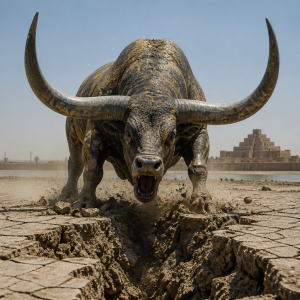
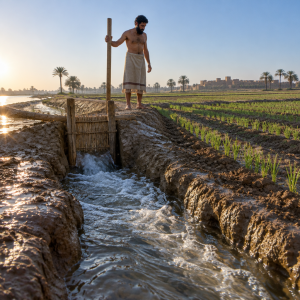
Humans were created to work. There is no benevolent design here. In Sumerian theology the lesser gods, the Igigi, went on strike from the backbreaking labor of digging the canals, and so the clever god Enki and the mother goddess Ninhursag fashioned humanity out of clay mixed with divine blood for one purpose: to take over the work and feed the gods their sacrifices. People exist to relieve the gods of their chores. It is one of the bluntest accounts of the human condition any culture has produced.
The afterlife is the same for everyone, and it is bleak. There is no heaven, no hell of punishment, no weighing of the heart as in Egyptian belief. Kings and beggars alike descend to Kur, a lightless cavern where the dead eat dust and drink muddy water, ruled by the grim queen Ereshkigal. Good deeds buy you nothing. What slightly improves your eternity is having living descendants to pour offerings — making the afterlife less a moral reckoning than a question of who remembers you.
**The cosmos is governed by the me — civilization itself, made into objects.** The Sumerians imagined the components of culture — kingship, the priesthood, truth, lovemaking, music, even disputation and the carpenter’s craft — as concrete divine powers called the me, which could be held, stolen, drunk away, and transported. When Inanna wanted to make her city of Uruk great, she did not pray for prosperity; she got Enki drunk and carried the me home by boat. Civilization, to a Sumerian, was a thing you could physically possess.
The gods are bureaucrats with home cities. Each major deity governed a specific city and lived in its temple as a literal resident, not a symbol. Enlil belonged to Nippur, Enki to Eridu, Inanna to Uruk, Nanna to Ur. The pantheon mirrored the political geography of a land of rival city-states, and divine status rose and fell with the fortunes of the cities below.
The Major Gods
The Sumerian pantheon was vast — god-lists name hundreds — but the texts return again and again to a core group the scribes sometimes called “the seven who decree the fates.”
The Ruling Triad
An (Anu) — sky-father and nominal head of the pantheon. An is the most senior and the most remote of the gods, the personification of the heavens themselves, from whom all authority descends. In practice he is so exalted that he rarely acts; he presides while others rule, a divine chairman emeritus.
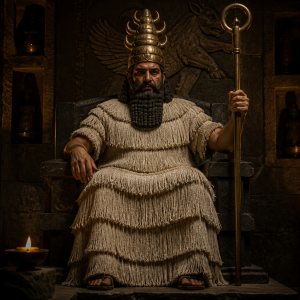
Enlil — “Lord Wind,” the executive power of the cosmos. Enlil holds the Tablet of Destinies and the real day-to-day authority; nothing of consequence happens without his word. He can be a giver of kingship and abundance, but he is also the god who, irritated by the noise of teeming humanity, decides to wipe them out in the Flood. Stern, dangerous, and indispensable.
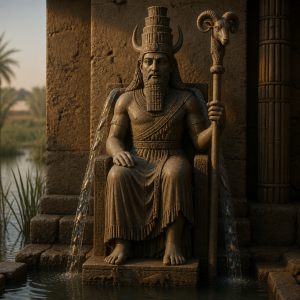
Enki — god of fresh water, wisdom, magic, and craft, dwelling in the Abzu, the freshwater abyss beneath the earth. Enki is the trickster-savior of the pantheon, endlessly clever and unusually fond of humans. Again and again he undercuts Enlil’s harsher decrees, warning humanity of the coming Flood and devising the schemes that keep the world running. Where Enlil is the storm, Enki is the water that finds a way around every obstacle.
Earth, Sky, and the Lights
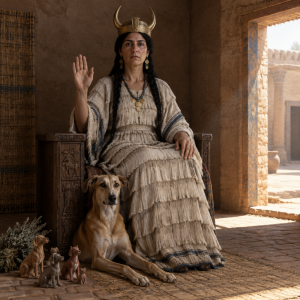
Ninhursag — the great mother goddess, “Lady of the Mountain,” also called Ki, Ninmah, and Nintu. She is the womb of creation, co-fashioner of humankind, and the divine midwife. In Enki and Ninhursag she both gives life to the paradise of Dilmun and curses Enki nearly to death, then relents and heals him — a goddess of generation and its limits.
Inanna — the most thrilling and contradictory deity in the pantheon: goddess of sexual love and of war, of the morning and evening star (the planet Venus), ambitious, brilliant, and dangerous. Unquestionably the most important goddess in all of Mesopotamian history, she refuses every limit placed on her, even the boundary of death itself. Her Akkadian successor is Ishtar.
Sin (Nanna/Suen) — the moon-god, father of the sun and of Inanna, lord of the city of Ur. The Sumerians reckoned time by his cycle, and his crescent was among the most sacred of symbols; kings sought his blessing and read his eclipses as omens of catastrophe.
Shamash (Utu) — the sun-god, who each day crosses the sky and each night journeys through the underworld. Because he sees everything under the sun, he is also the god of justice and truth, the divine judge to whom the wronged appeal — a striking early fusion of the literal light of day with moral clarity.
War, Death, and the Divine Assembly
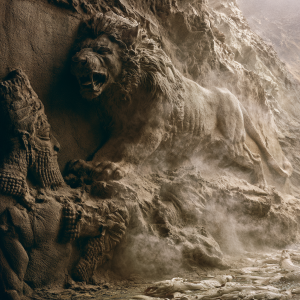
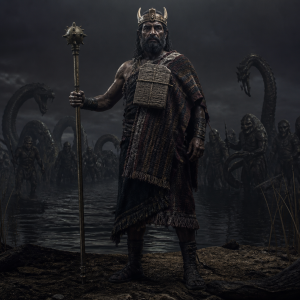
Ninurta — the warrior-farmer god, champion of the gods, slayer of monsters. In Lugal-e he defeats the demon Asag and organizes the very landscape — building the mountains, directing the rivers — turning his victory into the foundation of agriculture itself.
Nergal — god of plague, war, and the scorching summer sun, who becomes consort of Ereshkigal and co-ruler of the underworld. He is destruction made divine: the fever that empties a city, the violence that levels it.
The Anunnaki — the assembled great gods, the divine council that decrees the fates of the world and of the dead. Born of An and Ki, they are the senate of heaven; in later texts the term drifts toward the judges of the underworld. (Their counterparts, the laboring Igigi, are the younger gods whose rebellion against drudgery prompts the creation of humankind.)
Creatures, Monsters, and Supernatural Beings
Mesopotamian demonology is the richest and most influential the ancient world produced — a whole ecology of malevolent and protective beings that would echo through later Jewish, Christian, and Islamic tradition.
Demons of Disease and the Dark
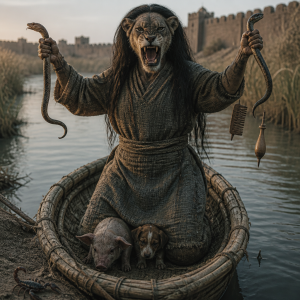
Lamashtu — a lion-headed, donkey-toothed she-demon who preys on pregnant women and infants, snatching babies from the womb and the breast. Unusually, she acts on her own malice rather than on the gods’ orders — a freelance horror. Mothers wore amulets against her throughout the Near East.
Pazuzu — king of the wind-demons, a snarling figure with a canine face, scaled body, talons, and wings. Genuinely terrifying — yet because he could drive off Lamashtu, families hung his image over the bed as protection. He is the demon you invite in to keep the worse one out. (Modern audiences know him as the possessing entity in The Exorcist.)
Gallu — pitiless underworld enforcers, the “police” of the dead, who drag the living down to Kur and know neither food, drink, mercy, nor bribery. They are the demons who seize Dumuzi in Inanna’s place.
Utukku — a class of spirits that could be either benevolent or evil; the evil utukku rose from the underworld or the desert to torment the living with sickness and madness.
Ghosts and the Restless Dead
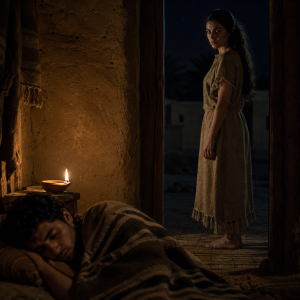
Gidim — the ghost of a dead person, which lingered if burial rites were neglected or offerings stopped. A neglected gidim would return to plague its family with illness until properly fed and remembered. Edimmu (Akkadian Ekimmu) are the angrier cousins — the vengeful dead of those who died badly or unburied. Alû was a faceless, half-formed demon that smothered sleepers, while Gello, a spirit of women who died young, hunted mothers and children and survived in folklore for thousands of years.
Guardians, Hybrids, and Sages
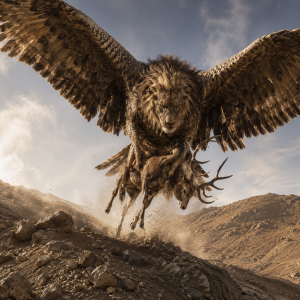
Lamassu — the great winged bull or lion with a human head, the protective guardian whose colossal statues flanked the gates of palaces. Far from a monster, the lamassu was a benevolent sentinel, warding evil from the threshold.
The Mushusshu — the “furious snake,” a scaled dragon with a serpent’s neck, lion’s forelegs, eagle’s hind talons, and a forked tongue, sacred to the gods and immortalized in glazed brick on Babylon’s Ishtar Gate.
Scorpion People — half-human, half-scorpion guardians who watch the gates of the mountain through which the sun passes; in Gilgamesh they guard the road to the land of the living.
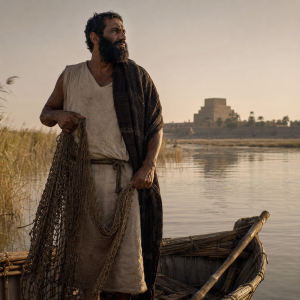
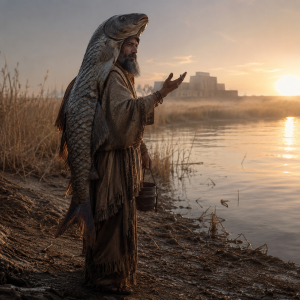
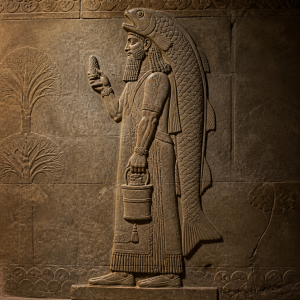
The Fish-man and the Winged Genie — these are the apkallu, the seven antediluvian sages sent by Enki to teach humanity the arts of civilization. The fish-cloaked sage (the figure later Greek writers called Oannes) rose from the sea each day to instruct the first cities; the eagle-headed, winged genie sprinkling purifying water became one of the most repeated images in Assyrian art. Their human pupil Adapa, the first and wisest of men, is their most famous student.
The Central Myths
The Descent of Inanna
The single most important Sumerian narrative, and one of the oldest hero-journeys into death ever recorded. Inanna, Queen of Heaven, decides to descend to the underworld realm of her sister Ereshkigal. At each of the seven gates of Kur she is stripped of one garment or ornament of power — her crown, her beads, her breastplate, her measuring rod — until she stands naked and powerless before her sister’s throne. The seven Anunnaki judges fix her with the eye of death, and Inanna is turned to a corpse and hung on a hook on the wall.
She has, wisely, left instructions. Her faithful vizier Ninshubur petitions the gods, and only Enki responds, crafting two sexless beings from the dirt under his fingernails who slip into the underworld and trick Ereshkigal into releasing the body. But the underworld’s law is absolute: no one leaves without sending a substitute. The demons that escort Inanna back up seize her husband Dumuzi, whom she finds sitting untroubled on his throne rather than mourning her — and she fixes him with the eye of death. His sister Geshtinanna’s grief wins him a reprieve: half the year in the underworld, half above, his descent and return marking the dying and reviving of the agricultural year. Why it matters: this is the template for every later myth of a deity who dies and rises with the seasons, and the ancestor of the descent-and-return pattern that runs through world literature.
Enki and Ninhursag: The Paradise of Dilmun
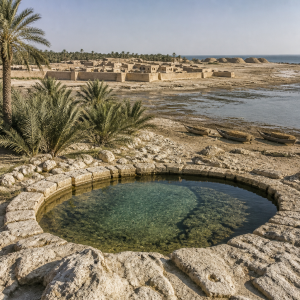
In the pure, bright land of Dilmun — where no creature kills, no sickness exists, and the old do not say “I am old” — Enki waters the earth and sets generation in motion with the mother goddess Ninhursag. But Enki’s restless lust drives the tale: he impregnates a chain of goddesses, then eats the eight plants Ninhursag has grown, and she curses him with the eye of death. Eight of his body parts fall sick. Only when a clever fox lures Ninhursag back does she relent, birthing eight healing deities, one for each ailing part — including Ninti, “Lady of the Rib,” whose name puns on both “rib” and “life.” Why it matters: the paradise without death, the forbidden eating that brings a curse, and the woman made from a rib all sit unmistakably behind the Eden story written down more than a thousand years later.
The Eridu Genesis: The First Flood
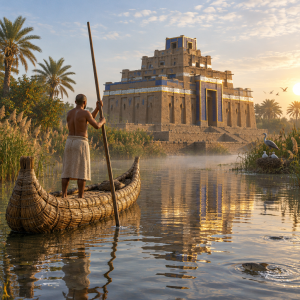
Humanity has multiplied and grown noisy, and Enlil, unable to sleep, persuades the divine assembly to destroy mankind with a flood. Enki, forbidden to warn anyone directly, speaks instead to a reed wall behind which the pious king Ziusudra is listening, and so technically keeps his oath while saving the world. Ziusudra builds a great boat, rides out seven days and nights of storm, and when Shamash breaks through the clouds he opens a window, prostrates himself, and sacrifices. For his piety he is granted eternal life in Dilmun. Why it matters: this is the oldest flood narrative on record, the direct ancestor of the Gilgamesh flood told by Utnapishtim and, through it, of the biblical Noah — the single clearest line of descent from Sumerian myth into the Bible.
Ninurta and the Demon Asag
In Lugal-e, the monstrous Asag — a demon so hideous his presence boils the rivers and sickens the fish, spawned upon the mountains and supported by an army of stone — rises to challenge the gods. The warrior Ninurta marches out and, after a furious battle, crushes him. Then comes the constructive half: Ninurta piles up the defeated stones into mountains, gathers the chaotic waters and channels them into the Tigris and Euphrates to irrigate the fields, and judges the stones, blessing the useful ones and cursing the rest. Why it matters: it fuses the combat myth (order-god slays chaos-monster) with an origin story for Mesopotamia’s entire irrigated landscape — victory is not just survival but the creation of civilization’s infrastructure.
The Afterlife and Cosmology
The Sumerians pictured a layered universe: the heavens (An) arched above, the earth (Ki) floated as a flat disc upon the primeval sea, and beneath the earth lay two realms — Enki’s sweet-water Abzu, source of springs and wisdom, and below even that, Kur, the land of the dead.
Kur (also called Kurnugi, “the land of no return”) is the bleakest underworld in ancient literature, and its bleakness is the point. Every spirit goes there, the just and the wicked alike, passing through the seven gates of the fortress Ganzir into a dark, dusty house where, as one text puts it, the dead are clothed like birds in feathers and eat clay and dust. There is no judgment, no reward, no torment calibrated to your sins — only a uniform grey eternity. Ereshkigal rules it with cold authority, attended by her vizier Namtar (fate, and bringer of disease) and by the merciless Gallu. The one thing that eases the dead is the cult of the living: regular offerings poured by descendants. A man with seven sons sits near the gods; a man with none gnaws scraps thrown in the street. The forgotten dead return as the ravenous Gidim to haunt the negligent.
Against this grimness the Sumerians set one shining counter-image: Dilmun, the pure land where the sun rises, untouched by death, sickness, or sorrow — a paradise reserved for a vanishingly few immortals like Ziusudra, and a reminder of everything ordinary mortality was not.
How Sumerian Mythology Connects to Other Traditions
It seeded the rest of Mesopotamia. The most direct line runs forward: Sumerian deities were absorbed wholesale into the Semitic-speaking cultures that followed. The whole Akkadian, Assyrian, and Babylonian tradition is a translation and elaboration of Sumerian originals — Inanna into Ishtar, Enki into Ea, the Eridu Genesis into the flood of Gilgamesh and the creation-epic Enuma Elish, where Marduk slays the chaos-dragon Tiamat. To read Sumerian myth is to read the foundation the entire Mesopotamian world was built on.
It shaped the Hebrew Bible. The parallels are too precise to be coincidence: a deathless paradise garden, a creation of humanity from clay, a woman associated with a rib, a great flood survived by one righteous man in a boat who sends out birds and sacrifices on landing. The Sumerian versions predate Genesis by a millennium and more, transmitted through the Babylonian captivity and the shared culture of the ancient Near East. Even the demon Lilith and the swarming evil spirits the Mazzikin of later Jewish lore trace their lineage to Mesopotamian demonology.
Its dying god echoes across the Mediterranean. Dumuzi, who spends half the year below and half above, becomes the Babylonian Tammuz mourned by women at the city gate (a practice the Bible itself condemns), and his pattern of seasonal death and return runs parallel to Egyptian Osiris and Greek Adonis — whose very name comes from the Semitic adon, “lord.”
Its sages reached Greece. The fish-cloaked apkallu who taught civilization survived into the Hellenistic age as Oannes in the writings of the Babylonian priest Berossus, carrying the Sumerian image of wisdom-from-the-sea into the Greek imagination.
Where to Start Reading
Begin with the primary texts in translation. The Descent of Inanna, the Eridu Genesis, Enki and Ninhursag, and Lugal-e are all freely available through the Electronic Text Corpus of Sumerian Literature (ETCSL) hosted by the University of Oxford — the closest thing to reading Sumerian myth in the raw. For the Akkadian inheritance, Andrew George’s Penguin translation of The Epic of Gilgamesh is the standard and includes the flood account.
For guides, Samuel Noah Kramer’s Sumerian Mythology and History Begins at Sumer opened the field to general readers and remain wonderfully readable; Thorkild Jacobsen’s The Treasures of Darkness is the great interpretive history of Mesopotamian religion; and Jeremy Black and Anthony Green’s illustrated Gods, Demons and Symbols of Ancient Mesopotamia is indispensable for the monsters and iconography. Diane Wolkstein and Kramer’s Inanna: Queen of Heaven and Earth renders the Inanna cycle as vivid literature with commentary.
Explore Sumerian Mythology on Gods and Monsters
Gods and Monsters has 15 entries catalogued directly under Sumerian mythology, with many more across the wider Mesopotamian world. Browse all Sumerian Mythology entries →
Inanna · Enki · Ninhursag · Ereshkigal · Sin · Adapa · Enkidu · Gallu · Gidim · Edimmu · Alû · Gello · Mushhushshu · Fish-man · Winged genie · Anu · Enlil · Shamash · Nergal · Ninurta · Anunnaki · Igigi · Asag · Lamassu · Gilgamesh
Frequently Asked Questions
Is Sumerian mythology the oldest mythology in the world?
It is the oldest mythology we can actually read. The Sumerians invented cuneiform writing around 3200 BCE and began recording their myths, hymns, and god-lists not long after, making theirs the earliest religious literature preserved anywhere on Earth. Older beliefs certainly existed — every culture has myth — but they were never written down, so Sumer holds the record for the oldest mythology that survives in its own words rather than being reconstructed from archaeology.
What is the difference between Sumerian and Babylonian mythology?
They are the same tradition at two stages. Sumerian mythology is the original, recorded in the Sumerian language by the world’s first city-builders in southern Mesopotamia. When later Semitic-speaking peoples — Akkadians, then Babylonians and Assyrians — came to dominate the region, they adopted the Sumerian gods and stories and retold them in their own language, renaming the deities (Inanna became Ishtar, Utu became Shamash) and adding new material like the creation epic Enuma Elish. Babylonian myth is essentially Sumerian myth, translated, expanded, and reorganized.
Who is the most important god in Sumerian mythology?
It depends on how you measure importance. In rank and authority, Enlil of Nippur held the real executive power and the Tablet of Destinies. In sheer presence in the surviving literature, Inanna dominates — no deity has more myths told about her. And Enki, god of wisdom and water, is the one who keeps the world running and saves humanity from the Flood. The sky-god An outranked them all in seniority but rarely acted.
Did the Sumerian flood story inspire the Bible’s Noah?
The Sumerian flood story is the oldest known ancestor of the Noah narrative, separated by more than a thousand years. In the Eridu Genesis, the gods send a flood and the pious king Ziusudra survives in a great boat, later retold in the Gilgamesh epic with the hero Utnapishtim. The shared details — divine decision to flood the world, one warned righteous man, a boat, the sending out of birds, a sacrifice on landing — show a clear line of cultural transmission through the ancient Near East into the Hebrew Bible, though scholars debate the exact route.
What happened to people after death in Sumerian belief?
Everyone went to the same place: Kur, a dark, dusty underworld beneath the earth ruled by the goddess Ereshkigal. There was no heaven and no hell of punishment — no judgment of the soul at all. The dead ate dust and drank brackish water in a grey, joyless eternity, regardless of how they had lived. The only thing that improved your lot was having living descendants who poured offerings of food and water; the forgotten dead grew hungry and returned as ghosts (Gidim) to torment the living.
Are the Anunnaki ancient aliens?
No. In the actual Sumerian texts, the Anunnaki are simply the assembled great gods of the pantheon — the children of the sky-god An who form the divine council and decree the fates, later associated with judging the dead. The “ancient astronaut” idea that they were extraterrestrial visitors comes entirely from 20th-century pseudohistory, principally Zecharia Sitchin’s writings, which mistranslate and misread the cuneiform. The genuine Anunnaki are a category of deity, not a spacecraft crew.