Siberian and Arctic Mythologies: The Complete Guide to Shamans, the World Tree, and Spirits of the Frozen North
The word shaman is not a generic term for a tribal magician — it is a specific loanword, taken from the Evenki šamán of central Siberia, and the religious world it names was born here, in the taiga and tundra stretching from the Ural Mountains to the Bering Strait and across the ice to Greenland. This is the homeland of shamanism itself. In most mythologies the gods are the protagonists; in the mythologies of the Siberian and Arctic peoples, the protagonist is the human being who travels to the gods — the shaman who falls into trance, flies up the World Tree or dives beneath the sea ice, and bargains with the spirits for a sick person’s stolen soul.
That single fact reshapes everything. There is no grand pantheon ruling from a mountaintop here, no Olympus and no Asgard — only sky gods so remote they barely intervene, an underworld crowded with the hungry dead, and a landscape saturated with spirits, every river and animal and stone possessing an inua or owner-soul. The drama is not who sits on the celestial throne but whether the shaman returns from the spirit-world alive.
Because these peoples were largely non-literate until the modern era, the mythology survives through the ethnographers who recorded it: Waldemar Bogoras and Vladimir Jochelson among the Chukchi and Koryak during the Jesup North Pacific Expedition; the Danish-Inuit explorer Knud Rasmussen, who crossed the Arctic by dog sled gathering the words of Inuit angakkuit; and the Finnish scholar Uno Holmberg, whose surveys of Siberian belief remain foundational. What they recorded is one of the oldest continuously living religious systems on earth.
What Makes Siberian and Arctic Mythology Different
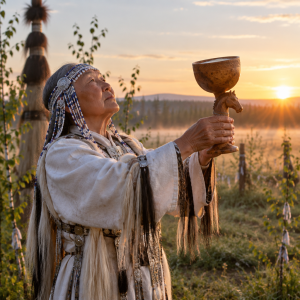
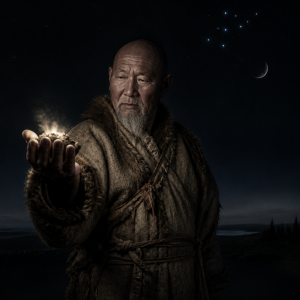
The shaman is the central figure, not the gods. In Greek or Norse myth the deities act and mortals react. Here the relationship inverts: the gods and spirits are forces to be negotiated with, and the negotiator — the shaman, the Inuit angakkuq, the Buryat böö, the Sami noaidi — is the true hero of the religion. He or she is chosen by spirits through a near-fatal “shamanic illness,” dismembered and reassembled in vision, and thereafter able to send the soul travelling between worlds. No other mythological tradition places ecstatic soul-flight at its absolute center.
Everything is alive. This is animism in its purest recorded form. A walrus, a snowstorm, a hunting knife, the sea itself — each has a soul that can be offended, appeased, or stolen. A hunter who fails to thank his kill, a woman who breaks a taboo, can sicken an entire camp because the affronted spirits withdraw the game. Morality here is ecological and relational, not commandment-based.
The cosmos is layered, and the World Tree connects it. Reality is stacked into an upper sky-world of seven, nine, or seventeen heavens, a middle earth where humans live, and a lower world of darkness — all threaded by a central axis, usually a colossal World Tree or world-pillar, whose branches cradle unborn souls in nests like roosting birds. The shaman climbs it. This vertical cosmos is the deep structure beneath Norse Yggdrasil and a hundred other “axis of the world” myths.
Creation is a dualistic dive, not a divine command. Across the Siberian belt the world is fished up from the bottom of a primordial sea by a diving bird, often at the order of a creator who works in tension with a dark double. There is no almighty word spoken into the void; there is a duck with a beakful of mud, and two brothers — one building, one spoiling.
The afterlife sorts you by how you died, not how you lived. This is the feature an AI overview always misses. In much of the Arctic there is no heaven for the good and hell for the wicked. Where your soul goes depends on the manner of your death — violence, drowning, childbirth, ordinary sickness — each routing you to a different realm. Virtue does not buy a better seat.
The Major Gods and Spirits
The Remote Sky and Creator Gods
Tengri — the eternal blue sky, the supreme heaven-god of the Turkic and Mongolic peoples of southern Siberia and the steppe. Tengri is less a person than the sky itself made sacred: vast, just, and impersonal, the source of cosmic order (töre) and the authority that legitimized khans. From his name comes Tengrism, arguably the oldest organized sky-religion of Inner Asia.
Num — the sky god and benevolent creator of the Nenets, a Samoyedic people of the western Siberian tundra. Num shaped the world from the primal water and remains good but distant; his very remoteness is the point, for the business of daily survival is conducted with nearer, smaller spirits. His shadow-self and son is Nga, the lord of death, who unmakes what Num makes.
Ülgen — the bright creator-god of the Altai Turks, who fashioned the light, the sun, and the good things of the world while his counterpart shaped the dark. Ülgen dwells in the highest heaven and receives the shaman who climbs the notched birch-pole of the sacrifice. He has no entry on the site yet, though he is among the most important deities in all of Siberia.
Kutkh — the Raven creator of the Chukchi, Koryak, and Itelmen of the far northeast, who made the world and the first people and then promptly behaved like a glutton and a fool. Part demiurge, part trickster, Kutkh is the Siberian cousin of the Raven who steals daylight across Native North America — and one of the most fascinating creator figures in the hemisphere. He is not yet on the site.
The Underworld and the Sea
Erlik — the lord of the dead and the underworld across Turkic and Altaic Siberia, the dark twin who created shadow as the bright god created light. Erlik rules the lower world’s nine layers, sends sickness up into the world of the living, and demands the souls he is owed; the shaman’s most dangerous journey is the descent to bargain with him. The Yakut adopted him as the master of their realm of demons.
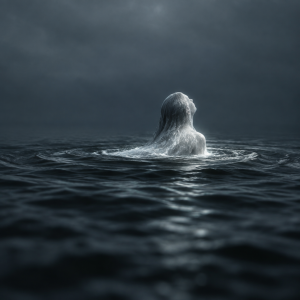
Sedna — the great sea-mother of the Inuit, mistress of the deep and keeper of every seal, walrus, and whale. Once a mortal girl, she was thrown from a boat and her clinging fingers chopped away; from those severed joints the sea mammals were born. When humans break taboo her hair tangles with their sins and she withholds the game, and only a shaman diving to comb her hair can free the animals again. She is the single most important deity in the Arctic.
Nga — the Nenets god of death and disease, son and dark antipode of Num, who introduced mortality into a world meant to be deathless. Alongside him sit Sila, the Inuit “indweller” of sky, weather, and intellect, and Torngarsuk, the spirit-master of the Tornait who empowers the angakkuq.
Creatures, Monsters, and Supernatural Beings
Demons of the Lower World
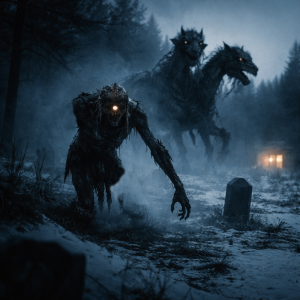
Abaasy — iron-toothed demon-spirits of the Yakut (Sakha) underworld, often the restless dead, who haunt graves and lonely places and feed on human souls. The lesser abaasy are grotesque asymmetries — one eye, one arm, one leg — and ride monstrous mounts in the service of the lord of the dead; their chief is a horror of three heads, six arms, and a body of iron. They cause the diseases the shaman must drive out.
Yelbeghen — a multi-headed, man-eating dragon-ogre of the Turkic peoples of the Altai and Sayan mountains, a creature of the underworld’s retinue. Originally a serpent (the name carries the old root for “giant serpent”), Yelbeghen swells across the epics into a seven-headed behemoth — and in the eclipse myth it is Yelbeghen who swallows the sun and the moon, a Siberian echo of the wolves that chase the lights across the Norse sky.
Monsters of the Ice and the Sea
Akhlut — a fearsome Inuit spirit that shifts between orca and wolf, hunting along the shoreline where the two worlds meet. You know it has come ashore by the wolf tracks that walk straight into the sea, and you fear it because nothing on ice or in water is safe from a predator at home in both.
Qalupalik — a humanoid sea-hag of the Inuit shore, green-skinned and clad in a coat of eider-duck feathers, with a great pouch on her back. She hums beneath the ice to lure children who stray too near the water’s edge and carries them down to keep forever — a cautionary spirit weaponized by every Arctic parent.
Keelut — a hairless, dog-like death-spirit of Inuit lore, an evil earth-dweller whose appearance foretells a death and who stalks travellers across the night tundra. The Qiqirn, a giant bald spectral dog, is its strange cousin — feared but also fearful, fleeing humans as much as they flee it.
Shapeshifters and the Wolves of Solitude
Ijiraq — Inuit shapeshifters who exist half in this world and half outside it, glimpsed only at the corner of the eye, who abduct children and abandon them in the cold. They can be appeased to return a lost child, but never truly seen.
Amarok — a gigantic lone wolf of Inuit myth that hunts down anyone foolish enough to travel alone at night. Unlike a true wolf pack, the Amarok hunts solo, and its lesson is communal: the Arctic does not forgive the person who cuts himself off from the group.
Kushtaka — the “land-otter man” of the Tlingit of the Pacific Northwest coast, a shapeshifter that mimics human voices and the cries of a baby to lure travellers to the water, where it transforms them into otter-people. It sits at the cultural edge where Arctic belief blends into the rich monster-lore of the Northwest coast.
The Hand-Made Monster and Other Obscurities
Tupilaq — perhaps the most disturbing idea in the whole tradition: a monster you build yourself. A Greenlandic Inuit witch assembles a tupilaq from bones, skin, hair, and parts of a dead child, sings it to life, and sends it through the sea to murder an enemy — but if the victim’s magic is stronger, the tupilaq turns and devours its maker. It is sorcery with a built-in fail-safe.
Almas — wild, hair-covered hominids of the Altai and Mongolian mountains, the Central Asian relatives of the Himalayan Yeti, reported for centuries by herders as near-human creatures of the high valleys.
Arimaspi — a legendary one-eyed people of the far north, known to the Greeks through Herodotus and Aristeas, who war endlessly with griffins over the gold of the Siberian mountains. Their myth is a fossil of real contact: a Greek rumor of the peoples and gold of the Altai, carried west along the Scythian trade routes.
The Central Myths
The Earth-Diver Fishes Up the World
In the beginning there was only water and sky. The creator sends a bird — a loon, a duck, a goldeneye — diving again and again to the bottom of the primal sea. Most fail and drown; finally one surfaces, half-dead, with a single beakful of mud in its bill. From that grain of mud the creator spreads the whole earth. In the dualistic versions told across Siberia, a second diver — sent by the creator’s dark twin — hides a little mud in its own mouth to make land of its own, and from that act of greed come the mountains, the swamps, and everything crooked in the world.
Why it matters: the earth-diver is one of the most widely distributed creation myths on the planet, forming a single belt from eastern Finland across Siberia and into Native North America. It is hard evidence of an ancient mythological bridge spanning the Bering land crossing — the same story told in dozens of languages on two continents.
Sedna and the Birth of the Sea Animals
A girl refuses every suitor until a stranger lures her away to a barren island. When her father comes to rescue her, a storm rises — raised by the spirits — and to save himself he throws his own daughter overboard. She grips the gunwale; he cuts off her fingers joint by joint. As the fingers sink they become the seals, the walruses, and the whales, and the girl sinks with them to become Sedna, mistress of the sea, holding all the food of the Arctic in her drowned hands.
Why it matters: this is the moral engine of an entire economy. Because every sea animal is literally part of Sedna’s body, hunting is a covenant, not a conquest — break the taboos and she clenches her fist. The shaman’s descent to comb the filth of human sin from her tangled hair is the central religious rite of the Inuit world.
Kutkh the Raven Makes the World and Makes a Fool of Himself
Among the peoples of Kamchatka the world is the work of Kutkh the Raven, who creates the land, the rivers, and humankind — and then, in the very next breath of the same cycle of tales, gorges himself, deceives his own family, fails, falls, and is mocked. The Koryak call him Big Raven, Quikinna’qu.
Why it matters: Kutkh dissolves the line between the sacred and the absurd. The same being who hangs the sun is a buffoon, and that is not a contradiction but the actual theology — a universe made by a creator who is also a trickster, where order and chaos are two moods of one bird. The Raven creator links Siberia directly to the Raven spirit traditions of the North American coast.
Cosmology and the Afterlife
The Siberian universe is built in three tiers. Above is the upper world of light, divided into many heavens — seven, nine, or seventeen — where the high gods dwell. In the middle lies the earth of humans and the lesser spirits. Below is the dark lower world of Erlik and the hungry dead, itself layered into nine descending levels. A single axis runs through all three: the World Tree, whose roots reach the underworld and whose crown brushes the highest sky, and in whose branches the souls of the unborn wait like nesting birds. The shaman alone can travel the whole height of it, climbing to plead with the sky gods or descending to wrestle souls back from the dead.
The Arctic afterlife is stranger than any moral heaven. The Inuit dead are not judged; they are sorted by the manner of their death. The Adlivun, the cold underworld beneath the sea, receives most of them to be purified before passing on. But those who died well, by violence or in childbirth, rise instead to a warm sky-land where the souls play ball with a walrus skull — and that game is the shimmer of the aurora borealis. Goodness in life does not decide the destination; the door you leave by does. It is one of the few mythologies on earth in which the northern lights are the dancing of the dead.
How Siberian and Arctic Mythology Connects to Other Traditions
The Native American bridge. The clearest connection is westward across the Bering Strait into the Americas. The earth-diver creation, the Raven trickster-creator, and the very structure of shamanism reappear among Indigenous North American peoples — and many “Arctic” figures already straddle the divide. The Wendigo of the subarctic forests, the otter-man Kushtaka, the water-monster Wentshukumishiteu, the cannibal giant Kukwes, and the Pacific Northwest Skookum all belong to the same circumpolar imagination as Sedna and the Akhlut.
The Slavic forest. When Russians pushed east into the taiga, the spirit-world they brought met one already there, and the two fused. The Russian household and forest spirits — the witch Baba Yaga in her walking hut, the deathless sorcerer Koschei, the forest-lord Leshy, the house-spirit Domovoi, the drowned Rusalka, and the river-demon Vodyanoy — share the same animist grammar as the Siberian land-spirits, and the prophetic bird-maidens Alkonost, Sirin, and Gamayun, along with the radiant Zhar-Ptitsa firebird, carry a memory of the soul-birds nesting in the World Tree.
The Norse and Sami north. The vertical cosmos with its world-axis is the same skeleton as the Norse Yggdrasil, and the Sami noaidi drummed himself into the same soul-flight as the Siberian shaman next door. Even the eclipse-monster Yelbeghen swallowing the sun mirrors the wolves that hunt the heavenly lights in Scandinavian myth, where Fenrir‘s brood will one day catch and devour them.
Where to Start Reading
For the Arctic, begin with Knud Rasmussen’s reports from the Fifth Thule Expedition, the indispensable firsthand record of Inuit belief gathered directly from the angakkuit in the 1920s. For Siberia proper, the classic ethnographies are Waldemar Bogoras’s The Chukchee and Vladimir Jochelson’s The Koryak, both produced by the Jesup North Pacific Expedition, and Uno Holmberg’s survey volumes on Finno-Ugric and Siberian mythology remain the best single overview of the cosmology.
For modern readers, Mircea Eliade’s Shamanism: Archaic Techniques of Ecstasy is the standard (if dated) comparative study, and Piers Vitebsky’s The Reindeer People and The Shaman are the most readable introductions, written by an anthropologist who lived among the Eveny.
Explore Siberian and Arctic Mythology on Gods and Monsters
Five entries currently carry the Siberian/Arctic Peoples’ tag on Gods and Monsters, with many more closely related Arctic and circumpolar figures catalogued nearby. Browse all Siberian/Arctic entries →
Num · Abaasy · Yelbeghen · Arimaspi · Tengri · Erlik · Almas · Sedna · Amarok · Qalupalik · Ijiraq · Akhlut · Keelut · Qiqirn · Kushtaka · Tupilaq · Yeti
Frequently Asked Questions
What is the difference between Siberian and Arctic mythology?
They are two overlapping regions of one circumpolar tradition. “Siberian” usually refers to the taiga and steppe peoples of northern Asia — Yakut, Nenets, Buryat, Altai Turks, Chukchi, Koryak — whose religion centers on the shaman, the three-world cosmos, and the World Tree. “Arctic” usually points to the Inuit and related peoples of the far north and Greenland, with figures like Sedna and the Amarok. They share shamanism, animism, and the earth-diver creation, which is why scholars treat them as a single belt rather than two separate mythologies.
Who is the most important god in Inuit mythology?
Sedna, the sea-mother, is the most important deity in the Inuit world. Because every seal, walrus, and whale was born from her severed fingers, she controls all the food of the sea, and when humans break taboo she withholds the game. The central work of the Inuit shaman, the angakkuq, is the dangerous soul-journey to the bottom of the sea to comb the tangles of human wrongdoing from Sedna’s hair and persuade her to release the animals again.
What is a shaman, and where does the word come from?
A shaman is a specialist who enters trance to send his or her soul travelling between the worlds — up to the sky gods or down to the dead — to heal the sick, recover lost souls, and guide the dead. The word itself comes from the Evenki language of central Siberia (šamán), which is why scholars consider Siberia the heartland of classical shamanism. The shaman is chosen by the spirits through a near-fatal initiatory illness, and is the true central figure of the religion, more important than any single god.
What is the World Tree in Siberian mythology?
The World Tree is the cosmic axis connecting the three layers of the universe: its roots reach the dark underworld of Erlik, its trunk passes through the human earth, and its crown rises into the upper heavens. The souls of unborn children are said to wait in its branches like nesting birds. The shaman climbs it in trance to reach the gods — a belief that closely parallels the Norse world-tree Yggdrasil and reflects an ancient shared cosmology across northern Eurasia.
What happens to the dead in Arctic mythology?
Unusually, the Inuit afterlife sorts the dead by how they died rather than how they lived. Most souls descend to the cold underworld of Adlivun to be purified, while those who died by violence or in childbirth may rise to a warm sky-land where the dead play ball with a walrus skull — and that game is the shimmering of the aurora borealis. There is no moral judgment of good versus evil; the manner of death, not virtue, decides the destination, which makes it one of the few traditions where the northern lights are literally the dancing of the dead.
What is a tupilaq?
A tupilaq is a murder-monster built by hand. A Greenlandic Inuit sorcerer assembles it from bones, animal parts, and pieces of a corpse, then sings it to life and sends it through the sea to kill an enemy. The catch is its built-in danger: if the intended victim’s magic proves stronger, the tupilaq turns around and devours the witch who made it. The carved ivory “tupilak” figures sold in Greenland today are modern art objects inspired by these once-secret and genuinely feared constructs.