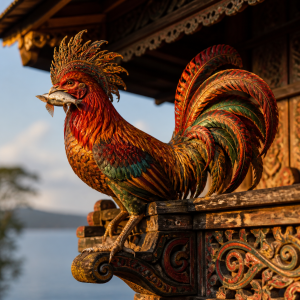
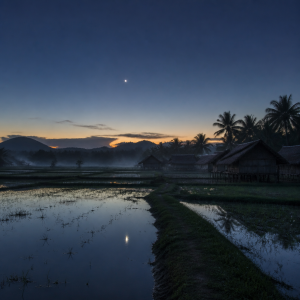
Philippine Mythology: The Complete Guide to Animist Spirits, Shapeshifting Aswang, and the Moon-Devouring Bakunawa
Philippine mythology has no single sacred book, no fixed pantheon, and no founding scripture — and that is precisely what makes it one of the most alive mythologies on earth. Spread across more than 7,000 islands and over a hundred ethnolinguistic groups, it survives less as a closed canon than as a living web of beliefs: the Tagalog creator Bathala in the north, the Maranao spirit-bird Sarimanok in the south, and a shapeshifting predator called the aswang that is still whispered about in provincial barrios today.
Because Spanish colonizers spent three centuries trying to erase the old religion, much of what we know was preserved sideways — in a 1613 Tagalog dictionary compiled by the friar San Buenaventura, in the chants of babaylan priestesses recorded by missionaries, and in UNESCO-protected oral epics like the Ifugao Hudhud. The result is a mythology that lives in the present tense. Where Greek gods are safely literary, Filipino lower mythology is functional folklore: people still bury garlic against the manananggal and say “tabi-tabi po” (excuse me) when passing an anthill, lest they offend a nuno sa punso.
This guide maps the whole territory: the deities of sky and sea, the dizzying bestiary of aswang and tikbalang, the central creation and eclipse myths, and the layered afterlife of a culture that believed every river, tree, and stone had a spirit you had better not anger.
What Makes Philippine Mythology Different
It is decentralized by design. There is no Filipino “Olympus.” Each region — Tagalog, Visayan, Ifugao, Maranao, Bicolano, Ilocano — has its own deities, its own creation story, and often its own name for the same monster. The “aswang” of Capiz is not quite the “aswang” of Antique. This polycentrism means Philippine mythology is better understood as a family of mythologies sharing a common animist grammar than as one system.
The supernatural is environmental, not heavenly. The core belief is animism: spirits called anito and diwata inhabit specific trees, mounds, rivers, and fields. You do not pray upward to a distant god so much as negotiate, constantly, with the invisible neighbors who own the land you walk on. Etiquette toward spirits is a daily practice, not a Sunday one.
The monsters are domestic. Where many traditions place their horrors in distant labyrinths or underworlds, the Filipino bestiary haunts the home. The tiyanak imitates a crying baby; the batibat kills you in your own bed; the aswang is your seemingly ordinary neighbor by day. The terror is intimacy, not distance.
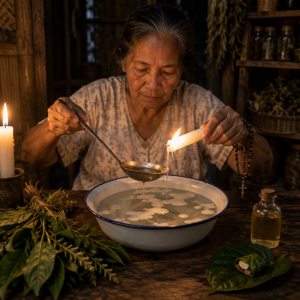
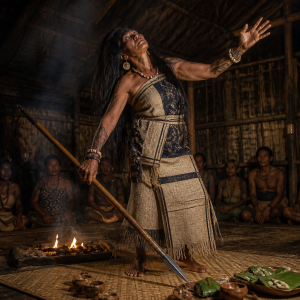
The shaman was usually a woman. The babaylan — the spirit-medium, healer, and ritual leader who could traverse the realms of the dead — was overwhelmingly female (or a feminized male asog). In a mythology with no priestly caste of men, spiritual authority ran through women, which is one reason colonizers targeted the babaylan so violently.
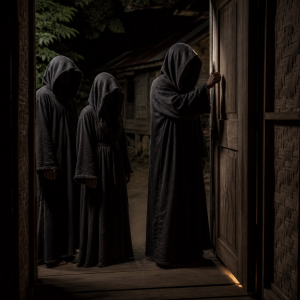
It absorbed its conquerors. Rather than dying under Christianity, the old beliefs fused with it. The Kumakatok, three hooded harbingers of death, wear distinctly colonial-era faces; the Santelmo fireball is named for the Catholic St. Elmo. Filipino folklore swallowed Spain the way the Bakunawa swallowed the moon.
The Major Gods and Deities
The Supreme Creator and the Sky Siblings
Bathala — supreme creator of the Tagalogs. Dwelling in the heavenly realm of Kaluwalhatian, Bathala (Bathalang Maykapal, “creator god”) made the earth and the first humans and was served by lesser anito as intermediaries. Crucially, Bathala was a remote, hands-off deity — present but rarely intervening, which left daily religious life to the spirits of place.
Apolaki — god of the sun and war, often named as a son of Bathala. Fierce and unwilling to share dominion, Apolaki is the bright, martial half of the most famous sibling rivalry in Philippine myth.
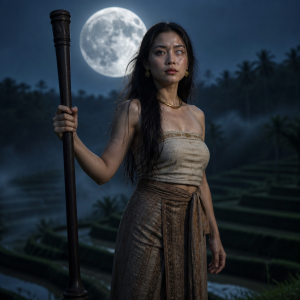
Mayari — goddess of the moon, sister of Apolaki and one of the most beloved figures in the pantheon. Described as the most beautiful deity in the heavens, she famously lost an eye in her war with her brother — the mythic reason moonlight is softer than the glare of the sun.
Tala — goddess of the stars, the third of the celestial siblings. She ushers the stars out at dusk and herds them home at dawn, standing guard so that the night sky is never wholly dark — and never wholly safe from the things that hunt beneath it.
Spirits of Place and Nature
Diwata — benevolent nature spirits, the Filipino cousins of fairies and the Hindu devata from which the name derives. Diwata guard mountains, forests, and seas, granting bounty to those who respect them and misfortune to those who despoil their domains.
Engkanto — enchanting environmental spirits, often strikingly beautiful and fair-skinned, who live in unseen kingdoms within the natural world. They can fall in love with humans, lure them into the spirit realm, or punish those who pollute their rivers and reefs. The name carries a Spanish loan (encanto, “enchantment”) layered over an older animist idea.
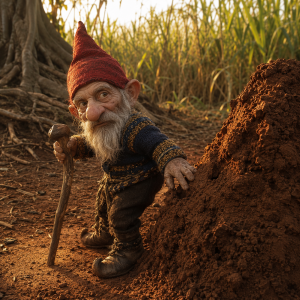
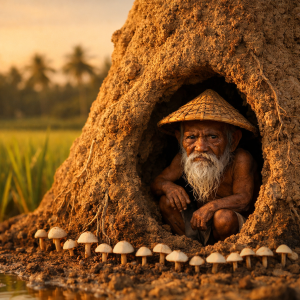
Nuno sa Punso — the “old man of the mound,” a tiny, easily offended ancestral spirit who lives inside anthills and earth mounds. Disturb his home without saying “tabi-tabi po” and he may curse you with swelling, fever, or worse. He is the everyday face of Filipino animism: the supernatural lives in your own backyard.
Duwende — dwarf-like goblins who dwell in houses, gardens, and mounds, divided in folk belief into the benevolent duwende puti (white) and malicious duwende itim (black). Leaving them food earns luck; insulting them earns illness.
Alan — winged forest spirits of the Tinguian people of northern Luzon, with fingers and toes reversed and a habit of hanging upside-down like bats. In their strangest myths they gather drops of blood and afterbirth and raise them into children, an eerie inversion of human reproduction that most surveys of world myth never reach.
Creatures, Monsters, and Supernatural Beings
The Aswang Complex
Aswang — the umbrella term for the Philippines’ most feared monsters, an entire category of shapeshifting, human-eating creatures rather than a single beast. An aswang passes as an ordinary villager by day and hunts by night, often craving the flesh of the sick, the dead, or the unborn. The aswang is the dark heart of Filipino horror and arguably the most culturally persistent monster in Southeast Asia.
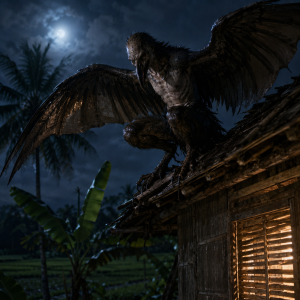
Manananggal — the most spectacular aswang. By night she severs her body at the waist, sprouts bat wings from her upper half, and flies off to feed on the unborn with a long, thread-like proboscis tongue, leaving her legs standing in the dark. Her fatal weakness: sprinkle salt, garlic, or ash on the abandoned lower half and she cannot rejoin it before dawn.
Wakwak — a vampiric bird-creature whose name imitates the flapping cry it makes in the night. In folk belief the sound is a deadly trick: the louder the wak-wak, the farther away the creature actually is.
Ekek — a winged, bird-beaked humanoid often confused with the manananggal and wakwak. Unlike the manananggal, the ekek does not split apart; unlike the wakwak, it has a true bird’s beak, with which it hunts for blood and flesh at night.
Tiyanak — a vampiric creature that takes the form of an abandoned infant. When a kindhearted traveler picks up the crying baby, it reverts to its true shape and attacks. In many tellings the tiyanak is the spirit of an unbaptized or aborted child, making it one of the most tragic and morally pointed monsters in the canon.
Tricksters of Forest and Field
Tikbalang — a towering creature with the head and hooves of a horse on a lean human body, lurking in mountains and forests. It leads travelers in circles until they are hopelessly lost; the counter-charm is to turn your shirt inside out. Tame one by plucking a golden hair from its mane and it will serve you for life.
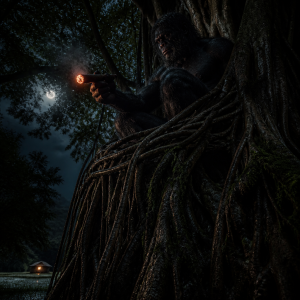
Kapre — a giant, dark, hairy being that perches in enormous old trees (often balete or acacia) smoking a massive cigar, the glowing ember visible in the dark. A kapre may bewilder trespassers into losing their way, but it can also grow fond of a particular human and is not inherently evil — more a territorial spirit of the great trees than a monster.
Pugot — a headless, shapeshifting being of Ilocano lore (the name means “decapitated”) that lurks in dark trees and abandoned houses, sometimes spitting fire or transforming into animals. It is the Filipino answer to the headless horseman, born of the islands’ own colonial violence.
The Obscure and the Regional
Sigbin — a goat-like Visayan cryptid that walks backward with its head tucked between its hind legs, said to suck the blood of victims from their shadows. Families rumored to keep a sigbin in a jar — the sigbinan — were believed to grow mysteriously wealthy. It is the Philippines’ answer to the chupacabra.
Batibat — an enormous, obese tree-dwelling hag of Ilocano belief who takes revenge when her home tree is cut into a house post. She sits on the sleeper’s chest and suffocates them — a folk explanation for bangungot, the very real sudden nocturnal death syndrome that has killed otherwise healthy young Filipino men.
Amalanhig — Visayan revenants: aswang who died before passing their curse to a successor and so claw their way back out of the grave. They cannot bend their stiff knees, so a victim escapes by running in zigzags or climbing — a rare monster you can outmaneuver with footwork.
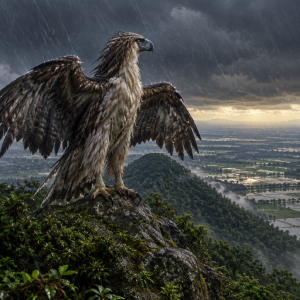
Minokawa — a colossal bird of Bagobo myth, large enough to swallow the sun and moon, with steel claws and beak, mirror eyes, and feathers like swords. It is the southern cousin of the Bakunawa’s eclipse-hunger, the sky-monster version of the same fear.
Multo — the ghost of the Filipino dead, from the Spanish muerto. A multo lingers because of unfinished business or a wrongful death, and ancestral multo are woven into everyday domestic life, remembered at meals and feared in empty rooms.
Santelmo — a hovering ball of fire seen over fields, swamps, and crossroads, believed to be a wandering soul or the spirit of someone who died violently. Named for St. Elmo’s fire, the colonial sailor’s omen, it is folklore’s poetry made from marsh gas and electricity.
The Central Myths
The Bamboo and the First People
In the Tagalog and Visayan creation story, the first man and woman, Malakas (“strong”) and Maganda (“beautiful”), emerged from a single great length of bamboo. In one famous version a bird — sometimes the omen-bird Tigmamanukan, sent by Bathala — pecked or split the bamboo open, releasing the pair from its two halves. Why it matters: unlike traditions where the first humans are shaped from clay by a god’s hands, here they grow from the land itself, equal and simultaneous — a quietly radical image of human origins that mirrors the egalitarian, nature-rooted worldview of pre-colonial society.
The War of Sun and Moon
After Bathala’s death (or withdrawal), his children quarreled over who would rule the world. Apolaki insisted on sole dominion; his sister Mayari demanded an equal share. They fought with bamboo cudgels until Apolaki struck out one of Mayari’s eyes. Horrified at what he had done, he relented, and they agreed to divide time: he would rule the day, she the night. Why it matters: the myth is an origin story for the very texture of the sky — it explains why the moon’s light is gentle and dim, and it frames the cosmos as a hard-won compromise between siblings rather than a victory of one over the other.
Bakunawa and the Seven Moons
Bathala once hung seven moons in the sky. The Bakunawa — a vast serpent-dragon of the deep sea — rose, enchanted by their beauty, and swallowed them one by one until only a single moon remained. To this day, the ancients said, an eclipse is the Bakunawa trying to devour the last moon, and the old remedy was to make a tremendous noise — banging pots, drums, and shouting — to startle the serpent into spitting it back out. Why it matters: the Bakunawa was not merely a monster but a calendar. Its movements structured a pre-colonial geomantic system used by babaylan, making this dragon the literal timekeeper of the islands.
The Epics: Hudhud and Ibong Adarna
The Hudhud of the Ifugao is a cycle of narrative chants performed during harvest and wakes among the famous rice terraces of northern Luzon — antiphonal, female-led, and sung in an archaic register, recognized by UNESCO as a Masterpiece of the Oral and Intangible Heritage of Humanity. Centuries later and in a colonial register, the Ibong Adarna emerged: a 19th-century Tagalog verse romance about three princes questing for a magical bird whose song heals the dying king — but whose droppings turn sleeping listeners to stone. Why they matter: together they bracket the Filipino imagination, from the pre-colonial sacred chant of the highlands to the Hispanized fairy-tale of the lowlands, proving the tradition never stopped generating new myth.
Cosmology and the Afterlife
Pre-colonial Filipinos, especially the Tagalogs, imagined a layered universe rather than a simple heaven and hell. Above lay Kaluwalhatian (or Kalangitan), the bright realm of Bathala and the benevolent anito. Below and apart lay Kasamaan — the realm of malevolent spirits, guarded by the dark deity Sitan, keeper of souls — and deeper realms of punishment the babaylan named Kalaliman. Between them stretched Alanganin, a liminal middle-world for souls who belonged fully to neither.
Where a soul went depended not only on virtue but on the manner of death and the rituals performed by the living. The babaylan held this cosmology together: in trance she traveled between worlds, escorting souls, retrieving the lost, and bargaining with spirits. Many Filipinos understood the self as dual — a body-soul (kaluluwa) and a breath of life-force (ginhawa) — so that death was a separation to be managed, not a single clean ending.
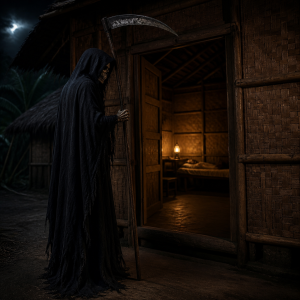
This is also where the islands’ deathlore lives. Kamatayan, the skeletal, scythe-bearing personification of Death, comes to collect the soul at its appointed hour; the Kumakatok, three hooded figures, knock on a door to announce that someone within will soon die. To meet them is to glimpse the boundary the babaylan crossed willingly and everyone else crossed only once.
How Philippine Mythology Connects to Other Traditions
The eclipse-serpent is everywhere. The Bakunawa swallowing the moon belongs to a vast Asian family of cosmic snakes and dragons: the Hindu shadow-demon that devours sun and moon, the world-encircling Norse serpent Jörmungandr, and the root-gnawing dragon Níðhöggr. Its serpentine cosmology also echoes the divine Naga of Hindu and Southeast Asian belief, a reminder that maritime trade carried Indian cosmology into the archipelago long before Spain arrived.
Sun-and-moon siblings rule across the map. The war between solar Apolaki and lunar Mayari rhymes with the estrangement of the Shinto sun-goddess Amaterasu and her storm-brother in Japanese myth, and with the Greek pairing of Helios and Selene (later Apollo and his sister). The lunar goddess Tala and her stars find a counterpart in the Chinese moon-dweller Chang’e.
The aswang sits inside a global vampire family. The blood-drinking, shape-shifting aswang and its winged kin parallel the European vampire and werewolf; the chest-crushing batibat is a sister to the Norse nightmare-spirit Mara and the medieval incubus and succubus. The blood-sucking sigbin is so close to the Latin American chupacabra that the two are routinely compared.
The radiant bird is a shared icon. The Maranao Sarimanok and the magical Ibong Adarna join the worldwide lineage of luminous, fortune-bringing birds: the Chinese Fenghuang, the immortal Phoenix, and the Hindu sky-king Garuda.
Where to Start Reading
The deepest pre-colonial sources are not books but the living oral epics: the Ifugao Hudhud, the Maranao Darangen, and the Ilocano Biag ni Lam-ang, all best approached through UNESCO and university translations. For early documentary evidence, the Spanish-era chronicles — Pedro Chirino’s Relación de las Islas Filipinas (1604) and the San Buenaventura Tagalog dictionary (1613) — preserve names and rituals the friars meant only to catalogue.
For modern readers, F. Landa Jocano’s Outline of Philippine Mythology remains the scholarly starting point, while Maximo Ramos’s Creatures of Philippine Lower Mythology is the indispensable field guide to the aswang and its kin. For a vivid contemporary synthesis grounded in primary sources, the work of The Aswang Project is the best gateway online.
Explore Philippine Mythology on Gods and Monsters
Gods and Monsters currently features 31 Philippine mythology entries, from supreme creators to the most obscure regional monsters. Browse all Philippine Mythology entries →
Bathala · Apolaki · Mayari · Tala · Diwata · Engkanto · Aswang · Manananggal · Wakwak · Ekek · Tiyanak · Tikbalang · Kapre · Sigbin · Batibat · Amalanhig · Minokawa · Bakunawa · Nuno sa Punso · Duwende · Alan · Pugot · Santelmo · Multo · Kumakatok · Kamatayan · Sarimanok · Tigmamanukan · Ibong Adarna · Ibong Tala · Hudhud
Frequently Asked Questions
Who is the supreme god in Philippine mythology?
Among the Tagalogs, the supreme creator is Bathala, who made the earth and the first humans and dwells in the sky-realm of Kaluwalhatian. But there is no single national high god: the Visayans, Ifugao, Bicolanos, and other groups each had their own creator. Philippine mythology is regional, so the “supreme god” depends entirely on which island and people you mean.
What is the difference between an aswang and a manananggal?
“Aswang” is an umbrella category for several kinds of shapeshifting, human-eating monsters, while the manananggal is one specific type. The manananggal’s signature trait is that it severs its body at the waist and flies off on bat wings, leaving its legs behind. All manananggal are aswang, but most aswang are not manananggal — the term also covers were-beasts, ghouls, and witches.
What causes a solar or lunar eclipse in Philippine mythology?
An eclipse is the serpent-dragon Bakunawa rising from the deep sea to swallow the moon, having already devoured six of the seven moons Bathala first created. In Bagobo myth the sky-bird Minokawa plays the same role. The traditional response was to bang pots, drums, and shout to frighten the creature into releasing the moon.
Why do Filipinos say “tabi-tabi po”?
It means roughly “excuse me, please” and is said aloud when passing mounds, old trees, or unfamiliar ground to avoid offending the spirits who may live there — especially the nuno sa punso, the easily angered old man of the anthill, or a duwende. Stepping on a spirit’s home without asking permission is believed to bring sudden illness that ordinary medicine cannot cure. The phrase captures the animist core of the whole tradition.
Is Philippine mythology related to Hindu or Chinese myth?
Yes, through centuries of maritime trade before Spanish contact. The word diwata derives from the Sanskrit devata, and the serpent cosmology of the Bakunawa echoes the divine Naga of Hindu and Southeast Asian belief. These were not wholesale borrowings but local reworkings of ideas that traveled the same sea routes as gold and spice.
Are these myths still believed in the Philippines today?
Many of the lower-mythology beliefs remain genuinely active, especially in rural areas. People still take precautions against the manananggal and aswang, blame the batibat for nocturnal death, and treat the tikbalang and kapre as real residents of forests and old trees. Catholicism did not erase the spirits; it layered over them, which is exactly why Filipino folklore feels so vividly alive.