Medieval Mythology: The Complete Guide to Bestiaries, Monstrous Races, and the Marvels at the Edge of the World
Medieval mythology has no pantheon. There is no Zeus, no Odin, no creation epic recited by firelight — because the people who made it were Christians who already had a single God and a finished cosmology. What they had instead was a hunger to fill the blank spaces of the map, and a conviction that every animal, real or rumored, was a coded message from their Creator. The result is one of the strangest bodies of myth ever assembled: a world where geese grow on trees, lambs sprout from the soil on stalks, headless men walk the deserts of Africa, and a weasel can kill a serpent whose mere gaze turns rock to powder.
This is the mythology of the bestiary and the Travels, of monks copying and recopying half-understood reports from Pliny the Elder until a misread sentence became a beast with a life of its own. Where Greek myth gives you the psychology of gods and Norse myth gives you the doom of warriors, medieval myth gives you a natural history of the impossible — encyclopedic, moralizing, and gloriously credulous. Its primary sources are the second-century Physiologus, Pliny’s Natural History filtered through the third-century compiler Solinus, Isidore of Seville’s seventh-century Etymologiae, the great illuminated bestiaries of the twelfth and thirteenth centuries, and the wildly popular fourteenth-century Travels of Sir John Mandeville.
What Makes Medieval Mythology Different
Every creature is a sermon. In a bestiary, the animal is never just an animal. The Panther sleeps for three days and wakes with sweet breath that draws all beasts to it — because it is a figure of Christ rising on the third day. The Caladrius looks at the sick to foretell whether they live or die, an emblem of divine judgment. The mythology is built on allegory: nature was a second scripture, and reading it correctly was a spiritual exercise, not a scientific one.
It is a mythology of secondhand rumor. Medieval beasts were not encountered; they were read about, copied from older copies, the errors compounding with each generation of scribes. The Allocamelus — a camel-bodied, donkey-headed creature — is almost certainly a garbled traveler’s account of the South American llama. The Barometz, a lamb that grew from a plant, was a misunderstanding of the cotton boll. The whole tradition is a centuries-long game of telephone played across the known world.
The monsters live at the edges, never the center. Medieval geography placed the marvelous at the margins — in India, Ethiopia, the unmapped islands of the eastern seas. The further from Christian Europe, the stranger the inhabitants: dog-headed men, the headless Acephali, and the one-legged Monopods with a single foot so large they used it as a parasol. Monstrousness was a function of distance, and the foreigner and the monster were often the same idea.
Heraldry manufactured its own beasts on purpose. Unlike most mythologies, medieval Europe knowingly invented creatures — composite animals like the Alphyn, Opinicus, and Ypotryll assembled from spare parts to serve as family badges. These beasts had no folklore behind them; they were designed, like logos, and then accumulated meaning afterward.
Alchemy gave it a parallel supernatural science. Alongside the bestiary ran the alchemical tradition, which populated the elements themselves with spirits and tried to grow an artificial human in a jar. This is mythology pretending to be laboratory work — the Homunculus and the four elementals are myths dressed in the language of experiment.
The Powers of the Medieval Cosmos: Demons, Devils, and Elemental Spirits
Medieval Christianity left no room for gods, so the supernatural agents of its mythology are demons, fallen angels, and the spirits that alchemists believed animated the natural world. These are the closest the tradition comes to a pantheon — a hierarchy of powers descending from the fallen Lucifer down to the lowliest household imp.
The Fallen and the Damned
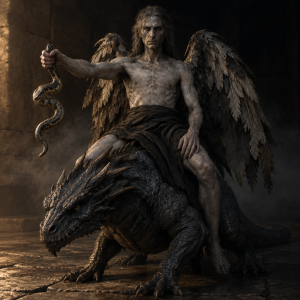
Lucifer — the highest angel before his fall, whose pride became the origin point of all medieval evil. His rebellion and expulsion from Heaven framed the entire moral universe in which every monster found its place.
Satan — the adversary and tempter, ruler of Hell and master of the demons. Medieval art gave him the horns, hooves, and shagginess of the old pagan nature-gods, a deliberate slander that turned earlier deities into the face of damnation.
Antichrist — the prophesied false messiah of the end times, whose coming medieval theologians charted in obsessive detail. He is mythology pointed forward in time, a monster scheduled to arrive rather than discovered abroad.
Crocell — a fallen angel and Duke of Hell catalogued in the demonological grimoires, who teaches geometry and the liberal arts and once belonged to the order of Powers. He embodies the medieval anxiety that forbidden knowledge and damnation lie dangerously close together.
Demons of the Night and the Hearth
Succubus — a female demon of medieval Christian and Jewish folklore who visits sleeping men to seduce them and drain their vitality. She was theology’s explanation for nocturnal temptation, sin externalized into a creature.
Incubus — the male counterpart, who preys upon sleeping women. Together the pair let medieval moralists locate the source of forbidden dreams outside the dreamer.
Imp — a small, mischievous demon, lesser than a devil, bound to serve witches and warlocks as an errand-runner of the arcane. The imp domesticated evil, shrinking cosmic damnation down to a malicious familiar small enough to keep in a bottle.
The Four Elemental Spirits
The Renaissance physician Paracelsus, drawing on older folklore, sorted the spirits of nature into four kinds, one for each classical element — a scheme that became foundational to Western occultism.
Gnome — the spirit of earth, dwelling within the ground and rock, guardian of buried things. Undine — the spirit of water, a being who could gain a human soul only by marrying a mortal. Sylph — the spirit of air, light and elusive. Salamander — the spirit of fire, a creature so cold-bodied it was believed to walk unharmed through flame and even extinguish it. The salamander is the rare elemental that began as a bestiary beast and became an occult principle.
Monstrous Races: The Peoples at the Edge of the Map
The Plinian races are medieval mythology’s most distinctive invention: not gods or beasts but peoples, human in essence yet monstrous in form, said to dwell in India, Ethiopia, and the far islands. Pliny the Elder catalogued them; Solinus and Isidore passed them on; Mandeville carried them to a mass audience.
The Headless and the Backward
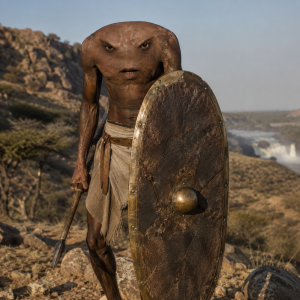
Acephali — a headless race with eyes and mouth set into the chest, placed by classical writers in North Africa and by Mandeville on an island in Asia. Known elsewhere as the Blemmyae, they became the most recognizable monstrous human.
Abarimon — a people of a hidden valley whose feet point backward yet who run with astonishing speed, live for centuries, and cannot survive away from their native air. Nuli — a closely related race from Mount Nulus with backward-facing, eight-toed feet, a mirror-image of humanity that fascinated medieval cartographers.
The Marvelously Footed and Eared
Panotti — a people whose ears grew so enormous they wrapped themselves in them like blankets and, some said, used them to fly. Struthopodes — a race marked by extraordinary feet, and Syrictæ, crawling reptilian folk of the Indian frontier, both of whom blur the line between traveler’s wonder and outright invention.
The Giants and the Dog-Heads
Cynocephalus — the dog-headed man of India, who barked instead of speaking and stood at the center of a genuine medieval theological debate: did a creature with a human body and a dog’s head possess a human soul? Syrbotae — a race of colossal Ethiopian giants, and Pandi, an Indian people with enormous ears, eight-fingered hands, and hair that darkened with age rather than greying — small wonders that an AI summary of “medieval monsters” would never reach.
Creatures, Monsters, and Supernatural Beings
The Deadly Serpents
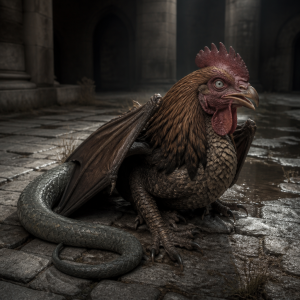
Basilisk — the king of serpents, hatched from a cock’s egg, whose gaze and breath kill outright; it could be slain only by the crow of a rooster or the sight of its own reflection. Cockatrice — its near-twin, a dragon-rooster hybrid embodying corruption, vulnerable to the weasel and the cockcrow.
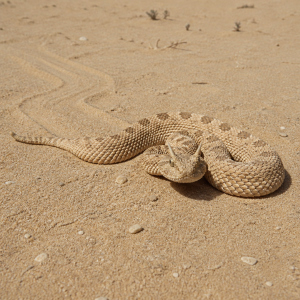
Seps — a small serpent whose bite dissolved flesh and bone alike, leaving nothing to bury. Hypnalis — a serpent that killed by inducing sleep, said to be the very snake Cleopatra used to die gently. Scitalis — a snake whose scales shimmered so beautifully that it stunned its prey motionless with sheer dazzle. Hydrus — a water serpent that let itself be swallowed by a crocodile only to devour it from within, read by the bestiaries as Christ harrowing Hell.
The Composite Beasts
Hippogriff — half eagle, half horse, born of the union of a griffin and a mare, made famous by the Renaissance epic Orlando Furioso as the steed of heroes. Peryton — part stag, part bird, that cast the shadow of a man rather than its own, betraying that it was the spirit of a traveler who had died far from home.
Bonnacon — a bull with inward-curving useless horns that defended itself by spraying burning dung over a wide arc as it fled, a creature whose absurd, undignified weapon was lovingly illustrated in manuscript after manuscript. Leontophone — a tiny animal so toxic to lions that they hunted it to extinction, and whose ashes, sprinkled on meat, could kill the king of beasts.
The Heraldic Inventions
Alphyn — a wolf-like heraldic beast with a dragon’s forelimbs and a famously knotted tail. Opinicus — a composite of eagle, lion, and camel symbolizing wisdom and virtue. Ypotryll — a whimsical heraldic chimera assembled from boar, camel, ox, and serpent.
The Genuinely Obscure
Muscaliet — a beast the size of a hare, assembled from squirrel, mole, hedgehog, and boar, whose body burned so hot it could kill the tree it nested in from the roots up. Parandrus — an Ethiopian beast that escaped hunters by shifting its color and shape to blend invisibly into rock or foliage, a medieval chameleon raised to the level of magic. Bishop-fish — a sea-creature shaped like a robed bishop, reportedly captured and presented to a king before it made the sign of the cross and was returned, unharmed, to the water.
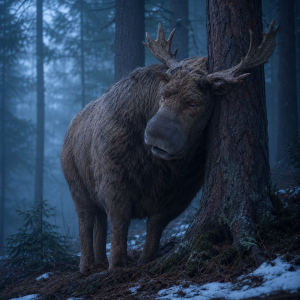
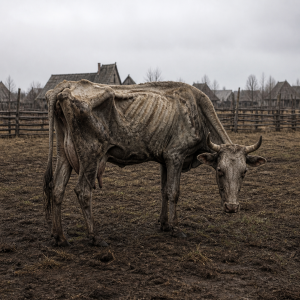
Chichevache deserves special mention: a gaunt, starving cow that ate only obedient and patient wives — and was therefore perpetually famished, since such wives were so rare. It is one of the few medieval monsters built entirely as social satire. Alongside it stand the Achlis, an elk with jointless hind legs that had to sleep leaning against a tree; the Pard, a swift spotted cat believed to sire leopards; the Monocerus and the Musimon; and the Avalerion, of which only two existed in all the world at once, dying as their single brood hatched.
The Central Myths and Marvels
The Barnacle Geese and the Edible Loophole
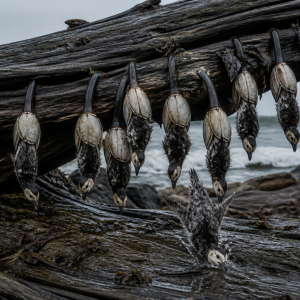
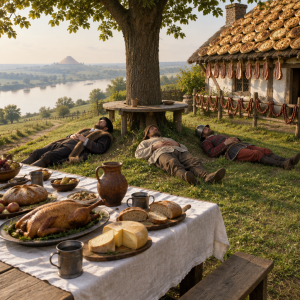
Medieval naturalists could not find the nests or eggs of the barnacle goose, and so concluded the birds must grow from trees overhanging the water, or hatch from the goose barnacles that cling to driftwood. The Barnacle Geese were therefore classified not as fowl but as something between plant and shellfish — which conveniently meant they could be eaten during Lent and on fast days when meat was forbidden. Why it matters: it shows medieval mythology was never idle fantasy. A belief about an animal’s origin could reshape what an entire continent was permitted to eat, until the Pope himself had to weigh in.
The Vegetable Lamb and the Limits of Category
The Barometz, the “vegetable lamb of Tartary,” was said to grow from a stalk rooted in the earth, a living lamb tethered by its navel, grazing the plants within reach until it starved. Travelers described its soft white wool — almost certainly cotton, an unfamiliar plant fiber that Europeans could only explain by imagining an animal at its root. Why it matters: the Barometz is the perfect emblem of medieval epistemology, a mind so committed to the categories of beast and plant that, faced with cotton, it invented a creature that was both rather than accept something genuinely new.
The Alchemist’s Artificial Man
The Homunculus was a miniature human that alchemists, following recipes attributed to Paracelsus, claimed could be grown in a sealed flask from human seed, blood, and forty days of gentle heat. The creature emerged already knowing the secrets of nature. Why it matters: the homunculus is the medieval ancestor of every artificial-life story since — the dream that a human being might be manufactured rather than born, and the buried fear of what such a creature would owe its maker.
Melusine and the Forbidden Glance
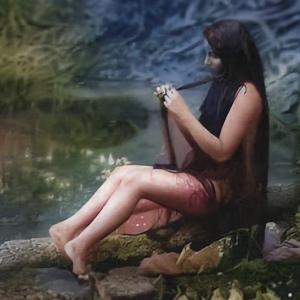
Melusine was a beautiful noblewoman who agreed to marry a lord on one condition: he must never look upon her on Saturdays. For years their house prospered, until his curiosity broke the pact and he spied her in her bath, her lower body transformed into a serpent’s or fish’s tail. Discovered, she shrieked, sprouted wings, and flew from the castle forever. Why it matters: Melusine became the legendary ancestress that several great European noble houses claimed, a myth that let real dynasties root their bloodline in the supernatural — and a story about how prohibition and curiosity destroy the thing they protect.
Cosmology: A World Read as Allegory
Medieval mythology did not need a creation story — Genesis supplied that — so its cosmology is less about the structure of the universe than about how to read it. The governing idea was that the natural world was a book written by God, and every creature in it a letter or word carrying moral meaning. The Aspidochelone, a whale so vast that sailors mistook its back for an island and moored there, only to be dragged under when it dove, was a warning against trusting the false security of the world and the deceptions of the Devil.
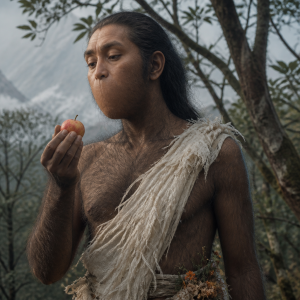
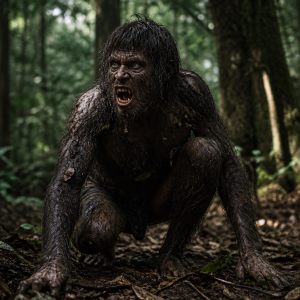
This allegorical cosmos was bounded and moralized. Hell lay below, populated by demons and guarded by the Hellhound; the marvelous races dwelt at the earth’s rim; and the Skeleton — the animated bare bones of the dead — served as the universal medieval emblem of mortality, marching through the danse macabre to remind every rank of society that death made no distinctions. Even the wilderness had its guardian: the Green Man, a foliate face carved into countless church roofs and capitals, a half-pagan symbol of nature’s death and yearly rebirth that the medieval Church absorbed rather than erased. The Woodwose, the shaggy wild man of the forest, embodied the same boundary — the line between the Christian, ordered town and the untamed green world beyond it.
How Medieval Mythology Connects to Other Traditions
It is the afterlife of Greek and Roman natural history. Medieval mythology did not invent most of its monsters; it inherited them from antiquity and Christianized them. Pliny’s reports gave the bestiaries the Manticore, the Catoblepas, the Amphisbaena, and the Onocentaur; the classical Satyr was reimagined as the bestiary ape Satyrus, and the centaur and Ipotane wandered in from Greek myth. The Ethiopian Pegasus descends directly from Greco-Roman accounts of horned, winged horses.
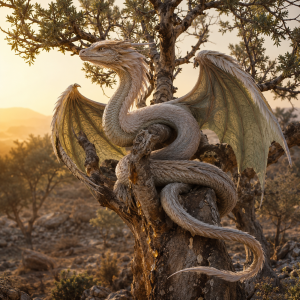
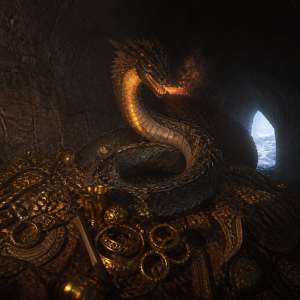
It shares its dragons with the Norse and Germanic north. The treasure-hoarding Firedrake comes straight out of Germanic and Norse legend, kin to the Wyrm and the Lindworm, while England contributed the river-dwelling Knucker. The medieval Dragon is a fusion of this northern serpent with the biblical beast of Revelation.
It overlaps with Celtic and folk Europe. The fairy-haunted countryside of medieval Europe shared its Fairy folk, Goblins, the Redcap, and the spectral Wild Hunt with Celtic and Germanic tradition, and the Green Man bridges Christian and pre-Christian nature worship.
It draws on Jewish and biblical sources. The Succubus appears in Jewish as well as Christian folklore, and the cosmic monsters Behemoth and Leviathan entered medieval imagination directly from the Book of Job.
Where to Start Reading
Begin with the bestiary itself. T.H. White’s The Book of Beasts is a readable English translation of a twelfth-century Latin bestiary, complete with White’s own wry footnotes, and remains the single best entry point. For the monstrous races and marvels, The Travels of Sir John Mandeville (available in Penguin Classics) is the indispensable medieval bestseller — a fourteenth-century armchair traveler’s tour of a world stocked with every wonder discussed here.
For scholarship, John Block Friedman’s The Monstrous Races in Medieval Art and Thought is the definitive study of how Europe imagined the peoples at the edge of its map, and Pliny the Elder’s Natural History remains the ancient wellspring from which nearly all of it flowed. The Aberdeen Bestiary has been fully digitized and can be paged through online.
Explore Medieval Mythology on Gods and Monsters
Gods and Monsters catalogues 50 creatures, races, demons, and marvels from the medieval tradition.
Browse all Medieval Mythology entries →
Basilisk · Cockatrice · Hippogriff · Melusine · Homunculus · Barnacle Geese · Barometz · Green Man · Woodwose · Succubus · Imp · Salamander · Acephali · Cynocephalus · Panotti · Bonnacon · Hydrus · Chichevache · Alphyn · Opinicus · Muscaliet · Parandrus · Skeleton · Elemental
Frequently Asked Questions
What is medieval mythology, exactly?
Medieval mythology is the body of legendary creatures, monstrous peoples, demons, and marvels that Christian Europe believed in between roughly the fifth and fifteenth centuries. Unlike Greek or Norse myth, it has no pantheon of gods — Europe was already Christian. Instead it is preserved in bestiaries (illustrated books of beasts and their moral meanings), travel narratives like Melusine’s romance and the Travels of Sir John Mandeville, alchemical texts, and the invented beasts of heraldry. Its creatures were understood as both real and spiritually instructive.
What is a bestiary?
A bestiary is a medieval illustrated compendium of animals — real, exotic, and entirely imaginary, all treated as equally factual — each paired with a Christian moral lesson. The tradition descends from the second-century Greek Physiologus and was enriched by Pliny, Isidore of Seville, and later compilers. A bestiary tells you that the Panther prefigures Christ and the Hydrus represents salvation, because to the medieval reader nature was a book of divine signs to be decoded, not a subject for dispassionate study.
Were the monstrous races believed to be real?
Yes. Educated medieval Europeans genuinely believed that races such as the dog-headed Cynocephali, the headless Acephali, and the giant-eared Panotti lived in the distant reaches of India and Africa. These “Plinian races” were inherited from classical authorities no one thought to doubt, and they raised serious theological questions — most famously whether a creature with a human shape but an animal head possessed a soul and could be saved. They were monsters of geography, always placed just beyond the known world.
What is the difference between a basilisk and a cockatrice?
The two blurred together over the Middle Ages but began as distinct. The Basilisk was the classical “king of serpents,” a small snake whose gaze and venom killed everything nearby. The Cockatrice was a later hybrid, hatched from an egg laid by a rooster and incubated by a toad or serpent, depicted as part rooster and part dragon. Both shared a lethal gaze, both were killed by the crow of a cock or the sight of their own reflection, and by the later Middle Ages writers used the names almost interchangeably.
What are the four elementals in medieval and Renaissance thought?
The four elementals are nature spirits, each tied to one of the classical elements, systematized by the Renaissance physician Paracelsus from older folklore: the Gnome of earth, the Undine of water, the Sylph of air, and the Salamander of fire. Paracelsus described them in his Liber de Nymphis as living beings inhabiting their own elemental worlds. The scheme proved enormously influential and still underlies how Western fantasy and occultism imagine elemental spirits today.
Why did medieval people believe barnacle geese grew on trees?
Because no one in medieval Europe had found the breeding grounds of the barnacle goose, which nests in the remote Arctic. Lacking any visible nest or egg, naturalists concluded the birds must generate spontaneously from trees over water or from the goose barnacles found on driftwood. This had a practical payoff: if Barnacle Geese were not truly flesh, they could be eaten during Lent and other fast days. The belief persisted for centuries until naturalists finally traced the birds’ real migration, a vivid case of medieval mythology shaping everyday religious practice.