Jewish Mythology: The Complete Guide to the Unspeakable Name, the Demons of the Night, and the Feast at the End of Days
Jewish mythology hides in plain sight. Most of its monsters, angels, and demons never made it into the Hebrew Bible’s polished final text — they live instead in the aggadah, the vast sea of rabbinic storytelling that surrounds the law like commentary written in the margins of the universe. This is a mythology that names a primordial sea-dragon God will one day carve up for a banquet, that records the recipe for building a man out of river clay, and that insists Adam had a wife before Eve who left him rather than lie beneath him.
What makes it strange among world mythologies is the central paradox: it is the mythology of a tradition that officially has no mythology. There is only one God, unnamed and unspeakable, and no pantheon — yet the spaces around that God teem with angels organized into armies, demons ruled by queens, giants whose bones became hills, and beasts so large the world cannot hold two of them. The myths grow in the gaps the scripture leaves open.
The sources are unusually traceable. The Hebrew scriptures give the skeleton; the Talmud, the various Midrash collections (Genesis Rabbah, Pirkei de-Rabbi Eliezer), the apocrypha and pseudepigrapha (the Books of Enoch, Jubilees), the medieval Alphabet of Ben Sira, and finally the Kabbalistic literature of the Zohar add flesh, scandal, and cosmic machinery. Read together, they form one of the most psychologically intricate mythologies on earth.
What Makes Jewish Mythology Different
The supreme god has a name no one is allowed to say. Yahweh is written with four consonants — the Tetragrammaton — and the actual pronunciation was deliberately allowed to die. Where Greek or Norse gods are invoked by name constantly, the God of Israel is approached through substitutes (Adonai, HaShem, “the Name”) because the true name is understood to hold the structuring power of reality itself. Mythology here begins not with a god you can picture but with a god you cannot even pronounce.
The demons are bureaucratically organized, and most of them are female at the top. Unlike traditions where demons are formless chaos, Jewish demonology built a hierarchy with four “queens of the demons” — Lilith chief among them — and whole species of spirits with Hebrew names: shedim, mazzikin, lilin. This is a demonology of categories and case law, not just horror.
The afterlife was an afterthought. For centuries the dead simply went to Sheol, a grey pit with no judgment, no reward, no punishment. The elaborate heaven-and-hell machinery most people associate with “the Bible” is largely a later, post-biblical development — which makes Jewish mythology unusual in caring far more about this world and the coming messianic age than about a soul’s individual fate.
Humans can imitate creation — and that’s the whole point of the scariest stories. The Golem exists because Jewish mysticism took seriously the idea that the same letter-combinations God used to make the world could be used by a holy enough rabbi. The mythology’s great horror is not a monster from outside but the consequence of a human reaching for divine creative power.
The monsters are being saved for dinner. The three primordial beasts — Leviathan, Behemoth, and Ziz — are not threats to be slain by a hero now. They are kept in cold storage until the end of time, when the righteous will eat them at a feast. Few mythologies file their dragons under “future catering.”
God, the Spirit, and the Hosts of Heaven
There is no pantheon, but there is a populated heaven. Jewish mythology develops an enormous angelology — ranked choirs of beings who carry out the divine will, sing before the throne, and occasionally interfere on earth.
The Divine and Its Aspects
Yahweh — the one God, creator of heaven and earth, whose unspeakable four-letter name encodes existence itself. He is simultaneously the intimate covenant-god of a single people and the abstract ground of all being.
The Holy Spirit (Ruach HaKodesh) — the divine breath or presence that hovered over the waters at creation and rested on the prophets. In Jewish thought it is an aspect of God’s activity in the world rather than a separate person, the channel through which prophecy and inspiration flow.
Angels and the Watchful Ones
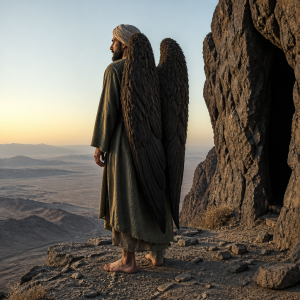
Guardian angels — the rabbinic tradition holds that individuals and even nations are assigned angelic guardians; a famous teaching has two angels escorting every person home from synagogue. They embody the idea that the heavenly bureaucracy reaches all the way down to the individual.
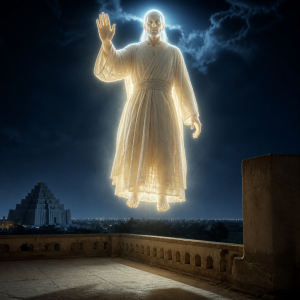
Irin — the “wakeful ones,” a high class of angel described in the Book of Daniel as descending to pronounce divine decrees. They are watchers in the original, loyal sense: sleepless sentinels of the divine court.
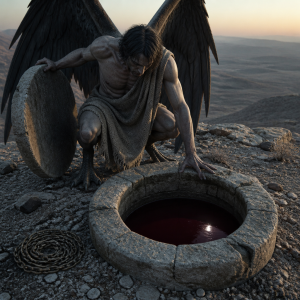
Grigori — the Watchers who went wrong. Two hundred angels who, in the Book of Enoch, descended to earth, took human women as wives, and taught humanity forbidden arts: metallurgy, weaponry, sorcery, and cosmetics. Their leader Shemhazai and the rebel Azazel turned a guard duty into the corruption of the world, and their punishment — bound beneath the earth until judgment — became the template for every “fallen angel” story that followed.
Demons, Night-Spirits, and the Queens of the Dark
Jewish demonology is one of the richest in the world precisely because rabbinic culture took the unseen seriously: the air, the Talmud says, is so thick with spirits that if the eye could see them no one could endure it. These beings are not simply evil — many are morally ambiguous bureaucrats of misfortune.
The Classes of Demon
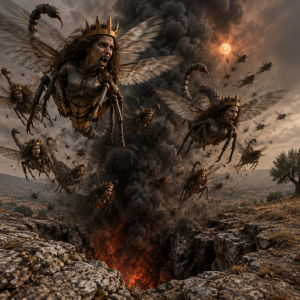
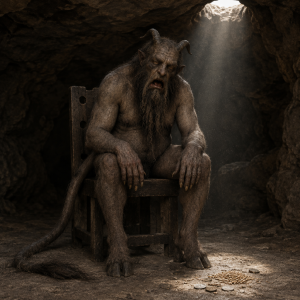
Shedim — the general term for demons, beings caught between angels and humans: they eat, reproduce, and die like people, but fly and know the future like angels. Some were said to have been created at twilight on the sixth day, when God ran out of time to give them bodies.
Mazzikin — the “harmers,” invisible spirits blamed for the everyday accidents of life: the stumble, the spilled cup, the sudden illness. They cluster in particular places and times, which is why so much of Jewish folk practice concerns where not to walk after dark.
Lilin — the children and attendants of Lilith, night-spirits who threaten infants and sleeping men. Their name shares its root with the Hebrew word for night, and they are the demonic counterpart to the protective amulets hung over a newborn’s cradle.
The Queens and the Seducers
Lilith — the most famous figure in all of Jewish mythology and its most subversive. In the medieval Alphabet of Ben Sira she is Adam’s first wife, made from the same earth as him, who refuses to lie beneath him as an inferior, speaks the ineffable Name, and flies away to the Red Sea to birth a hundred demon children a day. Her roots run back through Babylonian lilitu wind-demons to Sumerian night-spirits; her future runs forward into modern feminism, where her refusal became a banner.
Agrat bat Mahlat — one of the four queens of demons, a “dancing rooftop demon” who rides out with a retinue of eighteen myriads of destroying angels on certain nights. Talmudic tradition holds that the sage Abaye curbed her power, restricting her to Wednesday and Sabbath eves.
Succubus — the night-demon who visits sleeping men, drawing them into illicit union to breed more demons. In the Jewish framework these are not random temptresses but the daughters of Lilith, an entire reproductive economy of the dark mirroring the human one.
Satan — strikingly, not the cosmic archenemy of later Christianity. In the Hebrew Bible ha-satan is “the accuser,” a member of the divine court whose job is to test human righteousness, as in the Book of Job. He is God’s prosecuting attorney, not God’s rival — a role the parallel figure of Lucifer would only later inflate into rebellion in Christian tradition.
The Shells of Evil
Qliphoth — in Kabbalah, the “shells” or “husks,” the impure inverse of the divine emanations. Where the holy Sefirot are the ten attributes through which God structures creation, the Qliphoth are their dead bark, the realm of imbalance and evil. This is mythology as metaphysics: evil is not a being but a residue, the peel left over from creation.
The Beasts of Land, Sea, and Sky
Jewish mythology’s great monsters are cosmic in scale — primordial creatures made on the fifth and sixth days, too vast for the ordinary world.
The Primordial Trio
Leviathan — the coiling sea-dragon of the deep, so enormous that God created a male and a female but slew the female lest the pair multiply and crush the world. Its eyes blaze light, its breath boils the sea, and at the end of days its flesh will feed the righteous while its skin becomes their canopy. It descends from the Canaanite chaos-serpent Lotan.
Behemoth — the unstoppable land-beast, grazing on a thousand mountains each day, drinking a half-year’s worth of the Jordan in one gulp. Where Leviathan rules the sea, Behemoth rules the dry land, and the two are destined to kill each other in a final battle that prepares the messianic feast.
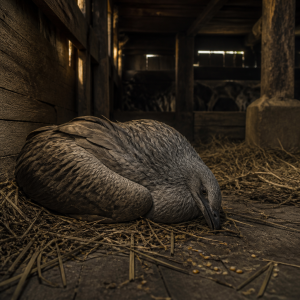
Ziz — the colossal bird that completes the trio, ruling the sky as Leviathan rules the sea and Behemoth the land. Its ankles rest on the earth while its head brushes heaven; spreading its wings can eclipse the sun. The three together represent God’s total dominion over creation.
Dragons and Wonder-Beasts
Tannin — the sea-dragons or great serpents created on the fifth day, sometimes identified with Leviathan, sometimes a whole class of chaos-monsters that God tames at the dawn of creation. They are the Hebrew Bible’s living memory of the Near Eastern combat between order and the watery deep.
Re’em — a beast of impossible size, often a giant wild ox, so large that only two could exist at once (one male, one female, at opposite ends of the earth) and so heavy that, in one legend, Noah could not fit it on the ark and had to tether it behind. A newborn re’em is already the size of a mountain.
Bar Juchne — a bird so vast that a single one of its eggs, when it accidentally fell, drowned sixty cities and uprooted three hundred cedars. It is the kind of obscure marvel that shows the rabbinic imagination delighting in scale for its own sake.
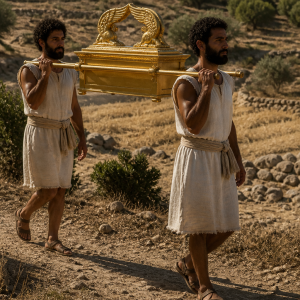
Tachash — a mysterious single-horned animal that existed only in the days of Moses, whose multicolored hide was used to cover the Tabernacle and then vanished from the earth forever. It is a creature defined entirely by its one sacred purpose.
The Giants and the Lost Races
Before the flood and in the conquest of Canaan, Jewish mythology populates the world with giants — the half-divine and the monstrous, remembered as the original inhabitants of the land.
Nephilim — the “fallen ones,” offspring of the Watchers and human women, giants whose violence filled the earth and helped provoke the flood. In the Book of Enoch their hybrid nature makes them monstrous: they consume everything, then turn on humanity itself, and their disembodied spirits become the world’s first evil spirits.
Anak — ancestor of the Anakim, the giant people whose presence made the Israelite spies feel “like grasshoppers.” Anak’s descendants are the giants Caleb must drive from Hebron.
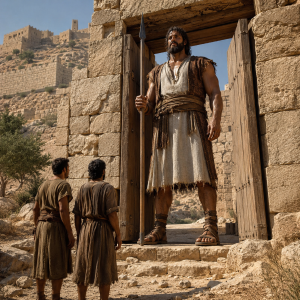
Rephaite — the Rephaim, an ancient race of giants whose name doubles, hauntingly, as a word for the shades of the dead. King Og of Bashan was remembered as their last survivor, his iron bed thirteen feet long.
Zamzummim — a giant people of the Ammonite territory, “as numerous and tall as the Anakim,” dispossessed and destroyed before Israel arrived. Their strange reduplicated name may imitate the murmuring, unintelligible speech outsiders heard in them.
Dead Sea Apes — in one rabbinic tradition, the people who built the Tower of Babel were punished by being transformed into ape-like creatures haunting the wilderness near the Dead Sea — a rare Jewish myth of degeneration rather than destruction.
The Central Myths
Lilith Leaves the Garden
According to the Alphabet of Ben Sira, God made Adam a first wife from the same dust, not from his rib. When Adam insisted on dominance, she retorted, “We are equal, for we are both from the earth,” pronounced the ineffable Name of God, and flew away. God sent three angels to retrieve her; she refused to return, and as punishment a hundred of her demon children would die each day — which is why, in revenge, she preys on human infants. Only the names of the three angels, written on an amulet, hold her off.
Why it matters: Lilith is the mythological pressure-valve for everything the official creation story left out — female autonomy, the terror of infant mortality, the anxiety that the first human relationship was a power struggle. She is proof that even a strictly monotheistic tradition generates myth in the cracks.
The Watchers and the Flood of Giants
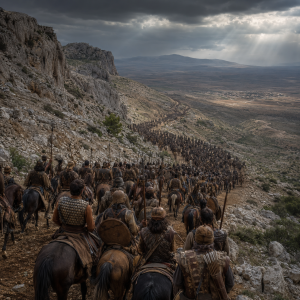
The Book of Enoch expands a cryptic line in Genesis — “the sons of God saw that the daughters of men were beautiful” — into a full myth of cosmic betrayal. The Watchers descend, marry human women, and father the monstrous Nephilim. Worse, they teach humanity forbidden knowledge: weapons, magic, astrology, cosmetics. The earth fills with bloodshed until God sends the flood and has the Watchers bound beneath the earth until the final judgment.
Why it matters: This is the origin story of evil as an intrusion — corruption taught from above rather than born in the human heart. It shaped Jewish, Christian, and even Islamic ideas of fallen angels, and it answers the unspoken question of where demons came from in the first place.
The Making of the Golem
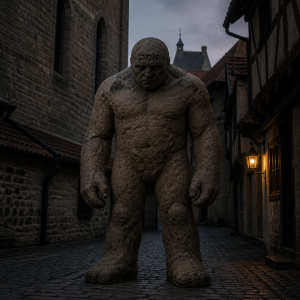
The most famous version places Rabbi Judah Loew, the Maharal of Prague, at the Vltava River in the late 1500s. To defend his community against the blood libel, he shaped a giant from river clay, circled it seven times reciting permutations of the divine names from the Sefer Yetzirah, and inscribed emet (“truth”) on its forehead. The Golem came to life and patrolled the ghetto by night — until it grew uncontrollable, and the rabbi had to erase the first letter, turning emet into met (“death”) and returning it to clay.
Why it matters: The Golem is the world’s oldest artificial-intelligence parable. It encodes both the glory and the danger of creative power: a holy act that, once it imitates God too closely, slips beyond its maker’s control. Every Frankenstein and rogue-robot story is its descendant.
The Afterlife and the World to Come
Here Jewish mythology is at its most distinctive — by being, for a long time, almost empty. The earliest Hebrew conception of death is Sheol: a dim, dusty pit beneath the earth where everyone, righteous and wicked alike, descends into a shadowy half-existence, cut off from God. There is no judgment, no fire, no reward. It resembles the Greek Hades more than any later heaven or hell, and its sheer bleakness explains why the Hebrew Bible directs almost all its hope toward life, descendants, and the future of the nation rather than personal immortality.
Only in the post-biblical and rabbinic period does the architecture fill in. Gehinnom (Gehenna) — named for a literal valley outside Jerusalem associated with child sacrifice — becomes a place of purification, but a strikingly merciful one: the standard sentence is capped at twelve months, after which the cleansed soul ascends. Gan Eden, a spiritual Garden of Eden distinct from the earthly one, becomes the abode of the righteous. Above it all stands Olam Ha-Ba, the World to Come, reached through the resurrection of the dead in the messianic age — and the Talmud insists that the righteous of all nations, not only Jews, have a share in it.
This is also where the great beasts return. When the Messiah comes, God will slay Leviathan, Behemoth, and Ziz, and serve their flesh to the righteous at a banquet, with Leviathan’s hide stretched into a canopy over the feast. The messianic age is preceded by a final cataclysmic war, the assault of Gog of Magog against Israel, after which the dead rise and the feast begins. The mythology’s eschatology is not about escaping the world but about its final, abundant restoration.
One restless figure haunts the gap between death and the World to Come: the Dybbuk, the spirit of a dead person — often one who died with unfinished business or sin — that clings to and possesses a living body. Unlike a demon, the dybbuk was once human, which makes its possession a tragedy as much as a horror, resolved only by a rabbinic exorcism that releases the soul to its proper rest.
How Jewish Mythology Connects to Other Traditions
Jewish mythology sits at a crossroads of the ancient Near East and parents two of the world’s largest faiths. Its monsters and demons carry the fingerprints of older neighbors and cast long shadows forward.
The Canaanite inheritance. The sea-dragon Leviathan is directly descended from Lotan, the chaos-serpent slain by Baal in Canaanite myth, and the Hebrew goddess-figure Asherah and storm-god Baal appear in the Bible precisely as the rivals Israel’s religion defined itself against.
The Mesopotamian roots. Lilith emerges from Babylonian and Sumerian night-demons, and the cosmic combat in which God tames the Tannin echoes Marduk‘s defeat of the chaos-ocean Tiamat in Mesopotamian myth.
The children: Christianity and Islam. Christianity inherited Satan, the angels, and the figures of Adam and Eve, transforming the courtroom accuser into a cosmic devil. Islam shares Moses, Noah, the patriarch Joseph, and a parallel demonology of unseen beings such as the djinn.
The dualist neighbor. The sharpening of Satan into an adversary and the cosmic struggle of light against darkness owe a debt to Zoroastrian ideas absorbed during the Persian period.
Where to Start Reading
The indispensable modern entry point is Howard Schwartz’s Tree of Souls: The Mythology of Judaism, the first systematic gathering of these scattered myths into one volume. For the primary sources themselves, the Soncino translation of the Babylonian Talmud and the Midrash collections (especially Genesis Rabbah and Pirkei de-Rabbi Eliezer) preserve the aggadic stories in their original argumentative setting.
For the apocalyptic material — Watchers, Nephilim, and the cosmic geography — read the Books of Enoch and Jubilees in a modern critical translation. Louis Ginzberg’s classic Legends of the Jews remains the great narrative synthesis, retelling the entire biblical story as the rabbis embroidered it. For the mystical layer of Golem, Sefirot, and Qliphoth, Gershom Scholem’s Major Trends in Jewish Mysticism is the foundational guide.
Explore Jewish Mythology on Gods and Monsters
Gods and Monsters currently has 33 entries drawn from the Jewish tradition, from the queens of the demons to the beasts being saved for the end of days.
Browse all Jewish Mythology entries →
Yahweh · Lilith · Golem · Dybbuk · Leviathan · Behemoth · Ziz · Nephilim · Grigori · Satan · Shedim · Mazzikin · Lilin · Agrat bat Mahlat · Qliphoth · Tannin · Re’em · Bar Juchne · Anak · Rephaite · Zamzummim · Adam · Eve · Moses
Frequently Asked Questions
Does Judaism actually have a mythology?
Yes — an immense one, though it lives outside the legal core of the tradition. The myths are found in the aggadah: the storytelling portions of the Talmud, the Midrash, the apocrypha, and later Kabbalistic works. Because Judaism is strictly monotheistic, it has no pantheon of competing gods, but it developed vast traditions about angels, demons, giants, primordial beasts, and the end of the world. The mythology fills the spaces the biblical text leaves open.
Who was Lilith and was she really Adam’s first wife?
The story of Lilith as Adam‘s first wife comes from the medieval Alphabet of Ben Sira, not from the Bible itself. In that account she was made from the same earth as Adam, demanded equality, and left him when he refused, becoming a demon who threatens infants. Her deeper origins lie in Babylonian and Sumerian night-demons. She is mentioned only once in the Hebrew Bible, in a single verse of Isaiah, as a wilderness creature — everything else is later mythology.
What are Leviathan, Behemoth, and Ziz?
They are the three primordial monsters of land, sea, and sky. Leviathan is the sea-dragon, Behemoth the colossal land-beast, and Ziz the sky-spanning bird. Jewish tradition holds that God created them at the beginning but is keeping them until the messianic age, when their flesh will be served to the righteous at a great banquet. Together they symbolize God’s dominion over all three realms of creation.
What is a Golem and where does the legend come from?
A Golem is an artificial being made from clay and animated through Kabbalistic use of God’s names, drawing on the mystical text Sefer Yetzirah. The most famous legend credits Rabbi Judah Loew of 16th-century Prague with creating one to protect his community, inscribing the Hebrew word emet (“truth”) on its forehead and deactivating it by erasing a letter to leave met (“death”). The Golem is often called the ancestor of every artificial-life and robot story.
What does Jewish tradition say happens after death?
It changed dramatically over time. The oldest layer describes Sheol, a neutral, shadowy underworld with no judgment. Later rabbinic thought developed Gehinnom, a place of purification usually limited to twelve months; Gan Eden, a spiritual paradise for the righteous; and Olam Ha-Ba, the World to Come reached through resurrection in the messianic age. Notably, Judaism teaches that righteous people of all nations have a share in the World to Come, and it places far more emphasis on this world than on the next.
Is the Jewish Satan the same as the Christian Devil?
No. In the Hebrew Bible, ha-satan means “the accuser” — a member of God’s heavenly court whose role is to test human righteousness, most clearly in the Book of Job. He acts with God’s permission, not against God. The transformation into a cosmic rebel and enemy of God, fused with the figure of Lucifer, largely happened later in Christian tradition, influenced by Persian dualism during the Second Temple period.