Irish Mythology: The Complete Guide to the Tuatha Dé Danann, the Otherworld, and the Hero Cycles
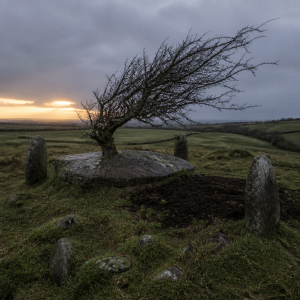
Irish mythology is the only major European mythology whose gods were never quite forgotten — they were demoted. When Christian monks set down the old stories in the eleventh and twelfth centuries, they could not bring themselves to call the Dagda and the Morrigan divine, so they reinvented them as a race of supernaturally gifted invaders, the Tuatha Dé Danann (“the people of the goddess Danu”), who conquered Ireland and were later driven underground by mortal men. Beaten but not destroyed, they retreated into the sídhe — the green burial mounds that dot the Irish landscape — and became the fairy folk who haunt Irish folklore to this day. No other pantheon has such a continuous, unbroken thread running from Iron Age gods to the changelings and banshees of nineteenth-century country tales.
The literature survives in four great cycles. The Mythological Cycle, preserved chiefly in the Lebor Gabála Érenn (“Book of the Taking of Ireland”) and the Cath Maige Tuired (“The Battle of Mag Tuired”), tells of the divine invasions. The Ulster Cycle centres on the boy-hero Cú Chulainn and the great cattle-raid epic, the Táin Bó Cúailnge. The Fenian Cycle follows the warrior-poet Finn mac Cumhal and his roving war-band, the Fianna. The Cycle of the Kings records the semi-legendary high kings of Ireland. Together they form one of the richest vernacular literatures of medieval Europe — and almost all of it was written down by the very monks whose faith should have buried it.
What follows is a complete tour of that world — its divine race, its hero-monsters and fairy-tricksters, its central myths, and the deathless Otherworld at its heart — with every entity that has a full entry on Gods and Monsters linked along the way.
What Makes Irish Mythology Different
The gods are euhemerized — turned into history. Unlike the Greek Olympians, who stayed openly divine, the Irish gods reach us disguised as a conquering people in a pseudo-history of Ireland. The Lebor Gabála Érenn presents the Tuatha Dé Danann as the fifth of six invading races, slotted neatly between the Fir Bolg and the human Milesians. This means Irish “myth” is written as chronicle, and the line between god, ancestor, and fairy is deliberately blurred. The Dagda is a god of abundance, a tribal king, and eventually a fairy-mound dweller — all at once.
There is no hell, and barely an afterlife of the dead. The Irish Otherworld is not a realm of judgement or punishment but a deathless land of youth, feasting, and music lying just beside our own — reachable through a cave, a lake, a fairy mound, or a voyage west. It is the opposite of the Greek Hades or the Norse Hel: a place you might be lucky enough to be invited to while still alive, not a grim destination for the dead.
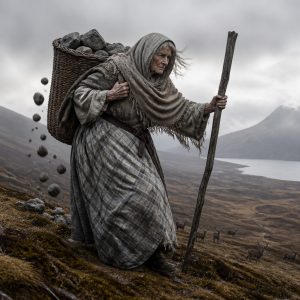
Sovereignty is a goddess you must marry. Irish kingship runs through a recurring idea found almost nowhere else in such concentrated form: the land itself is a goddess, and a king is only legitimate if he weds her. She appears as a loathsome hag who becomes a beautiful woman the instant the rightful king embraces her — or as Medb of Connacht, the sovereignty-figure turned warrior-queen who took husbands as she pleased.
The hero is a monster as much as a champion. Cú Chulainn’s defining trait is the ríastrad or “warp-spasm,” a berserk battle-frenzy that physically distorts his body into something unrecognisable and horrifying — one eye sucked into his skull, the other bulging onto his cheek, a column of black blood spouting from his head. Irish heroism is ecstatic and grotesque, not the disciplined courage of classical epic.
Fairies are the old gods, not pretty sprites. The fairy tradition that the wider world later sentimentalised is, in Ireland, the direct continuation of the defeated pantheon. The “fair folk” of the sídhe are dangerous, proud, and easily offended precisely because they are dethroned deities. To call them “the good people” was flattery offered out of fear.
The Major Gods: The Tuatha Dé Danann
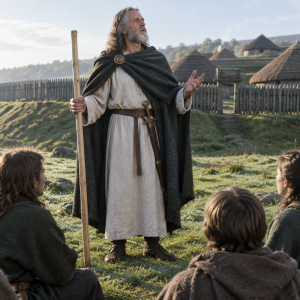
The Tuatha Dé Danann are not a tidy pantheon of fixed offices like the Olympians. They are a divine family of craft-gods, war-goddesses, and kings, defined more by skill and function than by rigid domain. Many are triple figures, and many share names and roles across the Celtic world.
Kings and Father-Gods
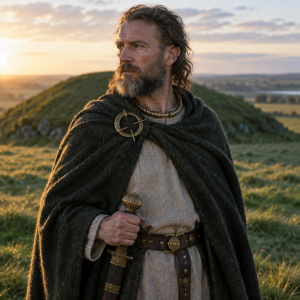
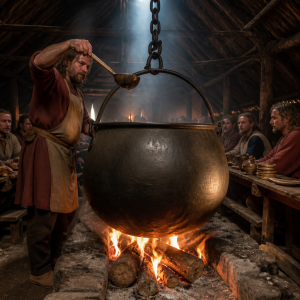
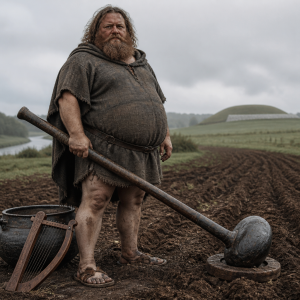
Dagda — the “Good God,” father-figure and chieftain of the Tuatha Dé. He carries a club so vast it must be dragged on wheels, one end of which kills and the other revives; a cauldron that never empties; and a harp that orders the seasons. He is gluttonous, comic, and immensely powerful all at once — a god of abundance, druidry, and the turning year.
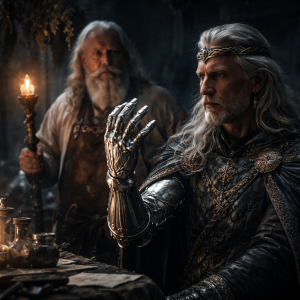
Nuada — first king of the Tuatha Dé, called Airgetlám, “Silver Hand.” He lost his arm in the first battle of Mag Tuired and with it his kingship, since Irish law forbade a blemished man to rule. Fitted with a working silver arm by the healer-god, and later restored to flesh, he regained the throne — only to cede it to a greater champion when the Fomorian crisis came.
Lug — Lugh of the Long Arm or Lámfada, the samildánach (“master of all arts”). He talks his way into Nuada’s hall by proving he is poet, smith, warrior, harper, sorcerer, and physician at once, and he leads the Tuatha Dé to victory in the second battle of Mag Tuired. There he kills his own grandfather, the Fomorian tyrant Balor, driving a sling-stone through the old giant’s deadly eye. The harvest festival of Lughnasadh still bears his name.
War, Sovereignty, and the Land
Morrigan — the “Phantom Queen,” goddess of war, fate, and sovereignty, who appears as a crow over the battlefield and prophesies the deaths of warriors. She is often a triple goddess (Badb, Macha, and Nemain or Anand), and her favour decides battles. In the Táin she offers herself to Cú Chulainn, and when he refuses her she turns against him as eel, wolf, and heifer.
Brigid — goddess of poetry, healing, and smithcraft, daughter of the Dagda, and one of the most enduring figures in all Irish tradition. Her threefold patronage of inspiration, the forge, and the hearth made her so beloved that the early Church absorbed her wholesale into Saint Brigid of Kildare, complete with a sacred eternal flame.
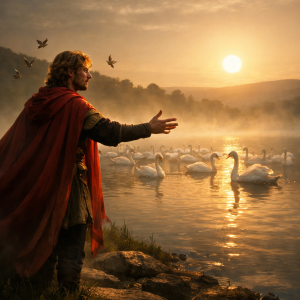
Aengus Óg — the youthful god of love, poetry, and the Brú na Bóinne (Newgrange). Son of the Dagda and the river-goddess Boann, he is the dreaming lover whose own courtship — pursuing a swan-maiden seen only in visions — became one of the tenderest stories in the tradition.
The Craft-Gods and Healers
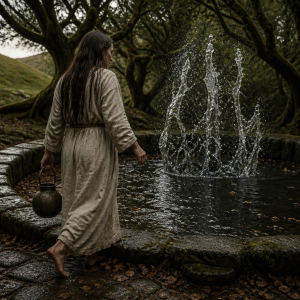
Dian Cécht — physician of the Tuatha Dé Danann, who fashioned Nuada’s silver arm and presided over the healing well of Sláine, into which slain warriors were dipped to be reborn for the next day’s fighting. His jealousy is as famous as his skill: he killed his own son Miach for surpassing him as a healer.
Goibniu — the divine smith, one of the three craft-gods (with the bronze-worker Credne and the wright Luchta) who forged the weapons of the Tuatha Dé. His spears never missed and his blades always killed; he also hosted the otherworldly Feast of Goibniu, whose ale granted the gods immunity from age and sickness.
Standing apart from the Irish race proper is Cernunnos, the antlered lord of beasts and the wild known across the wider Celtic world from Gaul to Britain. He is not native to the Irish texts, but he belongs to the same divine inheritance and is often grouped with the Irish gods as the horned god of fertility and the underworld.
Creatures, Monsters, and Supernatural Beings
Irish folklore swarms with supernatural beings, and the line between “monster” and “neighbour” is thin. Many are tutelary spirits of place; others are omens of death; a few are simply tricksters waiting for a careless traveller.
The Fairy Folk and Their Kin
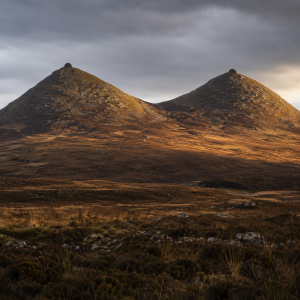
Sídhe — both the fairy mounds and the people who dwell in them, the aos sí, who are the Tuatha Dé Danann after their retreat underground. To live near a sídhe was to live beside the old gods, and the rules of courtesy toward them were taken deadly seriously.
Leprechaun — the solitary fairy shoemaker of the popular imagination, a cobbler who hoards gold and must grant wishes if caught. Beneath the tourist-shop image is an older, sharper trickster, forever scheming to break eye contact and vanish.
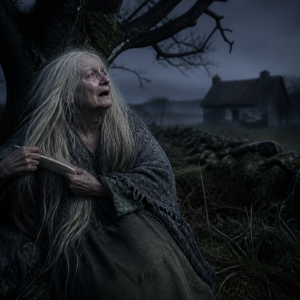
Banshee — the bean sídhe, “woman of the fairy mound,” whose keening wail foretells a death in the family. She is not a killer but a herald, attached to the great Irish families, mourning a death that has not yet happened.
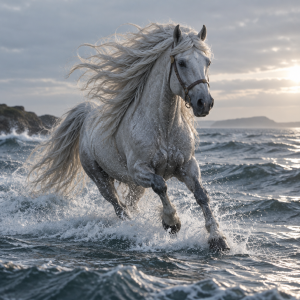
Púca (also the Phooka) — a shapeshifting spirit, by turns helpful and malicious, who appears as a black horse, goat, or hare and may carry a rider on a terrifying nocturnal gallop. The crops left unharvested after Samhain belonged to the Púca.
Leanan sidhe — the “fairy lover,” a beautiful muse-spirit who grants poets brilliant inspiration in exchange for their lives, burning them out young. She is the dark engine behind the romantic ideal of the doomed, gifted artist.
Gancanagh — the “love-talker,” a fairy seducer whose touch leaves mortals fatally addicted to his love, pining away once he abandons them. Far Darrig, the “red man,” is a grimmer practical-joker of the fairy court, fond of gruesome pranks. And the Fenodyree — a Manx cousin of the brownie — is a hairy, ungainly fairy who labours on farms by night in exchange for nothing but cream.
Heralds of Death
Dullahan — the headless horseman of Irish legend, who carries his own grinning head under his arm and rides a black steed (the Dullahan’s Horse); when he stops riding, a death occurs. He uses a human spine as a whip and cannot be barred by any gate.
Sluagh — the “host” of the restless dead, a flock of malevolent spirits who sweep in from the west to snatch dying souls and unwary travellers. Windows on the western wall of a house were kept shut against them. Fetch — an apparition or double of a living person, whose appearance foretells that person’s imminent death, much like the Germanic doppelgänger.
The Obscure and the Local
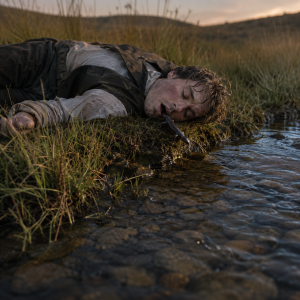
Alp-luachra — the “joint-eater,” a parasitic newt-fairy that crawls into the mouth of someone who falls asleep by a stream and devours the food they eat, slowly starving them. The folk cure was to eat heavily salted meat and lie open-mouthed over water until the creature, parched, leapt out.
Fear gorta — the “man of hunger,” a skeletal famine-spirit who roams the land begging during times of dearth; to give him alms brought fortune, to refuse him brought ruin. Fuath is a catch-all for malevolent water-spirits, while the Oilliphéist is a great serpent-dragon said to have carved out the course of the Shannon as it fled to the sea.
Enfield — a heraldic chimera with the head of a fox, the chest of a greyhound, the body of a lion, and the talons of an eagle, associated with the O’Kelly family of Ireland. The Werewolves of Ossory were a real medieval legend of a Leinster people cursed to take wolf-form for seven years at a time, recorded by Gerald of Wales — proof that Ireland had its own homegrown lycanthropy. And the Jack-o’-lantern begins as the Irish tale of Stingy Jack, a trickster barred from both heaven and hell and condemned to wander with a single coal in a hollowed turnip — the ancestor of the Halloween pumpkin.
The Central Myths
The Second Battle of Mag Tuired
The defining myth of the Mythological Cycle pits the radiant Tuatha Dé Danann against the Fomorians, a race of monstrous sea-raiders led by the one-eyed Balor, whose single eye destroys armies when its heavy lid is levered open. The Tuatha Dé, oppressed under the half-Fomorian tyrant Bres, rally behind the all-skilled Lug. In the climactic battle, the smith Goibniu re-forges broken weapons faster than they can be shattered, the healers revive the slain overnight in their well, and Lug finally puts a sling-stone clean through Balor’s eye — fulfilling the prophecy that Balor would die at the hand of his own grandson. Why it matters: this is the Irish version of the universal war between order and chaos, light and blight, and it explains how the gods won Ireland before they, in turn, lost it to humankind.
The Táin Bó Cúailnge — The Cattle Raid of Cooley
The great epic of the Ulster Cycle begins with a pillow-talk argument: Queen Medb of Connacht discovers her husband is one prize bull richer than she is, and resolves to seize the great Brown Bull of Cooley from Ulster. The catch: the men of Ulster lie helpless under a curse of birth-pangs, leaving the teenage Cú Chulainn to defend the province alone. He holds the army at fords in single combat for months, including a heartbreaking three-day duel against his foster-brother and dearest friend Ferdiad, whom he is finally forced to kill. Why it matters: the Táin is Ireland’s Iliad — the fullest portrait of the heroic ethos, of Cú Chulainn’s monstrous battle-frenzy, and of the tragic cost of a code that prizes honour above love.
The Pursuit of Diarmuid and Gráinne
From the Fenian Cycle comes Ireland’s archetypal love-triangle. Finn mac Cumhal, aged leader of the Fianna, is betrothed to the young princess Gráinne — who instead lays a magical compulsion on the handsome warrior Diarmuid Ua Duibhne to elope with her. The lovers flee across Ireland with the jealous Finn in pursuit for years. When Diarmuid is at last gored by an enchanted boar, Finn — who can heal any man with a drink of water from his cupped hands — lets the water run out twice through his fingers, and Diarmuid dies. Why it matters: the tale is a direct ancestor of the Tristan and Iseult romance and the medieval love-versus-loyalty literature of all Europe.
Oisín in Tír na nÓg
Oisín, the poet-son of Finn, is carried off by the fairy-woman Niamh of the Golden Hair to the Land of Youth, where he lives in bliss for what feels like three years. Homesick, he rides her white horse back to Ireland, warned never to let his foot touch the soil. He finds three hundred years have passed, the Fianna long dead and his world gone Christian; when his saddle-girth breaks and he tumbles to the ground, the centuries crash down on him at once and he withers into a blind old man. Why it matters: it is the purest Irish statement of the gulf between the deathless Otherworld and mortal time — and, in later tellings, a poignant meeting between the pagan past and Saint Patrick’s new faith.
The Otherworld: Cosmology and the Afterlife
Here Irish mythology is at its most distinctive. There is no grim underworld of the dead and no system of reward and punishment. Instead there is the Otherworld — a deathless, ageless realm of youth, music, feasting, and abundance that exists alongside the mortal world rather than after it. It goes by many names: Tír na nÓg (the Land of Youth), Mag Mell (the Plain of Honey or Delight), Tír Tairngire (the Land of Promise), Tír fo Thuinn (the Land Under the Wave), and Emain Ablach (the Isle of Apples that lies behind the later Avalon).
The Otherworld is reached not by dying but by crossing a threshold: entering a sídhe mound such as Newgrange, diving beneath a lake, walking into a mist, or voyaging west across the sea past the edge of the known world. Time runs differently there — a single night of fairy feasting can cost a mortal a hundred years, as Oisín learned to his ruin. The sea-god Manannán mac Lir, who is conspicuously absent from the Gods and Monsters collection, is its usual lord, ferrying the living across in his self-sailing boat.
This is why the defeated gods could “die” without dying. When the human Milesians — the Gaels, descended from the eponymous ancestress Scota — took Ireland, the Tuatha Dé Danann did not perish — they withdrew into the sídhe and became the aos sí, the deathless fairy-people living in a parallel Ireland just out of sight. Mortal death, in this scheme, was less an ending than a journey westward to a brighter shore. It is one of the few European mythologies in which the afterlife is essentially a paradise with no hell beneath it.
How Irish Mythology Connects to Other Traditions
Irish myth is the best-preserved branch of a once pan-European Celtic religion, and its closest relative is Welsh mythology. The Welsh Mabinogi shares whole families of gods with Ireland: the Irish sea-god Manannán mac Lir matches the Welsh Manawydan fab Llŷr, and the Irish Lug is cognate with the Welsh Lleu Llaw Gyffes — both “of the skilful hand,” both reflexes of the pan-Celtic god Lugus, who gave his name to cities from Lyon to Leiden.
The antlered Cernunnos links Ireland to the wider Gaulish and British Celtic world, where he was carved on monuments long before the Irish tales were written. Through this shared Celtic stratum, Irish myth also reaches back to a common Indo-European root: the war-goddess Morrigan as battlefield crow has parallels in the Norse valkyries who choose the slain, and the all-skilled Lug echoes the many-gifted high gods of other Indo-European peoples.
The deepest cross-current is with Christianity itself. Because monks recorded these myths, the traditions interpenetrate: Brigid the goddess becomes Brigid the saint, the isle of apples becomes Avalon, and the deathless Tuatha Dé are reframed as fallen angels — a pagan world surviving by truce with the faith that replaced it.
Where to Start Reading
The essential primary sources are medieval and surprisingly readable in translation. Begin with the Táin Bó Cúailnge in Thomas Kinsella’s celebrated translation, The Táin, which captures the savagery and strangeness of the Ulster Cycle. For the gods, seek out Elizabeth Gray’s edition of Cath Maige Tuired: The Second Battle of Mag Tuired, the single richest text on the Tuatha Dé Danann. The Lebor Gabála Érenn (Book of Invasions) supplies the pseudo-historical frame, and the Metrical Dindshenchas — the “lore of places” — ties hundreds of myths to specific hills, fords, and mounds across Ireland.
For a modern way in, Lady Augusta Gregory’s Gods and Fighting Men (1904) and Marie Heaney’s anthology Over Nine Waves are both excellent retellings, and Proinsias Mac Cana’s Celtic Mythology is the classic scholarly overview.
Explore Irish Mythology on Gods and Monsters
Gods and Monsters has 42 Irish mythology entries — gods, heroes, fairies, and monsters, from the great Tuatha Dé Danann down to the most local hearth-spirit. Browse all Irish mythology entries →
Dagda · Lug · Morrigan · Brigid · Nuada · Aengus Óg · Dian Cécht · Goibniu · Cú Chulainn · Finn mac Cumhal · Oisín · Diarmuid Ua Duibhne · Medb · Deirdre · Balor · Fomorian · Fir Bolg · Banshee · Leprechaun · Púca · Dullahan · Sídhe · Salmon of Knowledge · Sluagh
Frequently Asked Questions
Who are the Tuatha Dé Danann?
The Tuatha Dé Danann (“people of the goddess Danu”) are the principal gods of Irish mythology, presented in the medieval texts as a supernaturally skilled race who invaded and ruled Ireland. They include the Dagda, Lug, the Morrigan, Brigid, and Nuada. After their defeat by the human Milesians, they retreated into the sídhe mounds and became the fairy folk, the aos sí — which is why Ireland’s gods and its fairies are ultimately the same beings.
What is the most important story in Irish mythology?
The Táin Bó Cúailnge (Cattle Raid of Cooley) is the central epic, often called the Irish Iliad. It tells how Queen Medb of Connacht invaded Ulster to steal a great bull, and how the seventeen-year-old hero Cú Chulainn held off her entire army single-handed while the men of Ulster lay cursed. For the gods, the comparable keystone myth is the second battle of Mag Tuired, in which Lug kills the Fomorian tyrant Balor.
Is there a hell or underworld in Irish mythology?
No — and this is one of the tradition’s most striking features. Irish myth has no realm of punishment for the dead. Instead it has the Otherworld, a deathless paradise of youth and plenty called Tír na nÓg or Mag Mell, which lies alongside the mortal world and can be entered through fairy mounds, lakes, or a voyage west. Death was imagined less as judgement than as a crossing into that brighter country.
What is the difference between the Fomorians and the Tuatha Dé Danann?
The Fomorians are the monstrous, chaotic powers of Irish myth — often one-eyed or one-legged sea-raiders associated with blight, storm, and the wild — while the Tuatha Dé Danann represent skill, craft, and cultivated order. Their conflict, climaxing at the second battle of Mag Tuired, is the Irish version of the cosmic war between chaos and order. Tellingly, the two races intermarry: Lug himself is the grandson of the Fomorian Balor.
Are leprechauns and banshees really part of Irish mythology?
Yes, though they belong to its folklore layer rather than the ancient epics. The leprechaun is a solitary fairy cobbler who hoards gold, and the banshee (bean sídhe) is a fairy woman whose wail foretells a death. Both descend from the same fairy tradition as the sídhe, and behind that lies the dethroned Tuatha Dé Danann — so even the gift-shop leprechaun has a god somewhere in his ancestry.
Who was Cú Chulainn and why did he have to fight alone?
Cú Chulainn is the supreme hero of the Ulster Cycle, born Sétanta and renamed “the Hound of Culann” after he killed a guard-dog and offered to take its place. In the Táin he defends Ulster single-handed because the province’s warriors lie incapacitated by the curse of Macha, which struck them with the pains of childbirth in their hour of need. Cú Chulainn was exempt because he was only a youth — and because of his divine parentage from the god Lug. His berserk warp-spasm made him a one-man army.