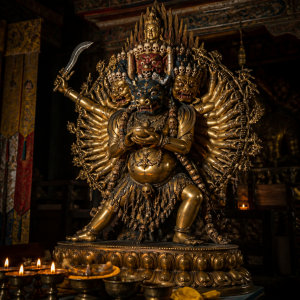
Himalayan Mythology: The Complete Guide to Sky-Cord Kings, Wrathful Protectors, and the Living Mountains
The first kings of Tibet did not die. They descended from the sky on a luminous rope called the dmu-thag, ruled until their heirs came of age, and then — their work done — climbed back up the cord into the heavens, dissolving into light and leaving no body behind. Seven kings came and went this way, the “Seven Tri of the Sky,” until a ruler named Drigum Tsenpo, goaded into a duel, cut his own sky-cord during the fight. The rope snapped, the way home was severed, and for the first time a Tibetan king left a corpse on the earth. Death entered the world not as a curse from the gods but as an accident of pride — the moment the link between heaven and humanity was cut.
That single image tells you what makes Himalayan mythology unlike anything else. Where Greek or Norse myth explains why humans are mortal, Tibetan tradition preserves the exact moment mortality began, and frames the whole spiritual project of the region as an attempt to repair that broken cord — to find the way back up. Himalayan mythology is not one tradition but a layered fusion: the indigenous Bon religion of mountain gods, sky-ropes, and warring spirits, overlaid by Tantric Buddhism carried over the passes from India, and braided through the folklore of Tibet, Nepal, Bhutan, Ladakh, and Sikkim. The two systems did not cancel each other out. They stacked.
What survives comes from a handful of extraordinary sources: the Bon and Buddhist chronicles of the Yarlung kings; the Bardo Thödol, the so-called Tibetan Book of the Dead, a manual for navigating the space between lives; and the Epic of King Gesar, at over a million lines the longest poem on earth, still sung by living bards. Beneath the monastic texts runs a vast oral world of village spirits, mountain lords, and snow-demons that the high philosophy never fully erased.
What Makes Himalayan Mythology Different
The gods are not on the mountains — the mountains are the gods. This is the most literal sacred geography in the world. Every great peak is a yul-lha, a territorial deity who owns the land in its shadow, sends or withholds the water, and demands offerings. Above them all stands Mount Kailash, understood as the physical manifestation of cosmic Mount Meru, the axis around which the entire universe turns. Pilgrims do not climb Kailash — to set foot on the summit would be to stand on the body of a god. They walk around it instead, a circuit that is said to erase the sins of a lifetime.
The demons were not defeated. They were converted. When Buddhism arrived in the eighth century, it did not exterminate the older gods — it conscripted them. The tantric master Padmasambhava (Guru Rinpoche) is said to have traveled across Tibet subduing the violent native spirits one by one, binding each with an oath to serve the dharma rather than destroy it. The terrifying local powers became dharmapalas, protectors of the very religion they once resisted. This is the engine of Himalayan myth: nothing is destroyed, everything is bound, sworn, and put to work.
Wrath is a form of compassion. The most alarming figures in the pantheon — fanged, flame-wreathed, garlanded with skulls, trampling corpses — are not evil. They are enlightened beings wearing terror as a tool. Mahakala is a wrathful emanation of the bodhisattva of compassion himself. The ferocity is aimed at ignorance and ego, not at people. To a tradition raised on serene Buddha-statues elsewhere in Asia, the Himalayan gods can look demonic; in fact they are mercy with its teeth bared.
Death is a skill you can rehearse. No other tradition maps the afterlife with such operational precision. The Bardo Thödol is not a story about death — it is a set of instructions read aloud to a dying or recently dead person, guiding their consciousness through the bardo, the 49-day intermediate state, past peaceful and wrathful apparitions that are really projections of their own mind, toward either liberation or a controlled rebirth. Dying well is a technique, and you are meant to practice it while alive.
Two religions occupy the same body. Bon and Buddhism never fully separated. The water-serpents the Bonpo feared became the Buddhist Naga; the mountain lords kept their old names under new vows; sky burial, prayer flags, and the spinning of mantras all carry pre-Buddhist DNA. Himalayan religion is a palimpsest you can still read both layers of at once.
The Major Gods and Deities
The Himalayan pantheon is arranged in tiers: serene bodhisattvas of boundless compassion at the summit, a battalion of wrathful protectors guarding the path, and beneath them a teeming population of mountain gods, water spirits, and Hindu deities who crossed the passes and stayed.
The Bodhisattvas of the Snows
Avalokiteśvara — the bodhisattva of infinite compassion and the patron deity of Tibet itself. The Dalai Lamas are understood as his living emanations, and his mantra, Om Mani Padme Hum, is the most-spoken phrase in the entire Himalayan world, carved into stones and spun in prayer wheels by the million.
Tara — the swift-saving mother goddess, born from Avalokiteśvara’s tears, who steps down from enlightenment to rescue beings in danger. Green Tara answers prayers in an instant; White Tara grants long life. She is arguably the most beloved female deity across the whole region.
Manjushri — the bodhisattva of wisdom, who wields a flaming sword to cut through ignorance and a book of perfected understanding. In Nepali tradition he is the culture hero who drained the primordial lake of the Kathmandu Valley with a stroke of that sword, making the land habitable.
Vajrapani — the thunderbolt-bearer, holding the vajra that gives him his name, embodiment of the Buddha’s power and energy. Often wrathful in form, he is the spiritual muscle of the bodhisattva trinity that completes compassion and wisdom.
Amitabha — the Buddha of Boundless Light, presiding over the western Pure Land of Sukhavati, a paradise into which the faithful aspire to be reborn. Avalokiteśvara is counted as his emanation, linking Tibet’s patron back to this serene celestial Buddha.
Maitreya — the Buddha yet to come, waiting in the Tushita heaven until the teachings of the present age are exhausted, when he will descend to renew the dharma. Colossal Maitreya statues watch over monastery courtyards from Ladakh to Bhutan.
Kṣitigarbha — the bodhisattva who vowed to empty the hells before claiming buddhahood himself, descending into the realms of torment to free the suffering dead. He is the guardian of beings trapped in the lowest reaches of the afterlife.
Guan Yin — the compassionate one in her East Asian female form, a development of Avalokiteśvara whose veneration spread along the same trade and pilgrimage routes that carried Buddhism across the Himalaya.
The Wrathful Protectors
Mahakala — the “Great Black One,” foremost of all the dharmapalas, a wrathful emanation of Avalokiteśvara who removes obstacles and guards monasteries. Black-bodied, crowned with skulls and wreathed in flame, he is mercy in its most ferocious mode.
Palden Lhamo — the only goddess among the eight great protectors and the principal protectress of Tibet, riding a mule across a sea of blood, the special guardian of the Dalai and Panchen Lamas. Her wrath is the wrath of a mother defending her children.
Yama — the lord of death and judge of the dead, who holds up the Wheel of Life in his jaws and weighs the karma of every soul that passes. In the Himalayan system he is both a terror to the wicked and, as Yama Dharmaraja, a tamed protector of the law.
Local Lords and Borrowed Gods
Shiva — the great Hindu ascetic, who in Hindu tradition sits in eternal meditation upon Mount Kailash itself, making the holiest peak in Tibetan Buddhism simultaneously the throne of a Hindu god — a perfect emblem of the region’s layered faiths.
Parvati — daughter of the Himalaya mountain personified, consort of Shiva, the goddess whose very name and parentage bind the Hindu pantheon to these ranges. In Nepal her fierce forms blur into the local mother-goddesses worshipped in the valley.
Dakini — the “sky-dancers,” wild and powerful female spirits of enlightened energy who initiate, test, and guide tantric practitioners, appearing as wisdom-goddesses or as fearsome hags depending on what the seeker needs to learn.
Creatures, Monsters, and Supernatural Beings
Beasts of Snow and Sky
Yeti — the migoi, the “wild man” of the high snows, an ape-like giant of immense strength credited in folklore with the power to turn invisible and to walk backwards to confuse anyone tracking it. Long before it became the West’s “Abominable Snowman,” the yeti was a genuine object of fear and respect across Tibet, Nepal, and Bhutan.
Snow Lion — the turquoise-maned celestial lion of Tibet, emblem of fearlessness and joyful energy, said to bound between the peaks and embody the clear, unconditioned mind. It appears on the Tibetan flag and among the Four Dignities of the prayer-flag world.
Wind Horse — the lungta, the flying horse that carries prayers and good fortune on the wind, printed at the center of every prayer flag. As the breeze frays the cloth, the horse gallops the blessings out across the world — a shamanic image of the soul’s vitality absorbed into Buddhist practice.
Druk — the Thunder Dragon whose roar is the thunder of the high storms, so central to the region that Bhutan calls itself Druk Yul, the Land of the Thunder Dragon, and its people the Drukpa. The dragon clutches wish-fulfilling jewels in its claws, sign of the wealth that guarded virtue brings.
Garuda — the great solar bird, eternal enemy of the serpents, adopted from Hindu myth as one of the Four Dignities and as a fierce destroyer of the naga-borne diseases and curses that plague mountain communities. The Bhutanese khyung is his local form.
Kinnara — half-human, half-bird celestial musicians of paradise, famed for their devoted love and their songs, who drift through the Buddhist heavens of the Himalayan imagination as emblems of beauty and fidelity.
Mayura — the golden peacock king, a former incarnation of the Buddha whose sacred chants warded off all harm, woven into the Buddhist menagerie that crossed the passes from India.
Spirits, Tricksters, and the Restless Dead
Gurumapa — a hulking, hairy ogre of Kathmandu folklore who once devoured misbehaving children, struck a bargain to leave the city in exchange for an annual feast of rice and buffalo meat — a domesticated monster still fed once a year to keep him content.
Khyāh — squat, shaggy, fairy-like beings of Newar folklore in Nepal, some bringing fortune and some mischief, said to wrestle people in the dark of a house or guard the hidden wealth of old families.
Chormandi — spirit-beings of Himalayan folk belief that hover between the categories of fairy and ghost, part of the dense undergrowth of local spirits that Buddhism never wholly cleared away.
Acheri — the ghost of a little girl who haunts mountain slopes, descending from the heights at night to spread sickness with her shadow; villagers tie red thread to ward her off, for she is said to fear the color.
Naga / klu — the serpent-spirits of springs, lakes, and underground streams, guardians of water, treasure, and fertility. In Tibet the Indian naga merged with the indigenous klu; pollute their pools or break their ground and they answer with leprosy, drought, and ruin.
Preta — the hungry ghosts, beings reborn with vast bellies and needle-thin throats, tormented by an appetite they can never satisfy — one of the six realms of rebirth, and a standing warning against a life ruled by craving.
Vetala and Rakshasa — the corpse-dwelling undead and the flesh-eating demons of South Asian myth, both of whom prowl the Himalayan borderlands; the rakshasas number among the very lha-srin spirits that Padmasambhava is said to have bound by oath.
The Central Myths
The King Who Cut His Own Sky-Cord
The earliest Tibetan kings were heaven-born, lowered to earth on the dmu-thag, a cord of light connecting throne to sky. Each ruled and then ascended again, dissolving without dying. The chain broke with Drigum Tsenpo. Provoked into a duel with his own stable-master Longam, the king was tricked into a fight in which, to ward off bad omens, he wore a corpse on his shoulder and swung his sword over his head — and in the frenzy severed his own sky-cord. Cut off from heaven, he fell and died, and his body had to be buried in the earth. Why it matters: this is the Himalayan myth of the origin of death and of kingship’s loss of divinity, the moment the world stopped being porous to heaven — and the wound that every later spiritual technology in the region tries to heal.
Padmasambhava and the Taming of the Demons
In the eighth century, King Trisong Detsen invited the tantric adept Padmasambhava to establish Buddhism in Tibet, but the land’s native gods and demons fought the new faith, throwing down monastery walls as fast as they rose. Rather than destroy them, Padmasambhava hunted each spirit to its mountain or lake and overpowered it, then offered a choice: be annihilated, or take an oath to defend the dharma. One by one the old terrors swore allegiance and became protectors. Why it matters: this is the founding act of Tibetan Buddhism and the template for the entire pantheon — the wrathful gods are reformed demons, and the landscape itself was spiritually conquered not by erasure but by conversion.
King Gesar of Ling
The oaths did not hold forever, and chaos crept back into the world. Heaven answered by sending Gesar, born to rule the kingdom of Ling, a warrior-emperor and emanation of Padmasambhava who spent his life subduing demon-kings, man-eating monarchs, and the enemies of the dharma across the whole of Inner Asia. His deeds are still sung by bards who enter a trance to recite verses they were never taught. Why it matters: the Epic of Gesar is the living heart of Himalayan oral culture, the longest poem in the world, and proof that the work begun by Padmasambhava — the endless taming of chaos — is understood as never quite finished.
Afterlife and Cosmology
The Himalayan cosmos is built around Mount Meru, the world-axis, ringed by continents and seas and crowned by the heavens of the gods; our world is Jambudvipa, the southern continent. Around this structure turns the Wheel of Life, gripped in Yama’s jaws, divided into six realms into which beings are reborn according to their karma: the gods, deluded by long pleasure into forgetting death; the jealous demigods, consumed by envy; humans, uniquely poised to win liberation; animals, ruled by instinct; the hungry ghosts, starving amid plenty; and the hell-beings, enduring torment until their bad karma burns away. None of these is permanent — even the gods eventually fall.
What happens between death and the next rebirth is mapped in unmatched detail by the Bardo Thödol. The consciousness passes first through the chikhai bardo, the dazzling clear light at the instant of death — the supreme chance for liberation; then the chonyid bardo, where the peaceful and wrathful deities manifest, all of them recognized by the wise as projections of one’s own mind; and finally the sidpa bardo, where the pull of karma drags the unliberated toward a womb and a new birth. A lama reads the text aloud to steer the dead through these 49 days.
The body that remains is given to the sky. In sky burial (jhator, “bird-scattered”), the corpse is carried to a high charnel ground and offered to the vultures — a final act of generosity, feeding one’s own flesh to other beings, and a stark teaching on impermanence: the body was only ever borrowed, and the Dakini are imagined receiving the offering as the birds rise.
How Himalayan Mythology Connects to Other Traditions
The deepest root runs to Hindu mythology. Shiva meditates on Kailash, Parvati is the daughter of the Himalaya itself, and gods like Garuda, the Naga, Yama, and the fierce Mahakala all began in Indian tradition before tantric Buddhism carried them north and gave them new vows. The traffic of Rakshasa demons and Vetala undead across the passes shows how porous the border between Indian and Himalayan myth has always been.
To the north and east, the influence reverses. The war-god Begtse entered the Tibetan pantheon from Mongolian shamanism in the sixteenth century, the most recent of the great protectors. And along the trade routes east, the compassion of Avalokiteśvara transformed into the Chinese goddess Guan Yin, while the death-judge Yama became the Chinese hell-king Yanluo — the same deity wearing three faces across three cultures, a map of how myth travels and is remade at every stop.
Where to Start Reading
The foundational text in translation is the Bardo Thödol, best approached through Robert Thurman’s The Tibetan Book of the Dead or the Francesca Fremantle and Chögyam Trungpa version, which restores its meditative rather than morbid intent. For the heroic tradition, Alexandra David-Néel’s The Superhuman Life of Gesar of Ling remains the classic gateway, with Robin Kornman’s scholarly translation of the epic for those who want the real thing.
For the wider mythology, René de Nebesky-Wojkowitz’s Oracles and Demons of Tibet is the indispensable (if dense) catalogue of the protector gods, while Per Kvaerne’s work on the Bon religion opens the pre-Buddhist layer and Mary Slusser’s Nepal Mandala covers the distinct Newar pantheon.
Explore Himalayan Mythology on Gods and Monsters
Five entries are tagged directly to the Himalayan Mythology category, with many more drawn from the overlapping Tibetan, Buddhist, and Hindu traditions of the region. Browse all Himalayan Mythology entries →
Yeti · Snow Lion · Wind Horse · Druk · Mahakala · Palden Lhamo · Vajrapani · Avalokiteśvara · Tara · Manjushri · Dakini · Gurumapa · Khyāh · Chormandi · Acheri · Naga · Garuda · Yama · Shiva · Maitreya · Amitabha · Kinnara
Frequently Asked Questions
What is the difference between Bon and Tibetan Buddhism?
Bon is the indigenous religion of Tibet, predating Buddhism, centered on mountain gods, sky-cord kings, water-spirits, and ritual specialists who managed the relationship between humans and a landscape full of powers. When Tantric Buddhism arrived from India in the eighth century, it absorbed much of Bon rather than erasing it — local gods became Buddhist protectors, and practices like sky burial and prayer flags carried over. Organized “Eternal Bon” later reorganized itself along Buddhist lines, so the two traditions today look remarkably similar while tracing different founders, Tonpa Shenrab for Bon and the Buddha for Buddhism.
Is the yeti part of Himalayan mythology or just a cryptid?
Both. Long before Western expeditions turned the yeti into the “Abominable Snowman” and a target for cryptozoology, the migoi was a real presence in the belief systems of Tibet, Nepal, and Bhutan — a powerful wild being of the high snows credited with invisibility and reversed footprints. In Bhutan it is one of the nation’s protected mythic animals. The modern monster-hunt is a thin Western layer over a deep and serious local tradition.
Why are so many Tibetan gods depicted as terrifying?
Because in Tibetan Buddhism, wrath is a form of compassion, not the opposite of it. The fanged, flame-wreathed dharmapalas like Mahakala and Palden Lhamo are enlightened beings whose ferocity is aimed at ignorance, ego, and the obstacles to liberation — not at the worshipper. Many of them were once genuine demons, bound by oath into the service of the dharma, so their fearsome forms also remember what they used to be.
What is Mount Kailash and why is it sacred to so many religions?
Kailash is a peak in western Tibet revered as the earthly form of cosmic Mount Meru, the axis of the universe. Tibetan Buddhists, Bonpo, Hindus, and Jains all hold it holy: Hindus see it as the throne of Shiva, Bonpo as the seat of their founder’s power, Buddhists as a great mandala-palace. It has never been climbed, by religious prohibition; pilgrims instead walk a 52-kilometer circuit around its base, believed to wash away the sins of a lifetime — or, completed 108 times, to secure liberation.
What is the Tibetan Book of the Dead actually for?
The Bardo Thödol is a practical manual, not a scripture about the afterlife in the abstract. It is read aloud to a person who is dying or recently dead, guiding their consciousness through the bardo — the intermediate state between death and rebirth — and teaching them to recognize the brilliant clear light at death, and afterward the peaceful and wrathful deities, as projections of their own mind rather than external threats. Recognizing them is liberation; failing to drives the soul toward another birth in one of the six realms. It is, in effect, a set of navigation instructions for dying well.
Who is King Gesar?
Gesar is the warrior-hero of the Epic of King Gesar, the longest poem in the world at over a million lines, and a figure revered across Tibet, Mongolia, and much of Inner Asia. Sent from heaven and counted an emanation of Padmasambhava, he was born to rule the kingdom of Ling and spent his life defeating demon-kings and protecting the dharma. His epic is still performed by bards who claim to receive the verses in trance, making it one of the last great living oral traditions on earth.