Guarani Mythology: The Complete Guide to the Land Without Evil, the Seven Cursed Children, and the Gods of Sun and Thunder
The Guarani did not wait for death to reach paradise. They tried to walk there alive. Yvy marã e’ỹ — the Land Without Evil, a real place somewhere across the continent where there is no hunger, no sickness, no death — was not a reward for the virtuous dead but a destination for the living, and entire villages would abandon their fields, fall in behind a prophet, and set out walking, dancing as they went, sometimes for months or years, hoping to arrive while they still breathed. Some of these migrations were still happening when Europeans showed up, and a few crossed thousands of miles of forest looking for the edge of the world. No other mythology in the Americas turns paradise into a journey you make on your own two feet.
That single idea reorders everything. Where Greek or Norse religion sorts the dead into fixed afterworlds, Guarani belief makes spiritual perfection — aguyje — something you cultivate now, in the body, through right living and sacred song, until you become light enough to cross over without dying at all. It is a theology of motion and of speech, built by peoples who spread across half a continent — modern Paraguay, northeastern Argentina, southern Brazil, and parts of Bolivia — and whose language is still spoken by millions and is co-official in Paraguay today. These are not museum myths. They are the living cosmology of a people who never fully left.
What survives in writing comes first through the Jesuits, who recorded the language with extraordinary care: Antonio Ruiz de Montoya’s Tesoro de la lengua guaraní (1639) preserved words the missionaries did not always understand. The deepest source, though, is the Ayvu Rapyta — the “foundation of human speech,” a corpus of Mbyá-Guaraní sacred songs recorded by the Paraguayan ethnographer León Cadogan in the 1950s, and only after the Mbyá decided to trust him with them. Behind every god below stands an oral tradition the Guarani guarded, for centuries, by refusing to hand it over.
What Makes Guarani Mythology Different
Paradise is a place, and you can walk to it. Yvy marã e’ỹ, the Land Without Evil, is the beating heart of Guarani religion — a tangible earthly paradise, often imagined across the sea to the east or at the center of the world, free of pain and death. Crucially, it is reachable by the living. Prophets called karai would receive the dance and the route in visions and lead whole communities on real migrations toward it. This is not a metaphor the Guarani happened to hold; it is a thing they repeatedly did, and it makes their faith one of the only mythologies on earth organized around a physical pilgrimage to heaven.
The universe is made of sacred speech. Before the earth existed, the creator unfolded the foundation of human language out of his own divinity. Words, for the Guarani, are not labels stuck onto a pre-existing world — they are the substance the world is made from. Each person’s soul is a ñe’ẽ, a “word-soul” or divine name-bearing breath that descends from the gods at birth and returns to them; to name a child is to learn which fragment of divine speech has come to dwell in it. A mythology in which language is older than matter is rare anywhere.
One cursed family explains all the monsters. Most traditions scatter their beasts across unrelated stories. Guarani mythology concentrates its terror into a single genealogy: the seven hideous children of Tau, the spirit of evil, and Kerana, a stolen human woman. Seven siblings, seven curses, one bloodline — the lizard with seven dog-heads, the serpent with a parrot’s beak, the golden child who steals other children, the werewolf of the graveyards. They are a family, not a bestiary, and when their story ends they are flung into the sky to become the Pleiades.
The forest has owners, and they are watching you. Guarani nature spirits are not vague woodland presences; they are owners — of the trees, the game, the women who wander too far at siesta. The Pombero and the Kurupi demand respect, tobacco, and honey, and they take revenge when ignored. In rural Paraguay and Argentina people still leave offerings and still lower their voices when they speak the spirits’ names. The supernatural here is not history. It is a neighbor.
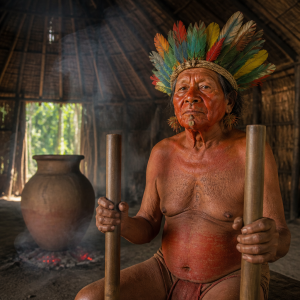
It is a living religion, not a reconstructed one. Unlike the Aztec or Norse pantheons, excavated from ruins and hostile chronicles, Guarani belief was never extinguished. The Mbyá, Pãi Tavyterã, and Ava Guaraní still sing the creation, still seek the Land Without Evil, still raise the prayer-house. To read these myths is to read the doctrine of a faith that still has living priests.
The Major Gods
Guarani divinity is layered. At the summit sit a small number of self-originating creator-fathers who rarely touch the world directly; below them stand the sun, the moon, and the paired spirits of good and evil who shape human life; and beneath those move the owners and monsters who fill the forest. The names and emphases shift between Guarani peoples — the Mbyá exalt Ñamandú, the Paraguayan tradition centers Tupã — but the architecture is shared.
The Four Divine Fathers
Ñamandú (also Ñande Ru, “Our Father,” or Ñamandú Ru Ete) — the supreme, self-created creator, who arose alone in the primordial darkness and unfolded the world out of his own body, beginning with the foundation of human speech. He is the fountain of all life and the father of the other gods, so exalted in Mbyá theology that he is rarely depicted and barely petitioned directly. (No dedicated entry on the site yet.)
Tupã — god of thunder, lightning, rain, and the waters, and in the Paraguayan tradition the great creator who descended to earth to make the world. His voice is the storm; the crash of thunder is Tupã moving across the sky. Of all the high gods he is the one ordinary people addressed most, and Jesuit missionaries seized on his name to translate the Christian God — which is why Tupã now means “God” in everyday Guarani.
Karai — the divine father of fire, lord of the sacred flame and of the eastern region of the cosmos. He is the keeper of the warmth that sustains life and the patron of the ardent, eloquent speech of the shaman-prophets who also bear his title. To possess the fire of Karai is to carry the heat of inspired words.
Jakaira — the father of the life-giving mist, tatachina, the soft spring fog that rises each year to dissolve the old season and breathe renewal into all living things. He is the lord of the sacred pipe and the fragrant smoke of prayer, the gentlest of the divine fathers and the one most associated with healing and the turning of the year. (No dedicated entry on the site yet.)
The Sun, the Moon, and the First Powers
Guaraci — the sun, the source of warmth and light and, in many tellings, the very face through which the creator looks upon the world. Daylight is his domain, and the growth of every crop and the path of every day belong to him; he is honored across both Guarani and neighboring Tupi peoples as the radiant guarantor of life.
Abaangui — the god of the moon, remembered for one of the most startling origin stories in any mythology: Abaangui possessed an enormous nose, which he cut from his own face and hurled into the sky, where it became the Moon. He governs the night and the tides of growth that the moon is thought to rule.
Arasy — the moon goddess and, in the Paraguayan creation, the co-creator who descended with Tupã to the hill at Areguá and helped him fashion the world and the first people. Mother of the heavens, she is paired with the sun-bringer as the feminine half of creation. (No dedicated entry on the site yet.)
Tau and Angatupyry — the spirit of evil and the spirit of good, the two opposed forces that Tupã left to dwell within humankind after he made the first people. Angatupyry is pure benevolent spirit; Tau is the restless principle of harm whose lust for a mortal woman will produce the seven monsters. Their eternal rivalry is the Guarani account of why every human heart contains both light and darkness. (No dedicated entries on the site yet.)
Rupave and Sypave — “Father of the People” and “Mother of the People,” the first man and first woman whom Tupã shaped from clay and quickened with breath. From them descend all human beings, and from their family line come the heroes and ancestors of the Guarani world. (No dedicated entries on the site yet.)
Creatures, Monsters & Supernatural Beings
The most famous beings in Guarani lore are a single accursed family, but the forests and rivers swarm with owners, tricksters, and terrors beyond them.
The Seven Cursed Children of Tau and Kerana
When the evil spirit Tau abducted Kerana, a beautiful mortal woman, the supreme powers cursed their union: every child she bore would be a sietemesino, born at seven months and shaped like a monster. There were seven, and together they are the dark heart of the Guarani bestiary.
A note on where the family comes from. The seven monsters are genuine Paraguayan folklore, collected and retold for well over a century. The family is younger. The genealogy that binds them — Tau and Kerana as parents, seven cursed sons, one domain apiece — was set out by the Paraguayan poet Narciso R. Colmán, writing as Rosicrán, in his 1929 epic Ñande Ypy Kuéra. Colmán said himself that the work was partly his own poetic invention, built on his reading of the petroglyphs at Cerro Tatukuá. It is a beautiful scheme, and it has been repeated in schoolbooks and encyclopedias ever since, but it is a 20th-century literary arrangement rather than an ancient cosmology. The monsters below are old; the family tree is not.
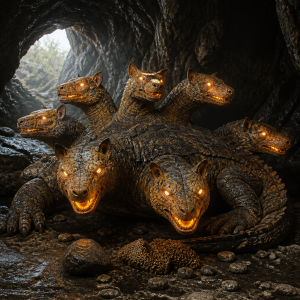
Teju Jagua — the firstborn, a colossal lizard crowned with seven dog’s heads and eyes that flash fire. Terrifying to behold, he was so monstrously heavy that he could barely move, and so he became a gentle guardian of fruit and of the caves where treasure is hidden — a monster who menaces almost no one.
Mbói Tu’ĩ — a vast serpent with the head and curved beak of a parrot, his body shimmering and his cry echoing across the wetlands. He is the lord of waterways and of all aquatic creatures, the protector of the swamps and marshes, the second-born of the brood.
Moñái — a great horned serpent and lord of the open fields, cunning and greedy, who commanded the birds of the air and hoarded the treasures his thefts and raids brought in. His undoing came through his appetite: lured into a cave by a feast and the charms of the heroine Porãsý, he was sealed inside and burned.
Jasy Jateré — the only one of the seven to wear a beautiful human form: a small, fair-haired, naked child who roams the forest at the hour of siesta carrying a golden staff. He whistles to lure children away from their homes into the woods, where they are lost, enchanted, or worse — the bogeyman every Guarani parent still invokes to keep children indoors at midday.
Kurupi — the spirit of fertility and sexuality, a short, hairy, ugly forest-dweller with a phallus so absurdly long he wraps it around his waist. He was blamed for unexplained pregnancies and for spiriting women away into the trees; in him the Guarani concentrated both the dread and the generative power of the wild.
Ao Ao — a ravenous, peccary- or sheep-like beast with great fangs, who hunts human beings in packs across the hills and is named for the bone-chilling “ao ao ao” cry he gives as he runs his prey down. Climbing a tree will not save you; only a palm tree, sacred and inviolable, can keep a victim out of his jaws.
Luison — the seventh and last, who took the full weight of the curse and became the most hideous of all: a gaunt, foul, dog-like creature who haunts cemeteries and feeds on the flesh of the dead. He is the lord of death itself, and his mere touch is an omen of dying. From him descends the Río de la Plata werewolf legend, the lobizón — the seventh son cursed to change shape.
Spirits of the Forest and Night
Pombero — the “lord of the night,” a short, hairy, swift forest spirit with backward feet and a taste for honey and tobacco, who whistles in the dark and rewards those who leave him offerings while tormenting those who mock him. He remains one of the most genuinely feared beings in rural Paraguay and Argentina, blamed for everything from spoiled crops to mysterious pregnancies.
The Central Myths
The Creation on the Hill at Areguá
In the Paraguayan telling, Tupã came from the sun and, with the moon goddess Arasy, descended upon a hill near Areguá. There the two created the seas and rivers, the forests and all their animals, and then humanity itself, breathing life into clay forms to make Rupave and Sypave, the first parents. Before departing, Tupã placed within his creation two spirits — Angatupyry, the good, and Tau, the evil — and withdrew, leaving the world to play out the struggle between them. Why it matters: the myth gives the Guarani a creation that is finished but not abandoned, a world deliberately seeded with both good and evil, which makes human moral struggle the continuation of a divine plan rather than a fall from one.
The Curse of Tau and Kerana
Tau, the spirit of evil, conceived a violent desire for Kerana, a woman of surpassing beauty, and abducted her. For this the supreme spirit Arasy laid a curse on their line: every child would be born deformed and monstrous. Seven came — Teju Jagua, Mbói Tu’ĩ, Moñái, Jasy Jateré, Kurupi, Ao Ao, and Luison — and they scattered to become the monsters of the swamp, field, forest, and grave. Why it matters: this is the Guarani theodicy, the explanation of where evil in the world comes from. It locates monstrosity not in chaos but in a single transgression — a forced union — and in its consequences, binding the whole bestiary into one moral story.
The Death of Moñái and the Sacrifice of Porãsý
The most heroic of Guarani myths centers on a human woman, Porãsý, who resolved to rid her people of the monsters. She seduced the greedy Moñái, drew him and his followers into a great cave on the pretext of a feast and a wedding, and arranged for the entrance to be sealed and set ablaze. To make certain none escaped, she gave her own life in the fire alongside them. Why it matters: against a mythology of inhuman terrors, the Guarani place a mortal, and a woman, as the decisive moral agent — the one who chooses self-sacrifice over survival — making courage, not divine power, the force that pushes back the dark.
The Search for the Land Without Evil
Again and again the Guarani prophets, the karai, received the vision: somewhere beyond the forests and the sea lay Yvy marã e’ỹ, the Land Without Evil, where death has no hold. Singing and dancing the sacred steps, they led their people on long migrations toward it, lightening their bodies through fasting and prayer in the hope of crossing over while still alive. Why it matters: no other belief turned its paradise into a destination on the map. The migrations were a literal, collective enactment of faith, and they shaped Guarani history — and Guarani resistance to colonization — for centuries.
Afterlife and Cosmology
Guarani cosmology hangs everything on a single distinction: the invisible world of the gods is the real and perfect one, and the visible world we inhabit is its imperfect, perishable copy. Everything here — bodies, plants, animals, time itself — is a flawed image of a luminous original kept in the home of the divine fathers. The goal of human life, then, is not to be rewarded after death but to become perfect enough to cross from the copy back to the original.
That state of perfection is aguyje — spiritual ripeness, achieved through right living, restraint, and above all sacred song and dance. A person who attains it reaches Yvy marã e’ỹ not as a ghost but bodily, transfigured and made light. Those who do not follow other paths: some accounts send a wandering soul-shadow, the anguéry, drifting near the earth, while the divine ñe’ẽ, the word-soul, returns to the father who sent it. The cosmos itself the Guarani picture as a structure that can age, decay, and be destroyed — and has been before — which is part of why the prophets’ warnings of cataclysm carried such urgency.
When the story of the seven monsters ends, the brood is cast up into the night sky to become the constellation the Guarani call the cluster of the seven — the Pleiades — whose appearance and disappearance mark the turning of the agricultural year. The bestiary, the calendar, and the heavens are one continuous text.
How Guarani Mythology Connects to Other Traditions
Guarani belief sits at the center of a web of related South American mythologies, many of which share its very gods. The Tupi peoples of the Brazilian coast — close linguistic cousins — worship the same sun under the name Guaraci and the same thunderer in Tupã, and the broader cluster of Tupi-Guarani traditions all reach, in their own ways, for a land beyond evil.
The forest spirits cross tribal lines most vividly of all. The Guarani Kurupi, owner-protector of the wild, is plainly a sibling of the Brazilian Curupira, the backward-footed guardian of the game animals — both punish hunters who take more than they need. The one-legged trickster Saci, the river-siren Iara who lures men to drown, the stinking giant sloth Mapinguari, and the Amazonian lawgiver-spirit Jurupari all belong to the same shared Amazonian and Río de la Plata imagination, in which the forest is owned and the rivers are dangerous.
And the tradition kept absorbing new material: Luison‘s evolution into the Río de la Plata lobizón shows Guarani myth reshaping the European werewolf into something distinctly its own — proof that this was never a closed system but a living one, still trading symbols across cultures.
Where to Start Reading
The indispensable primary source is the Ayvu Rapyta, the Mbyá-Guaraní sacred songs of creation recorded by León Cadogan in 1959 — the closest thing we have to Guarani scripture in the Guarani’s own words. For the colonial-era foundation, Antonio Ruiz de Montoya’s seventeenth-century Tesoro de la lengua guaraní and his account of the Jesuit missions, The Spiritual Conquest, preserve the earliest recorded vocabulary of the sacred.
For modern readers, the essential study is Hélène Clastres’ The Land-Without-Evil: Tupí-Guaraní Prophetism, which unpacks the migrations and the prophets better than any other single book, alongside the ethnographic work of Curt Nimuendajú and Branislava Susnik. For a quick orientation to the gods and the seven monsters first, the entries collected here on Gods and Monsters are a good place to begin.
Explore Guarani Mythology on Gods and Monsters
Gods and Monsters currently hosts 9 Guarani entries, spanning the high gods, the celestial powers, and the cursed brood of Tau and Kerana.
Browse all Guarani Mythology entries →
Tupã · Karai · Guaraci · Abaangui · Teju Jagua · Mbói Tu’ĩ · Moñái · Jasy Jateré · Kurupi · Ao Ao · Luison · Pombero · Curupira · Iara · Saci · Mapinguari · Jurupari
Frequently Asked Questions
What is the Land Without Evil in Guarani mythology? Yvy marã e’ỹ, the Land Without Evil, is a real earthly paradise in Guarani belief — a place with no hunger, sickness, war, or death. Unlike most afterlife concepts, it is reachable by the living: through spiritual perfection, fasting, and sacred dance, a person could become light enough to cross into it bodily. Guarani prophets led whole communities on long physical migrations searching for it, a practice that shaped the people’s history for centuries.
Who is the most important Guarani god? It depends on the tradition. Among the Mbyá-Guaraní the supreme deity is Ñamandú, the self-created creator who unfolded the world and human speech from his own body. In the Paraguayan tradition the central figure is Tupã, god of thunder and the creator who descended to the hill at Areguá — so important that his name became the ordinary Guarani word for “God.”
What are the seven monsters of Guarani mythology? They are the cursed children of Tau, the spirit of evil, and the mortal woman Kerana: Teju Jagua, a seven-headed lizard; Mbói Tu’ĩ, a parrot-headed serpent; Moñái, a horned snake of the fields; Jasy Jateré, a fair child who steals children; Kurupi, a spirit of fertility; Ao Ao, a man-eating beast; and Luison, the dog-like lord of death. When their tale ends they are cast into the sky as the Pleiades.
Is Guarani mythology still believed today? Yes. Guarani religion is a living tradition, not a reconstructed one. The Mbyá, Pãi Tavyterã, and Ava Guaraní peoples still sing the creation songs, seek the Land Without Evil, and maintain prayer-houses across Paraguay, Argentina, Brazil, and Bolivia. Folk beliefs in spirits like the Pombero and Jasy Jateré remain widespread in rural communities, where offerings are still left and names are still spoken with care.
Why did Abaangui throw his nose into the sky? In the myth of Abaangui, the moon god possessed an enormous nose. He cut it from his face and flung it upward, and there it became the Moon. The story is a striking example of Guarani origin myths, which often explain the great features of the heavens as parts of a god’s own body cast into the sky — much as the seven monsters become the Pleiades.
How is Guarani mythology different from Brazilian or Amazonian mythology? They overlap heavily, because the Guarani and the Tupi peoples are close cousins who share gods like Tupã and Guaraci and forest spirits like the Kurupi and its Brazilian counterpart the Curupira. What sets Guarani belief apart is its focus on the Land Without Evil and the prophetic migrations toward it, and its tightly organized “family” of monsters descended from Tau and Kerana.