Georgian Mythology: The Complete Guide to the Caucasus Pantheon, the Chained Hero Amirani, and the Three Worlds
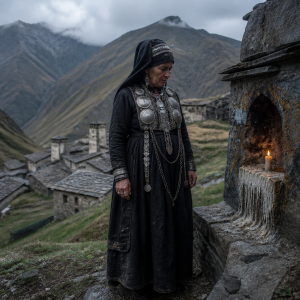
Georgian mythology is the indigenous belief system of the Caucasus highlands — a body of gods, hunting spirits, and chained heroes that survived in the mountain valleys of Svaneti, Khevsureti, and Pshavi long after Christianity arrived in the 4th century. Its single most famous figure is Amirani, a fire-bringing rebel chained to a Caucasus peak with an eagle devouring his liver — a myth the ancient Greeks themselves believed was the original source of their own Prometheus. Western Georgia is Colchis, the land of the Golden Fleece, so this tradition sits at the exact seam where Greek, Persian, Anatolian, and Slavic mythologies meet.
What makes the Georgian material so unusual is how little of it was ever written down by its own believers. Unlike the Greeks with Homer or the Norse with the Eddas, Georgian highlanders preserved their pre-Christian gods almost entirely through oral epic, shrine ritual, and circle-dance song — the Amiraniani cycle alone has been collected in roughly a thousand variants. The earliest texts that mention these deities, like the medieval Conversion of Kartli and the Life of Saint Nino, were written by Christians describing idols they were tearing down.
The result is a mythology of layers: a deep Caucasian substrate of hunting goddesses and weather demons, overlaid with a Zoroastrian-influenced royal pantheon imposed by the kings of Iberia, and finally folded into Georgian Orthodox Christianity, where pagan gods became saints and mountain shrines kept their old sacrifices under new names. This guide walks through all three.
What Makes Georgian Mythology Different
The fire-bringer was Caucasian before he was Greek. The story of a defiant hero chained to a mountain for stealing fire and gifting knowledge to humanity exists in Georgia as Amirani, and the Greeks set their own Prometheus’s punishment on the Caucasus range specifically. Many scholars read the Georgian version as older or independent rather than borrowed — meaning the most famous “Greek” myth of rebellion may have its roots in these mountains.
Hunting is a sexual contract with a goddess. In most mythologies the hunt is a test of skill. In Georgian highland belief it is a relationship: the golden-haired goddess Dali owns every ibex and deer, and a hunter prospers only by becoming her lover. Break her rules — boast, hunt on a forbidden day, or betray her bed — and the same goddess who gave you the mountains will throw you off a cliff. Few traditions make subsistence so intimate and so lethal.
The cosmos is a stack of three colored worlds. Georgian cosmology imagines a spherical universe of three superimposed layers, each with its own color: the white world above (zeskneli) for gods, the red middle world for the living, and the black world below (qveskneli) for demons and dragons. To die is simply to travel down through the layers — a vertical geography of the soul that predates the Christian heaven and hell later mapped onto it.
Dragons point you to water instead of hoarding gold. The Georgian dragon, the gveleshapi, is a word fused from “whale” and “serpent,” and in the oldest strata of the tradition these creatures were wise and benevolent — they revealed where springs lay by crawling across the ground above them. The malevolent treasure-guarding dragon is a later development; the Caucasian original was closer to a guardian of water.
The pagan gods became Christian saints without dying. When Georgia converted, its mountain deities did not vanish — they were absorbed. The supreme god Ghmerti simply became the Christian God; the weather-and-justice figure Kviria took on the role of a divine intermediary; shrines kept slaughtering animals for “saints” who were transparently old gods. Highland Georgia practiced a working folk paganism inside an Orthodox frame well into the modern era.
The Major Gods and Deities
The Supreme God and His Court
Ghmerti (Morige Ghmerti) — the supreme creator and head of the pantheon. Known as Morige Ghmerti (“God the Director”) and Dambadebeli (“the Creator”), he dwells in the ninth heaven on a golden throne and rules a court of subordinate deities. The sun is described as his daughter and the moon as his son, and a host of divine children, the ghvtisshvilni (“children of god”), descend to protect humanity from demons. After the conversion his name was simply transferred to the Christian God the Father — the same word, ghmerti, still means “God” in Georgian today.
Kviria — the mediator between Ghmerti and humankind, a son of the supreme god who functions as a kind of divine prime minister and judge. He protects human society, enforces divine justice, and in some regions governs fertility and the harvest; in the western mountains he was elevated to the rank of supreme deity in his own right. He is the figure most often invoked at the shrine when a community needed to petition heaven.
Mze-kali and Barbale — the solar feminine. Mze (“sun”) is grammatically and mythologically female in Georgian, imagined as a fertility goddess and the radiant daughter of Ghmerti. Closely tied to her is Barbale, goddess of the sun, of women’s and animals’ fertility, and of healing, honored at the winter solstice in the Barbaloba festival with round, sun-shaped cakes — a clear solar rite later assimilated to Saint Barbara.
The Royal God of Iberia
Armazi — the chief god of the Iberian state cult, installed by King Pharnavaz I around the 3rd century BC as the official deity of the kingdom of Kartli. The Life of Nino describes his idol on a mountain above the capital as a bronze man in golden chain armor and a war helmet, with emerald and beryl eyes and a sabre that flashed like lightning in his hands. Scholars read Armazi as a syncretic import — a fusion of the Zoroastrian high god Ahura Mazda with the Anatolian moon god Arma — a royal, imposed deity quite distinct from the older highland gods. His statue was said to shatter when Saint Nino brought Christianity to Georgia.
The Spirits of the Hunt and the Land
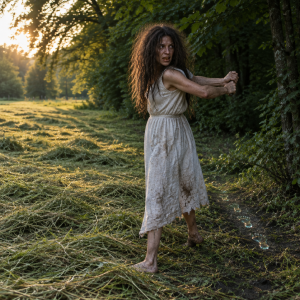
Dali — the goddess of the hunt and the most vivid figure in the whole tradition. She is a breathtakingly beautiful woman with golden hair and golden ornaments who lives high among the crags and owns all the hoofed wild animals — ibex, chamois, deer. She takes mortal hunters as lovers and grants them success on the mountain, but demands absolute discretion and fidelity. Most attested among the Svans of northwestern Georgia, she is one of the great hunting goddesses of world mythology.
Ochopintre — the goat-legged, goat-horned lord of the forest who herds the wild beasts alongside Dali. His name is read as a compound of the old pagan god Bochi and the Greek Pan (pintre), and the resemblance is exact: a horned woodland deity without whose blessing no animal can be taken. Hunters sacrificed to him before entering his domain, because to kill a beast he protected without his consent was to invite disaster.
Adgilis Deda — literally “Mother of the Place,” a gentle goddess of fertility, livestock, and locality worshiped especially in the northeastern highlands of Khevsureti. She is the guardian spirit of a specific spot — a pass, a settlement, a stretch of road — and the patroness of travelers who cross it. Each place had its own Adgilis Deda, making her less a single goddess than a principle of sacred geography.
Mamberi — the lord of wolves, worshiped in Svaneti as the master who commands the packs. In a herding society where wolves were a constant threat, a deity who could call them off or set them on was worth honoring, and Mamberi held that dangerous office.
Creatures, Monsters, and Supernatural Beings
Giants and Dragons
Devi — gigantic, often many-headed beings who dwell in the lower world and serve as the standard antagonists of Georgian heroic epic. A devi may have three, nine, or more heads, hoards treasure and captive maidens in an underground or mountain lair, and must be outwitted as often as overpowered. They are the ogres of the tradition, blocking the hero’s path the way the cyclops blocks Odysseus. The word travels widely — the same root gives the daēva of Persian myth and the deva of India, though the Georgian devi is firmly a monster.
Gveleshapi — the Georgian dragon, a name compounded from “whale” (veshapi) and “serpent” (gveli). These water-dwellers ruled lakes, rivers, and springs, and in the oldest layer of belief were wise and benevolent, even revealing hidden water to people. By the heroic-epic stage they had become chaos-monsters to be slain, warring constantly with the benevolent bird Paskunji in the underworld — a Caucasian echo of the universal serpent-versus-thunderbird conflict.
Witches, Birds, and Forest Folk
Kudiani — hideous hunchbacked witches with oversized teeth and, crucially, a tail: their name derives from kudi, “tail.” They disguise themselves as ordinary women to work their bewitchments, gather on a mountain ruled by their chief witch Rokapi, and feast on the souls and bodies of the people they deceive. They are the indigenous Georgian answer to the European witch, with the telltale tail giving the disguise away.
Paskunji — a phoenix-like bird of the underworld, and one of the great helper-creatures of the tradition. Paskunji wars with the gveleshapi dragons, but to a hero who spares or aids it, the bird becomes a saving ally: it can carry a man between the three worlds, heal mortal wounds, and revive the dying with its feathers or a sprinkle of its medicine. It belongs to the same family as the Persian Simurgh and the Arabian Roc — the giant benevolent bird that ferries heroes across the impossible distances of myth.
Ali — malevolent shapeshifting spirits, usually female, who haunt rivers, forests, and ruins and prey on travelers, the sick, and women in childbirth. An ali might appear as a beautiful woman, a hideous hag, or an animal, and capturing one’s hair or distinctive cap was said to bind it into service. They are the tradition’s restless, dangerous nature-spirits, lurking at the edges of the inhabited world.
The Central Myths
Amirani and the Theft of Fire
The Amiraniani is the national epic of pagan Georgia, a cycle so old it may reach back to the third millennium BC. Amirani is a demigod, born of a mortal and the hunting goddess, who grows into a dragon-slaying culture hero. He kills the great gveleshapi — in some versions he is swallowed and cuts his way out — frees captives from the devis, and above all defies Ghmerti himself, bringing humanity the secret of fire and the working of iron. For this theft of divine knowledge the supreme god condemns him to be chained to a peak in the Caucasus, where an eagle tears at his liver by day while it regrows by night, his loyal dog licking the chain to wear it thin until, each year, a divine hammer-blow renews it.
The myth matters because it is the clearest case in world mythology of a “Greek” story that may not be Greek. The punishment is point-for-point that of Prometheus, the Greeks located Prometheus’s rock in the Caucasus, and the Georgian version is embedded in a living oral tradition rather than a literary one. Whether the Greeks borrowed it, the Georgians did, or both inherited it from a shared Caucasian source, Amirani forces the question of where Europe’s great rebellion-myth was actually born.
Dali, Betgil, and the Hunter’s Fall
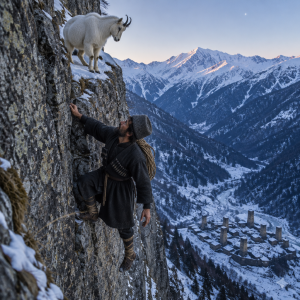
The most haunting Svan myth tells of the hunter Betgil (also Betkil), the favored lover of Dali. The goddess grants him unmatched success on the mountain on one condition — that he keep their bond secret and faithful. Betgil betrays her, whether by boasting, by sleeping with a mortal woman, or by hunting on a forbidden feast day. In her fury Dali lures him onto a sheer cliff face and strands him there: he cannot climb up or down, and after a long agony he falls to his death. The story survives in the Svan round-dance songs Bail Betkil and Betkani, sung and danced to this day.
It matters because it encodes the entire ethic of highland hunting. Game belongs to the goddess; the hunter is a guest under strict rules; and abundance taken without reverence or restraint is repaid with death. The myth is a survival code dressed as a love tragedy.
The Golden Fleece and the Land of Colchis
Western Georgia was the ancient kingdom of Colchis, and to the Greeks it was the fabulously wealthy edge of the world where the Golden Fleece hung in a sacred grove guarded by a sleepless dragon. Jason and the Argonauts sailed there to seize it, and succeeded only through the sorcery of Medea, daughter of King Aeetes of Colchis and a priestess of Hecate. The “golden fleece” likely preserves a real Colchian practice: panning mountain rivers for gold by submerging sheepskins to catch the flecks in the wool.
This myth matters because it stitches Georgia directly into the Greek mythic map. Colchis was the first major political formation of the ancestors of modern Georgians, and the Argonaut legend is the Mediterranean world’s memory of a real, rich, and distant Caucasian kingdom — the place where their heroes went to find the impossible.
The Three Worlds: Georgian Cosmology and the Afterlife
Georgian cosmology is built vertically. The universe is a sphere divided into three stacked worlds, the skneli, each with its own color. Above is zeskneli, the white upper world, home of Ghmerti and the gods. In the middle is the red world of the living — humans, animals, and plants. Below is qveskneli, the black netherworld, swarming with demons, evil spirits, and the gveleshapi dragons. Some accounts add a still-deeper outer darkness, gareskneli, the absolute void beyond the edge of everything.
Death, in this scheme, is literally a journey downward — the soul descends from the red world into the black. Heroes and shamans could in principle travel between the layers while alive, which is why Paskunji’s power to carry a passenger between worlds is so prized in the epics: it short-circuits the geography of death. The boundary between worlds is dangerous and guarded, and crossing it is the defining act of the hero.
When Christianity arrived, this three-tier cosmos mapped neatly onto the new religion: zeskneli became heaven and the abode of the Trinity, qveskneli became hell and the abode of the devil, and the colored vertical universe quietly carried on under Christian names. The persistence of that structure — older than the conversion, never fully replaced — is one of the clearest signs of how deep the pagan substrate ran.
How Georgian Mythology Connects to Other Traditions
Greek mythology is the most dramatic link. The Amirani–Prometheus parallel may run in Georgia’s favor, and the Greek Argonaut saga is set in Colchis — western Georgia itself — with Medea and King Aeetes as Colchian royalty. Ochopintre is a near-twin of Pan. The two traditions were not distant neighbors but overlapping mythic territory on the Black Sea coast.
Persian and Zoroastrian belief shaped the royal layer. The state god Armazi is widely read as a syncretism of Ahura Mazda, and centuries of Iranian political dominance left the imprint of Zoroaster‘s dualism and figures like Mithra on Georgian religion. The very word devi shares its root with the Persian daēva. Georgia’s benevolent bird Paskunji is a cousin of the Simurgh.
Anatolian and Slavic neighbors round out the map. The moon-god element in Armazi points to the Hittite Arma, tying Georgia to Hittite and Hurrian religion to the south, and the Georgian highlands share the storm-god-versus-serpent pattern with the Slavic world to the north, where Perun battles a chaos-dragon much as Georgian heroes battle the gveleshapi. Together with neighboring Armenian tradition, Georgian myth forms part of a distinctive South Caucasian religious world.
Where to Start Reading
The essential primary text is the Amiraniani, the Georgian folk epic of Amirani, available in scholarly collections that gather its many oral variants. For the medieval Christian sources that describe the pagan idols, read The Life of Saint Nino and the Conversion of Kartli (Moktsevai Kartlisai), which record the destruction of Armazi and his fellow gods. For the Greek side of Colchis, Apollonius of Rhodes’s Argonautica is the classical account of Jason, Medea, and the Golden Fleece.
For modern introductions, the work of Kevin Tuite on highland Georgian religion and the goddess Dali is the leading English-language scholarship, rigorous and readable. Georges Charachidzé’s comparative studies place Georgian myth in its Caucasian and Indo-European context, and broad surveys of Caucasian mythology offer an accessible overview for the general reader approaching this tradition for the first time.
Explore Georgian Mythology on Gods and Monsters
Gods and Monsters currently features 7 entries drawn from Georgian mythology, with more added as the index grows. Browse all Georgian Mythology entries →
Dali · Ochopintre · Armazi · Adgilis Deda · Devi · Kudiani · Paskunji
Frequently Asked Questions
Is Amirani the same as Prometheus?
They are not the same figure, but they share a strikingly identical core myth. Both are heroes who defy the supreme god to bring fire and knowledge to humanity, and both are punished by being chained to a peak in the Caucasus while an eagle devours a liver that regrows each night. The ancient Greeks themselves placed Prometheus’s rock in the Caucasus, and many scholars argue the Georgian Amirani is older or developed independently — meaning the famous Greek myth may actually have Caucasian roots rather than the other way around.
Who is the most important god in Georgian mythology?
It depends on the layer. In the deep folk tradition the supreme god is Ghmerti, the creator who rules the ninth heaven and whose name still means “God” in Georgian. In the official royal religion of the kingdom of Iberia, the chief deity was Armazi, a moon and warrior god imposed by King Pharnavaz I. The hunting goddess Dali is the most vivid and widely told figure in the surviving myths, even though she is not the supreme deity.
What is the Georgian goddess of the hunt?
Dali is the Georgian goddess of the hunt, a golden-haired beauty who lives among the high crags and owns all the wild hoofed animals such as ibex and deer. She is best known from the myths of the Svan people of northwestern Georgia. She takes hunters as lovers and grants them success, but demands secrecy and fidelity — and famously destroys the hunter Betgil when he betrays her. Her forest companion is the goat-legged Ochopintre.
Was Georgia really the land of the Golden Fleece?
Yes — the kingdom of Colchis, the destination of Jason and the Argonauts in Greek myth, corresponds to the historical region of western Georgia on the Black Sea coast. King Aeetes and his sorceress daughter Medea were its rulers in the legend. The Golden Fleece itself may reflect a genuine Colchian practice of catching river gold in submerged sheepskins, which is one likely real-world origin of the story.
What are the three worlds in Georgian cosmology?
Georgian cosmology divides the spherical universe into three vertically stacked worlds called skneli, each with its own color. The white upper world, zeskneli, is the home of the gods; the red middle world is the realm of living humans, animals, and plants; and the black lower world, qveskneli, is the netherworld of demons and dragons. Death is imagined as a descent from the red world into the black. After Georgia’s conversion, these layers were reinterpreted as the Christian heaven and hell.
What kind of creature is the Paskunji?
The Paskunji is a phoenix-like bird that lives in the underworld and serves as a powerful helper to heroes in Georgian epic. It wages constant war against the gveleshapi dragons, and a hero who aids the bird earns an ally that can carry him between the three worlds, heal his wounds, and even bring him back from the dead. It belongs to the same mythic family as the Persian Simurgh and the Arabian Roc.