European Mythology: The Complete Guide to a Continent’s Layered Gods, Bestiary Beasts, and Folk Spirits
There is no single European mythology, and that is precisely the point. What we call “European mythology” is not one tradition but a palimpsest — a continent’s worth of belief written, erased, and overwritten across four thousand years. Beneath everything lies a shared Indo-European substrate: a sky-father whose name survives intact in Zeus, in the Roman Jupiter, and in the Norse Tyr, all three descending from a single reconstructed god, Dyḗus Ph₂tḗr, “Sky Father.” On top of that foundation the continent stacked the classical pantheons of Greece and Rome, the war-bands of the Norse and Germanic north, the druidic world of the Celts, the forest-and-hearth spirits of the Slavs and Balts, and the genuinely non-Indo-European mysteries of the Finns and the Basques.
Then came the great solvent: medieval Christianity. Over a thousand years it dissolved the old pantheons but could not dissolve the creatures. The gods became saints or devils; the spirits of well and wood went underground into folklore; and a brand-new pan-European bestiary — basilisks, griffins, unicorns, the yale — was assembled in Latin manuscripts that crossed every border the pantheons never did. The comparative mythologist Georges Dumézil spent a career showing that under the surface, the same three-part Indo-European logic of priest, warrior, and farmer kept resurfacing from Iceland to the Black Sea.
This guide treats Europe as a single, contradictory landscape. It traces the shared sky-gods that connect the pantheons, the bestiary beasts that belong to no pantheon at all, the elemental spirits the Renaissance organized into a system, and the folk creatures — the poltergeist, the Sandman, the Bokkenrijders — that survived precisely because nobody important believed in them.
What Makes European Mythology Different
It is a stack, not a system. Most mythologies are a single coherent body. Europe’s is geological — distinct strata laid down in sequence and still visible in cross-section. A Bavarian village in 1500 might honor Christian saints, fear a thunder-god’s descendant in the storm, leave milk out for a household spirit older than Rome, and warn children about a bestiary monster invented by a monk. No priesthood ever reconciled these layers, and that incoherence is the tradition’s defining feature.
The same god wears a dozen names. Because the European pantheons share an Indo-European root, their chief gods are often the same god linguistically. The thunderer appears as the Norse Thor, the Slavic Perun, the Baltic Perkūnas, and the Vedic Parjanya — all reflexes of one storm-god who hurls a stone weapon at a serpent. Recognizing these cousins across borders is the entire project of comparative mythology, and it is something no other continent offers in such density.
The creatures outlived the gods. When Christianity ended the worship of Odin, the valkyries and elves and draugr did not die — they slipped from religion into folklore and kept going. Europe’s most continuous mythological tradition is not its theology but its bestiary: a shared cast of dragons, werewolves, and water-horses that crossed linguistic borders far more freely than any god ever did.
It built a monster encyclopedia. No other tradition produced anything quite like the medieval bestiary. Descending from a 2nd-century Greek text, the Physiologus, and expanded by Isidore of Seville, the bestiaries fixed a standardized roster of beasts — the basilisk, the cockatrice, the griffin, the unicorn, the amphiptere — each loaded with Christian moral meaning and copied across the whole Latin West. These creatures belong to “Europe” as a literary civilization rather than to any one people.
The Renaissance turned spirits into a periodic table. In the 16th century the Swiss physician Paracelsus took Europe’s scattered nature-spirits and sorted them into four elementals — the gnome of earth, the undine of water, the sylph of air, and the salamander of fire. This is mythology as engineering: an attempt to systematize folklore the way an alchemist systematized metals, and a uniquely European impulse.
The Sky-Father and the Layered Pantheons
European mythology has no single pantheon, but its many pantheons rhyme. Read across them and the same divine offices keep recurring — a remote sky-ruler, a violent thunderer, a love-goddess, a death-keeper — because they share an ancestor.
The Classical Olympians
The gods of Greek and Roman mythology became Europe’s lingua franca of myth, taught in schools long after their temples fell.
Zeus — king of the gods and the purest survival of the Indo-European sky-father, ruling from Olympus with the thunderbolt as both weapon and symbol of cosmic order.
Hera — queen of the gods, goddess of marriage, and the jealous counterweight to Zeus’s endless infidelities.
Poseidon — lord of the sea, earthquakes, and horses, whose moods the entire Mediterranean world depended on.
Hades — the unseen ruler of the dead, neither evil nor cruel, simply the warden of a realm no one escapes.
Athena, Apollo, and Aphrodite — wisdom, light, and love, the three Olympians who most thoroughly outlived their own religion to become permanent figures of Western art.
Hephaestus — the lame smith-god of the forge, the only Olympian who works, and Hecate — the torch-bearing goddess of crossroads, witchcraft, and the moon’s dark face. Pan, the goat-legged god of the wild, gave Europe both the word “panic” and, eventually, the visual template for the Christian Devil.
The Norse and Germanic Powers
Where the Olympians are radiant, the gods of the Norse and Germanic north are doomed, fighting a war against the giants they know they will lose.
Odin — the one-eyed god of war, poetry, and ecstatic frenzy, who hanged himself on the world-tree to win the runes and rides at the head of the Wild Hunt.
Thor — the red-bearded thunder-god and the same divine figure as the Slavic Perun and Baltic Perkūnas, defending gods and humans alike with the hammer Mjölnir.
Tyr — the one-handed god of law and sacrifice, whose name is the truest linguistic descendant of the original sky-father, and Freyja — goddess of love, war, and seiðr magic, who takes half the battle-dead. Loki, the shape-shifting trickster, is the engine of the coming apocalypse, father of the wolf Fenrir, while watchful Heimdallr waits to sound the horn at the end of the world.
The Celtic and Slavic Gods
The Celtic gods survive filtered through medieval Irish and Welsh manuscripts. The Dagda is the “good god,” a club-wielding father-figure with a cauldron that never empties; Lug is the many-skilled master of every craft; The Morrigan is the crow-goddess of war and fate; and Cernunnos, the antlered lord of beasts, stares out of the Gundestrup Cauldron. Brigid — goddess of poetry, smithcraft, and healing — was absorbed almost whole into the Christian Saint Brigid, and The Cailleach, the divine hag of winter, shapes the very landscape of Ireland and Scotland.
The Slavic pantheon centers on Perun, the thunder-god, locked in eternal combat with Veles, the horned, chthonic god of cattle, the underworld, and oaths — a “divine duel” myth that exactly mirrors Thor’s fights with the world-serpent. Svarog, the smith of heaven, and Mokosh, the moist Mother Earth and the only goddess in the official Kievan pantheon, round out a cosmos still half-preserved in folk custom. Further north, the Finnish sky-god Ukko wields a hammer like Thor’s despite belonging to a wholly different, non-Indo-European language family — a sign of how deeply these motifs traveled.
Creatures, Monsters, and Supernatural Beings
If the gods divide Europe by nation, the creatures unite it. Many of these beings appear, under local names, from Portugal to the Urals.
The Bestiary Beasts
These are the creatures of the manuscripts — heraldic, moralized, and pan-European by design.
Basilisk and Cockatrice — the twinned “king of serpents,” hatched from a cock’s egg, that kills with a glance and dies on seeing its own reflection. The pair became a medieval emblem of how evil destroys itself.
Griffin — the eagle-lion guardian of gold, and the Amphiptere, a winged, legless serpent of European forests and coats of arms, sworn guardian of sacred sites.
Yale — an antelope-like beast with horns it can swivel independently, a true bestiary obscurity that nonetheless ended up on the heraldry of English royalty. Beside it stand the Unicorn, the Manticore, and the regenerating Phoenix — all standardized for Europe in the same Latin pages.
Sea monk — a genuinely strange entry: a fish-shaped, monk-like creature reported in earnest from the waters off Denmark in the 1540s and printed in the era’s most respectable natural histories, a reminder that the bestiary was, to its readers, science.
Dragons, Serpents, and Their Kin
Europe’s dragons split into two great families. The western, winged, fire-breathing Dragon and its two-legged cousin the Wyvern dominate the heraldry of Britain and France; the legless Norse Lindworm crawls through Scandinavian saga; and the multi-headed Slavic Zmey Gorynych breathes fire over Russian folktale. The Provençal Tarasque — a turtle-shelled, lion-headed amphibian subdued by a saint rather than a knight — shows how thoroughly the dragon-slaying myth was Christianized.
Water Spirits and Drowning-Things
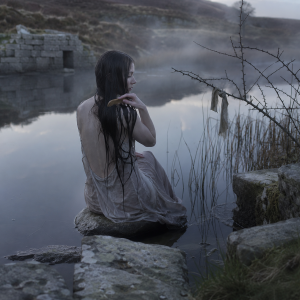
No theme is more pan-European than the spirit that lurks in water and pulls the unwary under. The Germanic Nix and the literary Undine are beautiful and tragic; the Celtic Water sprite guards a spring or loch; the Scottish Kelpie and Each Uisge are water-horses that lure riders to a drowning death; the Slavic Rusalka and Vodyanoy haunt rivers and millponds; and the half-built Orcadian Nuckelavee, a skinless horse-and-rider fused into one, is among the most horrifying beings in all of British folklore. The serpent-bride Melusine and the seal-wife Selkie turn the same water-spirit into a story about marriage and loss.
Household Spirits and the Restless Dead
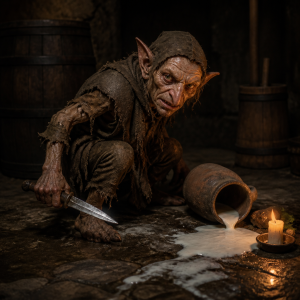
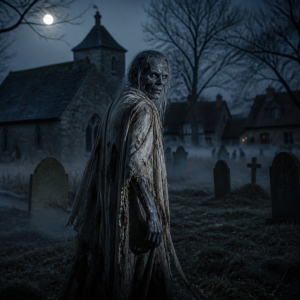
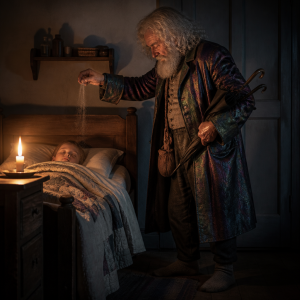
Every European hearth had its small god. The Scandinavian Nisse and Tomte, the Scottish Brownie, and the Slavic Kikimora keep or wreck a household depending on how they are treated. The Poltergeist — German for “noisy ghost” — is the household spirit gone violent, hurling crockery and rapping on walls. The dead themselves rarely rest: the Norse Draugr guards its grave-mound, the Breton Ankou collects souls in a creaking cart, the Romanian Strigoi and Moroi feed the legend of the Vampire, and the pale, plague-touched Blafard carries an 18th-century anxiety about decay and the New World. The German Sandman, who sprinkles sand to bring sleep, looks gentle until you read E.T.A. Hoffmann and remember he was once a child-stealer.
The Central Myths
The Wild Hunt
Across northern and central Europe, on the wildest nights of winter, a spectral host rides the sky — hounds baying, a furious leader at the front, and the souls of the dead swept up behind. This is the Wild Hunt, and its leader changes with the country: Odin in Scandinavia and Germany (where it is “Wodan’s Hunt”), various damned kings and huntsmen elsewhere, and the witch-goddess Perchta in the Alps. To see the Hunt was an omen of war or plague; to be caught out under it was to be carried off. Why it matters: the Wild Hunt is the clearest case of a single Indo-European storm-procession surviving the death of the gods, rebranding its leader again and again while keeping its terror intact — the same myth told in a hundred dialects.
The Marriage to a Water-Spirit
Again and again, a European man marries a supernatural water-woman under a single condition he is forbidden to break. He always breaks it. Melusine flies off as a dragon when her husband spies on her serpent-bath; the Selkie wife returns to the sea the moment she finds her hidden sealskin; the Undine gains a human soul through marriage but is bound to kill her husband if he betrays her. Why it matters: this “supernatural wife” story is one of Europe’s most stable narrative templates, encoding a recurring anxiety about marrying across a boundary — between human and inhuman, land and water, the known and the wild — and the impossibility of keeping such a marriage whole.
The Thunderer Versus the Serpent
The single oldest myth on the continent is a fight. A sky-borne thunder-god battles a chthonic serpent or dragon coiled around the roots of the world: Thor against the world-serpent, Perun against the snake-like Veles, Zeus against Typhon, Apollo against Python. Why it matters: comparative mythologists call this the “chaoskampf,” and its appearance in Greek, Norse, Slavic, and Baltic myth alike is one of the strongest pieces of evidence that all these traditions descend from one lost Proto-Indo-European religion. Christianity simply inherited the pattern wholesale as Saint George and the dragon.
Afterlife and Cosmology
There is no single European afterlife, and the contrast between the regional answers is itself revealing. The Greeks sent nearly everyone to the grey, joyless fields of Hades, guarded by the three-headed Cerberus — a democracy of the dead in which heroes and cowards shared the same dim eternity. The Norse split their dead: half the slain went to Odin’s Valhalla to fight and feast until Ragnarök, escorted by the Valkyries, while the rest went down to misty Hel. The Celts imagined an Otherworld that was not below but alongside — a land of eternal youth reachable across the western sea or through a fairy mound, where time ran differently and the dead were not so much gone as elsewhere.
What unites the European cosmologies is verticality and a tree. The Norse Yggdrasil, the Slavic and Baltic world-tree, and the classical layering of heaven, earth, and underworld all imagine the cosmos as a three-tiered structure with a sky-realm above, the human middle-world, and a serpent-haunted underworld below. And almost everywhere the cosmos is mortal: the Norse expected Ragnarök, the Slavs and Greeks told of ages that end and begin again. The European imagination, unlike some others, could never quite believe the world would last forever.
How European Mythology Connects to Other Traditions
The deepest connection is internal: the European pantheons are not neighbors but relatives. The shared sky-father, thunder-god, and dawn-goddess of Greek, Roman, Norse, Celtic, Slavic, and Baltic mythology all descend from a single Proto-Indo-European source, which is why the same myths keep reappearing in different costumes.
Yet not all of Europe is Indo-European. Finnish mythology, with its shamanic singer-heroes, and Basque mythology, centered on the serpent-goddess Mari, belong to language families that predate the Indo-European arrival — living reminders of an older Europe. The Etruscan gods, absorbed and renamed by Rome, are a third non-Indo-European thread.
The continent also borrowed across its southern and eastern edges. Greek myth drank deeply from the Near East; the Phoenix and Griffin flew in from Egypt and Persia; and the whole Medieval bestiary was stitched together from classical, biblical, and Eastern sources. Later national traditions like Romanian and Spanish mythology show the final layer: Christian, regional, and still haunted by the pagan creatures underneath.
Where to Start Reading
For the classical foundation, begin with Homer’s Iliad and Odyssey and Hesiod’s Theogony, then Ovid’s Metamorphoses — the single most influential transmission of Greco-Roman myth into later European art. For the north, the Old Norse Poetic Edda and Snorri Sturluson’s Prose Edda are indispensable; for the Celts, the medieval Irish Táin Bó Cúailnge and the Welsh Mabinogion. The shared creature-world lives in the medieval bestiaries, descendants of the Greek Physiologus.
For a comparative overview, Georges Dumézil’s work on the trifunctional Indo-European structure is the foundational modern lens, however much later scholars have qualified it. Jacob Grimm’s Teutonic Mythology (1835) remains the great quarry of Germanic folk-belief, and for an accessible single-volume entry point, the various national handbooks and a good encyclopedia of European folklore will carry a curious reader from the Olympians to the household spirits without losing the thread.
Explore European Mythology on Gods and Monsters
Gods and Monsters catalogs ten creatures filed directly under European mythology — the continent’s stateless beings, the ones that belong to no single nation — alongside hundreds more across its constituent traditions. Browse all European Mythology entries →
Amphiptere · Yale · Sea monk · Elemental · Undine · Water sprite · Poltergeist · Sandman · Bokkenrijders · Blafard · Basilisk · Cockatrice · Griffin · Unicorn · Dragon · Wild Hunt · Melusine · Kelpie · Nuckelavee · Vampire · Werewolf · Krampus
Frequently Asked Questions
Is there really one “European mythology”?
No — and anyone who tells you otherwise is flattening four thousand years of history. “European mythology” is an umbrella for many distinct traditions: the Greek and Roman pantheons, the Norse and Germanic gods, the Celtic and Slavic and Baltic worlds, plus non-Indo-European outliers like Finnish and Basque belief. What they share is a common Indo-European ancestry for many of the gods, and a common pool of folk creatures that crossed every border.
Why do so many European gods seem like the same god?
Because, linguistically, many of them are. The chief gods of the Indo-European traditions descend from reconstructed Proto-Indo-European deities: the sky-father behind Zeus, Jupiter, and Tyr, and the thunder-god behind Thor, Perun, and the Baltic Perkūnas. The comparative mythologist Georges Dumézil argued that an entire three-part social logic — priest, warrior, producer — was inherited along with the names, which is why the pantheons feel like variations on a theme.
What is the difference between a basilisk and a cockatrice?
Almost nothing, and that is the historical answer. Both are the venomous “king of serpents,” both kill with a glance, and both die on seeing their own reflection. The basilisk began as a small, deadly snake in Pliny’s Roman natural history; the cockatrice emerged in medieval England as a creature hatched from a cock’s egg incubated by a toad. Over the Middle Ages the two blurred into a single rooster-serpent hybrid, and most later sources use the names interchangeably.
What are the four elementals, and where did they come from?
The four elementals — the gnome (earth), undine (water), sylph (air), and salamander (fire) — were systematized by the Swiss alchemist Paracelsus in the 16th century. He didn’t invent the spirits; he organized much older folklore — water-nymphs, fire-lizards, earth-dwelling pygmies — into a neat scheme matching the four classical elements. The names “gnome,” “undine,” and “sylph” first appear in his writings, which makes the elementals a rare case of folklore engineered by a single author.
What is the Wild Hunt?
The Wild Hunt is a spectral procession of huntsmen, hounds, and the dead that storms across the European winter sky, most famously led by Odin (as “Wodan’s Hunt”) in Germanic lands and by the goddess Perchta in the Alps. Seeing it foretold disaster — war, plague, or death. Folklorists trace it to an ancient Indo-European myth of a storm-god leading the souls of the dead, which survived the conversion to Christianity by quietly swapping its divine leader for damned kings and devils.
Which European mythologies are NOT Indo-European?
Three stand out. Finnish mythology belongs to the Uralic language family and preserves a shamanic, song-based cosmos very unlike its neighbors. Basque mythology, built around the serpent-goddess Mari, comes from a language with no known relatives at all — a survival from pre-Indo-European Europe. And Etruscan mythology, which shaped Roman religion before being absorbed by it, was also non-Indo-European. They are the continent’s reminders that the Indo-European gods were once newcomers.