Colombian Mythology: The Complete Guide to Muisca Gods, Forest Guardians, and Shapeshifting Spirits
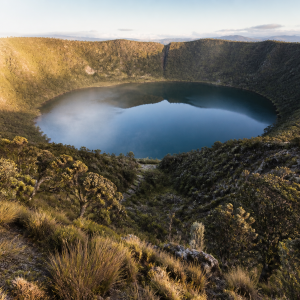
The legend of El Dorado — the golden kingdom that lured Spanish conquistadors to their deaths in the Andes for two centuries — was not a fantasy. It was a real Colombian religious ceremony, garbled by greed. At Lake Guatavita, north of modern Bogotá, the newly chosen ruler of the Muisca people was stripped naked, coated head to foot in gold dust, and floated on a reed raft to the lake’s center, where he dove into the water and his attendants threw emeralds and golden figurines into the depths as offerings. El hombre dorado — “the gilded man” — became, in the European imagination, a city, then an empire of gold. Colombia’s most famous myth is the one nobody in Colombia actually told.
That gap between what was believed and what was imagined runs through all of Colombian mythology, which is really three mythologies stacked on top of one another. Beneath everything lies the cosmology of the Muisca and other indigenous Andean and Amazonian peoples — a pantheon of sun, moon, water, and a civilizing hero who taught humanity to weave. On top of it sits the mestizo folklore of the colonial countryside: forest mothers, river tricksters, and one-legged seductresses who patrol the rivers and jungles. And braided through the Pacific coast and the Caribbean is a third stratum, Afro-Colombian, carried in the memory of enslaved Africans who fled into the rainforest of the Chocó and kept their water spirits and thunder gods alive.
Most of what survives of the Muisca pantheon comes to us through Spanish chroniclers — Fray Pedro Simón and the bishop Lucas Fernández de Piedrahíta — who recorded the myths even as the religion was being dismantled. The folklore came down by mouth, around cooking fires and on river journeys, which is why Colombia’s spirits are not frozen in scripture but still actively feared in living memory.
What Makes Colombian Mythology Different
It is three mythologies in one country. Greek or Norse mythology is a single coherent system. Colombian mythology is a geological cross-section: indigenous Muisca and Amazonian belief at the bottom, Spanish-Catholic colonial folklore in the middle, and West and Central African religion along the coasts. A single Colombian region can hold an Andean moon goddess, a Catholic-inflected weeping ghost, and a Congo thunder spirit, all believed in by the same community.
The gods are park rangers, not kings. Where most pantheons organize around thrones, war, and dynastic drama, Colombia’s most vivid spirits are ecological enforcers. Madremonte punishes those who foul rivers or clear forests; El Mohán guards the Magdalena River and drowns those who disrespect it; La Patasola is a guardian of the deep jungle. These are not metaphors bolted on later — punishing environmental harm is the spirits’ original job description.
El Dorado was literally true. Nearly every “lost city of gold” myth in world folklore is pure invention. Colombia’s is the rare one anchored in documented fact: archaeologists have recovered the Muisca votive rafts and golden offerings, and the exquisite Balsa Muisca raft in Bogotá’s Gold Museum depicts the very coronation rite that started the legend.
The monsters are overwhelmingly female — and overwhelmingly wronged. The most feared figures in Colombian folklore are women undone by betrayal, grief, or jealousy: the one-legged Patasola, the weeping La Llorona, the fire-wreathed Candileja, the shapeshifting La Tunda. They are cautionary tales about infidelity and cruelty, told largely to men and about the consequences of how men treat women.
The supreme god had no idol. The Muisca creator Chiminigagua was never worshipped directly. He was approached only through the visible heavens — the sun and the moon — an abstraction closer to a philosophical first principle than to a statue in a temple.
The Major Muisca Gods
The Muisca, who controlled the cold high plateau around Bogotá and Tunja, built one of the most sophisticated religious systems in the pre-Columbian Andes outside the Inca. Their gods governed light, water, fertility, and morality.
Creator and Civilizer
Chiminigagua — the supreme being and source of all light. In the beginning everything was darkness; Chiminigagua released the light held inside himself and sent out great black birds breathing luminous air across the mountains, then created the sun and moon. He was honored not in his own right but through them.
Bochica — the bearded civilizing hero, the most beloved figure in the Muisca pantheon. An old man sent from the heavens, he wandered the territory teaching the people to weave cotton mantles, fire ceramics, build, farm, and live by moral and political law. When the people fell into vice, it was Bochica who returned to set them right.
Sun, Moon, and the First Mother
Bochica’s wife was Huitaca, the goddess of pleasure, drunkenness, and sexual liberation, who rebelled against his sober teachings and urged the people toward dance and abandon. As punishment Bochica transformed her into a white owl — or, in another telling, into the moon itself. The Sun god Sué and Moon goddess Chía ruled the visible sky, and the rivalry between solar and lunar cults shaped Muisca politics: the zipa of Bacatá claimed descent from the Moon, the zaque of Hunza from the Sun.
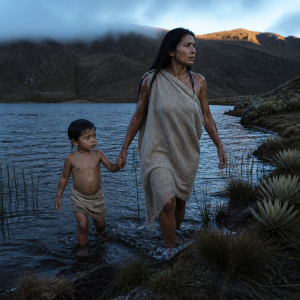
Humanity itself began with Bachué, “the woman of the good breast,” who emerged from the sacred lake of Iguaque carrying a three-year-old boy. When he came of age she married him, and together they peopled the Earth. In old age the couple walked back into the lake and dissolved into two great serpents — which is why, for the Muisca, lakes were holy and water was the doorway between worlds.
Rain, Earth, and the Rainbow
Chibchacúm was the god of rain, thunder, and the working people — farmers, builders, and traders prayed to him and offered him gold. But when the people of the Bogotá savanna angered him, he sent a catastrophic flood. Cuchavira, the rainbow, was born from the aftermath of that disaster, becoming the protector of the sick and of women in childbirth — a rare mythology in which the rainbow signals not just the end of a flood but ongoing mercy.
Creatures, Monsters, and Guardian Spirits
This is where Colombian mythology becomes a living thing. The colonial-era and indigenous creatures below are still invoked across rural Colombia today to explain disappearances, drownings, and the simple terror of the forest at night.
Guardians of the Forest and Rivers
Madremonte — “Mother of the Mountain,” a towering woman cloaked in moss and leaves with glowing eyes, who rules the wild and unowned places. She floods rivers, summons storms, and visits sickness on those who clear forests, poach animals, move boundary markers, or trespass on land that is not theirs. She is Colombia’s environmental conscience given a furious face.
El Mohán — a hairy, fiery-eyed river sorcerer who haunts the Magdalena and Cauca, smoking a cigar and luring fishermen and beautiful women into the water. He capsizes canoes, tangles nets, and seduces washerwomen, yet he is also a guardian who punishes those who pollute or overfish his rivers. Many older fishermen still leave him offerings of tobacco and rum.
La Patasola — perhaps the most feared spirit in the Colombian wilderness. An adulterous woman killed by her husband, she returned as a being with a single, hoofed leg who hops through the deep jungle. She appears to lonely woodcutters, miners, and hunters as a beautiful woman or a familiar loved one, then reveals fangs and a single bloody limb and devours them. Like Madremonte, she is also read as a protector of untouched wilderness — punishing the very men who venture too greedily into it.
Wandering Women and Ghost-Lights
La Llorona — “the Weeping Woman,” shared across Latin America but deeply rooted in Colombia, the ghost of a mother who drowned her own children and now wanders the riverbanks wailing for them. To hear her cry is an omen; to follow it is fatal.
La Candileja — the spirit of a grandmother who so spoiled her grandchildren that they grew into criminals; condemned in the afterlife, she roams the night as a screaming ball of fire with three flames, chasing wrongdoers and drunkards. She is a punishment specifically aimed at bad upbringing.
La Mojana — a small, wild-haired water sprite of the swamps and rivers of the Caribbean lowlands who steals unbaptized children and braids the manes of horses at night. She lives in golden palaces beneath the water and is both mischievous and genuinely dangerous to the careless.
Shapeshifters and Tricksters
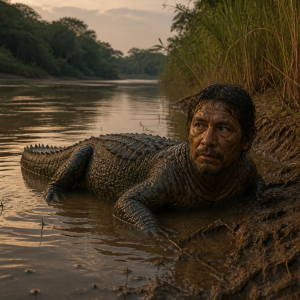
El Hombre Caimán — “the Caiman Man,” the most famous legend of the lower Magdalena town of Plato. A fisherman so obsessed with spying on bathing women that he used a sorcerer’s potion to turn into a caiman; when the second potion that would change him back was spilled, he was trapped forever as a half-man, half-reptile, condemned to haunt the river. His tale is sung every year in a riverside festival.
El Pollo Maligno — “the Evil Chicken,” a deceptively absurd horror: a man-eating chick or rooster, born of a child cursed by witchcraft, that hides in the forest and imitates the cheeping of a lost baby bird to lure hunters off the trail, then attacks. It is a reminder that Colombian folklore can find dread in the smallest, most ridiculous-seeming forms.
La Tunda (also recorded simply as Tunda) — the great shapeshifter of the Afro-Colombian Pacific. She takes the shape of a victim’s mother, wife, or sweetheart to lure children and unfaithful men deep into the mangrove jungle, where she feeds them camarones cooked in her own flesh to “entundar” them — to enchant and enslave them. Her one tell is a deformed leg shaped like a wooden churn. Only a baptism, a drum, and the prayers of a godparent can break her spell.
The Central Myths
El Dorado and the Lake of Guatavita
When a new zipa acceded among the Muisca, the court traveled to the sacred crater lake of Guatavita. The heir fasted in a cave, then was coated in sticky earth and blown over with gold dust until he gleamed. On a raft heaped with treasure he was poled to the lake’s heart, where he plunged into the cold water — washing the gold from his body as an offering to the gods below — while his nobles cast emeralds and golden figures into the depths. Spanish ears turned this rite into a city, then a continent-sized empire of gold, and men died by the hundreds searching for it. Why it matters: El Dorado is the clearest case in world mythology of how conquest distorts a sacred act into an object of plunder — and the recovered golden rafts prove the ceremony was real.
Bochica and the Flood of the Savanna
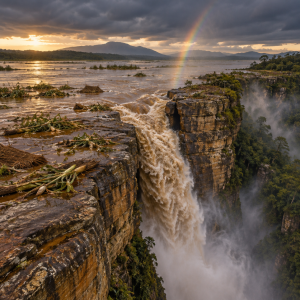
When the people of the Bogotá plateau abandoned Bochica’s teachings, the god Chibchacúm flooded their land in revenge, drowning the crops and homes of the savanna. The desperate people cried out, and Bochica appeared on a rainbow. Striking the mountains with his golden staff, he split the rock and opened a channel through which the floodwaters could drain, creating the thundering Tequendama Falls. He then condemned Chibchacúm to carry the Earth on his shoulders forever — and the Muisca said that when the god shifts the world’s weight from one shoulder to the other, the ground trembles. Why it matters: it is at once a flood myth, an earthquake myth, and an origin story for a real waterfall — Muisca cosmology mapped directly onto the landscape of the Andes.
Bachué and the Birth of Humanity
From the dark waters of Lake Iguaque rose Bachué with a small boy, and from their union came all the Muisca. Their return into the lake as serpents closed the circle: humanity comes from water and goes back to it. Why it matters: it explains why the Muisca made the high mountain lakes their holiest shrines — and why so much gold lies at the bottom of them.
The Afterlife and Muisca Cosmology
The Muisca divided reality into three worlds. There was Quyca, the middle world where people live; Guatquyca, the world above, home of Sué the Sun, Chía the Moon, and the other sky deities; and a lower world where the dead dwell. The journey of the soul after death was perilous: the deceased had to cross a great river or chasm in a boat made of spiderweb — which is why the Muisca held the humble spider sacred and forbade the killing of spiders, since the dead would one day need their silk to reach the next world.
Crucially, the Muisca did not run a moral sorting system like the Christian heaven and hell. The afterlife was a continuation, not a verdict. Rank and earthly station carried over, and the great mountain lakes — Guatavita, Iguaque, Siecha — were understood as gateways between the layered worlds, which is why offerings were given to water rather than buried in earth.
How Colombian Mythology Connects to Other Traditions
The forest guardians are a continent-wide family. Colombia’s Madremonte and Patasola are cousins of Brazil’s Curupira and Mapinguari — all of them spirits who defend the rainforest and turn hunters around in the trees. The forest-protector archetype stretches unbroken from the Amazon to the Andes.
The water-seducers share one ancestor. El Mohán luring women into the Magdalena is the same impulse as Brazil’s Iara and the Amazonian Yacuruna drawing victims beneath the rivers — the deep river as a realm of beautiful, fatal enchantment.
The wronged woman walks every border. La Llorona, La Tunda, and Venezuela’s La Sayona are the same warning in three accents — a woman destroyed by betrayal who returns to punish unfaithful men. The motif binds Colombia to Mexico, Venezuela, and the whole Catholic-colonial world.
The Pacific coast carries Africa. Afro-Colombian spirits like Madre de Agua and the thunder god Siete Rayos descend directly from Central African Kongo religion and the Yoruba orishas — Madre de Agua echoing Yemọja, the great water mother, and the hunter-spirit traditions of Oshosi. They are living proof that enslaved Africans carried their gods across the Atlantic intact.
The Muisca were Andean neighbors of the Inca. The Muisca veneration of the Sun and Moon, their offerings of gold to sacred lakes, and their mother-earth reverence run parallel to the Inca worship of Inti the Sun, the creator Viracocha, and Pachamama the Earth Mother — two great Andean civilizations reaching for the same sky.
Where to Start Reading
The foundational sources for Muisca religion are the colonial chronicles: Fray Pedro Simón’s Noticias historiales de las conquistas de Tierra Firme (1620s) and Lucas Fernández de Piedrahíta’s Historia general de las conquistas del Nuevo Reino de Granada preserve most of what survives of the pantheon, filtered through Spanish eyes. For the gold and the El Dorado rite, the collection of Bogotá’s Museo del Oro (Gold Museum) is the primary visual archive.
For the folklore, the indispensable modern guide is the Colombian historian Javier Ocampo López, whose Mitos y leyendas de Colombia and related compendiums catalog the regional spirits with care. For Afro-Colombian and Pacific traditions, look to the oral-tradition collections out of the Chocó and the work of folklorists documenting the arrullos and décimas in which these legends still live.
Explore Colombian Mythology on Gods and Monsters
Gods and Monsters has nine core entries in the Colombian Mythology collection, with more across the Afro-Colombian and wider South American categories.
Browse all Colombian Mythology entries →
Bochica · Chiminigagua · La Patasola · Madremonte · El Mohán · La Llorona · La Candileja · La Mojana · El Hombre Caimán · El Pollo Maligno · La Tunda · Tunda · Madre de Agua · Siete Rayos
Frequently Asked Questions
Was El Dorado a real place?
El Dorado was never a city — it was a person, and a ceremony. The phrase el hombre dorado (“the gilded man”) referred to the Muisca ruler who was coated in gold dust and floated onto Lake Guatavita to make offerings during his coronation. Spanish explorers misheard the rite as a kingdom of gold and spent two centuries searching for a place that never existed. The ceremony itself, however, was entirely real — golden votive rafts recovered from Muisca sites confirm it.
What is the most feared creature in Colombian folklore?
For rural Colombia, it is La Patasola — a one-legged female spirit who haunts the deep jungle and mountain trails. She appears to lonely men as a beautiful woman or a beloved relative, then transforms into a fanged horror and devours them. Hunters, miners, and woodcutters traditionally feared her most, and she doubles as a guardian who punishes those who exploit the wilderness.
What is the difference between La Llorona and La Tunda?
Both are dangerous female spirits, but they come from different cultural roots. La Llorona is the pan-Latin-American “Weeping Woman,” a grieving mother-ghost of largely Spanish-colonial origin who wanders riverbanks crying for her drowned children. La Tunda is specifically Afro-Colombian, from the Pacific coast: a shapeshifter who impersonates a loved one to lure children and unfaithful men into the mangroves and enchant them with food cooked from her own body.
Who were the Muisca gods?
The Muisca worshipped Chiminigagua, the creator and source of light; Bochica, the bearded civilizing hero who taught the arts and split the mountains to drain a great flood; the Sun god Sué and Moon goddess Chía; the rain-and-earthquake god Chibchacúm; the rebellious pleasure goddess Huitaca; and Bachué, the lake-born mother of humankind. Most were honored with offerings of gold and emeralds cast into sacred lakes rather than in temples.
What is El Mohán?
El Mohán is a river spirit of central Colombia — a wild, hairy, fiery-eyed sorcerer who lives in caves beneath the Magdalena and Cauca rivers. He smokes a cigar, plays a golden guitar, seduces washerwomen, and capsizes the canoes of fishermen who fail to respect him. He is feared as a kidnapper but also regarded as a guardian of the rivers who punishes pollution and overfishing.
Why do so many Colombian legends feature women who lure men to their deaths?
It reflects the social anxieties of colonial and rural society, where these stories did their cultural work. Spirits like La Patasola, La Tunda, and La Candileja were typically warnings aimed at men — against adultery, drunkenness, and wandering alone at night — and at the same time mourned women destroyed by male betrayal. Many are also nature guardians, so the “seductive woman” who punishes intruders fuses two fears at once: the dangers of desire and the dangers of the wild.