Buddhist Mythology: The Complete Guide to the Six Realms, the Bodhisattvas, and a Cosmos Without a Creator
Buddhist mythology begins with a refusal. There is no creator god, no first cause, no almighty being who spoke the universe into existence. The cosmos has simply always turned — beginningless cycles of worlds forming and burning away — and the gods themselves are trapped inside it, no closer to liberation than a beggar or a hungry ghost. This is the single most disorienting fact about Buddhist myth for anyone raised on Genesis or Olympus: the deities are not the point, and they cannot save you. Only understanding can.
And yet Buddhism is teeming with supernatural beings. As the teaching spread out of India across two and a half millennia — into Sri Lanka, Tibet, China, Japan, Thailand, Burma, and beyond — it absorbed the gods of every land it touched, demoting them from rulers to residents of the cosmic wheel. The Vedic king of heaven, Indra, became a Buddhist guardian. Brahma, the Hindu creator, was reframed as a powerful but deluded sky-deity who mistakenly believes he made the world. The result is one of the richest and most layered mythologies on earth, where a single figure can be a serpent-demon in one country and a benevolent rain-bringer in the next.
The source texts are vast: the Pali Canon of the Theravada tradition, the Mahayana sutras like the Lotus Sutra and the Pure Land scriptures, the Jataka tales of the Buddha’s previous lives, and the tantric literature of Vajrayana Buddhism. This guide maps that whole expanding universe — its enlightened beings, its monsters, its central myths, and the six realms through which every unliberated soul endlessly spins.
What Makes Buddhist Mythology Different
There is no creator, and the gods are not free. In most mythologies the gods sit at the top of reality. In Buddhism they sit inside it. The devas live immensely long, blissful lives in the heavens above Mount Meru — but those lives end, their merit runs out, and they are reborn lower down, sometimes in hell. A god is just a being having an extraordinarily good lifetime. The aim of Buddhist practice is not to join the gods but to escape the entire system.
The hero gives up paradise on purpose. A bodhisattva is a being who has earned enlightenment and the right to vanish into nirvana — and refuses it, vowing to stay in the burning world until every last creature is saved. This is the moral engine of Mahayana mythology, and it produces figures unlike any savior elsewhere: compassion so radical it postpones its own freedom indefinitely.
The same deity changes sex and species across borders. The Indian bodhisattva Avalokiteśvara, male and androgynous in India and Tibet, became the beloved female Guan Yin in China over roughly a thousand years. Mythological identity in Buddhism is fluid by doctrine: the Lotus Sutra explicitly states that compassionate beings manifest in whatever form — male, female, human, animal, divine — will best reach the suffering.
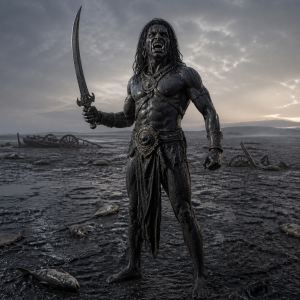
Monsters are former victims, and gods were once monsters. Because every being cycles through every realm, Buddhist mythology has no permanent villains. A hungry ghost tormented by craving may have been a miser; a fearsome guardian may be an enlightened being wearing a wrathful mask to frighten away evil. Identity is karmic and temporary, not essential.
The cosmos is unimaginably big and old. Buddhist texts describe billions of world-systems and time spans called kalpas so long that emptying a mountain by brushing it with silk once a century would be quicker. This deep-time, deep-space vision predates modern cosmology by two thousand years and gives the mythology a strange, vertiginous scale.
The Major Enlightened Beings and Gods
Buddhas and the Founder
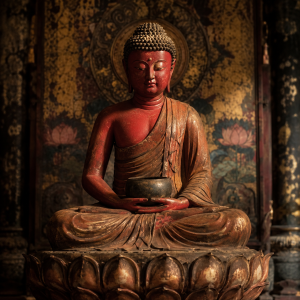
The Buddha — the awakened one, Siddhartha Gautama, the prince who became a teacher. He is not a god and never claimed to be; he is a human being who saw reality clearly and showed others the path. In myth, his birth, enlightenment, and death are ringed with cosmic portents, and he is only the latest in a long line of buddhas stretching back through previous ages.
Amitabha — the Buddha of Infinite Light, ruler of Sukhavati, the Western Pure Land. He vowed that anyone who sincerely calls his name will be reborn in his paradise, where enlightenment is easy. From this single vow grew Pure Land Buddhism, today the most widely practiced form in East Asia.
Maitreya — the Buddha yet to come, waiting in the Tushita heaven until the present teaching is forgotten, at which point he will descend to renew it. A devotional cult around Maitreya spread across Asia before the Common Era, and messianic movements have repeatedly claimed his imminent arrival.
The Great Bodhisattvas
Bodhisattvas — beings who have vowed to delay their own nirvana to liberate all others. They are the active saviors of Mahayana Buddhism, each embodying a perfected quality, and they are far more present in daily devotion than the remote buddhas.
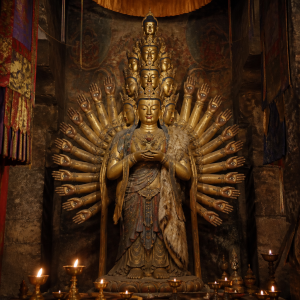
Avalokiteśvara — the bodhisattva of infinite compassion, who hears the cries of the world. In some images he has a thousand arms and eleven heads, grown so he can reach every sufferer at once. He is the earthly regent of Amitabha during the long interval before Maitreya comes.
Guan Yin — the Chinese, female evolution of Avalokiteśvara, the Goddess of Mercy and the most popular deity in Chinese folk religion. Sailors, mothers, and the desperate pray to her; her transformation from a male Indian bodhisattva into an East Asian goddess is one of the great case studies in how myth travels.
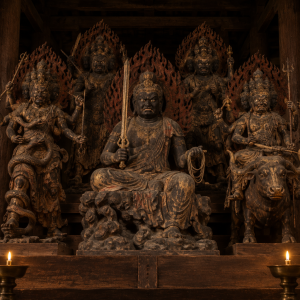
Manjushri — the bodhisattva of wisdom, who wields a flaming sword to cut through ignorance and rides a lion. He represents the sharp, liberating insight that severs delusion at the root.
Kṣitigarbha — the bodhisattva who vowed not to become a buddha until all the hells are empty. He descends into the realms of torment to comfort the damned, and in Japan, as Jizo, he became the gentle protector of dead children and travelers.
Tara — the swift female bodhisattva of the Himalayas, born from Avalokiteśvara’s tears of compassion. She rescues those in immediate danger; her green and white forms calm storms, cure illness, and guide souls toward liberation.
Guardians and Fierce Protectors
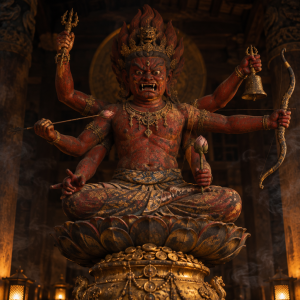
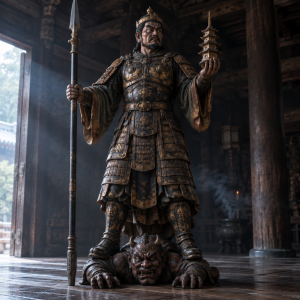
Vajrapani — one of the earliest bodhisattvas, wielder of the thunderbolt-scepter (vajra) and embodiment of the Buddha’s power. He is depicted as a muscular, wrathful guardian, the cosmic bodyguard who protects the teaching by force when persuasion fails.
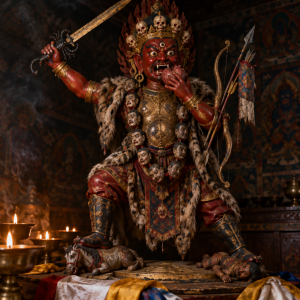
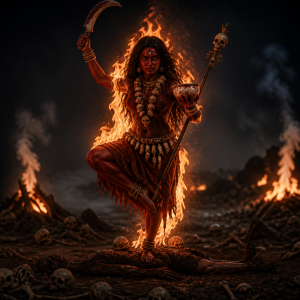
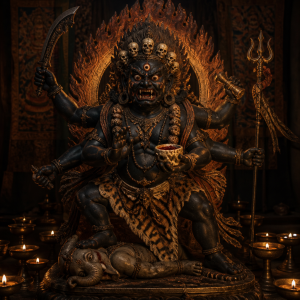
Mahakala — a wrathful protector adopted from Shiva, commanding time and cosmic order, his fearsome form a mask over deep compassion. In Tibetan and Mongolian Buddhism he is the great defender of monasteries and the Dharma.
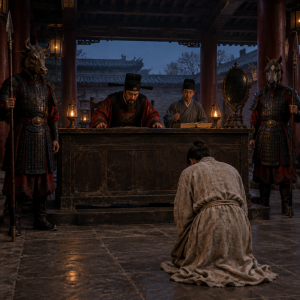
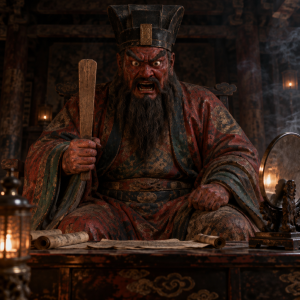
Yama — the lord of death, the first being to die who became the impartial judge of the dead. In Buddhist cosmology he rules over the hell realms and weighs the karma of every soul that arrives, mirror in hand, reflecting back each life’s deeds.
Creatures, Monsters, and Supernatural Beings
Serpents, Birds, and Celestial Beasts
Naga — the great serpent-beings who guard treasures and waters, half snake and half divine. In the Buddha’s life the naga king Mucalinda spread his hood over the meditating Buddha to shield him from a storm — making the naga one of Buddhism’s oldest protectors. Nagas are said to guard sutras too profound for their original age.
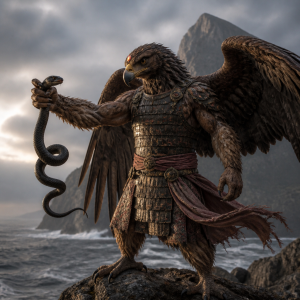
Garuda — the colossal golden eagle-being, eternal enemy of the nagas, who appears in Buddhist cosmology as one of the classes of supernatural creatures attending the Buddha. Its rivalry with the serpents structures whole layers of the cosmic ecology.
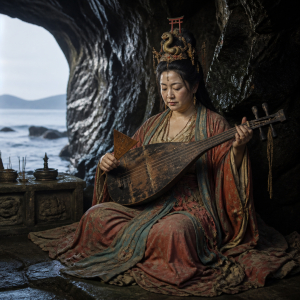
Kinnara — celestial musicians, half human and half bird, who embody ideal love and devotion. They appear in temple carvings across Thailand and Burma, eternally paired with their mates, the kinnari.
Mayura — the divine peacock, associated with protection and the transmutation of poison into beauty. The Mayura Sutra invokes a peacock-king whose chant wards off venom and danger.
Chinthe — the leonine guardian that stands in stone pairs at the entrances of pagodas across Burma and Southeast Asia, protecting sacred ground. The two lions flanking a temple stair are Chinthe, watching for anything that would defile the shrine.
Druk — the thunder dragon of the Himalayas, whose roar is the thunder itself. It became the national emblem of Bhutan, the “Land of the Thunder Dragon,” fusing Buddhist cosmology with cultural identity.
Spirits, Demons, and the Restless Dead
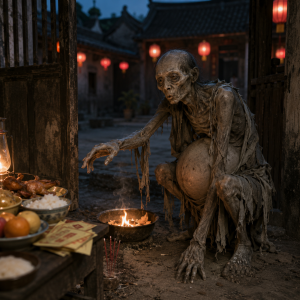
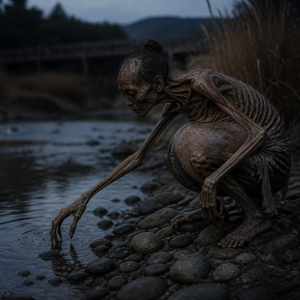
Preta — the hungry ghosts, beings reborn with mountainous bellies and needle-thin throats, doomed to crave endlessly and never be filled. They embody the karmic fruit of greed, and the entire East Asian Ghost Festival exists to feed them. They are among the most vivid moral images in any mythology.
Er Gui — the Chinese “hungry ghost” proper, a specific form of preta haunting the living during the seventh lunar month, when the gates of the underworld open and the dead wander free.
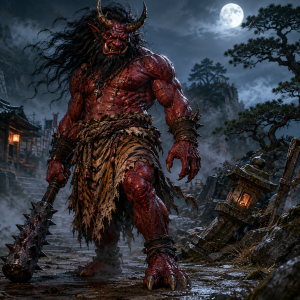
Akki — Japanese demons absorbed into Buddhist cosmology, fierce shapeshifting spirits that prey on the unwary; their iconography draws on Buddhist images of wrathful, horned beings.
Akuma — a malevolent Japanese spirit whose very name derives from the Buddhist concept of the demon-tempter, a being that obstructs spiritual progress and sows delusion.
Nariphon — one of the strangest beings in any tradition: a tree in the Himavanta forest that bears fruit shaped like beautiful young women, created (in Thai myth) to protect a goddess’s daughters from wandering ascetics. The fruit-maidens wilt after a few days like cut flowers.
The Central Myths
The Four Sights and the Great Renunciation
Prince Siddhartha was raised in deliberate luxury, his father determined to keep him from any knowledge of suffering so he would become a king rather than a monk, as a sage had prophesied. But on rides beyond the palace he saw four sights the gods placed in his path: an old man, a sick man, a corpse, and finally a serene wandering ascetic. Confronted for the first time with aging, illness, and death — and with one human response to them — he slipped away from the palace, his sleeping wife, and his newborn son in the night, cut off his hair, and became a seeker.
Why it matters: the Four Sights are the mythic statement of Buddhism’s founding problem. The luxury that was meant to imprison Siddhartha in contentment instead made the discovery of suffering unbearable, and the whole tradition flows from that recognition.
The Temptation by Mara and the Enlightenment
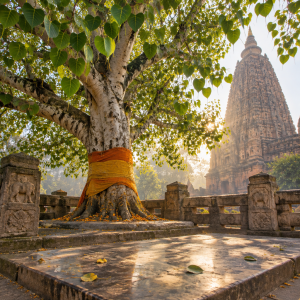
After six years of wandering and extreme asceticism that nearly killed him, Siddhartha sat beneath a fig tree — the Bodhi tree — and vowed not to rise until he understood. There the demon Mara, lord of desire and death, attacked: first with armies and storms, then by sending his three daughters, Desire, Discontent, and Delight, to seduce him. When Mara challenged Siddhartha’s very right to the seat of enlightenment, the meditator simply reached down and touched the earth, calling the ground itself as witness to his countless lifetimes of merit. The earth roared its testimony; Mara fled. By dawn Siddhartha had become the Buddha, the awakened one.
Why it matters: the earth-touching gesture, the bhumisparsha mudra, is the single most reproduced pose in Buddhist art worldwide. The myth dramatizes the core claim that liberation comes not from defeating an external evil but from unshakable insight that no temptation can move.
The Jataka Tales
On the night of his enlightenment the Buddha is said to have remembered all his previous lives — and these became the Jataka tales, hundreds of stories of the bodhisattva-to-be reborn as kings, merchants, monkeys, deer, and elephants, each life perfecting a virtue. In the most famous, he is a hare who throws himself into a fire to feed a starving traveler, and is honored by having his image set in the moon.
Why it matters: the Jatakas carried Buddhist ethics to the illiterate and the young across all of Asia, and they fold the animal realm into the moral universe — the hero was once a rabbit, so a rabbit’s life has dignity and consequence.
Cosmology: The Six Realms and the Wheel of Rebirth
Buddhist cosmology is best read as a map of where karma sends you. Every unliberated being cycles endlessly through six realms, all of them temporary, all of them suffering in their own way. The whole system is depicted as the Wheel of Life, clutched in the jaws of impermanence.
At the top are the deva realms — the heavens of the gods, perched on and above the cosmic mountain Meru, where beings enjoy lifetimes of bliss so absorbing they forget to seek liberation, until their merit is exhausted and they fall. Below them are the asuras, the jealous demigods who wage perpetual war on the devas over a wish-fulfilling tree whose roots are in their realm but whose fruit ripens in heaven. Then come humans — uniquely positioned, because human life mixes enough pleasure and enough pain to motivate the search for awakening; it is considered the most fortunate rebirth precisely because it is the one from which escape is easiest.
The three lower realms are states of increasing misery: the animals, driven by instinct and predation; the hungry ghosts, consumed by cravings they can never satisfy; and the hells (naraka), domains of hot and cold torment ruled by Yama, where the most negative karma is burned off over almost unimaginable spans before the being is reborn yet again. Crucially, even hell is not eternal. No realm is. The entire structure exists to make one point: nowhere in the cosmos, not even heaven, is a refuge — the only exit is off the wheel entirely, into nirvana.
How Buddhist Mythology Connects to Other Traditions
Buddhism’s deepest roots are in Hindu mythology, from which it inherited and reinterpreted a whole pantheon. Indra, Brahma, Yama, the nagas, Garuda, the yakshas, rakshasas, apsaras, and gandharvas all migrated into Buddhist texts — but stripped of supremacy, recast as residents of the wheel rather than its masters. The wrathful protector Mahakala is a direct adaptation of the Hindu Shiva.
As the teaching moved east, it fused with local traditions. In Chinese mythology Avalokiteśvara became Guan Yin and Buddhist hells merged with the Daoist underworld bureaucracy. In Japanese mythology Kṣitigarbha became the roadside-guardian Jizo, and buddhas were identified with native kami. In Tibetan mythology Buddhism absorbed the indigenous Bon spirits into a vast tantric pantheon, while across Thai and broader Southeast Asian mythology figures like Phra Phrom (a four-faced Brahma) and the earth-goddess Mae Thorani became objects of intense local devotion. Few mythologies have proven so willing to adopt a foreign god and give it a new home.
Where to Start Reading
For the words attributed to the Buddha himself, the Dhammapada is the short, aphoristic classic, and the Jataka tales are the most accessible entry into the mythology proper. The Mahayana imagination lives in the Lotus Sutra (for Avalokiteśvara and the bodhisattva ideal) and the three Pure Land sutras (for Amitabha’s paradise). The traditional life of the founder is told most beautifully in Ashvaghosha’s epic poem the Buddhacarita.
For modern introductions, Karen Armstrong’s Buddha is a clear narrative life; Donald Lopez’s The Story of Buddhism surveys the tradition’s spread and transformation; and Rupert Gethin’s The Foundations of Buddhism remains the standard scholarly overview of doctrine and cosmology together.
Explore Buddhist Mythology on Gods and Monsters
Gods and Monsters has 24 Buddhist mythology entries, from celestial buddhas to fruit-bearing trees that grow maidens. Browse all Buddhist mythology entries →
Buddha · Bodhisattvas · Amitabha · Avalokiteśvara · Guan Yin · Manjushri · Maitreya · Kṣitigarbha · Tara · Vajrapani · Mahakala · Yama · Naga · Preta · Er Gui · Kinnara · Mayura · Chinthe · Druk · Nariphon · Phra Phrom · Mae Thorani · Akki · Akuma
Frequently Asked Questions
Is there a creator god in Buddhism?
No. Buddhism has no creator god and no first cause. The cosmos is held to be beginningless, cycling through endless eras of formation and destruction. Gods like Brahma exist, but they are powerful, long-lived beings still trapped in the cycle of rebirth — and one Buddhist text gently mocks Brahma for mistakenly believing he created the world simply because he happened to appear first. Liberation comes from insight, not from a divine creator’s grace.
What are the six realms of rebirth?
They are the six states into which karma can send a being: the heavens of the gods, the realm of jealous demigod asuras, the human world, the animal world, the realm of hungry ghosts, and the hells ruled by Yama. All six are temporary and all involve suffering. The human realm is considered the luckiest, not because it is the most pleasant but because it offers the best chance to seek awakening and step off the wheel altogether.
What is a bodhisattva?
A bodhisattva is a being who has earned the right to enter nirvana but vows instead to remain in the cycle of suffering until every sentient being is liberated. The ideal defines Mahayana Buddhism. Great bodhisattvas like Avalokiteśvara (compassion), Manjushri (wisdom), and Kṣitigarbha (who works to empty the hells) function as active saviors and are far more present in daily devotion than the remote buddhas.
How did Avalokiteśvara become the goddess Guan Yin?
Over roughly a thousand years, from the Tang dynasty onward, the Indian male bodhisattva Avalokiteśvara was gradually depicted in China as female, emerging as Guan Yin, the white-robed Goddess of Mercy. The doctrinal basis is the Lotus Sutra, which says the bodhisattva of compassion manifests in whatever form — including female — will best reach those in need. Today Guan Yin is the most popular deity in Chinese folk religion.
Who tempted the Buddha, and what happened?
The demon Mara, lord of desire and death, tried to stop Siddhartha from reaching enlightenment beneath the Bodhi tree, attacking him with armies, storms, and finally his three seductive daughters. Siddhartha defeated him not by fighting but by touching the earth and calling it to witness his worthiness; Mara fled, and Siddhartha became the Buddha. The earth-touching gesture is the most common pose in Buddhist statuary worldwide.
Are Buddhist demons and gods the same as Hindu ones?
Many share names and origins but were reinterpreted. Buddhism inherited Indra, Brahma, Yama, the nagas, Garuda, the yakshas and rakshasas from Hindu mythology, but demoted them from cosmic rulers to beings still caught in rebirth. The wrathful protector Mahakala, for instance, is a Buddhist adaptation of the Hindu Shiva. The figures are recognizable; their status and meaning are transformed.