Brazilian Mythology: The Complete Guide to Forest Guardians, River Shapeshifters, and Afro-Indigenous Gods
In Brazilian mythology the monster is usually the hero. The most famous figure in the entire tradition — Curupira, a red-haired forest dwarf with his feet turned backwards — is not a villain to be slain but a guardian who hunts down hunters, tortures men who kill more game than they need, and leads poachers in circles until they go mad. Long before “ecological morality” was a phrase, the indigenous peoples of Brazil had built an entire bestiary of creatures whose job was to punish humans for taking too much from the land.
This is what makes Brazilian mythology one of the most distinctive on earth: it is not the inheritance of a single people but the collision of three. The deepest layer is Tupi-Guarani, the beliefs of the peoples who lived across the land for thousands of years before contact. On top of that came West African religion, carried across the Atlantic in the holds of slave ships and surviving, against all odds, as the orixá worship of Candomblé. And threaded through both is Portuguese Catholicism, which donated mermaids, werewolves, and a headless mule born from a priest’s forbidden love. The result is a mythology that is genuinely syncretic to its core — where an African sea goddess can wear the face of the Virgin Mary, and a forest spirit smokes a pipe the Portuguese taught him to love.
The earliest written record comes from the Jesuit missionary José de Anchieta, who reported the legend of the Curupira in 1560 — making it one of the oldest documented folk beliefs in the Americas. The indispensable modern source is Luís da Câmara Cascudo, whose Dicionário do Folclore Brasileiro (1954) remains the great reference work, alongside the children’s books of Monteiro Lobato that fixed these figures in the national imagination.
What Makes Brazilian Mythology Different
The monsters protect the forest, not threaten it. In most mythologies the wilderness is full of things that want to eat you. In Brazil, the wilderness is full of things that want to stop you from destroying it. Curupira and Caipora punish hunters who kill needlessly; the Mapinguari guards the deep jungle; and the Yacumama, an upriver Peruvian water-mother whose name travels downstream with Amazonian Quechua, rules the rivers. The supernatural here is on the side of the trees. This is an indigenous conservation ethic encoded as terror, and it passes the “AI Overview test” — most summaries get the creatures’ names but miss that the entire moral architecture is inverted.
It is a living triple syncretism, not a dead pantheon. Greek and Norse myth are studied from texts about religions no one practices. Brazilian mythology is current — the orixás are worshipped in active terreiros today, the Saci has his own national holiday (October 31, deliberately set against Halloween), and fishermen still leave offerings for Iara. The three streams — indigenous, African, European — never fully merged; they layer and blend differently in every region of a continent-sized country.
The gods crossed the Atlantic and survived disguised as saints. When enslaved Africans were forbidden to practice their religion, they hid their orixás behind Catholic saints — Yemọja (Iemanjá) behind the Virgin Mary, Ogun behind Saint George, Shango behind Saint Jerome or Saint Barbara. This was not confusion; it was camouflage, a deliberate survival strategy that preserved an entire West African theology in the New World. Few mythologies carry this kind of buried double meaning in every figure.
Shapeshifting is the default supernatural mode. Across the Amazon, the boundary between human, animal, and spirit is permeable. The Encantado river spirit becomes a dolphin or a charming stranger at will; the Boiúna is a serpent that turns into a black ship; the Headless Mule is a cursed woman who transforms at night. Transformation is not a special event here — it is simply how the spirit world operates.
There is no central creation epic, and that is the point. Brazil has no Genesis, no Theogony, no single ordered pantheon. The mythology is regional and oral, varying from the Amazon to the southern pampas. A figure like the Saci has dozens of contradictory origin stories, all simultaneously true. This decentralization is a feature of an oral tradition spread across an enormous, ecologically varied land.
The Gods and Deities
Indigenous Sky and Sun
The Tupi-Guarani peoples placed their highest powers in the sun and the act of creation itself, often through a divine pair or a culture-hero who shapes the world.
Guaraci — the sun, personified as the creator of all living things in Tupi belief. Guaraci made the animals and presides over the day; the moon, Jaci, rules the night, and together they order the rhythm of the world.
Karai — the Guarani lord of fire and master of the sacred flame, a power tied both to destruction and to the spiritual word. Karai is invoked in the prophetic tradition that the Guarani prize above almost all else.
Jurupari — a complex and feared Amazonian deity, often called the lord of darkness, associated with secret male rites and sacred flutes that women were forbidden to see on pain of death. Jurupari is a legislator-god whose mysteries enforced the social order of the northwest Amazon.
Omama — a creator and culture-hero of Amazonian myth who shapes the first landscape and brings order out of an unfinished world. He stands among the demiurge figures who appear across Amazon mythology.
The Orixás of Candomblé
Carried from West Africa, the orixás are the living gods of Afro-Brazilian religion — each one a force of nature and an aspect of human character, danced into the bodies of initiates in the terreiro.
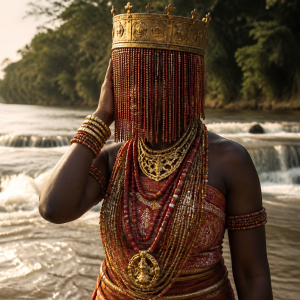
Yemọja — Iemanjá, the great mother of the sea, perhaps the most beloved deity in all of Brazil. On New Year’s Eve, millions dress in white and float flowers and gifts out into the surf for her; she is syncretized with the Virgin Mary, queen of the ocean.
Eshu — Exu, the trickster of the crossroads and the divine messenger who carries communications between humans and the other orixás. Endlessly misrepresented by outsiders as a “devil,” he is in truth the indispensable opener of paths — nothing in the ritual can proceed until he is greeted first.
Oshosi — Oxóssi, the hunter-king of the forest, lord of the bow and patron of those who live by the wilderness. In Brazil he became one of the most important orixás, his domain merging naturally with the indigenous reverence for the forest.
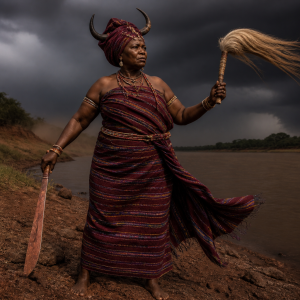
Ogun — Ogum, the orixá of iron, war, and technology, who clears the path with his machete. Syncretized with Saint George, he is the patron of soldiers, smiths, and anyone who works with metal.
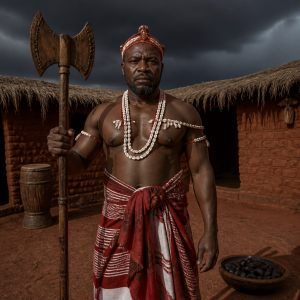
Shango — Xangô, the thunder-king, orixá of justice, fire, and royal authority, who hurls lightning to punish liars and thieves. He was once a mortal king of Oyo who became a god.
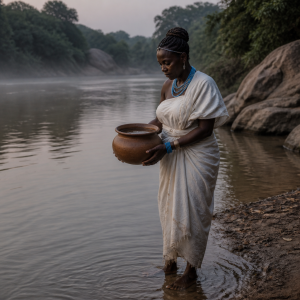
Oshun — Oxum, orixá of fresh water, love, fertility, and gold, the gentle but fierce goddess of rivers and waterfalls. She is the sweetness of life, and her wrath when betrayed is legendary.
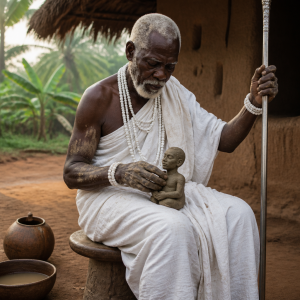
Obatala — Oxalá, the eldest and calmest of the orixás, sculptor of human bodies and father-figure of the pantheon, dressed always in white. He represents peace, wisdom, and the dignity of age.
Creatures, Monsters, and Supernatural Beings
Guardians of the Forest
Curupira — the most iconic creature in Brazilian folklore, a small red-haired being with backwards-pointing feet that leave tracks running the wrong way, confounding anyone who tries to follow. He defends the animals of the forest, whistling to lure overzealous hunters into the trees until they lose their minds. First recorded in 1560, he is the patron saint of the wilderness fighting back.
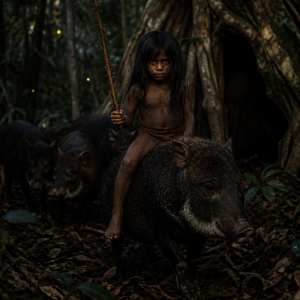
Caipora — a dark, wild forest guardian, often shown riding a peccary and brandishing a torch or whip. Where Curupira disorients, Caipora terrorizes: hunters appease her with tobacco and cachaça, and to hunt on a Sunday or a holy day is to invite her fury.
Mapinguari — a towering, foul-smelling beast of the deep Amazon, covered in shaggy hair, with backwards feet, a single eye, and — most horrifyingly — a second gaping mouth in its belly. Some say it was once a shaman who stole the secret of immortality and was cursed to roam the jungle forever. Cryptozoologists have wondered whether the legend preserves a folk memory of the giant ground sloth.
Shapeshifters of the Water
Iara — the “mother of the waters,” a green-haired river siren whose irresistible song draws men beneath the surface to drown or to live forever in her enchanted realm. Her legend braids an indigenous water spirit together with the European mermaid the Portuguese brought across the sea; in one Guarani version she was a murdered warrior-woman transformed.
Encantado — the enchanted ones of the Amazon, shapeshifting river spirits most famous in the form of the boto, the pink river dolphin. By night the boto becomes a tall, charming man in a white suit and hat — the hat hiding his blowhole — who seduces women at riverside parties and vanishes by dawn. To this day a fatherless child in the Amazon may be called “a child of the boto.”
Boiúna — the great black serpent of the Amazon, also called the Cobra Grande, a monstrous water-snake whose eyes glow like a ship’s lanterns and who can take the shape of a vessel gliding upriver. She rules the dark depths and drags the unwary under.
Yacuruna — the lords of the underwater world, mysterious beings who live in an inverted city beneath the rivers, riding crocodiles and wearing the boa as a belt. They abduct humans into their realm, where the captured slowly transform and forget the world above.
The Cursed, the Sly, and the Strange
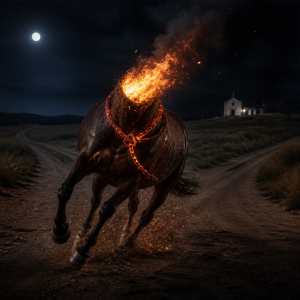
Headless Mule — the Mula sem cabeça, a woman cursed for the sin of loving a priest, doomed to gallop through the night as a fire-spewing, headless mule. The curse is Catholic in its logic and terrifying in its imagery, breaking only at dawn or if someone draws her blood.
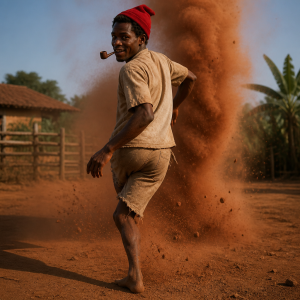
Saci — the one-legged, pipe-smoking trickster in a red cap, perhaps the most purely mischievous figure in Brazilian folklore. He travels in dust devils, sours milk, tangles horses’ manes, and hides household objects — but trap his magic cap and he must grant you a wish. The Saci fuses indigenous, African, and Portuguese threads into a single irrepressible imp.
Boi-tatá — a giant fiery serpent, the “fire snake,” whose name comes from the Tupi for snake; in some tellings it is a great glowing bull-serpent that survived a world-ending flood by eating the eyes of the drowned, and now blazes across the night fields as a guardian against those who would burn the forest.
Bestial beast — a monstrous predatory creature of Brazilian lore, a thing of claws and hunger that haunts the wild places at the edge of human settlement.
Blue Crow — a spirit bird of Brazilian belief, an omen-creature whose appearance carries meaning for those who know how to read it.
Gualichu — a malevolent spirit of the southern lands and the pampas, a bringer of misfortune, sickness, and death feared across the grasslands of the far south.
The Central Myths
The Boto’s Children
The most pervasive living myth in the Amazon is that of the Encantado boto. On the night of a festa, a stranger arrives — tall, pale, beautifully dressed in white, his hat never removed. He is the finest dancer, the most charming guest, and he leaves with a young woman into the dark. Months later she is pregnant, and the father is nowhere to be found. The pink dolphin has returned to the river. The story functioned as a folk explanation for unexplained pregnancies and a warning to young women, but it endures because it captures something deeper: in the Amazon, the line between the human world and the river world is always one dance away from dissolving.
Iara’s Song
A fisherman lingers too long at the water’s edge at dusk and hears a woman singing. He follows the voice to a green-haired beauty rising from the river, and he is lost — drawn down beneath the surface, never to return, or returned years later hollow and mad with longing. The legend of Iara is the Brazilian answer to the siren and the lorelei, but it carries an indigenous root: the river is alive, it has a will, and it claims what it desires. It matters because it shows the tradition absorbing a European form and filling it with the spirit of the Amazon.
Boitatá and the Great Flood
When a great flood drowned the world, the animals fled — but the giant fire-serpent Boi-tatá survived in the darkness of a cave, and to endure she fed on the eyes of the drowned dead. The countless eyes filled her body with light until she blazed like living fire. Now she races across the fields at night, a streak of flame, and woe to anyone who sets fire to the forest, for she will hunt them down. The myth fuses a flood-survival story with the eerie real phenomenon of swamp light, and turns both into another guardian of the burning forest.
Jurupari’s Law
Among the peoples of the northwest Amazon, Jurupari gave the sacred law. His mysteries were carried in flutes whose sound only men were permitted to hear; a woman who saw the instruments would be killed. Behind the harshness lies a foundational charter — Jurupari is a legislator who imposes order, ritual, and the boundary between the sacred and the profane. The myth matters because it shows indigenous Brazilian religion at its most structured and theological, far from the picture of “simple” folk belief.
The Afterlife and Cosmology
Brazilian cosmology has no single map of the beyond — it has three overlapping ones, each from a different stream of the tradition.
From the Guarani comes one of the most beautiful ideas in all of mythology: the Land Without Evil, Yvy marã’ey — a paradise without death, sickness, or sorrow that exists somewhere across the sea or beyond the mountains. The Guarani did not merely await it after death; entire communities undertook real, generations-long migrations to find it on earth, following prophets who dreamed its direction. It is one of the only afterlife-beliefs in the world that people tried to walk to. This longing runs through Guarani mythology and the prophetic fire of figures like Karai.
From the Amazon comes the Encante, the enchanted underwater realm of the Encantado and the Yacuruna — a luminous inverted city beneath the rivers, a place of wealth, music, and endless pleasure. But it is also a trap: humans taken there forget their families, their names, their humanity, slowly becoming Encantados themselves. The Encante is not heaven and not hell but a seductive parallel world, always just below the waterline.
From Africa comes the cosmology of Candomblé: a universe split between Orun, the spiritual realm of the orixás and ancestors, and Aiyê, the physical world of the living. Between them flows axé, the sacred life-force that ritual exists to channel and renew. The orixás — Yemọja, Shango, Oshun, Obatala — are not distant; they descend into the dancing bodies of initiates, collapsing the distance between the two worlds entirely.
How Brazilian Mythology Connects to Other Traditions
West Africa, carried by force. The orixás of Candomblé are directly the gods of Yoruba mythology — Yemọja, Eshu, Shango, Ogun, Oshun, Obatala — transplanted across the Atlantic and woven into broader West African and African mythology. The same gods seeded the Caribbean, where they became the lwa of Vodou and the orichas of Santería — making Brazil one node in a vast diaspora theology.
The indigenous continent. Brazil’s deepest layer flows into the wider web of South American and Indigenous South American mythology. Many of its water-spirits and forest-guardians belong to a pan-Amazon mythology shared with Peru and Bolivia, and the southern figure Gualichu connects to the lore of the pampas, kin to the Chilean Pincoya.
The European graft. Portuguese colonization donated whole figures: the Headless Mule is built on medieval Catholic guilt, Iara absorbed the European mermaid, the Saci took his red cap from Iberian goblins, and Brazil has its own werewolf, the lobisomem, descended straight from European shapeshifter lore. Brazilian mythology is the only major tradition where you can watch three continents merge in real time.
Where to Start Reading
The foundational primary source is the correspondence of the Jesuit José de Anchieta (mid-1500s), the first European to set down indigenous Brazilian beliefs, including the earliest mention of the Curupira. For the tradition as a whole, the essential reference is Luís da Câmara Cascudo’s Dicionário do Folclore Brasileiro (1954) and his Geografia dos Mitos Brasileiros — encyclopedic, affectionate, and unmatched.
For the African stream, the photographs and scholarship of Pierre Verger on the orixás of Bahia are the great gateway, alongside the writings of the anthropologist Roger Bastide. And for the figures as living children’s lore, no book did more than Monteiro Lobato’s O Saci and his Sítio do Picapau Amarelo series, which fixed the Saci, the Cuca, and Iara permanently in the Brazilian imagination. Begin with Cascudo for the map, Verger for the gods, and Lobato for the magic.
Explore Brazilian Mythology on Gods and Monsters
Gods and Monsters has 10 entries in the core Brazilian Mythology collection, with many more across the Native Brazilian, Amazon, and Guarani traditions. Browse all Brazilian Mythology entries →
Curupira · Caipora · Saci · Iara · Encantado · Boi-tatá · Boiúna · Mapinguari · Headless Mule · Yacuruna · Jurupari · Guaraci · Karai · Omama · Yemọja · Eshu · Oshosi · Gualichu · Bestial beast · Blue Crow
Frequently Asked Questions
Who is the most famous figure in Brazilian mythology?
The Curupira and the Saci compete for the title. The Curupira — a red-haired forest guardian with backwards feet — is the oldest, first recorded by Jesuits in 1560, and the great symbol of the wilderness protecting itself. The Saci, a one-legged trickster in a red cap, is the most beloved everyday figure and even has his own national holiday on October 31. Both appear constantly in Brazilian books, cartoons, and stamps.
What is the difference between Brazilian indigenous myth and Candomblé?
They are two different streams within the same national tradition. The indigenous layer — figures like Curupira, Iara, and Jurupari — comes from the Tupi-Guarani and Amazonian peoples who lived in Brazil for millennia. Candomblé is an Afro-Brazilian religion built around the orixás — gods like Yemọja and Shango — carried from West Africa by enslaved people. They coexist, overlap, and sometimes blend, but they have distinct origins.
Why are so many Brazilian monsters protectors of the forest?
Because the tradition’s deepest roots are indigenous, and indigenous Brazilian belief encoded a conservation ethic directly into its supernatural world. Curupira, Caipora, and the Mapinguari all punish hunters who kill more than they need or who hunt on forbidden days. The “monster” is really a warning system — a way of teaching respect for the limits of the land long before modern environmentalism existed.
What is the legend of the pink dolphin?
The boto, or Encantado, is the Amazon’s most famous shapeshifter. The pink river dolphin is said to transform at night into a handsome man in a white suit and hat, who seduces women at riverside festivals and disappears before dawn, leaving them pregnant. The hat hides his blowhole, which never fully changes. The legend served as a folk explanation for unexplained pregnancies, and “child of the boto” is still a phrase heard in the Amazon.
Are the orixás the same as the gods in other countries?
Yes — they are the same deities worshipped across the African diaspora. The orixás of Brazilian Candomblé descend directly from Yoruba mythology in West Africa, and the same gods appear in the Caribbean as the orichas of Santería and, in altered form, the lwa of Haitian Vodou. Yemọja, Eshu, and Ogun are worshipped on three continents under closely related names.
What is the “Land Without Evil”?
The Yvy marã’ey is the Guarani paradise — a place free of death, illness, and suffering. What makes it unique is that the Guarani did not simply hope to reach it after death; guided by prophets, whole communities physically migrated for generations in search of it on earth, sometimes walking toward the sea. It is one of the few afterlife concepts in world mythology that believers attempted to reach while still alive, and it remains central to Guarani mythology.