Arabic Mythology: The Complete Guide to the Jinn, the Lost Goddesses of Mecca, and the World on the Back of a Fish
Arabic mythology is the only major mythology whose supernatural population survived the arrival of a monotheistic religion intact. When Islam swept across Arabia in the seventh century, it shattered the idols and silenced the old gods — but it kept the jinn. Beings of smokeless fire that the desert tribes had feared for centuries did not vanish into “superstition”; they were written into the Qur’an itself, given their own chapter, declared a parallel creation with free will, religion, and the capacity for salvation or damnation. Almost nowhere else does a pagan spirit-world get canonized by the faith that replaced its gods.
That continuity is the key to the whole tradition. Arabic mythology has two layers fused into one. Beneath sits the pre-Islamic world of the jahiliyyah — the “age of ignorance” — with its triple goddesses worshipped as standing stones, its blood-soaked notions of the soul, its high god Allah already presiding over a crowded sky. Above it sits the Islamic and medieval layer: the cosmology of geographers and storytellers, the Roc of Sinbad’s voyages, the world-bearing fish Bahamut, the genie sealed in a brass jar. The two layers never fully separated, and the seams are where the tradition is most fascinating.
The sources are scattered rather than scriptural. There is no Arabian Theogony or Edda. Instead the material survives in Ibn al-Kalbi’s Book of Idols (Kitab al-Asnam, c. 800 CE), which records the old shrines before they were forgotten; in al-Qazwini’s Wonders of Creation (‘Aja’ib al-makhluqat, 13th c.), a medieval encyclopedia of cosmic marvels; in the hadith and the isra’iliyyat (lore borrowed from Jewish and Christian neighbors); and above all in The One Thousand and One Nights, where the folk imagination runs free. To read Arabic mythology is to assemble a picture from desert poetry, Qur’anic commentary, and a sailor’s tall tales told to a king to keep her alive one more night.
What Makes Arabic Mythology Different
The spirits outlived the gods. This is the headline feature and it has no real parallel. Most mythologies are killed wholesale by the religion that supplants them — the Norse gods became folklore, the Egyptian gods became dust. In Arabia, the high god Allah was retained and made absolute, the lesser goddesses were condemned and erased, but the jinn were promoted into doctrine. Surah 72 of the Qur’an is named for them; they are described as a creation older than humanity, made “from the smokeless flame of fire,” bound by the same moral law as people. A pagan bogey became an article of faith.
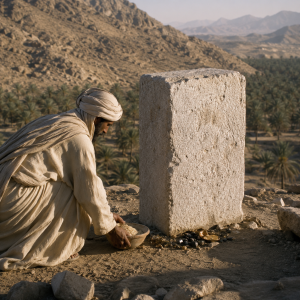
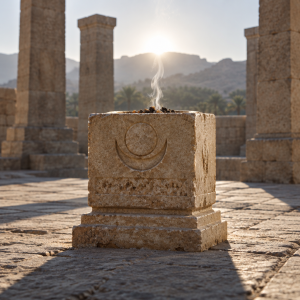
The gods were stones. Pre-Islamic Arabian religion was strikingly aniconic. The great goddesses were not statues of women but betyls — sacred standing stones believed to be inhabited by the divine. Al-Lat was a white cube of granite at Ta’if; Al-Uzza lived in a cluster of acacia trees and a stone in the Nakhlah valley; Manat was a black stone on the coast road to Medina. The Black Stone still set into the corner of the Kaaba is the last surviving member of this family — the one betyl Islam kept.
*There is no fixed pantheon, only a fixed kind.* Where Greek myth gives you twelve Olympians with stable roles, Arabian belief gives you a taxonomy of spirits. The jinn are not a cast of named characters but a whole species, subdivided endlessly: ifrit, marid, ghoul, shaitan, the half-bodied nasnas. The drama is less “what did this god do” than “what kind of unseen thing is out there in the dark, and what are its rules.”
The desert is the theology. This mythology was forged by people who lived at the edge of survival in an environment that could kill in an afternoon. The jinn haunt exactly the places that frighten a desert traveler: ruins, graveyards, lonely wells, the trackless sand of the Empty Quarter. The ghoul is the personified terror of dying alone off the caravan road and being eaten. The landscape did not decorate the myths; it generated them.
The afterlife was, at first, almost nothing. Pre-Islamic Arabs had remarkably little to say about life after death — a contrast that makes Islam’s vivid paradise and hell so revolutionary by comparison. The old belief held that a slain man’s unavenged spirit rose from his skull as a thirsting owl-like bird, the hama, crying isquni — “give me to drink” — until his blood was avenged. Eternity was not reward or punishment. It was the demand for vengeance, given wings.
The Gods and Powers of Pre-Islamic Arabia
Before Islam, the Arabian sky was crowded. A supreme creator presided over a host of lesser deities, tribal idols, and the spirit-world below — and crucially, the old religion held that all of them were connected by a kind of kinship.
The High God and His Daughters
Allah — the supreme creator god, worshipped across Arabia before Islam as the highest of the gods rather than the only one. The pre-Islamic Meccans already regarded Allah as the maker of the world and lord of the Kaaba; Islam’s radical move was not to invent him but to strip away everyone beneath him and declare him alone.
Al-Lat — “the Goddess,” a mother-figure of fertility and the earth, worshipped as a white cubic stone at Ta’if and once among the most powerful deities of the Hijaz. Her name is simply the feminine of Allah, a linguistic fossil of a time when god and goddess stood side by side.
Al-Uzza — “the Mightiest,” goddess of power and protection, identified with the morning star (Venus) and patron of the Quraysh, Muhammad’s own tribe. Her sanctuary in the Nakhlah valley near Mecca received the gravest offerings, and warriors called on her in battle.
Manat — the oldest of the three and the darkest in temperament: goddess of fate, destiny, and death, worshipped as a black stone on the road between Mecca and Medina. Her name shares a root with the Arabic for “time” and “doom”; she was the apportioner who measured out each life’s allotted span, an Arabian sister to the Greek Moirai.
These three — Al-Lat, Al-Uzza, and Manat — were called the “daughters of Allah,” and their worship sat at the very heart of Meccan religion. They are the goddesses named in the most famous theological crisis in early Islam (see The Central Myths below).
The Idol of the Kaaba
The chief idol of pre-Islamic Mecca was Hubal, a figure of red carnelian (agate) with a golden hand, who stood inside the Kaaba surrounded by lesser idols. He was a god of rain and divination: priests cast marked arrows before him to read the future, deciding marriages, journeys, and the legitimacy of newborns by the fall of the shafts. Hubal does not yet have an entry on Gods and Monsters, but he is the missing center of the Meccan story.
Creatures, Monsters, and the Hierarchy of the Jinn
Arabic mythology’s great contribution to the world’s bestiary is the jinn — not a single monster but an entire invisible nation, ranked from the merely mischievous to the world-shakingly powerful. Above and beside them swim the cosmic beasts and fly the great birds of the geographers’ imagination.
The Jinn and Their Kinds
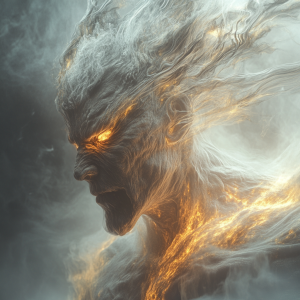
Djinn — the foundational race: beings created from “smokeless fire,” invisible to humans yet sharing the world with them, possessed of free will, gender, society, and faith. Some are Muslim, some are wicked, most are simply other. They can take animal or human shape, inhabit the thresholds of human life — doorways, drains, bathhouses — and were the original “genies” before European translation softened them into wish-granting servants.
Marid — the most powerful class of jinn, proud, immense, and associated with water and the sea. A marid is the spirit that grants wishes in the old tales, but never freely: it must be compelled, bound, or flattered into submission, and it remembers a captor’s insolence. These are the jinn that kings and sorcerers tried to enslave.
Ifrit — a vast, winged, smoke-and-fire jinn of the lower world, cunning and usually malevolent, dwelling in ruins and beneath the earth. In the Qur’an, “an ifrit of the jinn” offers to fetch the throne of the Queen of Sheba for Solomon in the blink of an eye — proof of the sheer power these beings command when bent to a master’s will.
Ghoul — the most feared jinn of the desert: a shapeshifting corpse-eater that haunts graveyards and lonely roads, luring travelers to their death and devouring the dead. Often female (the ghula), she can take the form of a beautiful woman or a desirable animal to draw a victim off the safe path. The English word “ghoul” comes directly from her Arabic name.
Nasnas — one of the strangest beings in any mythology: a creature with literally half a body — one eye, one arm, one leg, half a face — that hops about the wilderness with terrible speed. It is said to be the offspring of a jinn called the Shiqq (itself a half-being) and a human, an embodiment of incompleteness made flesh. An AI summary of “Arabian monsters” will almost never reach the nasnas; it should.
The taxonomy runs deeper still. The qutrub is a werewolf-like jinn that dwells in cemeteries and feeds on the dead — the Arabian cousin of the African werehyena. The si’lat are cunning female jinn skilled in disguise; the jann are the oldest and most neutral, whirlwind-dwellers of the open desert; and the shaitan is the rebellious, tempting jinn — the type to which Iblis, Islam’s Satan, belongs.
The Cosmic Beasts and Great Birds
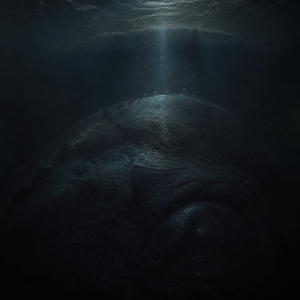
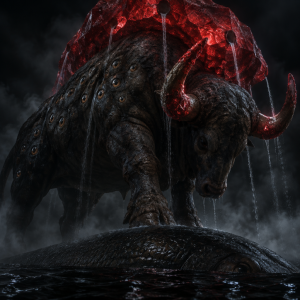
Bahamut — the colossal fish at the foundation of the world, so vast that all the seas placed in one of its nostrils would be like a mustard seed in the desert. In the medieval cosmology Bahamut bears a bull on its back, which bears the rock on which an angel stands holding the seven earths. (Western fantasy later turned this serene cosmic fish into a dragon — a mistranslation worth correcting.)
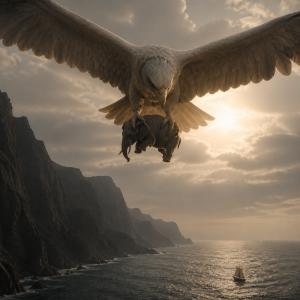
Roc — the titanic bird of The Thousand and One Nights, large enough to blot out the sun and carry off elephants to feed its young. Sinbad, marooned, once mistook its egg for a vast white dome and lashed himself to the bird’s leg to escape the island. The Roc is the giant-bird archetype that haunts every later sailor’s legend.
Anqa — a mysterious, immense bird of Arabian lore, said to live for ages and embody wisdom and the unattainable; so rare it became a proverb for something that exists in name but never in the hand. The Anqa is the Arabic kin of the Persian Simurgh and the Greek Phoenix.
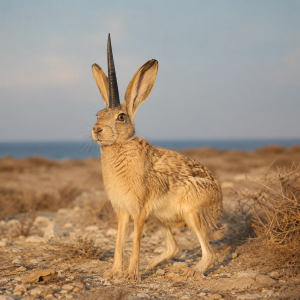
Al-mi’raj — a deceptively adorable horror: a yellow hare with a single black horn, living on a mysterious island, that devours animals many times its size and will charge a human on sight. Medieval bestiaries claimed all other creatures fled before it. It is the kind of small, strange entry that makes the tradition delightful.
Cinnamon bird — a bird of Arabian commercial legend that built its nest from cinnamon sticks high on unreachable cliffs, the source (so traders told gullible foreigners) of the precious spice. The story was almost certainly a clever cover invented by Arabian merchants to protect their trade routes and inflate the price — myth deployed as marketing.
Unicorn — the single-horned beast known across Arabian lore as the karkadann, a fierce desert creature later blended into the global unicorn myth; it appears in the Nights and in Arabic natural histories as a horned terror of the wastes rather than the gentle European maiden’s companion.
The Central Myths
The Three Goddesses and the “Satanic Verses”
The most consequential story in early Arabic religious history concerns the three “daughters of Allah.” According to Ibn Ishaq’s early biography of Muhammad, there came a moment when verses appeared to acknowledge Al-Lat, Al-Uzza, and Manat as exalted intercessors whose intercession was to be hoped for — a concession that would have folded the old goddesses into the new faith. The verses were swiftly repudiated as a satanic interpolation and replaced; Surah An-Najm (53) now dismisses the three as “nothing but names” the Arabs invented. Why it matters: this episode is the precise hinge on which Arabian polytheism died. It records, in the tradition’s own sources, the moment the goddesses were offered a place in Islam and then cast out — and it gave Salman Rushdie the title of the twentieth century’s most controversial novel.
Solomon and the Sealing of the Jinn
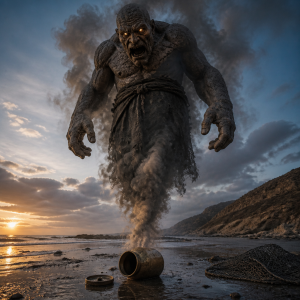
In Islamic legend, King Sulayman (Solomon) was granted dominion over the jinn, commanding them to build temples, dive for pearls, and labor at his will, all by the power of a signet ring engraved with the Greatest Name of God. The disobedient and the wicked among them he bound inside sealed brass vessels and cast into the sea. Why it matters: every “genie in a lamp” and every fisherman who unstoppers a jar to release a furious spirit descends directly from this legend. The familiar wish-granting genie of children’s stories is a domesticated marid or ifrit, still resentful at three thousand years in the bottle.
Sinbad, the Roc, and the Valley of Diamonds
In his second voyage, the merchant Sinbad is abandoned on a deserted island, discovers a gigantic white dome — the egg of the Roc — and ties himself to the returning bird’s leg to be carried over the mountains. He is dropped into a valley carpeted with diamonds and infested with serpents, and escapes by strapping himself to a slab of meat that merchants throw down for the eagles to carry up. Why it matters: the Sinbad cycle is Arabic mythology in its most exuberant mode — a fusion of real Indian Ocean trade geography with pure marvel, and the channel through which the Roc, the genie, and the talking marvels of the East entered the Western imagination.
Cosmology and the Afterlife
The medieval Arabic cosmos was a tower of marvels stacked beneath the throne of God. At the very bottom swam Bahamut, the world-fish, in an unfathomable ocean. On its back stood a vast bull named Kuyutha, with four thousand eyes, ears, and feet; on the bull’s back rested a mountain of ruby; on the mountain stood an angel bearing the seven earths upon its shoulders. The flat disc of the world was ringed at its edge by Mount Qaf, an emerald mountain whose color, the cosmographers said, is why the sky looks green-blue — and beyond Qaf lay the lands of the jinn, unreachable by men.
Scholars rightly note that this picture is not Qur’anic doctrine but folklore, gathered from the isra’iliyyat and the wonder-books; orthodox theologians treated it with caution. But as mythology it is gorgeous and coherent: a universe held up not by a god’s hand but by a patient chain of beasts, each bearing the one above.
The pre-Islamic afterlife, by contrast, was almost a void — and that emptiness is itself the tradition’s most distinctive theological feature. The desert Arabs of the jahiliyyah expected no paradise and feared no hell. The dead simply ceased, except for the unavenged: from the skull of a murdered man, belief held, rose the hama or sada, a restless owl-like bird that hovered over the grave shrieking “isquni!” — “give me to drink!” — until the killing was repaid in blood. Honor, not salvation, organized eternity. Islam’s later vision of a vividly described Garden and Fire was a thunderclap precisely because it arrived in a culture that had imagined so little beyond the grave.
How Arabic Mythology Connects to Other Traditions
Mesopotamia, just to the north. The world-encircling ocean and the cosmic beasts of Arabic cosmology reach back to far older Mesopotamian images — the primordial salt-sea Tiamat of Babylon, and the night-demoness Lilith, whose lore of child-stealing female spirits flows through the isra’iliyyat into Arabian beliefs about the si’lat and the qarinah. Al-Lat herself may share ancestry with the Mesopotamian underworld goddess Allatu.
Persia, the great neighbor. Persian and Arabic mythologies braided together after the Islamic conquests. The Arabic Anqa and the Persian Simurgh are nearly the same world-bird; the radiant Peri of Persian lore stands beside the jinn as the fairer order of fire-spirit; and the serpent-queen Shahmaran is shared across the whole Persianate and Anatolian world.
The Greek and Mediterranean world. The Roc is cousin to every giant bird from the Greek Phoenix to the elephant-snatching birds of medieval travel writing, and the fate-goddess Manat, apportioner of each life’s span, is a near-perfect Arabian parallel to the Greek Fates.
Africa and the wider world of shapeshifters. The corpse-eating qutrub of the jinn finds its echo in the African werehyena, and the ghoul has become a genuinely global monster — the one piece of Arabic mythology nearly every modern reader already knows by name.
Where to Start Reading
Begin with the primary sources, because their strangeness is the point. The One Thousand and One Nights — in Husain Haddawy’s clear, scholarly translation of the oldest Arabic manuscript — is the indispensable entry point; the voyages of Sinbad and the tales of fishermen and freed jinn are the mythology in its living form. For the pre-Islamic gods, Ibn al-Kalbi’s The Book of Idols (Kitab al-Asnam) is short and astonishing, a Muslim antiquarian’s record of the shrines his own faith had just destroyed. For the cosmos of beasts and marvels, dip into al-Qazwini’s Wonders of Creation.
Among modern introductions, Robert Lebling’s Legends of the Fire Spirits: Jinn and Genies from Arabia to Zanzibar is the most readable survey of jinn belief across the Islamic world, and Amira El-Zein’s Islam, Arabs, and the Intelligent World of the Jinn gives the subject real scholarly depth.
Explore Arabic Mythology on Gods and Monsters
Gods and Monsters currently hosts 13 entries in Arabic mythology, spanning the lost goddesses of Mecca, the ranks of the jinn, and the great beasts of the desert and the sea.
Browse all Arabic Mythology entries →
Allah · Al-Lat · Al-Uzza · Manat · Djinn · Ifrit · Marid · Ghoul · Nasnas · Shaitan · Bahamut · Roc · Anqa · Al-mi’raj · Cinnamon bird · Unicorn
Frequently Asked Questions
What is the difference between a jinn, an ifrit, and a marid?
Jinn is the umbrella term for the entire race of spirits made from smokeless fire; ifrit and marid are powerful classes within it. A marid is the strongest and proudest type, linked to water and the sea, and is the wish-granter of legend — but only when forced. An ifrit is a vast, winged, fiery jinn of the ruins and the underworld, usually malevolent and cunning. Think of “jinn” as the species and “ifrit” and “marid” as two of its most formidable breeds.
Are jinn the same as demons or genies?
Not quite, and the difference matters. Unlike demons in Christian thought, jinn are a neutral creation with free will: some are Muslim and righteous, some are wicked, most simply live their own lives unseen alongside humans. The wicked, tempting ones are the shaitan, the class to which Iblis belongs. The cuddly “genie” who grants three wishes is a European softening of the marid and ifrit of the Nights — in the originals these beings are proud, dangerous, and slow to forgive a captor.
Who were Al-Lat, Al-Uzza, and Manat?
They were the three principal goddesses of pre-Islamic Mecca, called the “daughters of Allah.” Al-Lat was a mother-goddess worshipped as a white stone cube; Al-Uzza, associated with the morning star, was the patron of Muhammad’s own Quraysh tribe; and Manat was the grim goddess of fate and death. All three were worshipped as sacred stones rather than statues, and all three were condemned by name in the Qur’an as Islam established the absolute oneness of Allah.
What is the Roc, and was it based on a real bird?
The Roc is the giant bird of The Thousand and One Nights, large enough to darken the sky and strong enough to carry elephants to its nest — most famous from Sinbad’s second and fifth voyages. It is a legend, but it may have been inspired by reports reaching Arabian ports of enormous birds from the Indian Ocean world — including the now-extinct elephant bird of Madagascar, whose football-sized eggs would have stunned any trader who saw them.
What is Bahamut, and why do video games make it a dragon?
In Arabic cosmology, Bahamut is a serene, colossal fish at the very bottom of the universe, bearing on its back the bull, the mountain, the angel, and the seven earths. The famous dragon “Bahamut” of Final Fantasy and Dungeons & Dragons comes from this name passing through Western fantasy, where it was reimagined as a fire-breathing reptile. The original is far stranger and gentler: a world-foundation so vast that the oceans in its nostril are a speck.
Where does the “genie in a lamp” story actually come from?
It descends from the Islamic legend of King Sulayman (Solomon), who was said to command the jinn by the power of a magic seal-ring and to imprison the rebellious ones in sealed brass vessels cast into the sea. Centuries of folk storytelling, gathered into The Thousand and One Nights, turned those sealed vessels into the fisherman’s jar and Aladdin’s lamp. The wish-granting servant is a captive marid or ifrit — which is why, in the oldest versions, the freed spirit is as likely to threaten its liberator as to thank him.