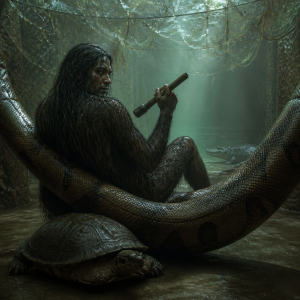
Amazon Mythology: The Complete Guide to River Serpents, Forest Guardians, and the Sacred Flutes of Yuruparí
In the northwest Amazon there is a sound no woman is permitted to see being made. When the long paxiúba-palm flutes of Yuruparí are played at male initiation, the women and uninitiated boys must hide in the houses; to look upon the instruments has traditionally meant death. The flutes are not musical toys but the voice of an ancestor, carved from the palm that grew out of his burned bones, and the rite around them — the Hee House of the Tukano and Tariana — encodes an entire cosmology of gender, law, and the origin of humanity. UNESCO now protects the knowledge of the jaguar shamans who keep it. This is the secret at the heart of Amazonian religion, and almost nobody outside the rainforest has heard of it.
That obscurity is the whole point. The Amazon basin is home to hundreds of distinct peoples — Tukano, Tariana, Desana, Barasana, Yanomami, Shipibo, Tupi, and many more — speaking unrelated languages and telling stories European chroniclers mostly never wrote down. There is no single Amazonian pantheon, no Iliad of the jungle, but something rarer: a living web of myth still told by the people who originated it, in which the line between the human and the animal, the river and the underworld, is so thin that a dolphin can walk into a dance dressed as a man and a serpent can be the river itself.
What survives in writing comes from a handful of remarkable documents. The greatest is the Legend of Yuruparí, dictated in Nheengatu by the Indigenous storyteller Maximiano José Roberto and translated into Italian in 1890 by Count Ermanno Stradelli — one of the only pre-Columbian South American epics to survive alongside the Maya Popol Vuh. In our own time the Yanomami shaman Davi Kopenawa gave the world The Falling Sky, a first-person account of his people’s cosmology. Between these poles lies one of the most distinctive religious imaginations on earth.
What Makes Amazon Mythology Different
The sacred is hidden by law, not displayed. Where most mythologies broadcast their gods in temples and statues, the core of northwest Amazonian religion is a secret kept by sound. The Yuruparí flutes are concealed underwater or in the forest between rituals and may only be seen and played by initiated men; the myth itself tells how women once held this power and lost it. Religion here is not a public spectacle but a guarded inheritance, transmitted through ordeal and silence — the opposite of a pantheon you can simply look up.
The river is a parallel civilization, not a backdrop. Beneath the water lies the Encante, a complete shimmering world of palaces and music, ruled by the Yacuruna water-people and prowled by the Encantado, the enchanted dolphin. The Amazon is the largest river system on the planet, and its mythology treats the water not as a boundary but as the doorway to a society as real and structured as the one on the bank — one that abducts the living and keeps them forever.
The great powers are mothers and guardians, not kings. The dominant supernatural figures are not thunder-wielding sky-fathers but enormous serpent-mothers — Sachamama, mother of the forest, and Yacumama, mother of the waters — and a population of forest-owners like the Boraro and the Curupira whose entire purpose is to punish humans who take more than they need. This is a theology of ecological reciprocity built directly into its monsters.
Shapeshifting is the normal state of being. In the Amazonian view a body is something you wear, not something you are. A dolphin is a person; a person can become a dolphin; the dead, the animal, and the spirit are versions of one another seen from different angles. This perspectivism — the idea that animals see themselves as people and see us as prey or spirits — is so pervasive that anthropologists coined the term after studying these very cultures.
Many of these myths are not “ancient” — they are now. Davi Kopenawa describes the creation work of the demiurge Omama not as folklore but as fact, and warns that the sky is falling again as outsiders destroy the forest. Amazonian mythology is among the most vital living religious traditions on earth, narrated in the present tense by people defending the world it describes.
The Major Gods and Culture Heroes
The Amazon has no organized pantheon in the Greek or Norse sense. Its great figures are creators, law-givers, and culture heroes scattered across hundreds of nations, bound together less by family trees than by shared themes: the origin of the forest, the gift of fire and agriculture, and the rules that make human society possible.
Omama — the demiurge and creator of the Yanomami, also called Omama or Omamë. In the cosmology recorded by the shaman Davi Kopenawa, Omai stabilized the world after the primordial sky collapsed, setting deep metal foundations to hold up the new sky, and fathered the Yanomami people with Thuëyoma, a fish-being who let herself be captured in the shape of a woman. He created the shaboris, the shamans who keep the world from falling — making him a creator whose work must be actively maintained or the heavens will crash down again.
Jurupari (also Jurupari) — the great culture hero and law-bringer of the Tupi-Guarani, Tukano, and Arawak peoples, and the most widespread cult encountered by the first Europeans in Brazil. His name has been translated as “the fruit miraculously begotten,” for he was born of a virgin who ate a forbidden fruit. He came to reform human society, imposing the laws of initiation and the prohibition of incest, and his voice still speaks through the sacred flutes. The two spellings survive as separate entries on the site, a useful reminder that a single Amazonian figure can wear many names across the basin.
Jurupari — recorded as a deity “born from defiance,” Jurupari embodies the harsher, demonic face colonial missionaries gave the same hero, recasting the law-giver as a forest demon. The doubled tradition — benevolent law-bringer to his own people, “devil” to the friars — is one of the most revealing facts about how Amazonian religion was received and distorted by outsiders.
The Guarani Sky and Creators
The Tupi-Guarani world, which fringes the southern and eastern Amazon, supplies some of the few named high gods in the region. Tupã is the thunder power invoked as a creator-force; Guaraci is the personified sun over the forest canopy; Karai embodies the sacred fire and the spoken word at the root of Guarani cosmology. These figures shade westward into the Amazon proper, where the boundaries between traditions dissolve into a continuum of shared powers.
Creatures, Monsters, and Supernatural Beings
If the Amazon is light on organized gods, it is overwhelmingly rich in spirits, guardians, and shapeshifters — the densest bestiary of any New World tradition. These beings are the real engine of Amazonian belief, the powers an ordinary person actually meets on the river or in the trees.
The River Serpents
Boiúna — the Cobra Grande, the immense black serpent of the Amazon’s waters, also called Mboiaçu. Said to grow hundreds of feet long with eyes that glow on the water like the lamps of an approaching boat, she capsizes canoes, drowns the careless, and shapeshifts into a sailing vessel or a beautiful woman to lure her victims. In some traditions she is bound up with the creation of the world itself and can change the very course of the rivers — the supreme power of the deep channels.
Sachamama — “Mother of the Forest,” a colossal boa of the Peruvian Amazon, around forty meters long with an iguana-like head and scales like plates of stone. She lies so still for so long that trees, vines, and whole thickets take root on her back, and travelers walk across her believing she is solid ground. She is the slow, vegetal heart of the jungle made flesh, and she does not move unless provoked.
Yacumama — “Mother of the Waters,” Sachamama’s aquatic counterpart, an anaconda swollen to monstrous size who guards the rivers and lakes and punishes those who foul them. Together the two serpent-mothers form a complementary pair — forest and water, boa and anaconda — and their legend doubles as one of the oldest environmental warnings on earth: pollute the source of life, and the mother of the waters will take you.
The Forest Guardians
Boraro — “the Pale One,” the man-eating forest spirit of the Tukano, a towering pale figure covered in black fur with forward-facing ears, backward-pointing feet, and no joints in his knees. He crushes victims in an embrace that pulps their flesh without breaking the skin, then drinks them through a hole in the skull and sends the empty, inflated body staggering home to die. Yet he is a guardian: like the Curupira he protects the game of the forest, and a traveler can escape by offering tobacco — or by pressing hands into his footprints, which locks his stiff legs so he topples and cannot rise.
Curupira — the most famous forest guardian of the Tupi-Guarani Amazon, a small figure with flaming red hair and feet turned backward so his tracks lead pursuers the wrong way. He punishes hunters who kill needlessly and loggers who fell too much, sending them in hopeless circles until they are lost forever. His backward feet are the single most recognizable image in Brazilian folklore.
Caipora — the Curupira’s close cousin, a guardian of game who rides through the canopy on a wild peccary, hiding animals from greedy hunters. Where the Curupira owns the trees, the Caipora owns the hunt.
Mapinguari — a giant, shaggy, unbearably foul-smelling beast of the deep forest, often described with a single eye and a gaping mouth in its belly, sometimes linked to folk memory of the extinct giant ground sloth. Slow but nearly invincible, it falls on hunters who take too much — an ecological enforcer in the body of an Ice Age monster.
The Water-People and Shapeshifters
Encantado — the “enchanted one,” most often the boto, the pink river dolphin, who climbs out of the water at night transformed into a handsome man in a white suit and hat — the hat hiding the blowhole that never quite disappears. He seduces women at riverside festas, fathers children, and slips back to the river by dawn; he can also drag the unwary down to the Encante, the underwater paradise from which they never return. Across the Amazon, a child of uncertain parentage is still called a “son of the boto.”
Yacuruna — the water-people of the Encante, a subaquatic civilization that mirrors the human world upside-down. They ride caimans like canoes, wear their feet and heads turned backward, and rule the river-bottom realm into which the Encantado lures its captives. To enter their city is to become one of them, your humanity slowly dissolving into the world below the water.
Iara — the river siren, a being of staggering beauty whose song draws men beneath the surface to drown. Scholars see in her a cultural layering: an Indigenous water-spirit gradually fused with the European mermaid after colonial contact, so that the Amazonian mãe-d’água now wears the tail and mirror of the Old World. She is the seductive, lethal face of the same waters the serpent-mothers guard.
Boi-tatá — the great fiery serpent, a snake of living flame whose blazing eyes streak across the flooded fields at night. In one tradition he survived a great flood by devouring the eyes of drowned animals, which is why he burns with their light; he punishes those who set fire to the forest — fire turned guardian against fire.
The Central Myths
The Theft and Loss of the Sacred Flutes
The central myth of the northwest Amazon is the story of Jurupari and the flutes. In the version recorded by Stradelli and in the living tradition of the Tukano and Tariana, the sacred instruments and the ritual power they carry originally belonged to the women. The men acquired them — by theft, by Yuruparí’s reforms, or after the hero was made drunk at a feast and burned to ashes, his bones rising again as the first paxiúba palm from which the flutes are cut. From that day the flutes have been kept hidden from women on pain of death, and the male initiation rite reenacts the moment power changed hands.
Why it matters: this is one of the most sophisticated myths of gender and social order in the Americas. It does not simply assert male authority — it admits that authority was taken from women, and builds an entire sacred institution around remembering that theft. The complex is so central that UNESCO inscribed the jaguar-shamans’ knowledge of it as Intangible Cultural Heritage.
Omai and the Falling Sky
In Yanomami cosmology the world has already ended once. The first sky collapsed, crushing its inhabitants and hurling them into an underworld below; the exposed underside of that ruined sky became the forest floor where the Yanomami now live — which is why they call the forest “the old sky.” The demiurge Omama raised a new sky and fixed it in place with metal foundations driven deep into the earth, then created the first people and the shamans who would keep the heavens propped up.
Why it matters: Davi Kopenawa frames this not as a story about the past but as an urgent warning about the present. The shamans hold the sky up through ritual; as miners and loggers kill the shamans and poison the forest, the supports weaken and the sky threatens to fall a second time — a creation myth that doubles as one of the most powerful environmental statements ever recorded from an Indigenous voice.
The Serpent and the Course of the Rivers
In the cycle of the Boiúna, the Cobra Grande is not merely a monster but a force present at the shaping of the waters, able to carve new channels, raise floods, and decide which boats reach home. Riverine communities tell of nights when two lights appear on the black water — the serpent’s eyes, mistaken for an oncoming canoe — and of fishermen who followed them and were never seen again.
Why it matters: the Boiúna myth turns the Amazon’s most dangerous feature, its vast unpredictable water, into a sentient will — a code of conduct for survival on the largest river on earth, dressed as a serpent two hundred meters long.
The Underwater World and the Amazonian Afterlife
The Amazon’s distinctive contribution to the geography of the beyond is that its otherworld lies below the water, not above the clouds. The Encante is a luminous mirror-city of palaces, music, and endless festival, ruled by the Yacuruna and patrolled by the Encantado. Those taken there — children who wander too near the bank, lone swimmers, lovers seduced by the dolphin-man — do not die so much as defect, becoming enchanted beings whose human nature slowly inverts, feet and faces turning backward like the Yacuruna who rule them. It is an afterlife of seduction rather than judgment: no weighing of sins, only the pull of a more beautiful world you can never leave.
This reflects the wider Amazonian conviction that death and transformation are the same event. In the perspectival worldview, every being lives in its own “village” seeing itself as human; to die, or to be taken by the boto, is to cross into another such village and take on its body. The shaman alone can make that crossing deliberately and return — which is why, in Yanomami thought, the death of the shamans is the death of the world.
How Amazon Mythology Connects to Other Traditions
The Amazon sits at the green heart of South America, and its myths bleed outward into every neighboring tradition. The strongest bond is with the Guarani and the broader Native Brazilian world: figures like the Curupira, Caipora, Iara, and Saci belong simultaneously to Amazonian and to national Brazilian folklore, and sky-powers like Tupã and Guaraci shade directly into rainforest cosmology. Forest tricksters recur across the family — the Guarani Jasy Jatere, Pombero, and Kurupi are siblings of the Amazon’s own forest-owners.
Westward, where the rainforest climbs toward the mountains, the great serpents of the Amazon meet the serpents of the Andes. The Andean Amaru, the cosmic snake that moves between worlds, is plainly kin to Sachamama and Yacumama — indeed Sachamama is claimed by both the Amazon and the Peruvian highlands. Northward, the man-killing forest power Canaima of the Pemon extends the logic of the vengeful jungle into the Orinoco basin.
The deepest point is structural. Where Mediterranean and Mesoamerican religions built monumental sky-gods and state temples, the Amazon distributed its sacred power horizontally — into rivers, animals, and the hidden knowledge of shamans — and tied nearly every major spirit to a rule about not over-taking from the forest. It is, in the most literal sense, an ecological religion, and one whose central warning, voiced through Omama and the falling sky, has only grown more urgent.
Where to Start Reading
Begin with the primary voices. The Legend of Yuruparí, in the line running from Maximiano José Roberto’s Nheengatu telling through Ermanno Stradelli’s 1890 Italian translation, is the foundational Amazonian epic — read it beside the Maya Popol Vuh and you see two of the only surviving long-form Indigenous sacred texts of the Americas. For a living counterpart, nothing matches Davi Kopenawa and Bruce Albert’s The Falling Sky, the most important first-person account of Amazonian cosmology ever published.
For the wider worldview, Eduardo Viveiros de Castro’s work on Amazonian perspectivism (Cannibal Metaphysics) explains why dolphins are people and jaguars see blood as beer. For Brazilian folklore specifically, Luís da Câmara Cascudo’s Geografia dos Mitos Brasileiros remains the indispensable map, and Candace Slater’s Dance of the Dolphin is the best English study of the living Encantado traditions of the river.
Explore Amazon Mythology on Gods and Monsters
Gods and Monsters has 6 entries catalogued directly under Amazon mythology, with many more across the surrounding Brazilian, Guarani, and South American traditions. Browse all Amazon entries →
Omama · Jurupari · Jurupari · Boiúna · Boraro · Sachamama · Yacumama · Yacuruna · Encantado · Curupira · Caipora · Iara · Mapinguari · Boi-tatá · Saci · Tupã · Guaraci · Karai · Canaima · Amaru
Frequently Asked Questions
What are the Yuruparí flutes and why are they hidden from women? The Yuruparí (or Jurupari) flutes are sacred wind instruments made from paxiúba palm, played at the male initiation rituals of Tukano, Tariana, and related peoples of the northwest Amazon. They carry the voice of the ancestral culture hero Jurupari, and the central myth tells how ritual power once belonged to women before the men took it. So the flutes are concealed between ceremonies and traditionally may only be seen by initiated men — the prohibition reenacts the moment authority changed hands. UNESCO recognizes the associated jaguar-shaman knowledge as Intangible Cultural Heritage.
Is there a single Amazonian creator god? No. The Amazon is home to hundreds of distinct peoples with their own cosmologies, so there is no universal creator. The closest figures are local demiurges and culture heroes: the Yanomami revere Omama (Omama), who built the sky and made the first people, while many Tupi-Guarani and Tukano peoples center their world on the law-giver Jurupari. Guarani traditions on the forest’s edge name sky-powers like Tupã and Guaraci. Amazonian religion is plural by nature.
What is the pink dolphin legend? It is the myth of the Encantado, the “enchanted” boto or pink river dolphin who transforms at night into a handsome man in a white hat — the hat hiding his blowhole — and seduces women at riverside parties before returning to the water by morning. He can also lure people to the Encante, the underwater city of the Yacuruna water-people, from which they never come back. The legend is still alive enough that unexplained pregnancies in Amazonian river towns are sometimes attributed to the boto.
Why do so many Amazonian spirits have backward feet? Backward-pointing feet are a recurring feature of forest guardians like the Curupira and the Boraro, and of the Yacuruna water-people. The detail is practical within the myth: tracks that point the wrong way send pursuers in the opposite direction, making the spirit impossible to follow and reinforcing its role as a protector who confounds intruders. It is one of the most distinctive signatures of South American forest folklore.
What are Sachamama and Yacumama? They are the two great serpent-mothers of the Peruvian and western Amazon. Sachamama, “Mother of the Forest,” is a giant boa so still that vegetation grows on her back and she is mistaken for solid ground. Yacumama, “Mother of the Waters,” is a monstrous anaconda who guards the rivers and lakes and destroys those who pollute them. Together they personify the forest and the water as living, maternal, and dangerous — and their stories function as some of the oldest conservation warnings on record.
Is Amazon mythology still believed today? Very much so. Unlike mythologies known only from texts, Amazonian belief is a living tradition narrated by the people who hold it. Yanomami shamans still describe the work of Omama and warn the sky may fall again as the forest is destroyed; the Yuruparí rituals continue in the northwest Amazon; and river communities across Brazil and Peru still tell of the Encantado, the Boiúna, and the serpent-mothers. It is one of the most vital religious traditions on the planet.