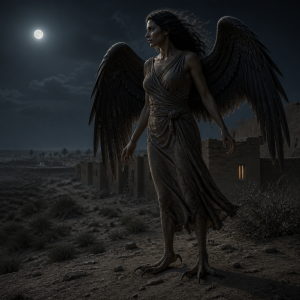
Akkadian, Assyrian & Babylonian Mythology: The Complete Guide to Marduk, the Enuma Elish, and the Demons of Mesopotamia
This is the oldest written mythology on Earth. While Greek myth reached us through poets and Norse myth through medieval Icelandic manuscripts, the gods of Mesopotamia were pressed into wet clay in cuneiform script more than a thousand years before Homer drew breath. When Assyrian king Ashurbanipal assembled his great library at Nineveh in the 7th century BCE, the creation epic his scribes copied was already ancient — and we read it today from the very tablets that burned in his palace and baked hard in the fire.
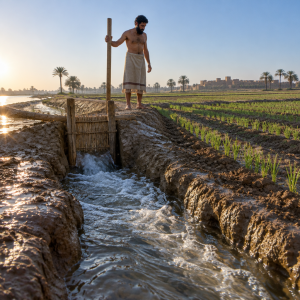
The Mesopotamians did not imagine that the gods made humanity out of love or curiosity. In the Atrahasis epic, the junior gods went on strike over the backbreaking labor of digging the rivers, so the senior gods slaughtered a divine ringleader, mixed his blood with clay, and molded human beings for one purpose: to take over the work. That bleak, transactional view of existence runs through everything — including an afterlife where kings and beggars alike eat dust in the dark.
The core sources are extraordinary: the Enuma Elish (the Babylonian creation epic), the Epic of Gilgamesh (the world’s first great work of literature), the Descent of Ishtar into the underworld, the apocalyptic Epic of Erra, and thousands of incantations against demons. The names shift across three overlapping cultures — Sumerian roots, Akkadian and Babylonian flowering, Assyrian militarization — but the cast remains recognizably one tradition, the bedrock from which the religions of the entire Near East would grow.
What Makes Mesopotamian Mythology Different
It is the source code for everything after it. The flood survivor who builds a boat and releases birds to find dry land is not Noah — he is Utnapishtim, and his story is a thousand years older than Genesis. The night-demon who threatens mothers and newborns is not a medieval invention — she is Lilitu, ancestor of Lilith. The seven-gated underworld, the dying-and-rising god, the cosmic sea-dragon of chaos: all of it begins here.
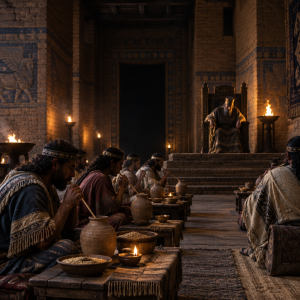
Humans were created as slaves, not as the crown of creation. Where later traditions place mankind at the center of a divine plan, Mesopotamian theology is brutally clear that people exist to feed and house the gods through temple offerings. The great ziggurats were not churches for worshippers; they were houses where the gods physically lived and were served meals twice a day.
The pantheon was rewritten for politics — openly. The Enuma Elish exists to explain why Marduk, a minor city god of Babylon, deserved to rule the cosmos: it tracks Babylon’s real political rise. When the Assyrians dominated the region, they simply edited the epic to put their national god Ashur in Marduk’s place. Myth here is statecraft you can hold in your hand.
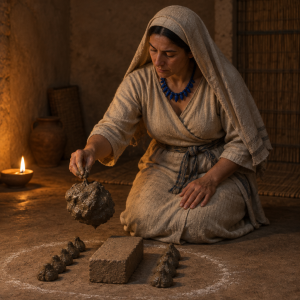
Daily religion was demon-warding, not prayer. For ordinary Mesopotamians, the supernatural threat was not a distant god’s judgment but the swarm of malevolent spirits — Utukku, Gallu, Rabisu — waiting at thresholds and in deserts. Religion was largely apotropaic: incantations, amulets, and figurines to drive evil away. A man would hang a hideous statue of one demon on his door specifically to scare off a worse one.
There was no heaven to hope for. Unlike Egypt next door, Mesopotamia offered no judgment, no reward, no paradise. Every single person — pious or wicked — descended to the same grey “house of dust.” The only thing that improved your fate was being properly buried and remembered by the living.
The Major Gods of Mesopotamia
The Ruling Powers of Sky, Air, and Water
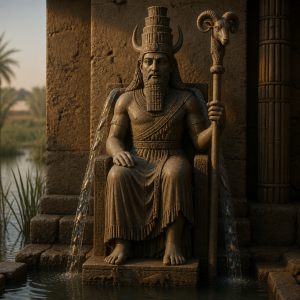
Anu — the remote god of the highest heaven and nominal king of the gods. He is authority in its most abstract form: rarely acting, almost never descending, the ultimate source of legitimacy that lesser gods invoke.
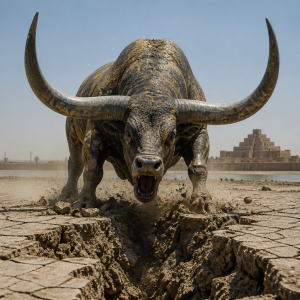
Enlil — lord of wind, storm, and the air between heaven and earth, and for much of Mesopotamian history the real executive power of the cosmos. It was Enlil who grew so annoyed by humanity’s noise that he sent the great flood to wipe us out.
Enki (Ea in Akkadian) — god of fresh water, wisdom, magic, and craft, and humanity’s great divine ally. When the other gods plotted the flood, it was Enki who whispered the warning that saved our species. Clever, mischievous, and endlessly resourceful, he is the trickster-sage of the pantheon.
The Astral Gods
Sin (Nanna) — the moon god, father of the sun and of Ishtar, wise and ancient, whose crescent crowned the great temple-cities of Ur and Harran. The Mesopotamians read the sky as scripture, and the moon’s phases governed their entire calendar.
Shamash — the sun god and the supreme god of justice, who sees everything under heaven and therefore judges all things. It is Shamash who hands King Hammurabi his famous law code on the carved stele, and Shamash who aids heroes against monsters.
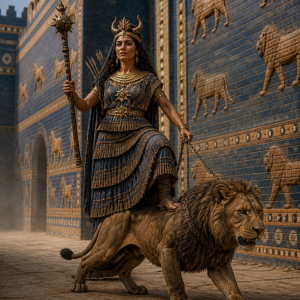
Ishtar — goddess of love and war, the morning and evening star (Venus), and the most vivid personality in the entire pantheon. Sexual, violent, proud, and dangerous, she is the Akkadian form of Sumerian Inanna, and her descent into the underworld is one of mythology’s foundational stories.
Champions, War Gods, and the Defeated
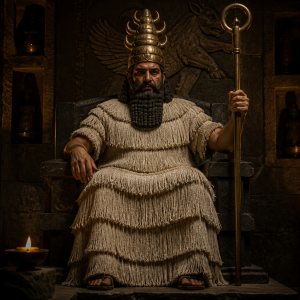
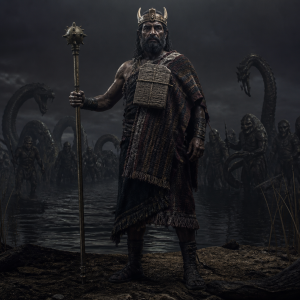
Marduk — the patron god of Babylon who rose to become king of the entire pantheon by slaying the chaos-dragon Tiamat. Armed with the four winds, a net, and a bow, he is the divine warrior whose victory the Enuma Elish recited every New Year to renew the cosmos.
Ninurta — god of war, the hunt, and (revealingly) of agriculture and the plough. The great dragon-slayer of an older generation, he defeated the storm-bird Anzû and the demon Asag, and his exploits were the template Marduk’s story later borrowed.
Nergal — god of plague, war, and scorching death, and king of the underworld through his marriage to its queen. Where Shamash is the gentle sun of dawn, Nergal is the killing sun of high summer — the sun that brings drought and fever.
Ishum — the level-headed god of fire and the herald and restraining counselor of Nergal. In the Epic of Erra it is the calm, reasoning voice of Ishum that finally talks the rampaging plague-god into stopping his slaughter — a rare portrait of divine mercy.
Kingu — the monstrous consort whom Tiamat appoints as general of her demon army and to whom she gives the Tablet of Destinies. After Marduk defeats him, it is Kingu’s blood that Ea uses to create humankind, which is why the Mesopotamians believed a rebel god’s blood ran in human veins.
Mothers, Primordials, and the Divine Collectives
Tiamat — the primordial goddess of the salt sea and the embodiment of chaos, mother of the first gods and of a brood of monsters. Marduk splits her enormous corpse in two to form the sky and the earth; the cosmos is literally built from her body.
Ninhursag — the great mother goddess of the mountains and birth, one of the oldest and highest deities, who shapes humanity from clay alongside Enki. In some traditions she is the divine midwife of all living things.
Ereshkigal — the dread queen of the underworld, Ishtar’s elder sister, ruling the land of the dead with absolute and joyless authority. She is one of the few death-rulers in world myth who is unambiguously a goddess, and she does not forgive trespass.
Anunnaki — the collective of the great gods, the divine assembly that decrees fates and sits in judgment. Igigi — the younger working gods whose labor strike, in the Atrahasis, forced the creation of humanity to take their place.
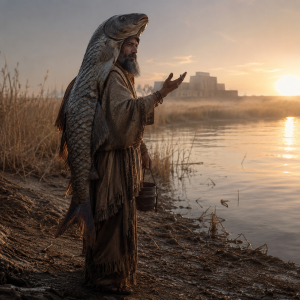
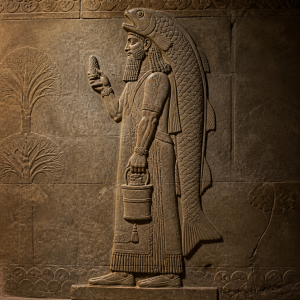
Apkallu — the seven antediluvian sages, half-fish or bird-winged, sent by Enki to teach humanity the arts of civilization before the flood. Their leader is Oannes, the fish-bodied sage who rose from the sea each day to instruct mankind in writing, law, and agriculture, then returned to the waves at night.
Creatures, Monsters & Supernatural Beings
The Guardian Hybrids
Lamassu — the colossal winged bull (or lion) with a human face that flanked the gates of Assyrian palaces, a protective spirit so powerful it warded evil from entire cities. The female-aspected protective counterpart is the Shedu.
Winged genie — the eagle-headed or human protective spirits (apkallu figures) carved on Assyrian palace walls, shown sprinkling sacred water from a bucket and cone to purify the king and the realm.
Urmahlullu — the “lion-man,” a guardian demon with a human upper body and a lion’s hindquarters who protected bathrooms and lavatories, places thought especially vulnerable to evil spirits. Gud-elim — the bull-man guardian, a horned protector of doorways and a servant of the sun god.
Dragons and Serpents
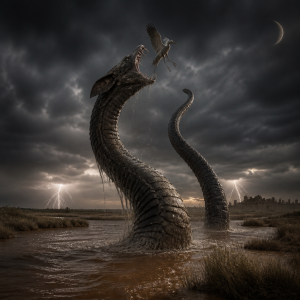
Mushhushshu — the “furious snake,” a scaled dragon with a serpent’s neck, lion’s forelegs, and eagle’s hind talons, sacred to Marduk. Its glazed-brick image still stalks the reconstructed Ishtar Gate of Babylon. Some identify it with the Sirrush, the dragon of that gate.
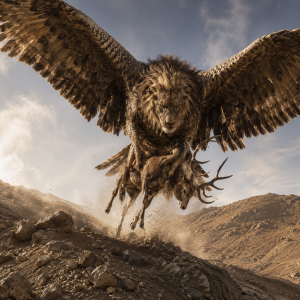
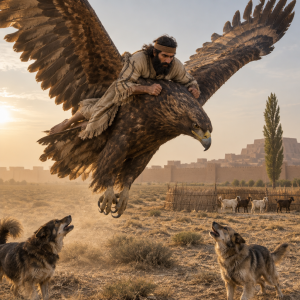
Anzû — the monstrous lion-headed eagle who stole the Tablet of Destinies from the gods, seizing supreme power until Ninurta shot it down. A storm-bird embodying the theft of cosmic order. Labbu — a colossal sea-serpent or dragon, created by the gods and then slain, in a fragmentary combat myth.
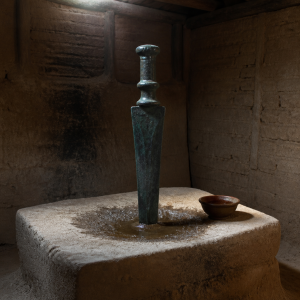
Asag (Asakku) — a hideous demon of disease so monstrous that its very presence made fish boil alive in the rivers; Ninurta destroyed it with his sentient mace. A second entry preserves the demon under its Akkadian name, Asakku.
The Scorpion-Folk and Composite Beings
Girtablilu — the scorpion-men, human above and scorpion below, who guard the gates of the sunset mountain in the Epic of Gilgamesh. Their gaze is death, yet they let Gilgamesh pass. Also called aqrabu amēlu, the Scorpion People.
Demons, Night-Hags, and the Restless Dead
Pazuzu — king of the wind demons, bringer of plague and the dry south-west wind, with a canine face, talons, and a scorpion tail. Yet Mesopotamians wore his image as protection — because the only thing that could fend off the child-killing Lamashtu was a demon as terrible as Pazuzu himself.
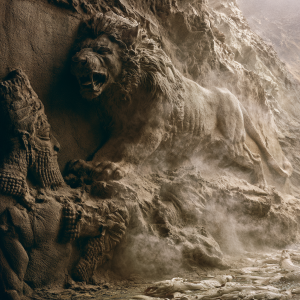
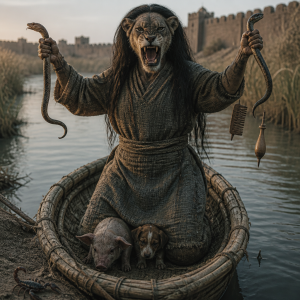
Lamashtu — the lion-headed daughter of Anu who preys on pregnant women and infants, slipping into homes to steal babies from the womb and the breast. Unlike most demons she acts on her own malice, not a god’s command. She is preserved under her variant name Labartu as well.
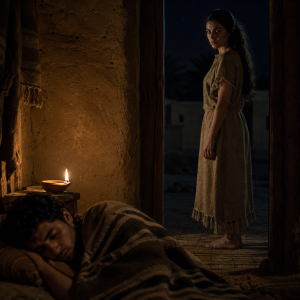
Lilitu — the storm-and-night spirits, female demons who haunt desolate places and seduce sleeping men. With the wraith-like Ardat-Lili, the frustrated unmarried demoness, they form the Akkadian root of the later Jewish Lilith.
Gallu — the underworld enforcers who drag the living down to the land of the dead, the demon-police of Ereshkigal. Alû — a faceless, formless demon that smothers sleepers in the night, an ancient personification of sleep paralysis. Rabisu — “the croucher,” a demon that lurks at thresholds and in shadows, springing on those who pass.
Utukku — a class of spirits that could be protective or malevolent; the evil utukku rose from the underworld to spread sickness. Alal — a destroyer-demon of Akkadian incantation. Edimmu (also Ekimmu and the Sumerian Gidim) — the vengeful ghosts of the unburied or improperly mourned dead, who torment the living until the rites are set right.
The Central Myths
The Enuma Elish: Order Carved from Chaos
In the beginning there was only water: Tiamat the salt sea and Apsu the fresh, mingling together. From them the gods were born, but their noise enraged Apsu, who plotted to destroy his own children — until Enki killed him first. Vowing revenge, Tiamat spawned an army of eleven monsters and set Kingu over them with the Tablet of Destinies. The terrified gods turned to young Marduk, who agreed to fight on one condition: if he won, he would rule them all. He trapped Tiamat in a net, drove the winds into her belly, and split her like a shellfish — half becoming the sky, half the earth. From Kingu’s blood, humanity was made.
Why it matters: The poem was recited aloud every spring at the Babylonian New Year festival, ritually re-creating the world. It is mythology functioning as politics and physics at once — explaining the shape of the universe and justifying Babylon’s right to rule it.
The Epic of Gilgamesh: The First Story of Mortality
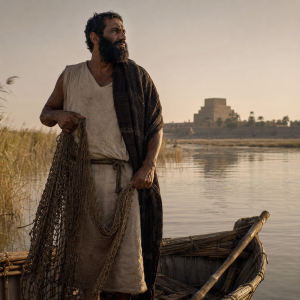
Gilgamesh, the tyrant-king of Uruk, meets his match in Enkidu, a wild man raised among animals, sent by the gods to humble him. They become inseparable, slay the forest-guardian Humbaba, and kill the Bull of Heaven after Gilgamesh spurns Ishtar. As punishment, the gods strike Enkidu dead — and Gilgamesh, shattered by grief and terror of his own mortality, journeys to the edge of the world to find Utnapishtim, the flood survivor who gained eternal life. He fails to win immortality, and learns to accept death.
Why it matters: Four thousand years old, it remains the most human of all ancient stories — a meditation on friendship, loss, and the terror of dying that reads as freshly now as it did in clay. Its flood narrative, with the boat and the released birds, is the direct ancestor of the Genesis account.
The Descent of Ishtar
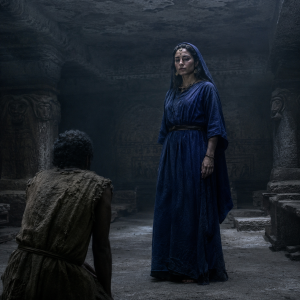
Ishtar, goddess of love, descends to the underworld ruled by her sister Ereshkigal. At each of the seven gates a garment or ornament is stripped from her, until she arrives naked and powerless — whereupon Ereshkigal has her struck dead and hung on a hook. With the goddess of fertility gone, all sexual reproduction on earth ceases. The gods must contrive her release, but the underworld’s law demands a substitute, and Ishtar’s doomed lover Dumuzi is taken in her place.
Why it matters: This is the archetypal dying-and-rising and seven-gates journey, echoed across millennia of myth and ritual, and a stark statement of the Mesopotamian conviction that even a goddess cannot cheat the underworld’s accounting.
The Epic of Erra: When the Plague God Rages
Erra, a form of the war-and-plague god Nergal, grows restless and persuades Marduk to step away from his throne, then unleashes indiscriminate slaughter across Babylonia, burning cities and killing the just alongside the wicked. Only the patient counsel of his herald Ishum finally calms his fury and turns his violence outward against Babylon’s enemies.
Why it matters: Likely composed after a real catastrophe, it is one of the ancient world’s most unflinching attempts to make sense of senseless mass death — and copies were worn as protective amulets, the poem itself believed to ward off the very plague it describes.
The Afterlife: The House of Dust
There is no darker afterlife in world mythology, and none more democratic. Every soul — king, priest, criminal, child — descended to the same place: Kur or Irkalla, the “land of no return,” ruled by Ereshkigal and her plague-god husband. The Epic of Gilgamesh describes it as the house “where dust is their bread and clay their meat,” where the dead sit in darkness, clothed like birds in feathers, and never see light again.
There was no judgment and no reward — virtue earned you nothing better than vice. What mattered was the living: a corpse needed proper burial and ongoing offerings of food and water from descendants. Neglect those rites and the dead returned as an Edimmu, a furious ghost (the Sumerians called it a Gidim) that would haunt and sicken the family until the duty was discharged. The gods of the dead held real power: when Ishtar threatens, in the Descent, to break down the gates of the underworld and “raise up the dead to eat the living,” she is invoking a genuinely feared cosmic catastrophe. Guarding the boundary between living and dead was the work of countless spirits, and crossing it required passing demon-guardians like the scorpion-men at the world’s edge.
How Mesopotamian Mythology Connects to Other Traditions
Sumer is its mother. Akkadian, Babylonian, and Assyrian myth are the Semitic continuation of older Sumerian religion. Inanna becomes Ishtar, the sky-god An becomes Anu, and the underworld of Ereshkigal and the ghostly Gidim carries straight across. It is less a separate mythology than the same one in a new language.
It shaped the Bible. The flood of Utnapishtim underlies Noah’s; the chaos-sea Tiamat survives as the Hebrew tehom, “the deep” over which the spirit of God hovers; and the demoness Lilitu becomes Lilith. The sea-dragon of chaos reappears as the biblical Leviathan.
It fed the Levant and Anatolia. The Mesopotamian storm-god stands behind the Canaanite Baal and Hadad, the grain-god Dagon, and the warrior-goddess Anat; Baal’s battle with the sea-dragon Lotan is a cousin of Marduk versus Tiamat.
It echoes in Greece. The god-versus-chaos-monster combat at the heart of the Enuma Elish — a young storm-god defeating a monstrous serpent to win kingship of heaven — is the same pattern as Zeus against Typhon, and the hybrid guardians of the East helped inspire creatures like the griffin.
Where to Start Reading
Begin with the primary texts in good modern translation. Stephanie Dalley’s Myths from Mesopotamia (Oxford World’s Classics) is the single best gateway, collecting the Enuma Elish, Atrahasis, the Descent of Ishtar, and the Epic of Erra with clear introductions. For Gilgamesh, Andrew George’s Penguin translation is authoritative and readable, with all the fragments laid out.
For the gods and demons themselves, Jeremy Black and Anthony Green’s illustrated Gods, Demons and Symbols of Ancient Mesopotamia is indispensable, and Benjamin Foster’s Before the Muses is the fullest anthology of Akkadian literature.
Explore Mesopotamian Mythology on Gods and Monsters
Gods and Monsters has 33 entries catalogued under Akkadian, Assyrian & Babylonian mythology, with dozens more across the wider Mesopotamian world. Browse all Akkadian, Assyrian & Babylonian entries →
Marduk · Tiamat · Ishtar · Enki · Enlil · Anu · Shamash · Sin · Nergal · Ninurta · Ereshkigal · Anunnaki · Gilgamesh · Enkidu · Utnapishtim · Humbaba · Pazuzu · Lamashtu · Lamassu · Mushhushshu · Anzû · Apkallu · Adapa · Edimmu
Frequently Asked Questions
What is the oldest mythology in the world?
Mesopotamian mythology is the oldest written mythology we have. Sumerian myths were recorded in cuneiform on clay tablets by around 2600 BCE, and the Akkadian, Babylonian, and Assyrian traditions that grew from them give us the world’s first epics, including the Epic of Gilgamesh and the creation epic Enuma Elish. They predate Greek, Norse, and Hindu written sources by well over a thousand years.
What is the difference between Sumerian, Akkadian, Babylonian, and Assyrian mythology?
They are successive layers of one continuous tradition. The Sumerians created the original myths and gods; the Akkadians (a Semitic people) adopted and translated them, renaming many deities — Sumerian Inanna became Akkadian Ishtar. The Babylonians elevated their city god Marduk to supremacy, and the Assyrians later did the same for their god Ashur. The cast and stories stay largely the same; the names and the politics shift.
Who was the most important Mesopotamian god?
It changed over time. In the oldest layers, Enlil the storm-god held executive power, with Anu as the remote king of heaven. As Babylon rose to dominance, Marduk was promoted to king of the gods in the Enuma Elish. Under the Assyrian Empire, their national god Ashur took that role. The god of wisdom, Enki, remained beloved throughout as humanity’s protector.
Is the Mesopotamian flood story the original Noah’s Ark?
It is far older. The flood narrative in the Epic of Gilgamesh, in which Utnapishtim builds a great boat, rides out a divine flood, and releases birds to find land, was written more than a thousand years before the Book of Genesis. The parallels are so close that most scholars see the Genesis account as drawing on this older Mesopotamian tradition rather than the reverse.
Why did the Babylonians fear demons so much?
Mesopotamian religion treated illness, misfortune, and death as the work of malevolent spirits rather than abstract forces. Demons like Pazuzu, Lamashtu, the Gallu, and the threshold-lurking Rabisu were believed to cause real harm, so daily religious practice centered on protective amulets, figurines, and incantations. Strikingly, people warded off one demon with the image of another — wearing Pazuzu to repel the child-killer Lamashtu.
Is Lilith from Mesopotamian mythology?
Her roots are there. The Jewish demoness Lilith descends from the Mesopotamian Lilitu and Ardat-Lili, classes of night-and-storm demons who haunted desolate places and endangered men and infants. Over centuries these figures passed into Jewish tradition, where they were consolidated into the single named figure of Lilith. The continuity of the night-demon across three thousand years is one of mythology’s longest unbroken threads.