
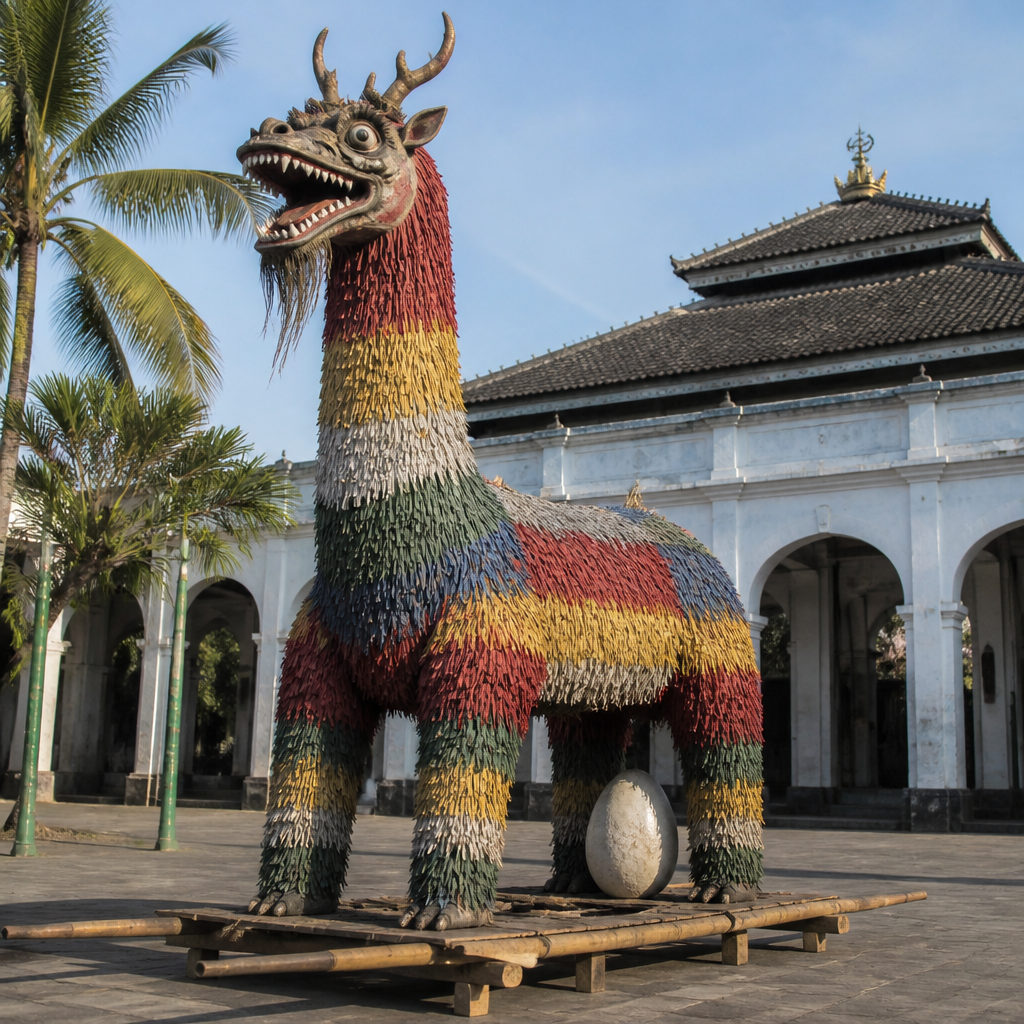
Warak Ngendog
Also Known As: also Warak Ngendhog, Warak Ngendok; Javanese warak, “rhinoceros,” and ngendog, “to lay an egg,” with a competing derivation from Arabic wara’, the discipline of keeping oneself clean of wrongdoing
Region/Culture: Southeast Asia
Mythos: Indonesian Mythology
Primary Type/Nature: Monsters and Beasts
Mythical Attributes: A composite beast assembled from a dragon, a goat and the Prophet’s steed, carrying a single egg that stands for the reward waiting at the end of a month of fasting.
Role in Mythos: It is the mascot and moving centrepiece of Dugderan, the Semarang festival that announces the arrival of Ramadan.
Relation to Humans: The people of Semarang treat it as a portrait of themselves, its three animal parts standing for the Javanese, Chinese and Arab communities of the city. Children are given small paper and bamboo versions to carry home from the festival market, so most residents meet the creature first as a toy.
Once a year the traffic on Jalan Pemuda gives way to an animal that has never existed. It comes up the road six metres tall, its fur standing out from its flanks in hard curls that point the wrong way, banded red and yellow and white and green and blue like something assembled by a committee that could not agree. The head swings above the crowd with its mouth open and its teeth showing. Between the hind legs, with no explanation offered and none apparently required, sits a single enormous egg.
This is the warak ngendog, and it belongs to one city. Semarang, on the north coast of Central Java, builds it every year in the last days before Ramadan and parades it from the city hall to the Great Mosque of Kauman, and then it is gone again for another eleven months. The name is a small joke that has hardened into doctrine. In Javanese, warak is the rhinoceros and ngendog means to lay an egg, which gives a rhinoceros that lays eggs, an impossibility in two words. The other reading is more solemn and just as widely repeated: warak from the Arabic wara’, the effort to hold oneself clear of filth and arrogance, with the egg as the reward that arrives after the holding is done. Semarang has never chosen between the two, and the creature is better for it.
Look at the body and you can read the city off it. The classic form has the head of a goat, the animal a Javanese family keeps in the yard and slaughters at Eid, with two horns standing straight up and two ears standing straight beside them, eyes bulging, upper and lower teeth filed to points, and a long thick beard. The neck is long and stiff and unbending, borrowed from the camel or from the buraq that carried Muhammad on the night journey, and the people of Semarang will tell you that the neck is straight because they are, blunt to a fault and proud of it. Later makers swapped the goat head for a dragon head, the Chinese contribution, with the crocodile snout and the forked tongue and the small branching antlers of a deer. The three communities the Dutch had penned into separate quarters of the city, Javanese and Chinese and Arab, were put back together in one body, and the seam does not show.
That was the point. The festival is called Dugderan for the two sounds that open it: the flat dug of the great drum struck in the city hall yard, and the der of the cannon fired into the air afterwards. It began in 1881, when the regent of Semarang, Purboningrat, and the scholar Kyai Saleh Darat set out to settle a quarrel that had been running for years about which day Ramadan actually started, and to pull a city apart at the seams back into one crowd. A drum and a cannon carry, but they do not draw. So an animal was built, gaudy enough that nobody could ignore it, and the animal turned out to be the part everyone remembered.
Nobody knows who built the first one. The Semarang historian Amen Budiman searched for a maker and found no record at all, only the tradition itself, handed down in more or less the same shape by people who never thought to sign their work.
There is a darker reading of the creature that sits underneath the civic one. The scaled body, the gaping mouth, the fangs, the deliberately unpleasant face: these are nafsu, the appetite in a person that fasting exists to break. The warak ngendog is the thing you are supposed to be fighting for thirty days, dressed in party colours and dragged through the streets in broad daylight so that everyone can see what it looks like. The egg between its legs is the other half of the bargain. Discipline first, then the reward, and the reward is round and whole and waiting.
On an ordinary afternoon in the week before the fast, the creature is much smaller and much easier to carry. A child comes out of the market at Johar holding a warak the length of a forearm, made of split bamboo and coloured paper, and swings it by its stick while the smell of frying oil and spiced ganjel rel bread follows them down the road. The paper fur rattles. It is a toy, and it is also the whole theology of the month reduced to something a six-year-old can hold.
Then the drum lands. The mayor strikes it in the city hall yard, the announcement of the new moon is read out, and the cannon goes off overhead while the crowd is still shouting. The golden carriage moves off toward Kauman with the paper flowers of the kembang manggar bobbing above it, and behind the carriage comes the beast, swaying on its platform, three kilometres of open road and a city that has stopped work to look at it.
Its powers are simple and entirely borrowed. It cannot fly like the buraq, cannot summon rain like the dragon, cannot do anything at all except be looked at, and being looked at is what it was built for. It commands a crowd, it holds a truce, and once a year it makes a divided coastal city agree on a date. Its limitations are equally plain. It exists for about a week. It cannot outlast the fast it announces, and its own imagery insists that it is meant to lose. Every generation of makers has quietly redesigned it, giving it a tiger’s head or forgetting to curl the fur backwards or turning the whole thing into a cartoon on a batik sarong, so the creature has no fixed body to defend. What survives is not the animal. It is the arrangement the animal stands for, which has held in Semarang for well over a century, one drumbeat and one cannon shot at a time.
Frequently Asked Questions
What is the Warak Ngendog?
Warak Ngendog is a mythical composite animal from Semarang in Central Java, Indonesia, and the mascot of the city’s Dugderan festival. It combines a dragon or goat head, a long camel or buraq neck, and a goat’s body and legs, and it carries a single large egg between its hind legs. A giant version is paraded through the city in the days before Ramadan begins.
What does the name Warak Ngendog mean?
In Javanese, warak means rhinoceros and ngendog means to lay an egg, so the name literally describes a rhinoceros laying an egg. A second widely repeated derivation traces warak to the Arabic wara’, meaning restraint or keeping oneself free of wrongdoing, which makes the egg the reward earned at the end of a month of fasting.
What do the parts of the Warak Ngendog represent?
The three animals in its body stand for the three main communities of Semarang. The dragon head represents the city’s Chinese population, the buraq or camel neck represents its Arab population, and the goat body and legs represent the Javanese. The Dutch colonial administration had divided Semarang into separate ethnic quarters, and the creature puts the city back together in a single form.
When and why was the Warak Ngendog created?
It first appeared with the Dugderan festival in 1881, credited to the regent of Semarang, Purboningrat, and the religious scholar Kyai Saleh Darat, who wanted a single agreed announcement of the start of Ramadan and a way to bring a segregated city into one crowd. No record survives of who actually built the first one. The historian Amen Budiman looked for a maker and found nothing.
Is the Warak Ngendog evil?
The creature is not a villain but a symbol of nafsu, human appetite and desire, which is why it is given fangs, a scaled body and a deliberately menacing face. Fasting is meant to defeat it, and the egg it carries stands for the reward that follows that discipline. In practice the people of Semarang treat it with affection and sell it to their children as a toy.
Related Entries
Barong, Rangda, Batara Kala, Dewi Sri, Bedawang, Singa, Leyak, Harimau Jadian, Orang Bunian, Burak, Naga, Qilin, Kirin, Garuda