
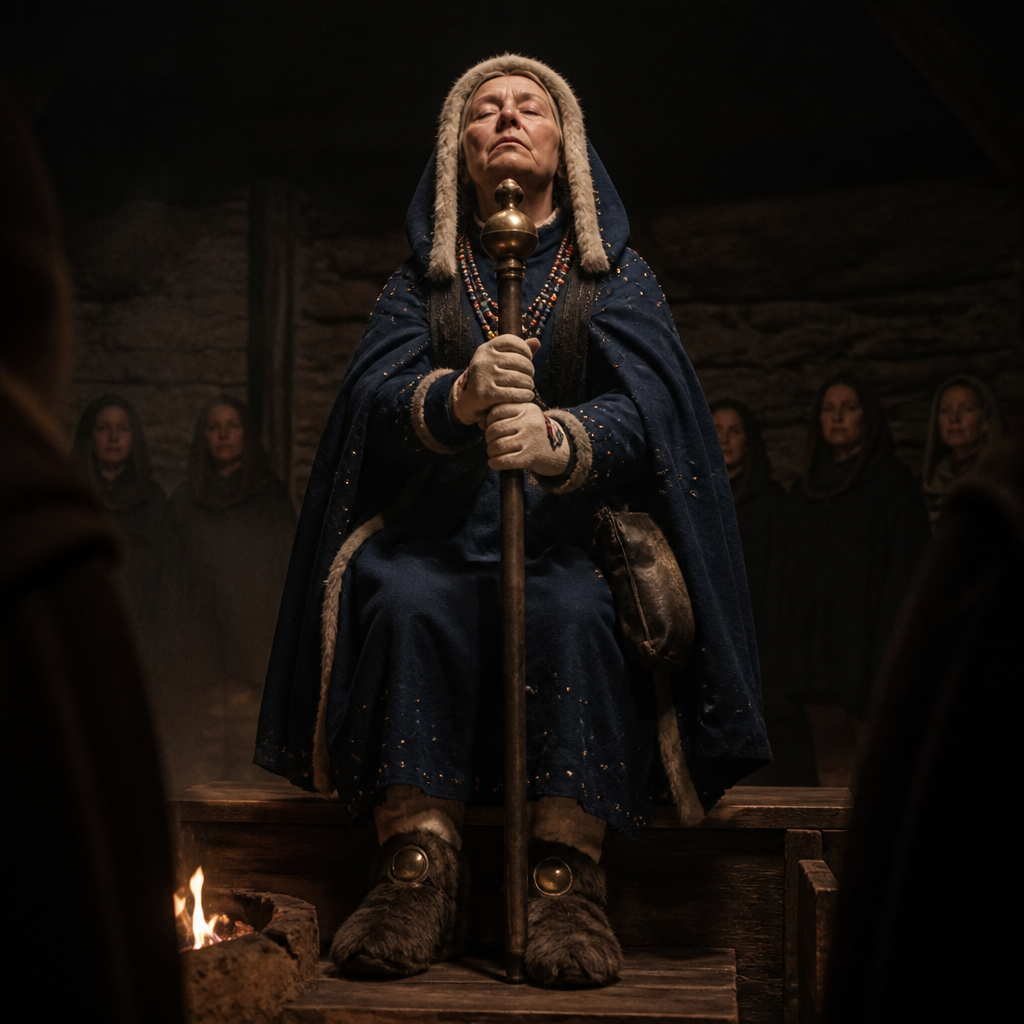
Völva
Also Known As: Old Norse vǫlva, plural vǫlur, from vǫlr, a staff; also called spákona, prophecy-woman, and in one saga simply the Little Sibyl
Region/Culture: Northern Europe
Mythos: Norse Mythology
Primary Type/Nature: Heroes and Mortals
Mythical Attributes: Seated on a raised platform and sung to by a ring of women, she goes somewhere the rest of the household cannot and comes back with the coming year in her mouth.
Role in Mythos: She is the travelling seeress of the Norse world, whose name comes from the staff she carries and whose profession is the practice called seiðr.
Relation to Humans: Farms invite her in when the season has gone wrong and want to know when it will stop, and she is fed, seated above everyone, and treated with an anxious courtesy that is not quite respect. Even Odin has to go and ask one, and in the one case where she has died first he raises her from the grave to do it.
She comes in the evening, with the man who was sent to fetch her, and the household has already had time to be nervous. Every person in the room greets her, and she answers each of them according to how much she likes the look of them. A high seat has been made ready with a cushion stuffed with hen feathers. She is taken by the hand and put up on it. Then she is asked to look at the farm, the animals and the people, and she says almost nothing.
Her name is Þorbjörg, and everyone calls her the Little Sibyl. She has had nine sisters, all of them in the same profession, and she is the only one still alive. It is a hungry winter in Greenland, the fishing has failed, some of the boats have not come back, and the biggest farmer in the district has decided it is his job to find out when this will end.
The Norse word for her is vǫlva, and it is built on vǫlr, a staff. She is the staff-woman, named for the thing she carries rather than for what she knows, and the object turns out to matter more than anyone reading the sagas alone would guess.
The description of her clothing in that Greenland account is one of the most detailed portraits of a working practitioner anywhere in medieval northern literature, and it reads like a costume assembled to be looked at. A cloak of dark blue, strapped shut, set with stones all the way to the hem. Glass beads at the neck. A hood of black lambskin lined with white cat fur, and gloves of catskin, white and furred on the inside. Calfskin shoes, hairy, with long tough laces ending in big brass buttons. A belt of touchwood carrying a large skin pouch, in which she keeps the things she needs for the work. And the staff, with a knob at the top, mounted in brass and set with stones.
Her dinner is prepared to a specification. A porridge made with goat’s beestings, the thick first milk after birth, and for meat the hearts of every kind of animal that could be found on the place. She eats it with a brass spoon and a walrus-ivory knife whose point has been broken off.
The next day she asks for women who know a particular song. Nobody in the house does, and a search is made, and eventually a young Christian woman named Guðríðr admits that her foster-mother taught it to her back in Iceland. She does not want to sing it, and says so, on the grounds of her religion. She is talked into it. The women make a ring around the platform, Þorbjörg sits up on it, and Guðríðr sings, and the writer of the saga says nobody present had ever heard a voice like it.
Afterwards the seeress thanks her and explains what has just happened. Many spirits came, she says, because they liked the song, and they were spirits who had been refusing to come and refusing to submit. Now a great deal is clear to her that was hidden before. The famine will lift in the spring. The sickness will go sooner than expected. And Guðríðr will make a good marriage in Greenland that will not last, and go home to Iceland, and found a line so bright that the seeress says plainly she cannot make out the end of it.
Then the household queues up and asks her about their own lives, one at a time. The saga notes that very little of what she told them failed to come true, and adds that the weather improved in the spring exactly as she had said.
That whole scene was long treated as a piece of thirteenth-century historical fiction, written by Christians reconstructing something they had never seen. Then the archaeology arrived. Something in the order of forty graves across Scandinavia have now been identified as belonging to women buried with iron staffs, often with unusual imported goods and unusual burial treatment. The clearest of them is a tenth-century grave at the Danish fortress of Fyrkat: the richest burial in that cemetery, a woman laid in a wagon body, in a blue costume worked with red and gold, with silver toe rings, a bronze bowl carried from somewhere in Asia, silver amulets in the shape of birds’ feet, a tiny silver seat of the kind the sources say a seeress sits on, and a pouch holding hundreds of henbane seeds. And a metal staff.
The staff was the thing the word had been pointing at all along.
Her powers are the ones the sources actually grant her, and they are narrower than the reputation. She sees what is coming, particularly the shape of the season and the fate of individuals. She works only when a group of people sing for her, which makes her the least solitary magician in European folklore. And the practice she belongs to, seiðr, is powerful enough that Odin himself learns it and is mocked for it, since it was held to be women’s work and shameful in a man.
Her limits are as clearly drawn. She cannot begin without the song, and in the Greenland account the whole ceremony nearly fails because nobody can remember the words. She does not command anything; the spirits come because they enjoy the music and can decline. She tells people what will happen and never changes it. And the most famous völva in the literature is dead when we meet her, hauled up out of her grave by Odin and made to talk about the end of the world, in the plainest statement anywhere of what these women were for and how little say they had in it.
Frequently Asked Questions
What is a völva in Norse mythology?
A völva was a Norse seeress and practitioner of the magic called seiðr, who travelled between farms performing prophecy. The name comes from vǫlr, a staff, after the wand she carried. She was seated on a raised platform, sung to by a ring of women, and afterwards answered questions about the coming season and about individual futures.
What did a völva look like?
Eirik the Red’s Saga describes one in unusual detail: a dark blue cloak strapped shut and set with stones to the hem, glass beads, a black lambskin hood lined with white catskin, catskin gloves, shaggy calfskin shoes with brass buttons, a belt with a large skin pouch of charms, and a staff topped with a brass-mounted knob set with stones.
Is there archaeological evidence for the völva?
Yes. Around forty Scandinavian graves contain women buried with iron staffs, frequently alongside exotic imported goods and unusual burial rites. The richest is Fyrkat grave 4 in Denmark, which held a woman in a wagon burial with a metal staff, silver bird’s-foot amulets, a miniature silver seat and a pouch of several hundred henbane seeds.
What is seiðr?
Seiðr is the form of Norse magic the völva practised, involving prophecy and contact with spirits, performed from a raised seat with the help of a sung incantation. It was regarded as women’s work, and the sources record that Odin’s own knowledge of it was held against him as shameful.
Did Odin consult a völva?
Yes, more than once. The poem Völuspá is a völva’s answer to him, delivered as a full account of the world from its beginning to Ragnarök. In another poem he rides to the underworld and raises a dead völva out of her grave to force her to explain the dreams troubling his son.
Related Entries
Odin, Norns, Freyja, Valkyrie, Ragnarök, Yggdrasil, Hel, Draugr, Fylgja, Hamingja, Landvættir, Mímir, Æsir, Vanir, Skadi