
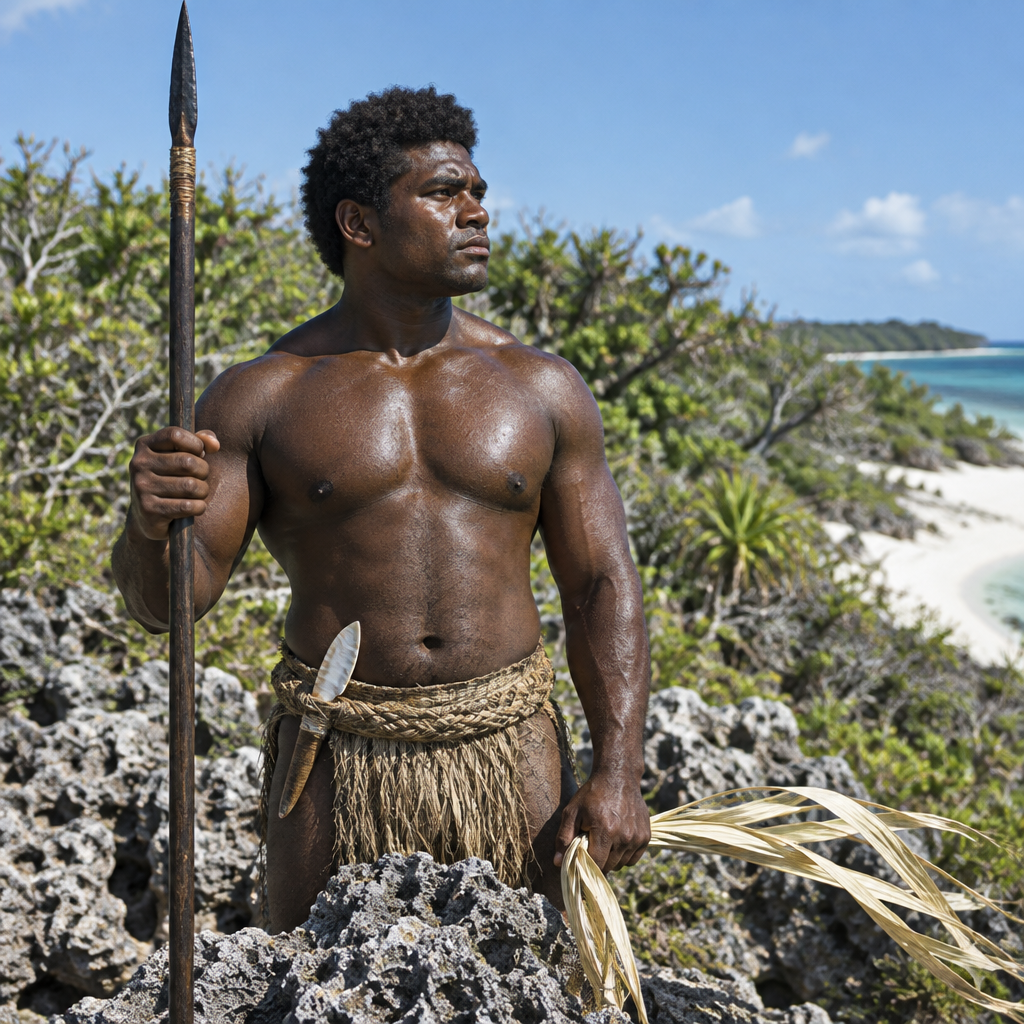
Tudava
Also Known As: Boyowan and Kilivila tradition of the Trobriand Islands, Milne Bay Province, Papua New Guinea; son of Bolutukwa, whose name is also given as Bolitukwa, Bolitubwa, Bolitewewa and Mitigis
Region/Culture: Oceania
Mythos: Papua New Guinean Mythology
Primary Type/Nature: Heroes and Mortals
Mythical Attributes: He carries his mother’s magic rather than any strength of his own, and every victory in his cycle is won by charmed leaf, charmed streamer and charmed bowl rather than by the spear he keeps choosing not to throw.
Role in Mythos: He is the culture hero who ends the man-eating of the ogre Dokonikan, puts yams in the place of human flesh, and leaves the gardening magic the islands still work by.
Relation to Humans: The Trobriand landscape is read as his leavings, with footprints in the paths, stones along the Kaibola reef and a clam shell at Laba’i that an elder remembered handling as a boy. Garden magicians address him by name at the opening of their spells, so he is spoken to rather than merely remembered.
Water came off the stalactites one cold drop at a time onto a woman asleep on the floor of a grotto in the coral ridge above Laba’i. She had not chosen to sleep there. Bolutukwa was the last person left on that stretch of the Trobriand coast, and the drip that fell on her is where the whole thing starts.
Everyone else had gone because of Dokonikan. He ate people. He had worked through Kiriwina village by village, cooking what he caught in a ground oven or boiling it, and the families still alive built canoes at Laba’i and pushed off for Keli. Bolutukwa’s brothers filled their hulls with wives, children and gear, and there was no room. The youngest came back for her, looked at his own crowded canoe, and said that if she died it could not be helped. He left her anyway.
So she lived in the rock, and after the water opened her she gave birth in a long, strange sequence: a bologu fish, then a pig, then the scented kuebila shrub that islanders wear as ornament, then a kalala fish, then a cockatoo, a parrot, a small bird called sikuaikua, a dog, and last of all a son. She named him Tudava. When Bronislaw Malinowski wrote that list down during his Trobriand fieldwork in the First World War, it overturned what he thought he had understood about Trobriand accounts of how a child is made.
The boy grew fast and grew big. One day he asked his mother why the two of them were living in the bush, and she told him plainly: there is a man here called Dokonikan, he killed your uncles and your grandparents, and he is the reason we are alone. Tudava said he would go and see him. She said he was too young. Then she said tomorrow.
That night she worked her magic over the leaves and the streamer, and in the morning she sent him out to throw his spear. It flew and pinned a lizard in a yakwala tree. He carried the thing home and asked whether that was the one. No, she said, that is a lizard, and when the dancing season comes we will take its skin for a drum. He went back and speared a frog. That is food, she said, for the dry months when nothing else is in the bush. He went back and speared a cuscus. Food again. He threw once more at a place called Kwepuboya and the spear came down on nothing at all, and he stood there working out where the ogre actually lived. The ground still carries the name of him standing and thinking. Then he threw the charmed pandanus streamer. It went out to Mwatawa and came back against his chest. He threw it toward the rocky scrub inland, and it broke its string and vanished into the bush, and he followed.
Dokonikan was sitting under a mokakana tree with his head bent over a length of string he was plaiting, red fruit scattered around him where birds had knocked it down. He was swearing at the birds for wasting his food. Above him Tudava scratched a fruit with his thumbnail and dropped it so it landed against the ogre’s leg, and Dokonikan picked it up, turned it over, and found a human mark on the skin.
What followed was almost courteous. Dokonikan called up into the branches to ask where his friend lived, and Tudava came down and said he had heard this man killed people and had come to see for himself. Then he began feeding him. The charmed vana bundles went into the ogre’s mouth one after another, and the image the telling reaches for is fish stunned by poison on the reef, drifting up to knock their heads against the coral. Dokonikan went along quite happily. Tudava walked him from morning until afternoon, back over the ground where he had thrown his practice spears, down to the shore at Labai, and by then the huge body had gone soft and slow and stupid.
At the water’s edge Tudava swung on a rope called pilipali, touched the ogre’s shoulder with his foot, and pulled the foot back. Dokonikan twisted round, chopped off his own arm and ate it, certain he had caught a leg. The other arm went the same way, then a leg, and the body came down. He never felt any of it. Tudava picked up a clam-shell knife and told him whose uncles he had eaten before he cut through the neck. The man who told this story at Laba’i in 1971 said the shell was still lying about the village when he was young, and that he had seen it himself.
He ran his spear through the eyes to carry the head. Standing on the ground at Pulula he shouted, and along the coast the birds and the leaves and the fish jumping in the shallows were making such a racket that his mother had to tell them all to be quiet before she could hear her son’s voice.
The head went to Keli by water, in a wooden bowl she sang over and set on the current. It knocked at the eldest brother’s doorway and floated off before he could reach it, and did the same at the second and the third and the fourth. At the fifth it stayed. The youngest brother, the one who had cried for his sister before abandoning her, carried it in, blew up the fire and understood what he had. He hid it in his wife’s basket, sent his brothers and their sons out to cut yam stakes, and spent the day cooking mashed yams. When the men came back hungry he sat them around the pot. They ate down through the good food at the top until a shell scraped something hard near the bottom, teeth set in the pudding like the boss of a shield.
They sailed to Laba’i to see what their sister had borne. Tudava sat with his back to the sea and made his mother call out their progress, island by island, while she begged him not to kill her brothers. Each uncle led out a daughter and threw down a veguwa, one of the valuables, and Tudava sorted the girls to the right and the left by which man had fathered them. The youngest brother’s daughter he kept and married. The other four he killed on the shore, and the teller says the bones can still be pointed out. A culture hero is not obliged to be kind.
His power is almost entirely borrowed. The streamer that finds the ogre, the leaves that unhinge him, the bowl that hunts down the one brother who deserved to receive it, all of these are his mother’s work, and he never does land the spear he keeps deciding not to throw. What he has of his own is size and a very long patience. It is also a word that turns people to stone: the women of Kaibola laughed at him from the reef as he paddled past and are standing there yet, red-haired, children on their backs. He left similar evidence up the coast, stone where he stopped, stone where he squatted.
Underneath the adventure sits the reason he matters. He belongs to the Lukuba clan and Dokonikan to the Lukwasisiga, and his cycle runs the same way as every other Trobriand migration story, north to south and west to east, which is how the islands remember somebody arriving with new things. The new thing was food. He put yams where men had been, and the cannibalism stops in his generation and does not come back. Garden magicians have opened their spells with his name ever since, over the taro beds and the yam beds, asking to be regarded, asking for the garden watched unfailingly and weedless.
He did not stay to rule any of it. He went along the coast and out to Nadili, where he is said to be living on an island he thickened the air around so that nobody can find it. He can still be heard, though. When he kills a pig the squeal carries over the water, and when he coughs, that carries too.
Frequently Asked Questions
Who is Tudava?
Tudava is the great culture hero of the Trobriand Islands of Papua New Guinea, born in a cave at Laba’i to a woman left behind when her brothers fled the island. He killed the man-eating ogre Dokonikan, ended cannibalism by putting yams in the place of human flesh, and left the islands the garden magic their magicians still recite.
How was Tudava born?
His mother Bolutukwa, also called Mitigis, was sheltering alone in a grotto in the coral ridge above Laba’i when water dripping from the stalactites fell on her and opened her body. She then gave birth in succession to a fish, a pig, a scented shrub, a second fish, a cockatoo, a parrot, a small bird, a dog, and finally to Tudava.
How did Tudava kill Dokonikan?
He did not fight him. Using charmed leaf bundles his mother had prepared, Tudava fed the ogre until his mind failed, then walked him all day to the shore and dangled a foot against his shoulder, so that Dokonikan hacked off and ate his own arms and a leg believing he had caught Tudava. Tudava then cut off his head with a clam-shell knife and carried it away on his spear.
What happened to Tudava’s uncles?
Tudava sent Dokonikan’s head to Keli in a bowl floated on the current, and it stayed only at the door of the youngest uncle, the one who had wept for his abandoned sister. That uncle hid the head at the bottom of a pot of mashed yams and let his brothers eat down to it. When the men sailed to Laba’i, Tudava took the youngest brother’s daughter as his wife and killed the other four daughters on the beach.
Why is Tudava important to the Trobriand Islands?
Tudava is credited with the yam and taro gardening that Trobriand life is built on, and Trobriand garden magicians still address him by name at the opening of their spells. He is also claimed as an ancestor of the Lukuba clan, and features of the landscape, including footprints in the paths and standing stones along the Kaibola coast, are explained as traces he left behind.
Related Entries
Kilibob (Kulbob), Afek, Masalai, Suangi, Qat, Qasavara, Tagaro, Marawa, Abaia, Adaro, Māui, Tāwhaki, Gadao, Paikea