
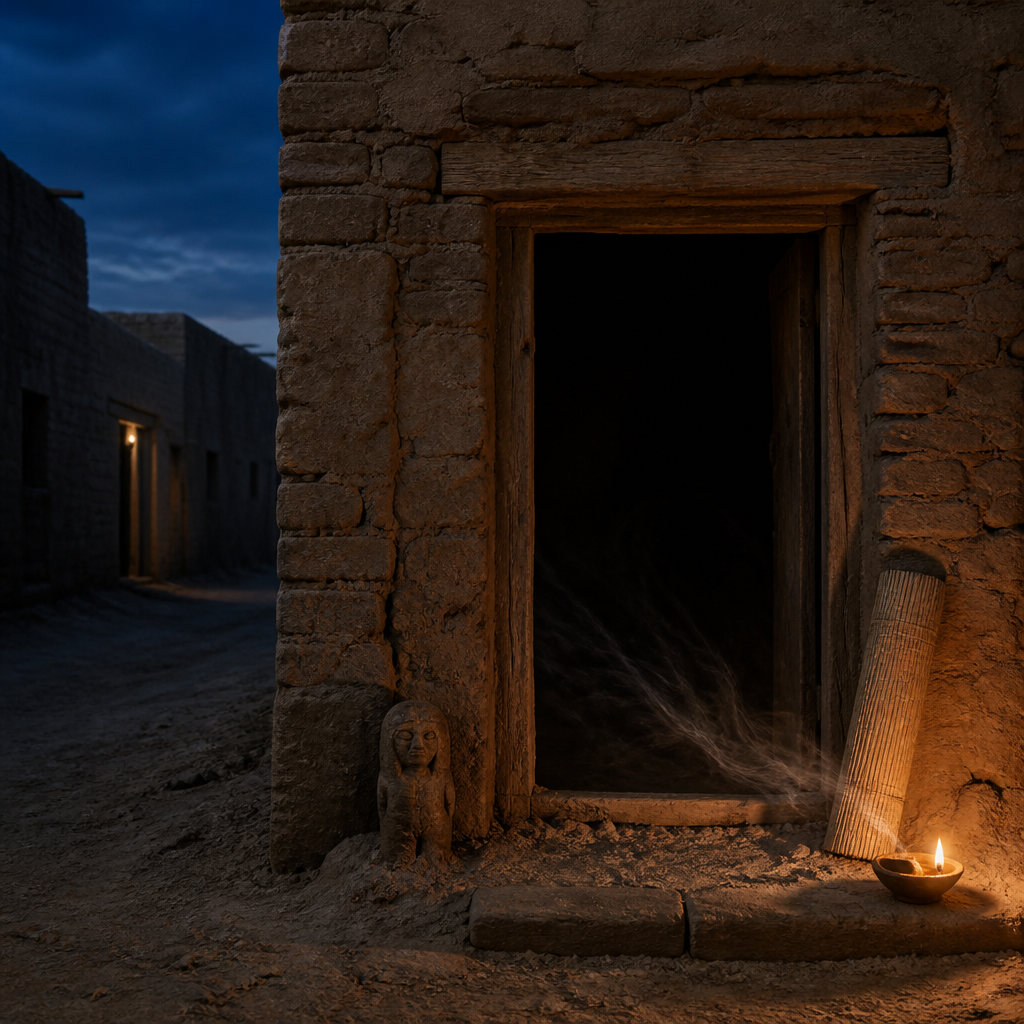
Rabisu
Also Known As: Akkadian rābiṣu, “the croucher” or “the lurker,” from the verb rabāṣu, “to lie in wait”; written with the Sumerian sign maškim; also rendered Rabasa, “the Lingerer”
Region/Culture: Mesopotamia and Ancient Near East
Mythos: Akkadian/Assyrian/Babylonian Mythology, Mesopotamian Mythology, Sumerian Mythology
Primary Type/Nature: Demons and Devils
Mythical Attributes: A wind-borne lurking spirit that crouches at thresholds and other boundaries to spring on those who pass, afflicting them with sickness or misfortune.
Role in Mythos: In the incantation literature it is a subordinate agent of divine will, dispatched by the god Enlil to punish human transgression rather than an independently evil power.
Relation to Humans: Ordinary Mesopotamians feared it as one of the swarm of unseen spirits waiting at doorways, wells, and dark corners, and warded it off with amulets, threshold rituals, and burning incantations such as the Šurpu series. Because it struck at the boundaries of a house, protective figures and guardian gods were stationed at precisely the places it was thought to wait.
At the hour when the light drains out of a Babylonian street and the mud-brick walls give back the last of the day’s heat, the doorways go black first. That darkness in the doorway had a name. The rabisu was the thing that waited there, folded into the shadow where the threshold met the street, patient as a landlord and about as welcome. It did not chase. It crouched, and it let the world come to it.
The name says almost everything the Mesopotamians were willing to commit to clay about it. Rābiṣu is a plain grammatical form of the verb rabāṣu, “to lie in wait,” so the word means simply “the croucher,” the one who lies in ambush. There is a small joke buried in the etymology, and the scribes would have felt it. The very same word, written with the Sumerian sign maškim, named an ordinary court official, a bailiff or commissioner who conducted the preliminary examination at a trial and stood witness to contracts. In the letters from Amarna and Ugarit a rabisu is a royal agent, a man of rank. Somewhere along the way the term for a functionary who lurks at the edge of your legal affairs became the term for a spirit that lurks at the edge of your house. Both meanings survived side by side, which tells you how the Mesopotamians felt about officials.
Ask what it looked like and the record goes quiet. Pazuzu has his snarling dog’s face and his clawed feet, cast in bronze by the thousand. Lamashtu has her lion’s head, her donkey, the piglets at her breast. The rabisu has none of this. No Assyrian craftsman ever gave it a body, because it was never really a body. It was a position and an action, a lurking where there should be none. When the texts reach for an image they reach for weather. The rabisu moves like a current of air, and it comes in flocks, the way a dust storm comes, many of them at once on the same hot wind. Walls are no defence against something shaped like wind. It slides under the door, through the gap in the reed matting, into the room where you thought you were alone.
Where such a thing comes from is a stranger question than it looks, because for a long stretch of its history the rabisu was not evil at all. In the demonology worked out by the scribes it was a neutral being, a kind of errand-wind sent down by Enlil, the storm god who ruled the pantheon and decreed the fates. Enlil dispatched the rabisu the way a king dispatches an officer. Whether its arrival meant ruin or reward was not a matter of the spirit’s own malice but of what the human on the receiving end had done. When the incantations call it rābiṣ lemnu, the “evil croucher,” the evil belongs to the deed it is sent to perform, not to the creature itself. It is the arrow, not the archer. That is a colder theology than a simple monster, and in some ways a worse one, because it means the thing at your door is not breaking any rules. It was sent.
The old poem called the Curse of Agade shows the machinery at full stretch. Naram-Sin, grandson of Sargon and lord of a city that had never lost a war, turns against Enlil and pulls down his temple at Nippur. Enlil’s answer is not a duel but a weather system. He looses ruin out of the eastern mountains and a wind that will not turn back, and destroyers pour into the streets and the houses, and Akkad, which no army could take, is simply erased. The wind-borne agents of that catastrophe are cut from the same cloth as the rabisu, spirits that need no gate because they arrive as air. A city offers no protection when the punishment is the atmosphere itself.
The most famous crouch of all may not be Mesopotamian, or may be Mesopotamian underneath. In the fourth chapter of Genesis, God warns Cain that if he does not do well, “sin is crouching at the door; its desire is for you, but you must master it.” The Hebrew word for that crouching thing, rōbēṣ, is the exact cognate of Akkadian rabāṣu, and one modern translation drops the euphemism and calls it plainly a demon lurking at the door. Whether the writers of Genesis borrowed the picture or simply shared it, the image is the one the Babylonians already knew by heart: a hostile presence folded into the doorway of a man who is about to make a bad decision, waiting for him to step across.
Against it the Mesopotamians brought the whole apparatus of threshold magic. Its name appears in the great banishing series, the Šurpu, among the demons whose grip is burned away by ritual, and it was fought with amulets, with muttered incantations, and with small clay guardian figures buried at the doorway to hold the line it was thought to haunt. The winged bulls at the palace gates, the lamassu and the shedu, kept watch over exactly the boundaries the rabisu wanted. Its natural enemy was the god of the watched night, Ishum, the torch-bearing herald who walked the sleeping streets and kept the lanes lit while the lurkers sat in the dark. Here is the limit built into the creature. Its whole power is positional. It has to lie in wait at a boundary, and it strikes only what comes across unready. Bind it with the right words, station a guardian at the threshold, carry the right charm, or simply be a soul under no divine sentence, and the thing in the doorway has nothing to say to you. It cannot come in after you. It can only wait.
The modern imagination has been less disciplined than the cuneiform record. A 1970s occult paperback recast the rabisu as an ancient vampiric fiend, and a recent horror game filled a buried Iraqi temple with bat-winged Mesopotamian bloodsuckers wearing its name. It makes for good nightmares. It also hands a face to a thing that pointedly never had one. The rabisu the scribes actually feared was quieter and worse: a patch of waiting darkness at the one place the day forces everyone to cross.
Frequently Asked Questions
What is the Rabisu in Mesopotamian mythology?
The Rabisu is an ancient Mesopotamian demon whose name means “the croucher” or “the lurker.” It was believed to wait at thresholds, doorways, wells, and dark corners to ambush people as they passed, afflicting them with sickness or misfortune.
Is the Rabisu evil?
Not originally. In Akkadian demonology the Rabisu was a morally neutral spirit, a wind-like agent dispatched by the god Enlil to punish human wrongdoing. When texts call it the “evil Rabisu,” the evil refers to the harmful task it was sent to carry out rather than to its own nature.
What does the Rabisu look like?
No ancient Mesopotamian source describes a fixed appearance for the Rabisu, and unlike Pazuzu or Lamashtu it was never depicted in art. It was imagined as a formless lurking presence or a gust of wind rather than a creature with a body.
How did people protect themselves from the Rabisu?
Mesopotamians warded off the Rabisu with amulets, protective incantations, and threshold rituals, including the banishing series known as the Šurpu. Guardian figures such as the lamassu and shedu, along with the night-watchman god Ishum, were associated with guarding the boundaries where the Rabisu was thought to wait.
Is the Rabisu connected to the Bible?
The Rabisu is widely linked to Genesis 4:7, where God warns Cain that “sin is crouching at the door.” The Hebrew word for the crouching thing, rōbēṣ, is a cognate of the Akkadian rabāṣu, and some translations render it directly as a demon lurking at the door.
Related Entries
Utukku, Gallu, Alû, Asakku, Asag, Edimmu, Labartu, Pazuzu, Lamassu, Shedu, Ishum, Enlil, Lilith