
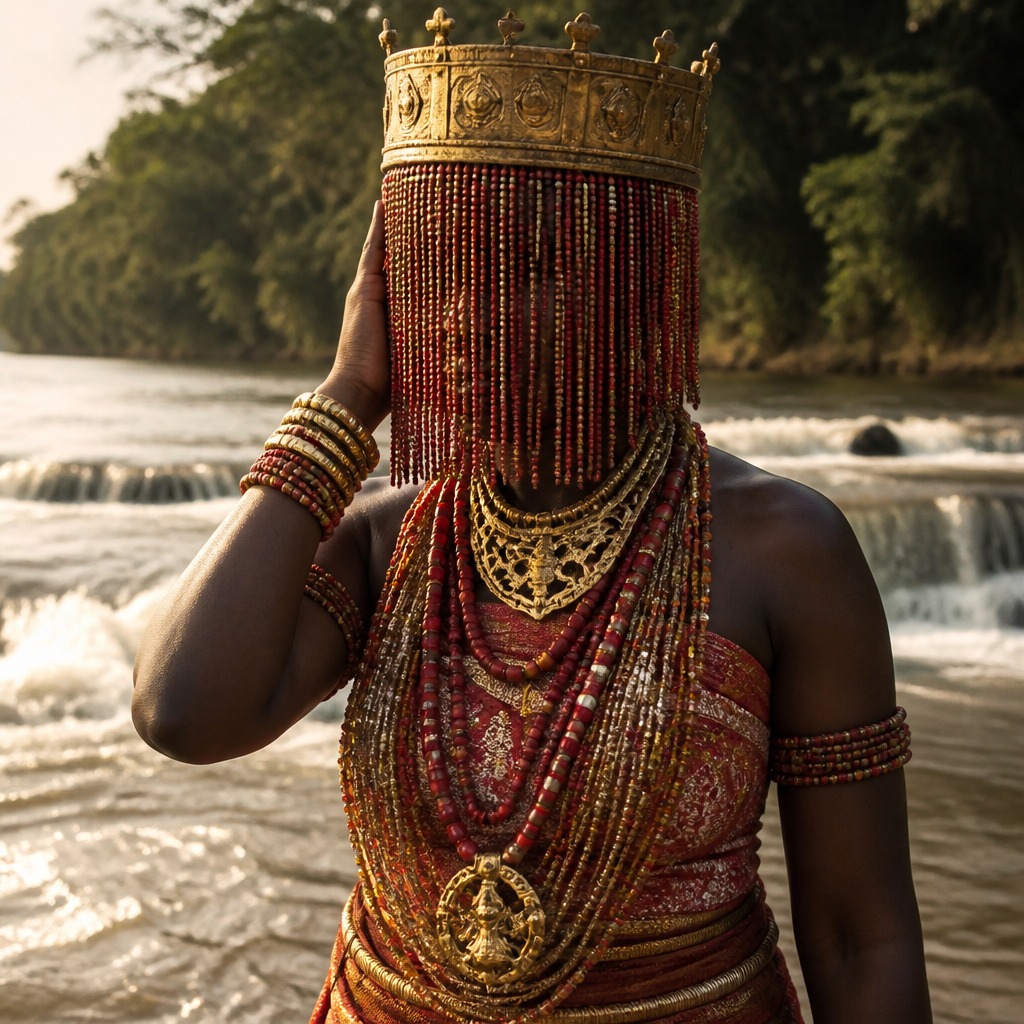
Ọba
Also Known As: (also written Ọbà; Obá in Cuba and Brazil), orisha of the Ọba River, senior wife of Shango
Region/Culture: West Africa
Mythos: Yoruba Mythology, Brazilian Mythology, Caribbean Mythology
Primary Type/Nature: Gods and Deities
Mythical Attributes: She is the water of the Ọba River itself, and the severed ear that stands for a wife’s counsel given past the point of sense.
Role in Mythos: She is the senior of Shango’s three wives, tricked by a co-wife into mutilating herself for him, and driven out of his house into the riverbed she has occupied ever since.
Relation to Humans: The farmers and fishermen strung along her whole length live off her water, and at Ogbomoso her worshippers praise her as an owner of parrot tail feathers who fights on the left. Her devotees in Cuba and Brazil come to her for marriage, fidelity and the loyalty that costs something.
The water comes down out of the savanna north of Ogbomoso brown and unhurried, past the dam, past villages of okra and maize, and then it stops being polite. Where the Ọba runs into the Ọ̀ṣun the two rivers break apart over rock and shout at each other in a long stretch of rapids. People have been explaining that noise for centuries, and the explanation involves two wives, one husband, and a knife.
Ọba is the river, and the river is named for her. It rises about fifteen kilometres north of Ogbomoso, runs south as the main tributary of the Ọ̀ṣun, and carries her name the whole way down. Her worship began at the head of it, near Igbon, and moved into the safer walls of Ogbomoso when the nineteenth-century wars made the countryside untenable. She was the senior of the three wives of Shango, the fourth Alaafin of Oyo and the orisha of thunder, sharing him with Ọ̀ṣun and Ọya. In a household of that shape, seniority is a position to be defended rather than a comfort.
The story everyone knows starts with a question asked in good faith. Ọba wanted to know how to hold her husband’s attention, and Ọ̀ṣun told her, in the confidential tone of a woman handing over something precious, that Shango’s favourite dish was made with a human ear. Ọba went looking for one in the market and found none for sale. So she took a blade to her own head, and dropped what she cut into the amalá, which in Brazil is puréed okra thickened with palm oil and dried shrimp, and set it steaming in front of him.
He asked what was in it before he ate. She told him. What happened next is the same in every telling: revulsion, shouting, and a woman running out of a house she will not return to. In the Yoruba version she runs until she falls, and where she falls she becomes water. Ọ̀ṣun runs too, and that is why the meeting place of the two rivers is so violent.
The tellings scatter once they leave Nigeria. William Bascom collected versions across Yoruba country, Cuba and Brazil in the 1970s, and found the trickster changing hands: in several Cuban accounts it is Ọya rather than Ọ̀ṣun who does it. One Cuban version drops the rivalry entirely and turns the act into logistics. The goat has run out, Shango needs feeding for his fight with Ogun, and Ọba cuts off both ears because there is nothing else in the house. The verses of the Odu Ifá go the other way and let the gesture work: she gives her ear on Ifá’s advice, and it binds Shango to her precisely because none of his other wives would sit still and listen. Ọya had her own campaigns. Ọ̀ṣun had other men.
Bascom also found the thing that makes her interesting. The story is known across the Yoruba world and both sides of the Atlantic, and her own priest at Ogbomoso did not recognise it. The most famous fact about her is not told where she is actually worshipped. There they praise her as the one who owns parrot tail feathers and fights on the left, which is the language of rank and war rather than of a woman weeping over a soup pot, and it suggests an older Ọba underneath the one the diaspora carried away.
Nobody in the Nigerian record describes her face. The Ọba you can look at is the one they make in Brazil: a small beaded figure in gold and red, heavy in the hand, under a brass crown hung with a fringe of strands. Brazilian practitioners call that fringe the chorão, the crybaby, and read it as her tears of joy, though the fringe on a Yoruba monarch’s crown does a colder job, hiding the face and shielding the country from the force of the royal gaze. Her right hand is raised to the side of her head. The gesture is always the same and it is never explained on the object itself, because it does not need to be.
She reached Cuba and Brazil inside the same cargo as the rest of the orisha, and settled there as the patron of marriage and of the loyalty that costs something, syncretised with Saint Catherine of Siena. In Candomblé she arrives third in Xangô’s house, after Oxum and Iansã, which is a demotion from the Nigerian arrangement and tells you which co-wife the Brazilian tradition considers most important.
What she can do, she does as water. She feeds a basin of farms and fishing villages from Ogbomoso down to the confluence, and the reservoir built across her in 1964 still supplies the town that took her worship in. Her power in the shrines is the power of the sacrifice itself, of a thing given that cannot be taken back, which is why people bring her the parts of a marriage that have gone wrong.
Her limit is written into the same gesture. She is the wife who listens, and a listener is the one you can lie to. Every version of her story turns on her believing something, and no version has her checking it first. There is a newer limit too, and it is not mythological. Her river now runs at the bottom of the pollution scale, sewage and market waste and very little dissolved oxygen, and the fish taken from her reservoir have been found carrying parasites. The rapids at the confluence are still loud.
Frequently Asked Questions
Who is Oba in Yoruba mythology?
Oba is the orisha of the Oba River in southwestern Nigeria and the senior wife of Shango, the orisha of thunder and the fourth Alaafin of Oyo. Her worship began near Igbon at the river’s source and relocated to Ogbomoso during the wars of the nineteenth century. She is worshipped alongside her rival co-wives Oshun and Oya.
Why did Oba cut off her ear?
Oshun told Oba that Shango’s favourite dish was made with a human ear, presenting it as a secret shared between co-wives. Unable to buy one at the market, Oba cut off her own and served it to Shango in a stew. He was appalled when she admitted what was in the bowl, and she fled his house in humiliation.
How did Oba become a river?
In the Yoruba telling, Oba ran from Shango’s anger, fell, and turned into the river that carries her name. Oshun fled at the same moment and became her own river. Where the two rivers meet the water breaks into rapids, and the tradition explains that turbulence as the rivalry between the two wives.
Do all versions of the story agree?
No. In several Cuban accounts it is Oya rather than Oshun who tricks her, and one Cuban version removes the rivalry entirely, with Oba cutting off both ears simply to feed Shango during his conflict with Ogun. In the verses of the Odu Ifa the gesture succeeds and binds Shango to her. William Bascom, who collected versions in Nigeria, Cuba and Brazil, found that her own priest at Ogbomoso did not recognise the story at all.
Who is Oba syncretised with in Cuba and Brazil?
Oba is syncretised with Saint Catherine of Siena. In Brazilian Candomblé she is Obá, the third wife to enter Xangô’s house after Oxum and Iansã, and her shrine figures show her in gold and red beadwork with one hand raised to her ear.
Related Entries
Shango, Oshun, Yemọja, Obatala, Ogun, Eshu, Orunmila, Oshosi, Olokun, Babalú-Ayé, Ajé, Mami Wata