
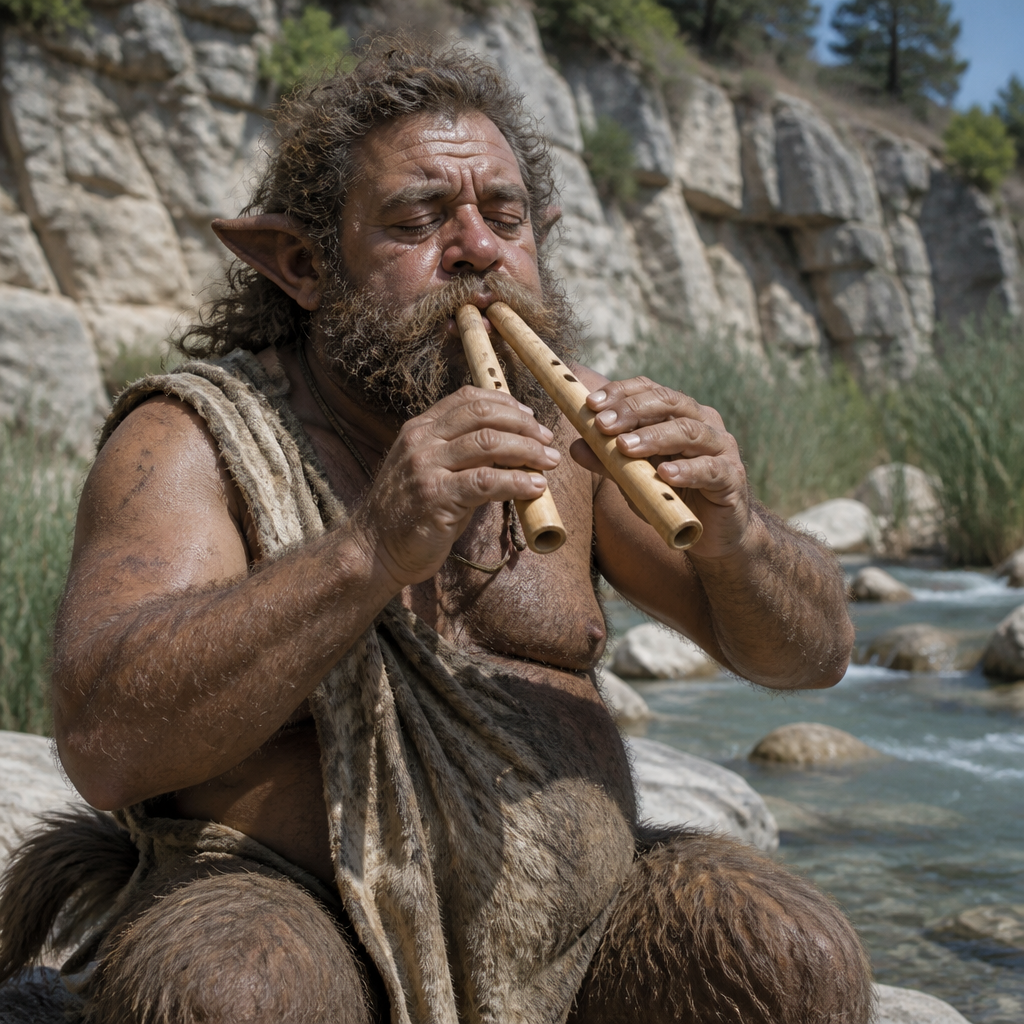
Marsyas
Also Known As: Greek Marsyas; a Phrygian silenos or satyr, son of Hyagnis or of Olympos or of Oeagrus depending on the source; also the name of the river at Celaenae
Region/Culture: Southern Europe
Mythos: Greek Mythology, Roman Mythology
Primary Type/Nature: Fairy Folk and Spirit Beings
Mythical Attributes: He plays the double pipes better than anything else alive and is destroyed for being better at them than a god is at something else.
Role in Mythos: He picks up the flute Athena threw away, challenges Apollo to a musical contest, loses on a technicality, and is flayed alive.
Relation to Humans: The Phrygians of Celaenae kept his skin hanging in their marketplace and said it stirred when a Phrygian tune was played near it and hung dead when the music was Apollo’s. Centuries later the Romans put a statue of him in their own Forum and made it stand for the freedom of a city.
The instrument is lying in the grass by the river because a goddess has just thrown it there in a temper. Athena invented it, drilled the holes through the boxwood herself and liked the sound very much, and then caught sight of her own reflection in the water while she was playing and saw what blowing does to a face. She threw it down on the bank and swore that whoever picked it up would be sorry. Marsyas picked it up.
He was a silenos of Phrygia, one of the heavy older satyrs, and the accounts of his parentage do not agree, which is normal for satyrs. What is agreed is that he taught himself the thing. He worked out that breath makes the sound, learned the fingering, practised, and got better day by day until he was making music sweeter than anyone had heard, and then he did the one unrecoverable thing and said so out loud. He challenged Apollo.
The terms were fixed in advance: the winner could do whatever he liked with the loser. The Muses judged, and in one telling Midas of Phrygia was there as well, since Midas turns up at every musical contest in that part of the world.
What happens next is the reason the story is remembered as unfair rather than as tragic. Marsyas plays and is winning. Then Apollo turns his lyre upside down and plays the same tune again, and invites his opponent to do the same with the pipes. A lyre held the wrong way up still works. A flute held the wrong way up is a stick. That is the whole contest.
Ovid does not spend a word on the verdict and goes straight to the skin. The satyr screams a question that is one of the most quoted lines in the poem, asking why he is being torn away from himself, and then says that a pipe was not worth this. Then the description, which is unusually exact: the whole of him one wound, blood everywhere, the sinews bare, the veins uncovered and still pulsing, the guts visible and twitching, and the light coming through between his ribs. In other versions Apollo does not do it himself but hands him over to a Scythian with a knife, which is somehow worse.
Everyone in the countryside cried, and the ground could not absorb it. The tears of the fauns and the satyrs and the nymphs and the herdsmen soaked in, ran together in the earth’s veins, and came back out as a river, and the river is called the Marsyas, and Ovid ends the passage by calling it the clearest stream in Phrygia.
There was a real river of that name. It rose in the marketplace of Celaenae, ran through the town and joined the Meander, and travellers wrote about it. Herodotus went past with an army and recorded the local story: the skin of Marsyas the silenos was hanging in that marketplace, and the Phrygians said Apollo flayed it off him and hung it there himself. Several centuries later Aelian passes on the detail that gives the whole business its atmosphere. Play a Phrygian tune near the skin and it moves. Play something in Apollo’s honour and it hangs there like a dead thing and does not hear you.
The Greeks kept turning the story over without settling it. Diodorus says that Apollo repented afterwards, tore the strings off his own lyre and had nothing to do with music for a while. Pausanias says the pipes themselves were carried down the Marsyas into the Meander, came up again in another river entirely, washed ashore in Sicyonian territory and were given to Apollo by the shepherd who found them, so that the god ended up owning the instrument that had beaten him. Plato, in one of the drier jokes in the dialogues, has Socrates offer to be skinned so long as his hide is not turned into a wineskin like the satyr’s.
The Romans took him somewhere nobody would predict. In the Forum at Rome there stood a statue of Marsyas, a broad satyr with a wineskin over one shoulder and his right arm raised, and it was not a warning. It stood for libertas, and Servius records that free cities in the provinces put up copies of it in their own fora. The image turns up on Republican coins, on a carved relief of Trajan’s day, on lamps, and on the coinage of eastern cities two and three hundred years later, where it announces that the town is a Roman colony with the standing that goes with it. The god flayed him for presumption and the empire adopted him as the sign of a city allowed to speak.
His powers are limited and total. He can play the aulos better than any other being in the record, human or otherwise, and that is all. He has no strength, no cunning, no protector and no cult worth the name outside his own valley, although the Phrygians at Celaenae credited him with turning back an army of Gauls with the water of his river and the sound of his flute.
His weakness is that the contest was never about music. Apollo does not beat him at playing; Apollo changes the test to something a stringed instrument can do and a wind instrument cannot, and then collects a prize that was agreed before anyone knew what the terms would mean. Marsyas names his own punishment in one late telling, saying he will be skinned for a wine-sack, which is the closest the tradition comes to admitting that he understood the rules perfectly well and played anyway.
Frequently Asked Questions
Who was Marsyas?
Marsyas was a Phrygian silenos, a heavy older satyr, who found the double flute that Athena had thrown away and taught himself to play it. He challenged Apollo to a musical contest on the agreed terms that the winner could do as he liked with the loser, lost, and was flayed alive.
How did Apollo beat Marsyas?
By changing what was being tested. After Marsyas had played well enough to be winning, Apollo turned his lyre upside down, played the same tune again, and challenged Marsyas to do the same with the pipes. A lyre works upside down and a flute does not, so Marsyas could not answer and the Muses gave Apollo the victory.
Why did Athena throw away the flute?
She had invented it and liked the sound, but caught sight of her reflection in the water while playing and saw how the instrument distorted her face. She threw it onto the riverbank and declared that whoever picked it up would be punished. Marsyas found it there.
What happened to the skin of Marsyas?
The Phrygians of Celaenae said Apollo hung it in their marketplace, and Herodotus records seeing the story attached to the town. Aelian passes on the local claim that the skin would stir when someone played a Phrygian tune nearby, and hang motionless when the music was in honour of Apollo.
Why was there a statue of Marsyas in the Roman Forum?
The Forum Marsyas showed him as a satyr with a wineskin on his shoulder and one arm raised, and it stood for libertas rather than for punishment. Servius records that free cities in the provinces set up copies in their own fora, and the image appears on Roman coins and on provincial city coinage as a mark of colonial status.
Related Entries
Apollo, Athena, Midas, Pan, Satyr, Silenus, Faun, Nymph, Naiad, Arachne, Niobe, Cybele, Sabazios, Dionysus, Artemis