
Lagarfljot Worm
Also Known As: Icelandic Lagarfljótsormurinn, “the worm of Lagarfljót”; the serpent of the long glacial lake beside Egilsstaðir in East Iceland
Region/Culture: Northern Europe
Mythos: Icelandic Mythology, Cryptids
Primary Type/Nature: Monsters and Beasts
Mythical Attributes: A serpent that grew from a small heath-worm guarding gold until it filled a lake, now held to the bottom by bindings at its head and tail so that only its humps ever break the surface.
Role in Mythos: It is the great lake monster of East Iceland, whose appearances were read as warnings of hard years and momentous events to come.
Relation to Humans: In the folk tale it once spat poison and killed the people and animals crossing the water, until it was bound and made harmless. Since then it has been a thing to watch for rather than to fear, reported by farmers, foresters and travellers from the fourteenth century to the twenty-first.
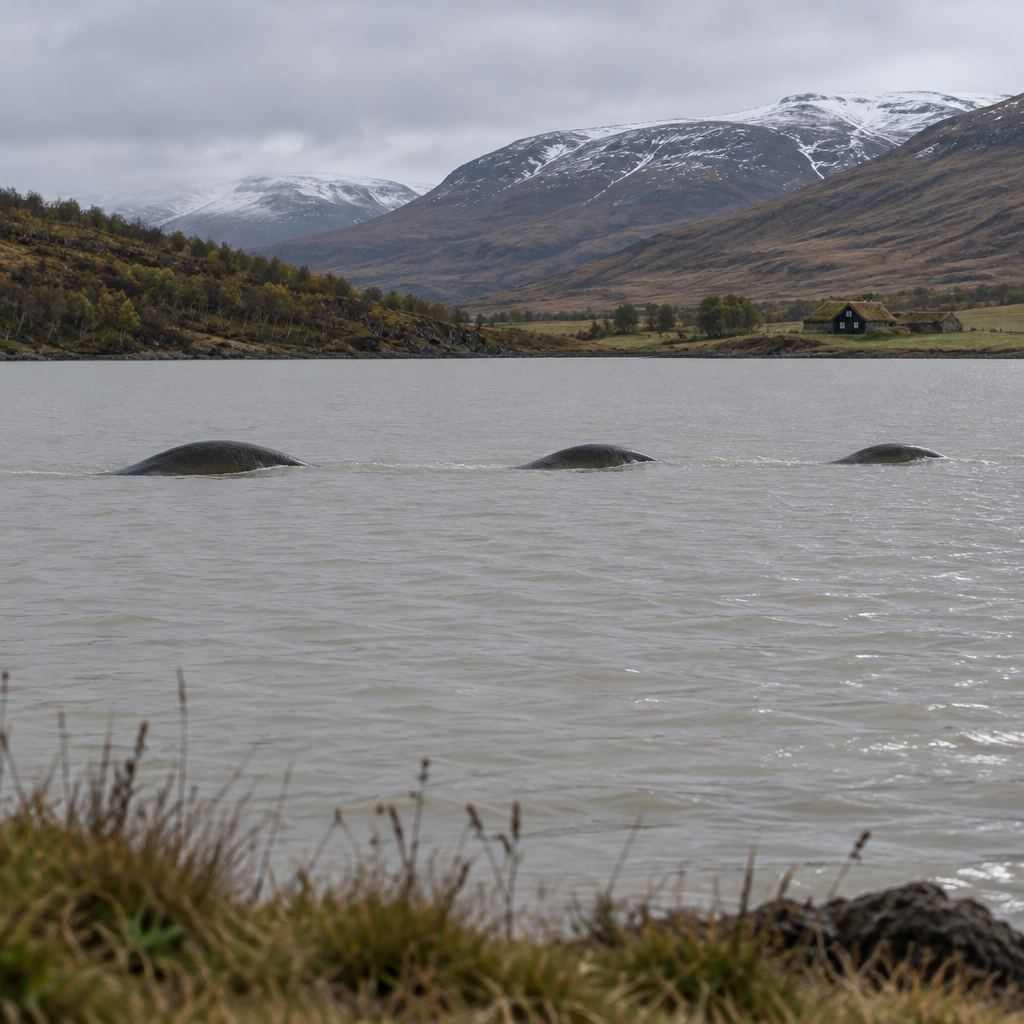
Out on Lagarfljót the water is the colour of milky tea, thick with glacial silt, and nothing below the surface can be seen at all. On a calm day the lake lies flat as pewter for miles. Then something lifts out of it. A dark hump, then another some way off, then a third, low and smooth like islands that were not there a moment ago. No head. No tail. And then the lake is flat again.
That is very nearly the oldest account there is. An Icelandic annal for the year 1345 records a marvel seen in Lagarfljót: shapes standing out of the water like islands or humps, a long way apart, with nobody able to make out either a head or a tail. The annal does not call it a worm. It calls it a wonder and leaves it there.
The story of how it got into the lake came later, and Jón Árnason printed it in his great collection of Icelandic folk tales in 1862. A woman on a farm by the lake gave her grown daughter a gold ring. The girl asked how to make the most of it, and her mother told her to lay it under a heath-worm, a small crawling creature of the moorland, because gold kept that way would grow. So the girl found one, put the gold beneath it, and shut both away in a little wooden box.
A few days later she opened the box. The worm had grown so much that the box was splitting at the seams. Frightened, she threw the whole thing, worm, gold and box, into the lake. That was the last mistake anyone made with it for a while. The worm kept growing in the water until it was huge, and it began to attack anyone who tried to cross, spitting poison and killing people and livestock on the banks.
The farmers sent for two Finns, which in Icelandic tradition meant sorcerers from the far north, very likely the Sámi, whose magic was held in awe. They were to kill the worm and bring back the gold. They dived into the lake and came up again almost at once. The worm, they said, was too strong to kill, and the gold could not be had. Under the gold, according to one telling, lay a second worm far worse than the first. So they did the next best thing. They bound the beast with two cords, one fastened behind its fins and one around its tail, and pinned it to the bottom. Since then it has harmed nobody. Now and again it heaves its back up above the surface, and that is when people on the shore take notice.
What they took notice for was news. A sighting was a sign of something big on the way, often a hard season or a failure of the hay. The idea travelled a long way. A map of Iceland published by Abraham Ortelius in 1585 marks the lake with a note that the creature shows itself when some great event is near. Bishop Gísli Oddsson, writing about the wonders of Iceland before his death in 1638, gave it one, two or three humps and blamed it for floods in the river and tremors in the ground. The poet Stefán Ólafsson, who died in 1688, gave it nine humps and had its head and tail fixed to the lake floor. Another local tradition says Bishop Guðmundur the Good bound it with a prayer to stay down until Judgement Day. If so, the prayer has worn thin.
The sightings never quite stopped. The forester Sigurður Blöndal, later director of the Icelandic Forest Service, said he and a neighbour watched it on an October morning in 1962 for about ten minutes, rising and sinking like a wave, too big to be a trick of the light. In the early 1980s a contractor laying a telephone cable across the lake said he had felt its presence, and the cable was later found damaged in many places. Nobody has ever produced a body, a bone, or a clear photograph.
Then came the video. In February 2012 the national broadcaster RÚV showed footage filmed by a farmer in winter, of something long and dark appearing to swim upstream through the ice-flecked water. It went round the world. A frame-by-frame study by the researcher Miisa McKeown pointed out that the thing never actually went anywhere. It stayed in place and flexed back and forth in the current, the way a frozen fishing net might. The local council, Fljótsdalshérað, had meanwhile set up a thirteen-member committee to settle the question. In 2014 it reported that its members could not agree on the photographs, but that seven of the thirteen believed the worm could be seen in the video. The filmmaker received a reward. Not everyone thought tourism had nothing to do with it.
The heath-worm at the start of the tale was probably no worm at all. Nineteenth-century naturalists matched it to the large black slug of Icelandic moorland, which is one more reason the girl’s experiment looks unwise in hindsight.
As a monster, its strength is size and the lake itself. Lagarfljót is long, deep and opaque, and anything in it can stay hidden indefinitely. In the old tale it had poison too, and enough sheer bulk to send two sorcerers back up gasping. Its weakness is the binding. Whatever it once was, the worm of the folk tale is tied down, head and tail, and all it can do now is lift its back into the air and let people wonder what it means.
Frequently Asked Questions
What is the Lagarfljot Worm?
The Lagarfljot Worm is a serpent-like lake monster said to live in Lagarfljót, a long glacial lake beside Egilsstaðir in East Iceland. It is usually reported as a row of dark humps, with its head and tail almost never seen. It is Iceland’s best known lake monster.
How did the Lagarfljot Worm get into the lake?
According to a folk tale printed by Jón Árnason in 1862, a farm girl laid a gold ring under a small heath-worm in a box so that the gold would grow. The worm grew instead, until the box began to split, and she threw it into the lake. It kept growing there and began killing people and animals.
How was the Lagarfljot Worm stopped?
In the folk tale, two Finnish sorcerers were sent to kill the Lagarfljot Worm, but they found it too strong. Instead they bound it to the lake bottom with one cord behind its fins and another around its tail. After that it could no longer harm anyone.
When was the Lagarfljot Worm first seen?
The earliest record usually linked to the Lagarfljot Worm is an Icelandic annal entry for 1345, which describes humps rising from the lake like islands with no head or tail visible. Sightings were later recorded by bishops, poets and local people, and a map by Abraham Ortelius in 1585 noted the creature.
Is the Lagarfljot Worm video real?
A video of the Lagarfljot Worm shown on Icelandic television in February 2012 became famous worldwide. A frame-by-frame analysis suggested the object did not move forward and may have been a frozen fishing net in the current. In 2014 a local committee reported that seven of its thirteen members believed the worm could be seen in the footage.
Related Entries
Lyngbakr, Landvættir, Lindworm, Wyrm, Lambton Worm, Loch Ness Monster, Brosno Dragon, Ogopogo, Champ, Nahuelito