
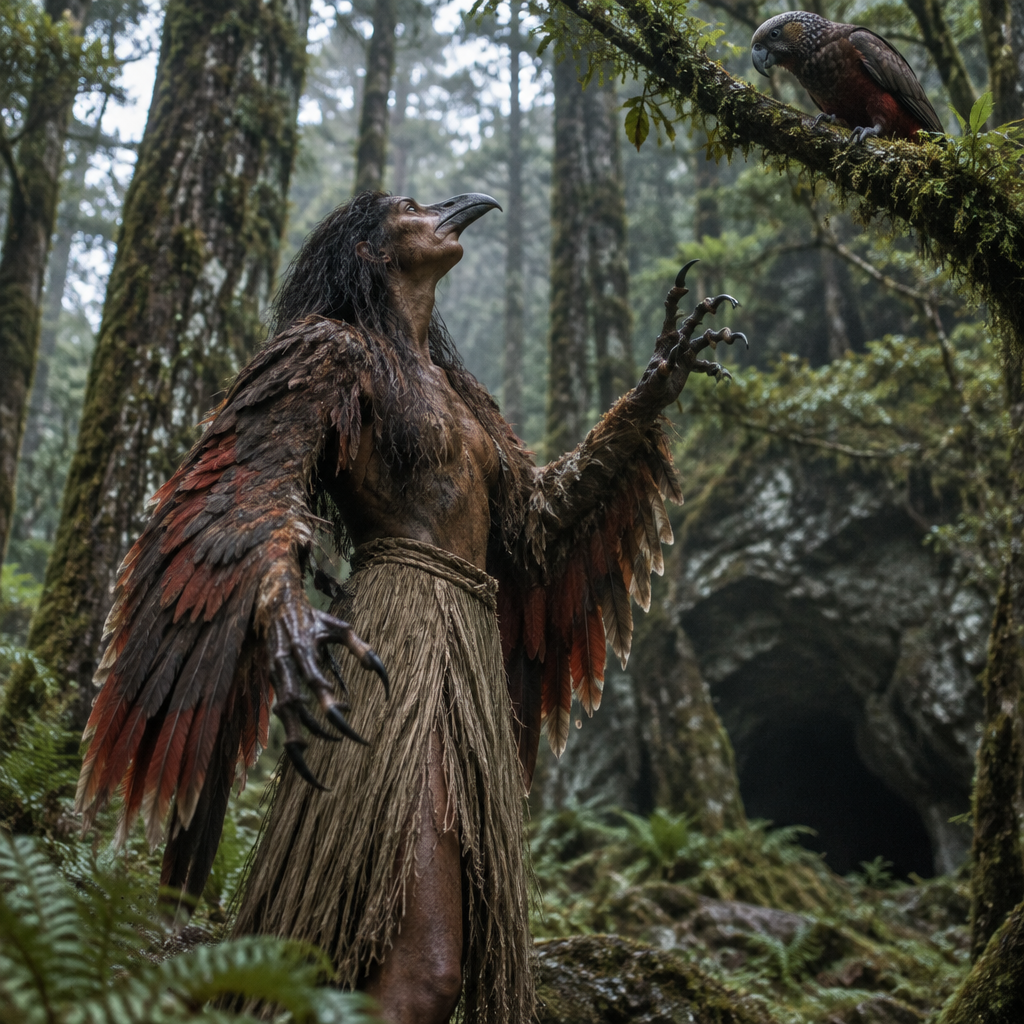
Kurangaituku
Also Known As: also spelled Kurungaituku; sometimes glossed as Kura of the claws; called Hine-ingoingo in one version recorded by Elsdon Best
Region/Culture: Oceania
Mythos: Maori Mythology
Primary Type/Nature: Monsters and Beasts
Mythical Attributes: A bird-woman of the forest who spears birds with her lips, runs faster than any man, and keeps a cave full of birds, lizards and fine cloaks.
Role in Mythos: She is the great obstacle of the Hatupatu cycle of Te Arawa, the captor the young hero must escape before he can return home and avenge the burning of the Arawa canoe.
Relation to Humans: In the Te Arawa telling she seizes the wandering Hatupatu, keeps him in her cave and feeds him raw birds, and he robs her and flees. In the Raukawa telling she finds him hurt on her land and nurses him, so the same encounter becomes a story of kindness repaid with betrayal.
High on the ranges above Rotorua a kākā lands on a branch and settles its feathers. Something below it moves, and a long, hard mouth shoots up through the leaves and pins it. The bird is drawn down into the shadow, where a woman with wings along her arms is already reaching for the next one. She does not use a spear. She does not need one.
This is Kurangaituku, the bird-woman of Te Arawa and Raukawa tradition, and most people meet her through the story of a boy she caught. Hatupatu was the youngest of four brothers, and the brothers starved him. On their long bird-hunting trips they kept the fat birds for themselves and handed him the stringy ones. In the version Sir George Grey published in 1855 in his book Polynesian Mythology, Hatupatu took to raiding the storehouse of preserved birds, faked a war party to cover his thefts, and was caught. His brothers killed him and buried him under a heap of feathers. His parents, guessing what had happened, sent a spirit in the shape of a blowfly. It found the body and brought him back to life.
Alive again, Hatupatu walked straight into worse trouble. He saw a bird struck by something he could not make out, threw his own wooden spear at the same bird, and hit the lips of the woman who had been hunting it. He ran. It did him no good. She had wings on her arms and very fast feet, and she ran him down and carried him off to her cave in the rocks.
Her home is described with real care in the old tellings. It held a two-handed wooden weapon, a cloak of red kākā feathers, a heavy cloak of dog skin, a flax garment, and a household of tame lizards and small pet birds on their perch. Kurangaituku ate everything raw and served Hatupatu the same way. He pretended to eat and let the birds drop out of sight. Each morning she went off hunting, and each morning he lit a fire, cooked for himself, and studied her treasures.
Then he made his move. He sent her off to hunt on ranges so far away they took a whole day to reach. As soon as she was gone he took the cloaks and the weapon, killed the lizards and the pet birds, and smashed their perch. One small bird got away. It flew after its mistress and told her.
She came back fast, guided by the little bird, its cries carrying across the hills. She was almost on him when Hatupatu spoke a charm to a great rock, and the rock split and closed around him. Kurangaituku hunted round it, raging, and could not find the seam. When the sound of her faded he slipped out and ran for Rotorua. The rock still stands beside State Highway 1 near Ātiamuri. It is called Te Kōhatu o Hatupatu, people say her claw marks are on it, and some leave small offerings there. It is a registered wāhi tapu, a sacred site.
The chase ended at Whakarewarewa, among the steam. Hatupatu knew the ground and leapt from crust to crust over the hot springs. Kurangaituku did not know it, or thought the steaming earth was cool, and waded in. The crust broke under her and she was boiled to death. The pool is remembered by name as Whangapipiro. The smell of sulphur hangs over the whole field, and the old story gives that heat a body to remember.
Grey’s version is the one most often reprinted, but it is far from the only one. The missionary Richard Taylor recorded the story in the same year, 1855, and in his telling Hatupatu shuts the house so the birds cannot get out. Enid Tapsell wrote in 1927 that the two lived together for a time before he grew tired of her and left. Harry Dansey, in 1966, made Hatupatu her slave, who killed her birds for mischief. In a version published by Elsdon Best she goes by the name Hine-ingoingo, and she is kind to a young man who treats her badly. The Raukawa people tell it differently again. In the account kept by Huirama Te Hiko, Hatupatu was hunting without right on Raukawa land, and Kurangaituku found him injured and nursed him back to health. That changes the ending a good deal.
That sympathetic reading has grown louder in recent years. The scholar Ngahuia Te Awekotuku has written about the bird-woman as a maker and a keeper, whose cave was a refuge for birds. The novelist Whiti Hereaka retold the whole story from her side in the novel Kurangaituku, published by Huia in 2021, and it won the top fiction prize at the Ockham New Zealand Book Awards in 2022. In Rotorua a carved tōtara figure of her, made by Pine Taiapa, has served since 1933 as the trophy of an annual sports tournament that still bears her name.
Her powers grow straight out of what she is. She is half bird, so she has the bird’s speed and the bird’s weapons: wings on her arms, claws on her hands, a mouth that strikes like a spear. She is a hunter of the high forest, so she can cover distance no man can match and track by the calls of birds that serve her. Her weaknesses come from the same place. She trusts what her small birds tell her, and she can be sent away. She cannot see into a rock that has closed. And she is a creature of the forest, not of the thermal ground, so the place Hatupatu knew best was the one place she could not cross.
Frequently Asked Questions
Who is Kurangaituku in Māori tradition?
Kurangaituku is a bird-woman from the traditions of Te Arawa and Raukawa, two iwi of the central North Island of New Zealand. She is described with wings on her arms, claws for fingers and a beak-like mouth that she uses to spear birds. She is best known from the story of the young Te Arawa man Hatupatu, whom she captured and kept in her cave.
How did Hatupatu escape Kurangaituku?
While Kurangaituku was away hunting on distant ranges, Hatupatu took her cloaks and weapon and killed her pet birds and lizards. One small bird escaped and warned her, and she chased him. Hatupatu spoke a charm to a rock, which opened and hid him, and he later fled toward Rotorua.
How did Kurangaituku die?
In the Te Arawa telling, Kurangaituku died at Whakarewarewa near Rotorua. Hatupatu leapt across the hot springs, but she tried to wade through the steaming ground, broke through the crust and was boiled to death. The pool is remembered as Whangapipiro.
Is Kurangaituku good or evil?
It depends on who tells the story. In the Te Arawa version recorded by Sir George Grey in 1855, she is a dangerous captor who eats raw food and is outwitted by the hero. In the Raukawa version kept by Huirama Te Hiko, she finds Hatupatu injured and nurses him, and he betrays her.
Where is the rock where Hatupatu hid from Kurangaituku?
The rock is Te Kōhatu o Hatupatu, beside State Highway 1 near Ātiamuri in the South Waikato. People say it carries the claw marks of Kurangaituku, and visitors sometimes leave offerings there. It is a registered wāhi tapu, or sacred site.
Related Entries
Hatupatu, Hinemoa, Patupaiarehe, Ponaturi, Taniwha, Tane, Hawaiki, Harpy, Siren, Strix, Ogre