Korean Mythology: The Complete Guide to Bear-Ancestors, Living Shaman Epics, and the Land of Spirits
Korea’s founding myth begins not with a war in heaven or a flood, but with a bear who wanted to be human. Shut in a cave with nothing but mugwort and twenty cloves of garlic, told to avoid sunlight for a hundred days, the bear endured — and a tiger, given the same test, gave up and fled. On the twenty-first day the bear emerged as a woman, Ungnyeo, and from her union with a heavenly prince came Dangun, the founder of the first Korean kingdom. A nation that traces its origin to patience and self-transformation rather than conquest is already telling you something distinctive about how Koreans imagined the sacred.
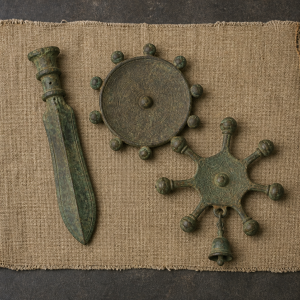
The deeper surprise is that Korean mythology was never frozen into a single scripture. Where the Greeks had Homer and the Norse had the Eddas, much of Korea’s living mythology survives because shamans — almost all of them women, called mudang — still chant it aloud. During a ritual called a gut, a shaman recites a bon-puri, the “origin-explanation” of a god, sometimes for hours from memory. These oral epics, especially those preserved on Jeju Island, are among the most complete shamanic narratives on earth, and were still being performed in the twentieth century when folklorists finally wrote them down.
The written record is thinner and later. The cornerstone is the Samguk Yusa (“Memorabilia of the Three Kingdoms”), compiled around 1281 by the Buddhist monk Iryeon, which preserves the Dangun legend and the foundation myths of the early kingdoms. Beside it sit the Samguk Sagi, court histories, and the vast body of oral shaman song. Everything below draws on that double inheritance: the monk’s brush and the shaman’s voice.
What Makes Korean Mythology Different
It is a living oral religion, not a dead literature. Most world mythologies reach us as texts written by people who no longer believed them. Korean myth is different: the bon-puri creation epics were being sung by working shamans within living memory, and Korean shamanism (Muism) is still practiced today. The mythology is something performed, not merely read — which is why so much of it survives in regional variants rather than one official version.
The landscape itself is divine. There is no neat Olympian pantheon ruling from a single mountain. Instead every mountain has its Sansin (mountain spirit), every sea and river its Dragon King, every household its guardian gods of the hearth, the gate, the outhouse, and the roof beam. Korean cosmology is radically decentralized — the divine is distributed across the whole inhabited world rather than concentrated in a ruling family of gods.
The dead are sorted by bureaucracy, not by sin alone. When you die in Korean tradition you do not simply go to heaven or hell. Black-robed messengers called jeoseung saja escort you to a court of ten kings who weigh your life like magistrates reviewing a case file. This Confucian-Buddhist legal afterlife — paperwork, judges, sentences — turns death into something closer to a trial than a reward.
Women carry the sacred. The central figures of Korean shamanism are overwhelmingly female: the mudang who channel the gods, and the goddesses they invoke — the abandoned Princess Bari who becomes guide of the dead, the grandmother goddess Samsin who governs childbirth, the earth-creating giantess Mago. In a society long shaped by patriarchal Confucianism, the spirit world remained stubbornly matriarchal.
Creation is regional and competitive. There is no single creation story. On the mainland the giantess Mago shapes the land; on Jeju the heavenly king Cheonjiwang fathers twin sons who literally compete — in a flower-growing contest — for the right to rule the living and the dead. Korean myth tolerates, even embraces, the idea that different regions remember the beginning differently.
The Major Gods and Divine Figures
Korean deities fall into loose, overlapping groups: the heavenly rulers of the foundation myth, the creators of the shaman epics, the guardian spirits of nature and home, and the lords of the dead. No single hierarchy binds them, and many are known only from the regional song-cycles of a single province or island.
The Heavenly Founders
Hwanin — the supreme sky god, also called Haneullim (“Lord of Heaven”), who rules the celestial realm and grants his son permission to descend to earth. He is the distant high god behind the founding of Korea itself, more a cosmic authority than an active character.
Hwanung — the heavenly prince who longed for the human world and descended to the peak of Mount Taebaek with three thousand followers and the three “Heavenly Seals.” He governed wind, rain, and clouds, taught agriculture and law, and answered the bear’s prayer to become human — making him the divine father of the Korean people.
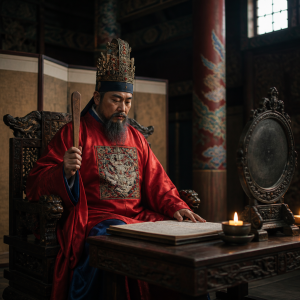
Dangun — son of Hwanung and the bear-woman Ungnyeo, and the legendary founder-king of Gojoseon, Korea’s first kingdom, traditionally dated to 2333 BCE. After a reign of centuries he is said to have become a mountain god, dissolving the line between king and spirit — and Koreans still mark his founding each year on the holiday of Gaecheonjeol.
The Creators of the Shaman Epics
Mago Halmi — a primordial giantess who shaped Korea’s mountains, islands, and rivers, sometimes by digging earth in her apron, sometimes by her own bodily scale. She is the closest Korean parallel to a creator-from-the-body figure like the Chinese Pangu, and survives mostly in scattered regional legends rather than a single text.
Cheonjiwang — the Heavenly King of the Jeju Island creation epic, the Cheonjiwang bonpuri. He descends to order a chaotic cosmos that has two suns and two moons, fathers the twin demigods Daebyeolwang and Sobyeolwang on an earthly woman, and sets in motion the contest that divides the worlds of the living and the dead.
Daebyeolwang and Sobyeolwang — the twin sons of Cheonjiwang. After shooting down the surplus sun and moon to make the world livable, the brothers compete to rule it. The cunning younger twin, Sobyeolwang, wins the world of the living by trickery; the elder, Daebyeolwang, takes the realm of the dead and rules it with the strict justice his brother lacked — an origin story for why the living world is full of deceit and the dead world is fair.
Jacheongbi — goddess of grain and agriculture from the Jeju song-cycles. A nobleman’s daughter who disguises herself as a man to follow the scholar she loves to heaven, endures trials, and returns bearing the five grains. She is one of Korean myth’s great portraits of female determination winning fertility for humankind.
Samsin Halmoni — “Grandmother Samsin,” the triple goddess of childbirth and fate who shapes infants in the womb and protects children to the age of seven. New Korean mothers still set out offerings of rice and seaweed soup to her, one of the most enduring survivals of the old religion into everyday life.
Guardians of Nature and the Threshold
Sansin — the mountain god, the single most beloved spirit in Korean folk religion, painted as a white-bearded sage seated beside a tiger under a pine. Nearly every Korean Buddhist temple keeps a small Sansin-gak shrine to him in a corner of the grounds, a quiet admission that the older mountain faith never really left.
Yongwang — the Dragon King of the sea and ruler of rain and water, to whom fishermen and farmers prayed for safe voyages and good harvests. He is the Korean face of the East Asian dragon sovereign.
The Heroes and the Lords of Death
Jumong — the divine archer-king who founded the kingdom of Goguryeo in 37 BCE. Born from an egg to the daughter of the river god Habaek and a son of heaven, he was so gifted with the bow that his name itself means “skilled archer,” and he fled persecution by crossing a river that his fish and turtles rose to bridge. He is Korea’s great heroic founder, where myth shades into recorded history.
Yeomra — the dread king and chief judge of the dead, fifth and most powerful of the ten kings who try every human soul. His authority descends directly from the Buddhist and ultimately Hindu death-god Yama, naturalized into a Korean magistrate who cannot be bribed and overlooks nothing.
Princess Bari — the abandoned seventh daughter who became the guide of souls. Cast out at birth for being yet another girl, she alone journeys to the far west to fetch the medicine that will revive her dying parents, and in reward becomes the divine psychopomp who leads the dead to the afterlife. She is the patron goddess of the mudang themselves — every shaman, in a sense, walks Bari’s road.
Creatures, Monsters, and Supernatural Beings
Korean folklore is crowded with shapeshifters, dragons in waiting, and household goblins who are as likely to make you rich as to wrestle you in a field. The most distinctive feature is moral ambiguity: very few of these beings are simply evil. Most are bargaining partners, tests, or tricksters.
Foxes and Shapeshifters
Gumiho — the nine-tailed fox, a fox that has lived a thousand years and gained the power to take the shape of a beautiful woman. In older tales she is a predator who devours human livers or hearts; in later, more sympathetic versions she longs to become fully human and will succeed only if she can refrain from eating human flesh for a thousand days. She is one of the great tragic monsters of East Asian myth.
Kumiho — the same nine-tailed fox under its alternate romanization, a reminder of how deeply this figure runs in the Korean imagination. The gumiho/kumiho is kin to the Chinese Huli jing and the Japanese Kitsune and Kyūbi-no-kitsune, but where Japan’s nine-tailed fox can become the benevolent harvest deity Inari, Korea’s stayed darker and more dangerous.
Dragons and Serpents
Yong — the Korean dragon, a benevolent water-deity of rivers, rain, and the sea rather than a hoard-guarding menace. Wingless, serpentine, and wise, the yong carries a yeouiju (a wish-fulfilling orb) and was a royal symbol of the king himself. It is the eastern counterpoint to the European Dragon.
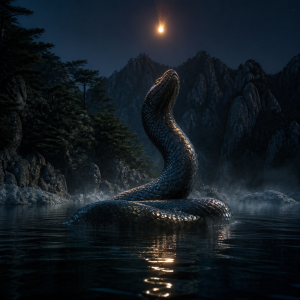
Imugi — the “proto-dragon,” a great hornless serpent that must wait — often a thousand years — before it can ascend to heaven and become a true yong. Some tales say it needs to catch a fallen yeouiju orb; others that it simply must endure. The imugi is patience and unfulfilled potential made flesh.
Kye-ryong — the extraordinary “chicken-dragon,” a dragon with the head of a rooster that appears at moments of cosmic significance. In the foundation legends of the Silla kingdom, a kye-ryong gives birth to the queen Aryeong, marking her as no ordinary mortal — a creature that exists to announce the sacred.
Goblins, Guardians, and Beasts
Dokkaebi — Korea’s beloved goblin, a horned, often one-legged nature spirit born from discarded household objects soaked in human blood or use. Mischievous rather than evil, a dokkaebi wields a magic club (bangmangi) that can conjure food and gold, loves to challenge travelers to wrestling matches, and can be outwitted by anyone who knows its weakness. It is closer to a trickster than the demonic Japanese Oni.
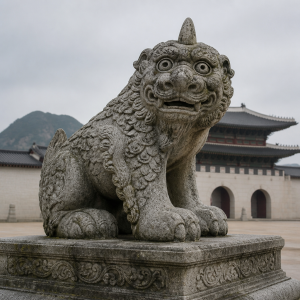
Haetae — a lion-like beast with a single horn and a scaled body, a guardian of justice that can sense guilt and devours the wicked. Believed to ward off fire, stone haetae still flank the gates of palaces and now serve as the official mascot of Seoul. Its very presence is a verdict.
Chollima — the “thousand-li horse,” a winged steed so swift no mortal could ride it, capable of covering four hundred kilometers in a day. Shared with Chinese tradition, it has become a potent modern political symbol on the Korean peninsula, but its mythic root is simply unattainable, heaven-touching speed.
Bulgasari — a monstrous chimera with a bear’s body, an elephant’s trunk, a tiger’s claws, and an ox’s tail, whose appetite is for iron and metal. The more weapons it eats the larger and more unstoppable it grows — an obscure but unforgettable figure that an AI summary of Korean myth almost always misses.
Samjok-o — the three-legged crow that lives in the sun, an emblem of solar power, longevity, and royal authority especially prized in the Goguryeo kingdom. It belongs to the same sun-bird tradition as the broader East Asian three-legged bird, and once ranked above even the dragon and the phoenix as a symbol of heaven’s mandate.
The Central Myths
The Bear, the Tiger, and the Birth of a Nation
The prince Hwanung descends from heaven and rules a sacred city on Mount Taebaek. A bear and a tiger, longing to be human, beg him for help; he gives them sacred mugwort and garlic and orders them to stay out of the sun for a hundred days. The impatient tiger quits, but the bear endures and is transformed into the woman Ungnyeo. Lonely, she prays for a child, and Hwanung takes human form to marry her. Their son is Dangun, who founds Gojoseon. Why it matters: this is Korea’s national origin story, and it locates the country’s identity in endurance, transformation, and the marriage of heaven to earth rather than in violence — the tiger’s path of force fails, the bear’s path of patience prevails.
Cheonjiwang and the Flower Contest of the Twins
In the Jeju creation epic, the world is barely livable — two suns scorch the day, two moons freeze the night. The Heavenly King Cheonjiwang descends, fathers the twins Daebyeolwang and Sobyeolwang, and the brothers shoot down the extra sun and moon. Then they compete to rule the world, and the decisive test is a flower-growing contest: whoever grows the finer bloom wins the realm of the living. The honest elder twin grows the true flower, but the younger swaps the pots while he sleeps and steals the living world by fraud. Why it matters: the myth is a theodicy — it explains why the world of the living is riddled with injustice and deceit (it was won by cheating) while the world of the dead, ruled by the wronged elder twin, is perfectly fair.
Princess Bari’s Journey to the Land of the Dead
A king and queen desperate for a son have seven daughters; the seventh, Princess Bari, is cast away at birth. Years later, when both parents fall mortally ill, the six raised-in-luxury daughters refuse to seek the cure. Only the abandoned Bari undertakes the harrowing journey to the western paradise, laboring for years to earn the life-giving water and resurrection flowers. She returns to revive her dead parents — then renounces the kingdom they offer to become the eternal guide who leads human souls to the afterlife. Why it matters: Bari is the founding myth of Korean shamanism itself, the model for every mudang who mediates between the living and the dead, and a startling elevation of the most disposable member of a Confucian household into a goddess.
The Afterlife and Cosmology
Korean cosmology stacks the universe into three broad realms — the heavens (Cheonsang), the human world (Igeung or Iseung), and the underworld of the dead (Jeoseung) — but the most vivid imaginative energy goes into the journey of the soul after death.
When a person dies, three black-robed messengers, the jeoseung saja, escort the soul on a forty-nine-day passage. Far from a simple gate, the underworld is a vast judicial bureaucracy presided over by the Ten Kings of Hell, of whom Yeomra is the chief. Each king reviews a different aspect of the deceased’s conduct, consulting ledgers that record every deed; sinners pass through a sequence of hells calibrated to their offenses before being assigned a rebirth. This legalistic vision — judges, files, sentences — fuses indigenous belief with imported Buddhist and Confucian ideas of cosmic justice.
What keeps the system from cold despair is the figure of Princess Bari, the compassionate guide who leads frightened souls through the ordeal, and the underlying logic of the Jeju twin myth: the dead inhabit the fairer of the two worlds. Where many traditions make the afterlife a place of dread, Korean myth quietly insists that the realm of the dead is where justice finally works the way it should.
How Korean Mythology Connects to Other Traditions
Korea sits at a cultural crossroads, and its mythology absorbed and reshaped the great currents of East Asia while keeping a stubborn local accent.
The deepest debts are to Chinese mythology. The death-judge Yeomra is the Chinese Yanluo Wang, himself a Buddhist adaptation of the Hindu Yama of Hindu mythology — a single death-god traveling from India through China into Korea and changing costume at every border. The nine-tailed Gumiho shares an ancestor with the Chinese Huli jing, and the giantess Mago echoes the cosmic body of Pangu.
The ties to Japanese mythology run both ways across the strait. The fox-spirit family connects the gumiho to the Kitsune and Kyūbi-no-kitsune, though Korea’s version stayed more monstrous than the harvest-blessing Inari. The Korean Dokkaebi is often compared to the Japanese Oni but is far less demonic, and both cultures share the East Asian dragon-king of the sea. Shared sky-god dramas — the descent of heavenly rulers, the divine ancestry of kings — rhyme with the stories of Amaterasu, Susanoo, and the creator pair Izanagi and Izanami.
Look further west and the parallels turn structural. Princess Bari, who descends to the land of the dead and returns, walks the same mythic road as the Greek Persephone and the soul-guiding ferryman Charon of Greek mythology; the guarded threshold of the dead recalls Hades and his hound Cerberus. These are almost certainly independent inventions — proof that the human imagination keeps arriving at the same answers about death.
Where to Start Reading
The indispensable primary source is the Samguk Yusa (c. 1281) by the monk Iryeon, available in English translation; it preserves the Dangun legend and the early kingdom myths in their oldest written form. For the shaman epics — Bari, Cheonjiwang, Jacheongbi — the essential scholarly gateway is James Huntley Grayson’s Myths and Legends from Korea: An Annotated Compendium of Ancient and Modern Materials, which collects and contextualizes the oral and written traditions together.
For modern readers, Heinz Insu Fenkl’s essays and retellings make the shamanic material accessible, and the growing body of translated bon-puri texts lets you hear the creation epics close to the form a mudang would actually chant. Begin with Dangun and Bari, then move to the Jeju cycle once the world-picture clicks into place.
Explore Korean Mythology on Gods and Monsters
Gods and Monsters currently catalogs 10 Korean entries, with more added regularly as the index grows. Browse all Korean Mythology entries →
Dangun · Hwanung · Gumiho · Kumiho · Dokkaebi · Haetae · Yong · Imugi · Kye-ryong · Chollima
Frequently Asked Questions
What is the main creation myth in Korean mythology? There isn’t just one. The mainland tradition credits the giantess Mago with shaping the mountains and rivers, while the famous Jeju Island epic, the Cheonjiwang bonpuri, tells how the Heavenly King Cheonjiwang descended to a broken cosmos with two suns and two moons and fathered twin sons who shot down the extras and then competed to rule. The foundation of Korea as a nation is told separately, through the story of Dangun, son of the heavenly prince Hwanung and a bear who became a woman.
Is the gumiho evil? Not always. The Gumiho (also spelled Kumiho) is a thousand-year-old nine-tailed fox that takes the form of a beautiful woman, and in older tales she is a deadly predator who eats human livers. But many stories make her tragic rather than wicked: she wants to become fully human and can do so only by resisting her nature for a thousand days. Korea’s fox is generally darker than the Japanese Kitsune, which could become the benevolent rice deity Inari.
What is the difference between an imugi and a yong? A Yong is a fully realized Korean dragon — a wise, benevolent water-deity of rain and the sea, often carrying a wish-granting yeouiju orb. An Imugi is a giant serpent that has not yet ascended: it must wait, traditionally a thousand years, or obtain a fallen orb, before it can transform into a true dragon. The imugi is essentially a dragon-in-progress, a symbol of patience and unfulfilled potential.
Who guides souls to the afterlife in Korean belief? The dead are escorted by black-robed messengers called jeoseung saja to a court of ten kings led by Yeomra, who judges every soul. The compassionate guide who leads souls safely through this ordeal is Princess Bari, an abandoned seventh daughter who journeyed to the land of the dead to save her parents and became the patron goddess of Korean shamans. Yeomra himself descends from the Buddhist and Hindu death-god Yama.
What is a dokkaebi? A Dokkaebi is a Korean goblin or nature spirit, often born from a discarded household object that has absorbed human use or blood. Unlike the demonic Japanese Oni, the dokkaebi is mischievous rather than malevolent — it loves wrestling matches and riddles, carries a magic club that conjures gold and food, and may reward a clever or kind human as readily as it torments a foolish one.
Is Korean mythology the same as Chinese or Japanese mythology? No, though they share deep roots. Korea absorbed Buddhist and Confucian ideas and many figures from Chinese mythology — the death-judge Yeomra, the dragon-king of the sea, the nine-tailed fox — and exchanged motifs with Japanese mythology across the strait. But Korea kept a distinctive core: a living shaman tradition led by women, the bear-ancestor founding myth, the regional Jeju creation epics, and goblins and dragons with their own unmistakably Korean character.