
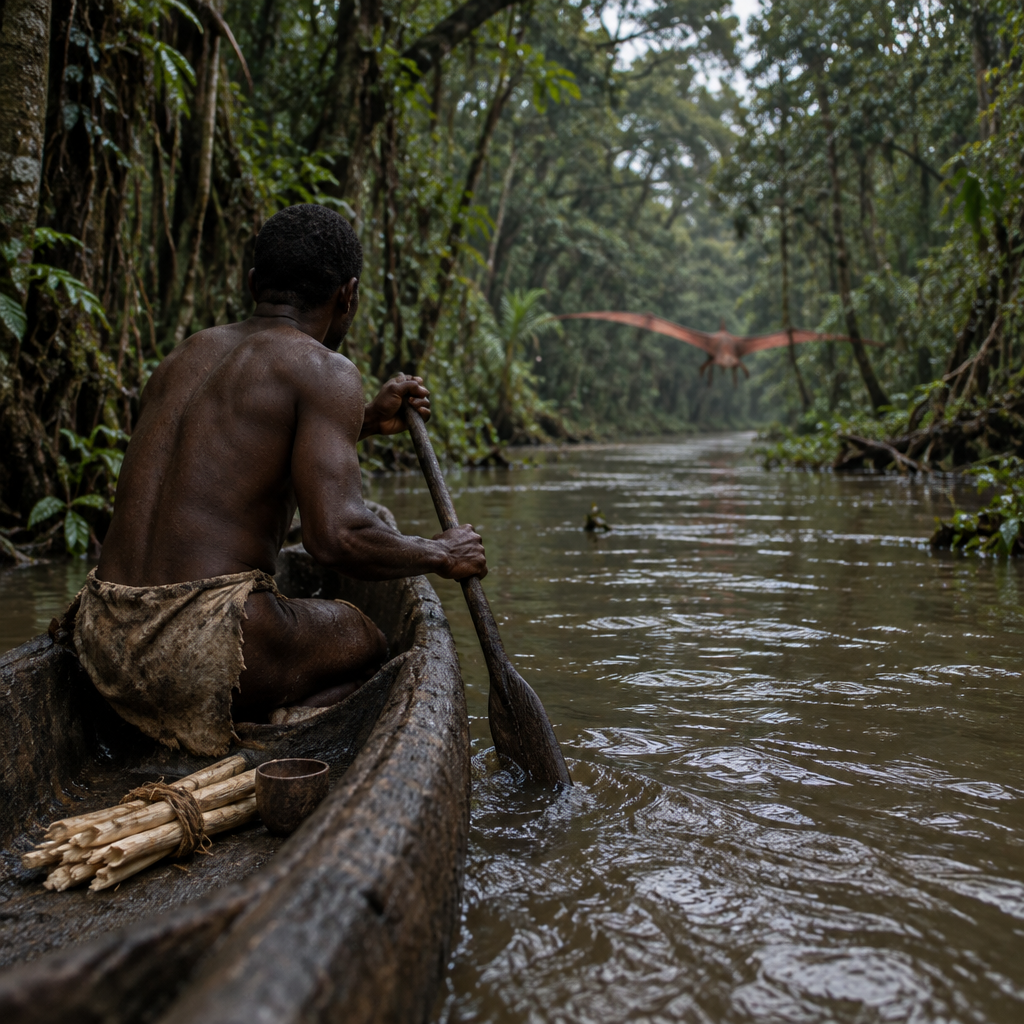
Kongamato
Also Known As: a Kaonde name, glossed tentatively by Frank Melland in 1923 as overwhelmer of boats; the charm against it is muchi wa kongamato
Region/Culture: Central Africa
Mythos: Cryptids, Bantu/Congo Mythology
Primary Type/Nature: Monsters and Beasts
Mythical Attributes: It lives below certain river fords, can hold back the current so the water rises and drowns anyone crossing, and is said to swallow any missile thrown at it and never to die.
Role in Mythos: Among the Kaonde of the Kasempa district in what is now north-western Zambia, it is the danger of the river crossing, the one hazard of the water against which they kept a charm.
Relation to Humans: Travellers carried a bundle of mulendi root and a cup of the same root ground in water, and sprinkled the water when the kongamato came. People said that very few who saw one lived, and four deaths in the Mutanda River in 1911 were laid to it.
Somewhere below the ford, where the river runs on out of sight, something stops the water. The current slows and backs up, the level rises, and a canoe that was crossing easily a moment before is suddenly in a flood. That is how the Kaonde of the Kasempa district, in what is now north-western Zambia, described the kongamato, and they had a charm against it.
The whole of the early record is one book. Frank Melland, magistrate for the Kasempa district from 1911 to 1922, published *In Witch-Bound Africa* in 1923, an account of the Kaonde and their beliefs. The kongamato appears in his chapter on charms, under the heading of accidents at river crossings, and then gets a short chapter of its own. Everything said about it below comes from those few pages unless it is marked otherwise.
The charm came first. A traveller ground part of the root of the mulendi tree, mixed it with water in a bark cup, and cut more of the root into strips tied in a bundle. The bundle went into the canoe, or was carried on foot through a dangerous ford. When the kongamato came, the bundle was dipped in the cup and the water flicked out over the river, and that kept off both the creature and its flood. Melland gave the name a tentative meaning, the overwhelmer of boats, and put a question mark against his own translation.
It was only when he asked what the thing actually was that the account turned strange. The first answer was that it was a bird. Pressed, the speaker changed it: not really a bird, more like a lizard, with wings of skin like a bat’s. Melland’s further questions produced a wingspan of four to seven feet, an overall red colour, no feathers, and possibly teeth in the beak. He then fetched two books from his house with pictures of pterodactyls, and every man present picked the picture out as the kongamato. One of them was Kanyinga, a headman from the Jiundu country, where the creature was said to be most active.
Melland was careful about what that proved. He had already dismissed two dinosaur stories from the region, one from Lake Bangweulu around 1909 and one from Katanga in 1919, on the grounds that local people had never heard of such animals and that anything that size would leave tracks. This, he thought, escaped both objections. Against it he set the fact that no reward would persuade anyone to take him to one, or to bring him a carcass or even a fragment. The answer he got was that few people see a kongamato and live, that it cannot be hurt and eats whatever is thrown at it, and that it never dies, so there are no remains to find. He concluded that some such reptile might have existed within living memory, and said frankly that he had no faith in its powers.
The Kaonde did not class it as a sorcerer’s creature. It was not, Melland wrote, an unnatural thing like the mulombe, one of the instruments of witchcraft described elsewhere in the same book, but a terror of the ordinary world in the way a man-eating lion or a rogue elephant is, only far worse. Some said it was seen, some only that it was felt. The last deaths put down to it were in 1911, two men and two women drowned in the Mutanda River near Lufumatunga village. Sceptics at the time pointed out that the river was in flood anyway and that nobody saw how they died.
After Melland left the district, a correspondent he identifies only by the initials C.H.H. sent him two more details, which Melland passed on while doubting both. A paddler whose boat slowed to a halt however hard he worked knew that a kongamato had taken hold of it from underneath. And a kongamato that ate a person took only the little toes and little fingers, the ear lobes and the nostrils. Nobody claimed to have found a body left that way.
The Jiundu swamp, the creature’s reputed home, was the one part of the account Melland could describe from his own eyes. Some fifty square miles of inland delta on high limestone ground, the river splitting into countless channels under tall trees, tangled creepers and ferns, moist loam and rotting leaves underfoot, and much of the water simply sinking into the ground and never coming out. For years it had sheltered outlaws who fired on any uniform that came near. By the time he wrote, they had left and cut a road through it. He closed by asking whether the winged thing now had the swamp to itself, or was only a story.
That is the whole of the Kaonde record. No source gives the kongamato an origin, a name for its young, a story of anyone defeating it, or any telling earlier than Melland’s enquiries. Later writers on unknown animals gathered further reports from Zambia and neighbouring countries in the 1950s and argued over whether a large stork or a big bat lay behind them, but none of that comes from the people who carried the mulendi root across the fords.
Frequently Asked Questions
What is the kongamato?
The kongamato is a dangerous river creature in the beliefs of the Kaonde people of north-western Zambia, recorded by the colonial magistrate Frank Melland in his 1923 book *In Witch-Bound Africa*. It was said to live below river fords and to hold back the water so that it rose and drowned people crossing. Melland’s informants described it as a red, featherless, lizard-like flier with skin wings.
Why is the kongamato called a pterodactyl?
When Frank Melland showed his Kaonde informants pictures of pterodactyls in two books, every man present identified the picture as the kongamato. Their description of a red, featherless creature with bat-like wings of four to seven feet and possibly a toothed beak also fit the picture. Melland thought this suggested some such reptile might have existed within living memory, but he never saw one.
How did people protect themselves from the kongamato?
The Kaonde used a charm called muchi wa kongamato. A traveller carried a bundle of mulendi root and a bark cup of the same root ground in water, and when the kongamato came, dipped the bundle and sprinkled the water to keep the creature and its flood away.
Where does the kongamato live?
The kongamato was said to live downstream of certain fords, and the Jiundu swamp in north-western Zambia was named as one of its main haunts. Frank Melland described the Jiundu as about fifty square miles of dense swamp forest, where much of the river water vanishes underground.
Has anyone been killed by a kongamato?
The latest deaths attributed to the kongamato in Frank Melland’s record were in 1911, when two men and two women died in the Mutanda River near Lufumatunga village. Sceptics at the time noted that the river was in flood and that no one witnessed how they died.
Related Entries
Chinawezi, Mokèlé-mbèmbé, Emela-Ntouka, Ninki Nanka, Inkanyamba, Impundulu, Grootslang, Nandi Bear, Jersey Devil