
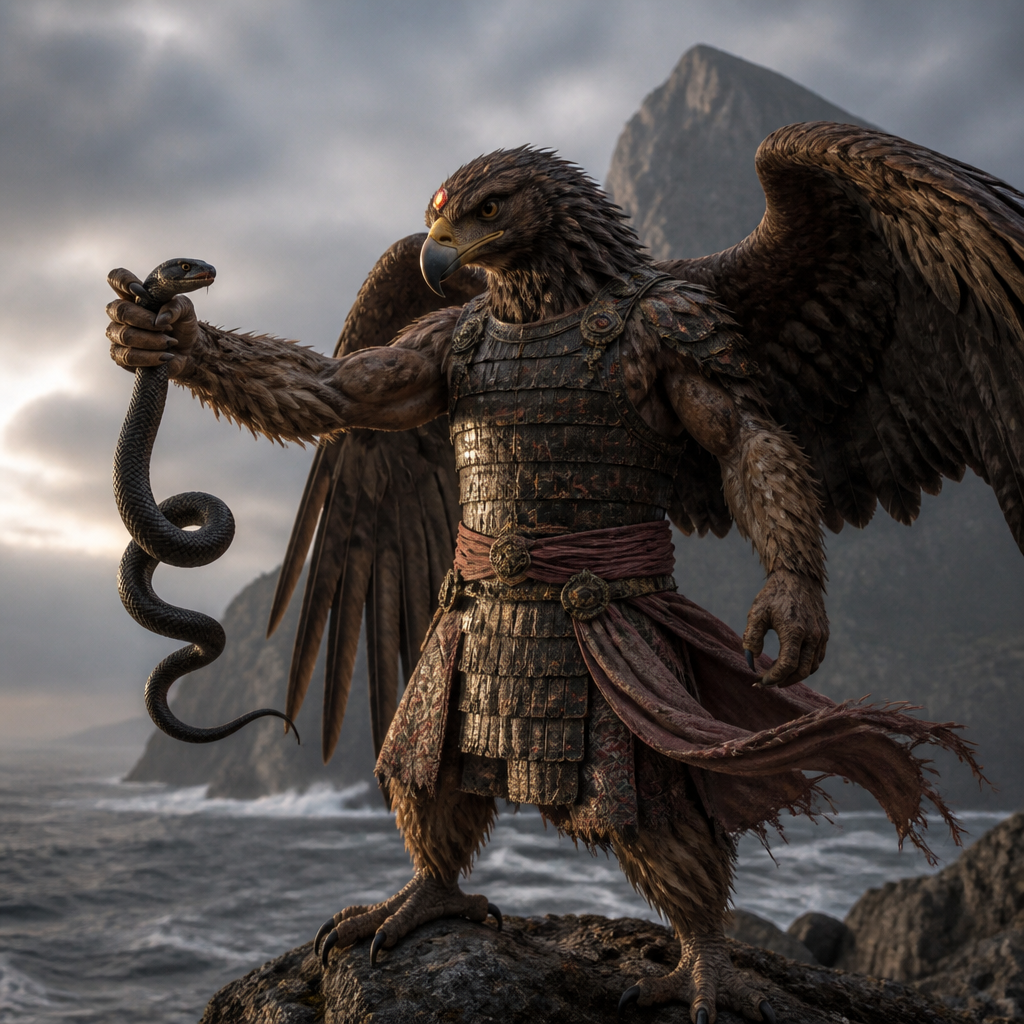
Karura
Also Known As: 迦楼羅; also Karura-ō 迦楼羅王, “Karura King”; Skt. Garuḍa; Chn. Jialouluo
Region/Culture: East Asia
Mythos: Japanese Mythology, Buddhist Mythology
Primary Type/Nature: Gods and Deities
Mythical Attributes: An enormous golden bird-man who breathes fire and hunts serpents and dragons for food.
Role in Mythos: Karura is one of the Hachibushū, the eight classes of converted Indian beings sworn to guard the Buddha’s teaching, and serves among the twenty-eight attendants of the Thousand-Armed Kannon.
Relation to Humans: Karura is rarely a central object of devotion in Japan and is met instead as a guardian in temple statuary, as a masked dancer in gigaku and gyōdō processions, and as the fire behind Fudō Myōō’s back. Tradition credits it with teaching people how to treat snake venom, and with the accident that gave the earth its veins of emerald.
Over the sea that rings Mount Sumeru, a shadow crosses the water and everything beneath it dives. The wings that cast it are gold. They beat once and the sound carries like thunder rolling off a mountain, and the smell that comes down with the wind is hot, scorched, faintly sulphurous. The bird is hunting serpents. It always finds them.
Karura is the Japanese name for the Indian Garuda, and very little of the original bird was lost in the crossing. Japanese accounts give it a man’s body under an eagle’s head, a beak of hooked horn, eyes that belong to a bird of prey, and feathers the colour of struck brass. Fire comes out of its mouth as a matter of course, not as a weapon reserved for great occasions. A wish-granting jewel, the nyoi hōju, sits at its head, the same jewel said to have come out of a dragon king’s skull. As for size, one Japanese reckoning puts it at three hundred ri, which is to say more than a thousand kilometres from wingtip to wingtip, a figure that stops being a measurement and becomes an argument. It circles the four heavens of Sumeru and it eats dragons.
The hatred is inherited. In the Mahābhārata, two sisters make a wager on the colour of a divine horse’s tail. Kadrū, mother of serpents, wins by cheating, and her sister Vinatā becomes her slave. Vinatā’s egg cracks, and out comes a bird burning so brightly that the gods mistake him for the fire god and pray to him by the wrong name. The price set for his mother’s freedom is the amrita, the nectar of immortality, which the gods keep behind a wall of flame, a wheel of turning blades and two serpents that never blink. He swallows rivers and puts the fire out. He makes himself small enough to slip between the blades. The serpents he simply kills. Then he carries the pot away without tasting a drop of it, which is the detail everything else turns on.
Viṣṇu meets him in the air and is impressed enough to offer him immortality without the nectar, and a place above himself on his own banner. Indra, wanting the pot back, offers the serpents as food. The bargain is struck and the pot returns. So the greatest hunger in the heavens is not a natural appetite at all. It is a licence, granted by a god who wanted his property back.
Buddhism inherited the bird along with the grudge and put it to work. Karura belongs to the Hachibushū, the eight classes of Indian beings recruited out of Hindu myth and set to guard the Dharma, standing in company with the asura, the yaksha, the gandharva, the kinnara, and, in one of the more pointed arrangements in religious art, the naga king Sakara. The old feud is kept on the payroll. But the terms are softened: a naga that has taken refuge in the Buddha, or that carries a Buddhist talisman, is safe from Karura. The bird cannot touch it. A mercy with a loophole is still a mercy, and it is the loophole that makes the bird a Buddhist.
Nowhere is this more visible than in a dim hall in Nara. Kōfuku-ji holds a set of the Eight Kinds of Mythological Beings made in 734 in hollow-core dry lacquer, cloth soaked in lacquer and built up in layers over a core that was afterwards removed, so the figures are hollow, light and slightly uncanny to lift. The Karura stands about a metre and a half, an armoured warrior in Tang-style plate with a fierce beak and round avian eyes, but human ears and a human hairline. It has no wings. Its left hand is gone and so is the coxcomb that once rose from its skull. A few paces away in the same set stands Sakara, the dragon king, a serene young man with a snake coiled through his topknot. Predator and prey have been sharing a room for nearly thirteen hundred years without incident.
At Sanjūsangen-dō in Kyoto, Karura appears again among the twenty-eight guardians ranged before the thousand Kannon, carved in wood in the Kamakura period, bird-headed and intent, playing a flute. Elsewhere it survives as a face rather than a body: a gigaku mask for a bird dance performed between the eighth and twelfth centuries, a parade mask at Hōryū-ji, a noh mask with a raptor’s glare. Its fire outlived all of them. The flames that ring the wrathful statues of Fudō Myōō are called karura-en, Karura flames, and the burning halo behind him is the karura enkō. Some hold that the fire is the bird’s vomit. Others say the halo is simply the shape of its outstretched wings, seen from behind. Occasionally the bird’s own head is worked into the flames, watching from inside the fire.
There is a Puranic story in which Karura kills an asura and, flying home, lets the corpse’s bile fall. It strikes the ground and hardens into veins of emerald, which is why the stone is said to draw the poison out of anything it touches. The same bird is credited with teaching the first cure for snakebite. A creature that lives entirely on venom hands back the antidote. Its powers all run from that: the blazing rays of the sun and the force of the wind personified, thunder in its wings, fire in its throat, a body that cannot be killed and does not sicken, and a jewel on its brow that grants whatever is asked of it.
The limits run from the same place. Its deathlessness was given, not taken, and it never drank the nectar it stole. Its diet is a permission that could in principle be withdrawn. Its enemies escape it by conversion, which is to say the one thing it cannot burn through is a change of heart. And in Japan it is almost never the god at the centre of the hall. The greatest bird in the Buddhist heavens works someone else’s door.
Frequently Asked Questions
What is Karura in Japanese mythology?
Karura is the Japanese Buddhist form of the Hindu bird deity Garuda, a giant golden creature with a human body and the head, beak and wings of an eagle. It breathes fire, feeds on dragons and serpents, and serves as a guardian of the Buddha’s teaching. It belongs to the Hachibushū, the eight classes of protective beings adopted into Japanese Buddhism from Indian myth.
Why does Karura eat dragons?
Karura eats nāgas, the serpents and dragons of Indian myth, because of a family feud recounted in the Mahābhārata: its mother Vinatā was enslaved by her sister Kadrū, the mother of serpents. After Garuda stole the nectar of immortality to buy his mother’s freedom, Indra granted him the right to feed on serpents in exchange for the nectar’s return. A nāga that has converted to Buddhism or carries a Buddhist talisman is exempt and cannot be eaten.
What are Karura flames?
Karura-en, or Karura flames, is the Japanese term for the fire that Karura breathes from its mouth. The name also attaches to the blazing halo behind statues of the wrathful deity Fudō Myōō, known as karura enkō. Some traditions say the flames were spewed by Karura itself, while others say the halo is shaped like the bird’s outstretched wings, and Karura’s head is sometimes shown within the fire.
Where can you see Karura in Japan?
The most famous image is the dry-lacquer statue at Kōfuku-ji in Nara, made in 734 as part of the Eight Kinds of Mythological Beings and designated a National Treasure. It shows Karura as a wingless armoured warrior with a beak, bird’s eyes and human ears. A Kamakura-period wooden Karura also stands among the twenty-eight guardian deities at Sanjūsangen-dō in Kyoto, where it is shown playing a flute.
Is Karura the same as the phoenix?
No. Karura is frequently confused with the hōō, the East Asian phoenix, and with the karyōbinga, the celestial bird-bodied musician, but all three are distinct creatures. Karura is a fire-breathing predator of dragons and a guardian of Buddhism, not an auspicious omen bird or a heavenly singer.
Related Entries
Garuda, Naga, Asura, Kinnara, Yaksha, Gandharva, Deva, Tengu, Yamata no Orochi, Indra, Vishnu, Fenghuang, Simurgh, Roc, Thunderbird