Indian Mythology: The Complete Guide to a Subcontinent of Gods, Indigenous Cosmologies, and the Monstrous India of Ancient Travelers
There is no such thing as Indian mythology in the singular. The phrase covers the Vedic and Hindu tradition that most of the world pictures — Vishnu sleeping on the cosmic ocean, Shiva dancing the universe into being — but it also covers the indigenous gods of Manipur who were worshipped long before Sanskrit reached the northeast, the tribal cosmologies of the hills, and a fourth India that never existed at all: the land of mouthless men and gold-mining ants that Greek and Roman geographers swore lay just past the source of the Ganges. A subcontinent that has produced four world religions and over a thousand living languages does not have a mythology. It has an archive.
This guide is the wide-angle view. The Vedic-Hindu mainstream is so vast it has its own complete guide on this site, and the high-altitude spirit world of the Himalayas has another. What you will find here is everything those two leave out and everything that ties them together: the Meitei pantheon of the Imphal Valley, the regional folk-demons that haunt village India, and the strange, persistent European fantasy of India as the edge of the monstrous world. The sources range from the Sanskrit Vedas and the great epics — the Mahabharata and the Ramayana — to the Meitei puyas written in the old Meitei Mayek script, to Pliny the Elder’s Natural History and the lost Indica of Megasthenes.
Read together, these traditions reveal something no single one of them shows: India has always been a place where mythologies meet, borrow, conquer, and quietly survive inside one another.
What Makes Indian Mythology Different
It is a federation, not a pantheon. Greek myth has one Olympus; Norse myth has one Asgard. India has dozens of simultaneous, overlapping religious worlds that never fully merged. The Sanskritic gods of the Devas sit alongside indigenous traditions like Meitei Sanamahism, whose supreme beings — Pakhangba and Lainingthou Sanamahi — have nothing to do with the Vedic deities and predate their arrival in the northeast. To understand Indian mythology you have to hold many cosmologies in mind at once.
Time is a wheel, not a line. Where most Western mythologies run from a creation to an apocalypse, Indian thought folds the whole drama into endlessly repeating cosmic ages, the yugas. The world is created, decays, and is destroyed over and over, and the destroyer is not evil — it is Shiva, clearing the ground for the next cycle. Even the final avatar Kalki does not end the story; he resets it.
The gods come down in person. The doctrine of avatara — divinity taking flesh to repair a broken age — has no real parallel elsewhere. Vishnu descends as a fish (Matsya), a tortoise (Kurma), a boar (Varaha), a man-lion (Narasimha), and as the human heroes Rama and Krishna. Mythic time and human time interlock.
The monsters are relatives, not opposites. The Asuras, Daityas, and Rakshasas are not a separate creation set against the gods — they are their cousins, born of the same parents, sometimes more pious and more disciplined than the gods themselves. Good and evil are matters of role and moment, not of species.
India was itself a myth — to outsiders. For more than a thousand years, Europe’s idea of India was a catalogue of wonders: people with no mouths, men with backward feet, ants the size of foxes that mined gold. This invented India, preserved by the Astomi, the Abarimon, and the gold-digging ants, is as much a part of “Indian mythology” as anything in the Vedas — it is simply mythology about India rather than from it.
The Many Pantheons of India
The Vedic and Hindu High Gods
The familiar core of Indian mythology is the Hindu trinity and the powers around it — covered in depth in the Hindu mythology guide, but essential context here.
Brahma — the creator, four-faced and oddly under-worshipped, who speaks the worlds into existence and then largely recedes.
Vishnu — the preserver, who maintains cosmic order and returns age after age in his avatars to set a derailed world right.
Shiva — the destroyer and transformer, ascetic and lord of the dance, whose annihilation is the necessary hinge of every new cycle.
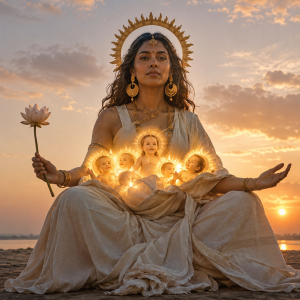
Around them stand the goddess in her many forms — Devi, the warrior Durga, the fierce Kali, and the gentler Parvati, Shiva’s consort and the mother of Ganesha — and the older Vedic powers who once ruled the hymns: Indra the storm-king, Agni the fire, Varuna the cosmic-law-keeper of the waters, Vayu the wind, Surya the sun, Soma the sacred draught, and Yama, first of the dead and judge of the afterworld. The river Ganga, the goddess of speech Sarasvati, and the fortune-goddess Lakshmi round out a world where almost every force of nature has a face and a name. The mother-figure Aditi, the boundless one, is the womb from which many of these gods are born.
The Meitei Gods of Manipur
Far to the northeast, in the Imphal Valley, a wholly separate pantheon has been worshipped for centuries under the indigenous religion of Sanamahism. Its creation story, the Malem Leishemlol, begins with a formless supreme deity alone in the void — and it owes nothing to the Vedas.
Pakhangba — a primordial deity depicted as a serpentine dragon, the youngest son of the creator and the only biological son of the earth-mother. In Meitei myth he won the throne of the world not by circling the universe but by circling his father’s seat — proving that devotion outruns brute effort. He became the divine ancestor and emblem of Manipur’s kings.
Lainingthou Sanamahi — Pakhangba’s elder brother, the great household god whose name the religion itself carries. He is worshipped in the southwest corner of every traditional Meitei home, the protector of the family and the most intimate of the high gods.
Leimarel Sidabi — the supreme mother-earth goddess, lady of nature, fertility, and the household, mother of Pakhangba and one of the central powers of the Meitei cosmos. Where the Hindu earth is often a passive bride to be rescued, Leimarel Sidabi is a sovereign creator-goddess in her own right.
Langmeidong — a guardian spirit-being of the same indigenous tradition, one of the many local divinities of place that fill the Meitei world below its high gods.
Creatures, Monsters, and Supernatural Beings
The Demons of Village India
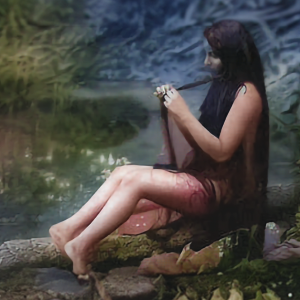
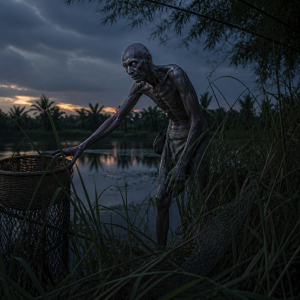
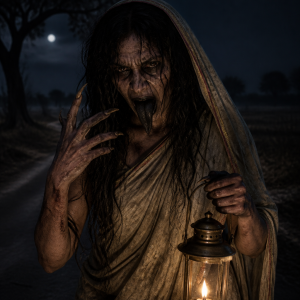
Below the great gods runs a dense undergrowth of spirits that ordinary people actually feared. The Bhoota is the restless ghost of one who died badly or without rites — a category, not a single creature, into which most Indian hauntings fall. The Churel, the vengeful spirit of a woman who died in childbirth, walks with her feet turned backward and preys on the men of her own family. The Pishacha is a flesh-eating demon of the cremation ground, the Preta a hungry ghost trapped between lives, and the Vetala a corpse-riding spirit who answers riddles and hangs from trees — the narrator of one of the most famous Indian story-cycles.
The Acheri and the Spirits of the Hills
The Acheri is one of the most quietly chilling figures in Himalayan folklore: the ghost of a little girl who lives on the mountain summits and comes down at dusk to dance. Her shadow, falling across a sleeping child, brings disease — colds, consumption, the goitre endemic to those high valleys. She favors victims dressed in red, and the only protection is a scarlet thread tied around the throat. The Acheri is folk epidemiology in mythic form: a way of explaining why healthy children in isolated hamlets sickened overnight. She shares her cold mountain world with the Yeti and the household ogre Gurumapa of the wider Himalayan tradition.
The Sacred Beasts
Indian myth teems with magnificent animals. The Nagas, serpent-people of the underworld waters, guard treasure and wisdom and intermarry with kings. Garuda, the sun-eagle, is their eternal enemy and Vishnu’s mount. The Vanaras, the monkey-people led by Hanuman, are loyal allies of Rama. And in the Tamil south, the Jallikattu bull stands at the center of an ancient, still-living festival of courage — a living animal raised almost to the mythic, embodying the virility and pride of the community that runs with it.
The Monsters That India Never Had
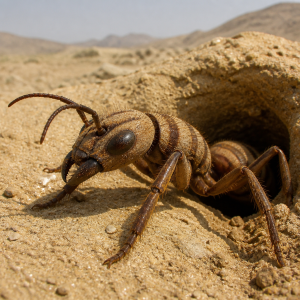
The strangest beasts attached to India were invented thousands of miles away. The Leucrota, described in medieval bestiaries, was a composite predator of the Indian highlands said to imitate human speech perfectly in order to lure travelers to their deaths. The gold-digging ant, reported by Herodotus and Megasthenes alike, was a fox-sized creature that threw up gold dust as it burrowed, which locals stole by distracting it with meat. These are not Indian myths; they are myths Europe told about India — and they are examined below.
The Central Myths
The Churning of the Ocean of Milk
Gods and demons, the Devas and Asuras, call a truce to do the impossible together: churn the cosmic ocean to extract amrita, the nectar of immortality. They use the world-mountain as a churning-stick and the cosmic serpent as the rope, and Vishnu steadies the whole apparatus as the tortoise Kurma. Out of the churning rise the treasures of the world — the goddess Lakshmi, the moon, the wish-cow, the divine elephant Airavata — and finally the nectar itself, which Vishnu cunningly keeps from the demons. Why it matters: it is the foundational image of Indian cooperation-in-tension — that creation requires gods and demons pulling on opposite ends of the same rope.
The War of the Ramayana
The prince Rama, avatar of Vishnu, is exiled to the forest with his wife Sita, who is abducted by the ten-headed demon-king Ravana. With an army of Vanaras and the unbreakable devotion of Hanuman, Rama crosses to the island fortress of Lanka, kills Ravana, and recovers Sita. Why it matters: the Ramayana set the template for ideal kingship, marriage, and duty across South and Southeast Asia for two and a half millennia — and made Hanuman perhaps the most beloved and widely worshipped figure in living Hinduism.
The Two Brothers and the Throne of the World
In the Meitei creation myth, the creator sets his sons Sanamahi and Pakhangba a contest: whoever circles the universe seven times and returns first will rule it. Sanamahi sets off at a run. But Pakhangba, advised by his mother Leimarel Sidabi, simply circles his father’s throne — for to circle the source of the universe is to circle the universe — and wins. Why it matters: the same parable of wit-over-effort appears in the Hindu story of Ganesha circling his parents to win a race against Skanda — a striking echo between two pantheons that supposedly developed apart, and a window into how Indian traditions quietly cross-pollinate.
Afterlife, Cosmology, and the Wheel of Rebirth
No Indian afterlife is final, and that is the whole point. The dominant model is samsara: the soul is reborn again and again, its station in each life shaped by the karma of the last, until — if it is fortunate and disciplined — it escapes the wheel entirely into moksha, liberation. Yama, the first mortal to die, became the lord of the dead and the keeper of the ledger, weighing each life before sending it on. The hungry ghosts, the Pretas, are those whose desires bind them to the world; the Bhootas are the unsettled dead who never received proper rites.
The cosmos itself breathes in immense cycles. The four yugas turn from a golden age of perfect order to our own degraded Kali Yuga, an age of strife, after which the world dissolves and is reborn. The Meitei cosmos runs on its own logic entirely — built and dissolved by Leimarel Sidabi and the creator-gods, structured around the cardinal directions and the household hearth rather than the Sanskrit yugas. Two clocks, two cosmologies, one subcontinent.
How Indian Mythology Connects to Other Traditions
The Indo-European family. The oldest Vedic gods are cousins of the gods of Europe. Varuna shares deep roots with the Greek sky-father and Roman Jupiter; the storm-god Indra parallels Thor of the Norse tradition; and the very word deva is kin to the Latin deus. The dawn-goddess Ushas and the Greek Eos descend from the same Proto-Indo-European mother. These are not borrowings but shared inheritance from a common ancestral mythology.
The serpent everywhere. The Naga who guards water and treasure rhymes with dragons across Asia — the celestial serpent Pakhangba of the Meitei, the dragons of Chinese myth, and the world-serpents of many traditions. The serpent-at-the-foundation-of-the-world is one of humanity’s most widely shared mythic images.
The Greek invention of India. The single largest “foreign” influence on Indian mythology runs the other way: the Greek and Roman geographers who turned India into a wonder-cabinet. The Astomi, Abarimon, and gold-digging ants entered the European imagination through Greek texts and survived into medieval maps — proof that mythology about a place can outlive and outshine the facts.
The Monstrous India of the Ancient Travelers
This is the part of “Indian mythology” the textbooks skip. Beginning with Ctesias of Cnidus, who never went there, and continuing with Megasthenes, who actually served as a Greek ambassador to the Mauryan court, classical writers described India as the planet’s farthest, strangest edge — and Pliny the Elder gathered their reports into his Natural History, where they hardened into “fact” for over a thousand years.
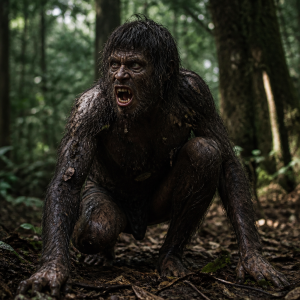
The Astomi lived near the source of the Ganges, hairy all over and entirely without mouths, surviving on nothing but the scent of roots, flowers, and wild apples — and a single foul smell could kill them. The Abarimon dwelt in a valley of the great mountains with their feet turned backward, yet ran faster than anyone, ranging the forests with wild beasts. The Nuli, a closely related race from a fabled mountain, had backward-facing feet with eight toes each. And the gold-digging ants — bigger than foxes, said Megasthenes — threw up gold as they dug, which the Indians stole by leaving out meat to distract them.
Scholars now read these not as travelers’ errors but as literary inheritance — Greek tropes about “the East” passed from author to author. Yet they belong in any honest account of Indian mythology, because for most of European history this was Indian mythology: a monstrous, marvelous frontier that revealed far more about Greek and Roman anxieties than about the subcontinent itself.
Where to Start Reading
For the Hindu mainstream, begin with the primary sources in translation: the Rigveda for the oldest layer of gods, and the two great epics — the Mahabharata (in the abridged form of John Smith’s Penguin edition, or C. Rajagopalachari’s beloved retelling) and the Ramayana. Wendy Doniger’s The Hindus: An Alternative History is the most readable scholarly overview, while Roberto Calasso’s Ka renders the myths as literature.
For the indigenous and outsider traditions there is no single book. The Meitei material lives in the puyas and a small but growing body of scholarship on Sanamahism; the monstrous-India tradition is best approached through Pliny’s Natural History (Book 7) directly and through John Block Friedman’s The Monstrous Races in Medieval Art and Thought. That spread of sources is itself the lesson: Indian mythology cannot be read from one shelf.
Explore Indian Mythology on Gods and Monsters
The site currently holds 14 entries filed directly under Indian mythology, spanning the indigenous Meitei gods, Himalayan spirits, and the monstrous races of the ancient travelers — with hundreds more across the linked Hindu and Himalayan collections.
Browse all Indian mythology entries →
Pakhangba · Lainingthou Sanamahi · Leimarel Sidabi · Langmeidong · Acheri · Aditi · Parvati · Bhoota · Astomi · Abarimon · Nuli · Leucrota · Gold-digging Ant · Jallikattu · Vishnu · Shiva · Durga · Hanuman · Naga · Garuda · Yeti
Frequently Asked Questions
Are Indian mythology and Hindu mythology the same thing?
No. Hindu mythology is the largest single strand of Indian mythology, but not the whole. India is also home to indigenous traditions like Meitei Sanamahism, with its own creator-gods Pakhangba and Lainingthou Sanamahi; to tribal and regional folk religions; and to the Buddhist and Jain mythologies born on the same soil. “Indian mythology” is the umbrella; Hindu myth is its biggest panel. The site keeps a dedicated Hindu mythology guide for that mainstream.
Who is the supreme god in Indian mythology?
There is no single answer, and that is characteristic. In mainstream Hinduism the role is shared and contested between Vishnu, Shiva, and the Goddess Devi, depending on the worshipper’s sect. In Meitei Sanamahism it is the formless creator above Pakhangba and Lainingthou Sanamahi. Indian religious thought is comfortable with many simultaneous “supreme” beings in a way most Western traditions are not.
What are the monsters of Indian mythology?
They divide into three kinds. Native demons and spirits — the Rakshasas, Asuras, Churel, Pishacha, and Vetala — populate the epics and village folklore. Sacred beasts like the Nagas and Garuda blur the line between monster and god. And a third class — Leucrota, the gold-digging ant, Astomi — are creatures invented by foreign writers and merely located in India.
Why did the ancient Greeks think India was full of monsters?
Because India was the farthest edge of the world they knew, and the edge of the world is where every culture puts its monsters. Writers like Ctesias and Megasthenes — and Pliny after them — described mouthless men (Astomi), backward-footed runners (Abarimon), and gold-digging ants not from observation but from inherited literary convention. These accounts say more about Greek and Roman fears than about real India, yet they shaped Europe’s image of the subcontinent for over a millennium.
What is the Meitei religion of Manipur?
Sanamahism is the indigenous, pre-Hindu religion of the Meitei people of Manipur in northeast India. It centers on a formless creator, the earth-mother Leimarel Sidabi, the household god Lainingthou Sanamahi, and the serpent-dragon Pakhangba, divine ancestor of Manipur’s kings. It survived centuries of Hindu influence and is undergoing a strong revival today. The site’s Meitei mythology page is the entry point.
How does rebirth work in Indian mythology?
In the dominant Hindu and broader Indic model, the soul passes through countless lives — samsara — its next birth determined by karma, the moral weight of its actions. Yama, lord of the dead, judges each life. The goal is not heaven but moksha: release from the cycle altogether. Those who die badly may become restless Bhootas or hungry Pretas instead of moving on. Note that indigenous traditions like the Meitei hold their own, distinct views of the dead.