
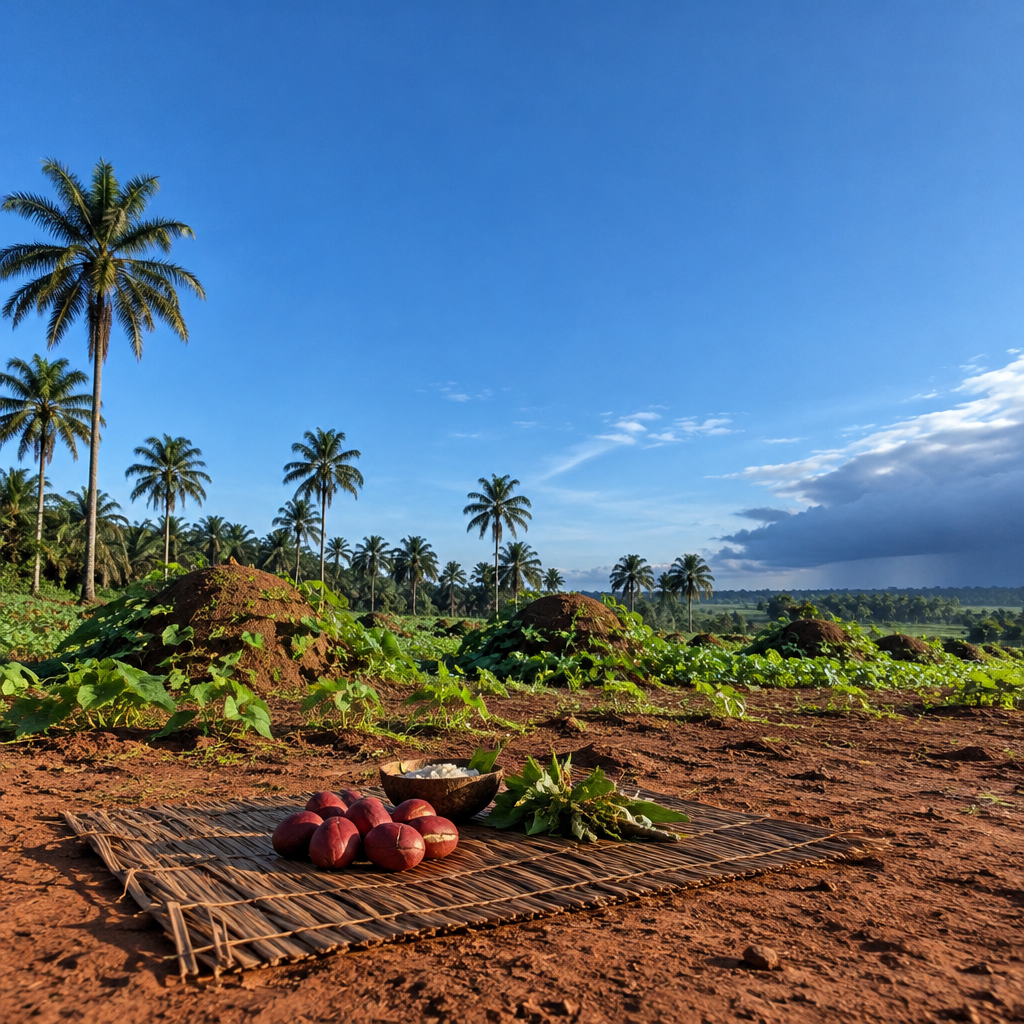
Igwe
Also Known As: the ordinary Igbo word for sky; also the title of the kings of many northern Igbo towns, from the longer form Igwekala or Eluigwekala, the sky is greater than the land
Region/Culture: West Africa
Mythos: Igbo Mythology
Primary Type/Nature: Gods and Deities
Mythical Attributes: The god of the open, bright sky, consulted through oracles for counsel and tied to the coming of rain.
Role in Mythos: He is the sky set against Ala the earth, a power whose older place in worship was taken over in many districts by his storm-bringing brother, the thunder god Amadioha.
Relation to Humans: People went to his oracles for advice rather than for wealth or health, which they asked of other gods. In northern Igbo kingship the sky he stands for lends its name and its height to the king himself.
In the dry months the sky over the Igbo country is a hard, pale blue, and the dust of the harmattan hangs in it like smoke. Then the rains come, and the same sky turns dark and loud. The Igbo had one plain word for that great roof over everything. The word was igwe. It named the sky, and for many people it also named the god who lived as the sky.
Igwe never collected a crowded mythology. No tale survives of his birth, his quarrels or his children, and nobody records a carved figure of him standing in a shrine. What the record holds is a position. Igwe is up. Ala, the earth goddess, is down. Between them lies the whole of human life, the yam fields and the compounds and the markets, and the two great powers meet at the horizon on every side.
The clearest early account comes from P. Amaury Talbot, a British colonial officer posted to the Degema Division of southern Nigeria in 1914, who published *Some Nigerian Fertility Cults* in 1927. Among the Etche Ibo, Talbot found the thunder god Amade Onhia, the figure now usually written Amadioha, standing at the head of local worship. When he first asked about the sky, most of the people he spoke to told him that the Thunderer had a brother, and that the brother was Igwe, lord of the bright sky.
Talbot then listened to the rain-making prayers, and they told a different story. In the words the rain-makers used, the thunder, the lightning, the black storm cloud and the clear blue overhead all belonged to one being. Talbot concluded that Igwe and Amadioha had once been two faces of a single sky god, the fair-weather face and the storm face, and had drifted apart into two deities over time. Most of his informants already treated them as separate. The prayers remembered something older than the people praying them.
Talbot also recorded which brother was winning. Igwe, he was told, had once been worshipped far more widely than he was by then. The reason was practical. Igwe gave counsel through his oracles, and that was all. He did not hand out wealth, health or good fortune. Amadioha did, and the petitioners followed the gifts. Where the Thunderer ruled, Talbot wrote, he had quietly taken over the duties of Igwe, whom Talbot called the Ibo sky god proper. Even the role of husband to the earth went with him. In Talbot’s Etche material it is Amadioha, as lord of the soaking rainstorm, who fertilises the Earth Goddess.
A god who only gives advice does not keep many friends.
The picture from the north is different again, and it comes through kingship rather than prayer. In many northern Igbo towns the king is called the Igwe. A local history of Nnewi by C. N. Ugochukwu (2000) traces the title to Igwekala or Eluigwekala, a phrase that says the sky, or the heaven above the sky, is greater than the land. In 2002 the Immigration and Refugee Board of Canada, answering a question about the Igwe of Nnewi, quoted an American professor of anthropology on the point. The title, the professor explained, ties the king to a sky deity and installs him as something close to divine on earth. In the same reply the professor noted that the earth goddess Ani, another name for Ala, is sometimes said to be married to Igwe, earth to sky, and that this divine marriage turns up in many northern Igbo royal systems.
So the marriage that Talbot heard given to Amadioha in the south is given to Igwe himself in the north. The two accounts do not contradict each other so much as show the same idea living in different houses. Sky and earth belong together. Which name the sky goes by depends on the town.
It is easy to see the ordinary work of such a god. A man with a hard choice before him walks to the oracle at first light, while the air is still cool and the leaves drip from the night’s dew. He lays down his offering and asks what he should do. He goes home with an answer, not a fortune. That was the whole bargain Igwe offered.
There is also a quieter argument in the background. A standard Gale reference entry on Igbo religion notes that the idea of an Igbo supreme being, Chukwu or Chineke, is contested, and that some writers tie it to the rise of centralised political power, to borrowing from Islam and Christianity, and to the invention of sky gods named Igwe. On that view the bright, lofty sky god is partly a product of kingship, lifted up to match the kings who took his name. The same reference lists Igwe as the sky among the spiritual powers of the Igbo world, beside Anyanwu the sun and Ana the earth. Both things can be true. The word for sky is old, the reverence for it is old, and the grandeur may have grown with the crowns.
Igwe’s power, as far as anyone recorded it, was the power of the view from above. He saw everything under him and could say what he saw, so his oracles gave sound counsel. His sky held the rain that the rain-makers called down, and in the north it gave a king his height. His weakness grew from the same source. A god of distance and clear weather had little to offer a farmer whose child was sick or whose yams had failed. The storm god brought rain, punished liars with lightning and answered prayers for health. Over the generations, in town after town, people turned their faces from the bright sky to the thundering one, and Igwe was left with his oracles and his name.
Frequently Asked Questions
Who is Igwe in Igbo religion?
Igwe is the Igbo god of the sky, and igwe is also the ordinary Igbo word for sky. The colonial officer P. Amaury Talbot, writing in 1927, called him the Ibo sky god proper and lord of the bright sky. No myth of his birth or family survives.
Is Igwe the same as Amadioha?
Not quite. Talbot found that the Etche Ibo described Amadioha, the thunder god, as Igwe’s brother, but their rain-making prayers treated thunder, storm and the clear sky as one being. Talbot concluded that the two had once been aspects of a single sky god, and that Amadioha had taken over many of Igwe’s duties.
Is Igwe married to Ala?
In many northern Igbo towns the earth goddess Ani, or Ala, is sometimes said to be married to Igwe, earth to sky. An anthropologist quoted by the Immigration and Refugee Board of Canada in 2002 said this divine marriage appears in many northern Igbo royal systems. In Talbot’s southern Etche material, the earth goddess’s husband is the thunder god Amadioha instead.
Why are Igbo kings called Igwe?
In many northern Igbo towns the king’s title is Igwe, from the phrase Igwekala or Eluigwekala, meaning the sky is greater than the land. The title links the king to the sky deity and marks him as close to divine on earth. A local history of Nnewi by C. N. Ugochukwu (2000) gives this origin.
Why did Igwe lose worshippers?
Talbot was told that Igwe had once been worshipped more widely, but that he only gave advice through his oracles. People seeking wealth, health and good fortune turned to Amadioha instead. Where Amadioha became the leading god, he absorbed Igwe’s role.
Related Entries
Ala (Igbo), Amadioha, Chukwu, Anyanwu, Agwu, Ahia Njoku, Ekwensu, Nyame, Olodumare (Olorun), Shango